Week 8 - Challenge 6 - Core & Cavity Design
AIM :
Create the Core and cavity blocks for the switch bezel designed in the earlier challenge.
INJECTION MOULDING:
Ijection machine
The injection machine is a machine that melt plasticize the molding material inside the heating
cylinder and inject this into the mold tool to create the molded product by solidifying inside it. The
injection machine is constructed of a mold clamping device that opens and closes the mold tool, and
device that plasticize and inject the molding material. There are several types in the injection
machine, and the difference is made by how these two devices are arranged.
(1) Horizontal injection machine : Both mold clamping device and injection device compounded
horizontally
(2) Vertical injection machine : Both mold clamping device and injection device compounded vertically
(3) Two-color injection machine
(4) Rotary injection machine
(5) Low foam injection machine
(6) Multi material injection machine
(7) Sandwich injection machine
OBJECTIVE:
- to create core
- to create cavity
- to create parting line
- to create parting surface
- to create draft analysis for cavity
- to create draft analysis for core
TOOLING AXIS:
- IT IS THE AXIS IN WHICH THE DIRECTION CORE AND CAVITY OPEN. THIS IS THE VERY IMPORTANT FOR PRODUCTION OF PLASTIC COMPONENT. MOST OF THE DEFECT WILL DONE IMPROPER TOOLING AXIS CREATION BY THE PLASTI DESIGNER.
- THERE ARE SO MANY METHODS FOR CREATION OF TOOLING AXIS. INTERSECT IS THE ONE OF THE METHOD FOR CREATING THE TOOLING AXIS.
- Tooling axis is the movement direction of the mould and cavity, so it is very important to creat the tooling axis for the plastic product model while design, to analys the draft angle effect for the product. For this model the tooling axis is created by suing normal to surface method. There are different type to creat tooling axis which is mention below:
CORE :
Core is a movable part , having the ejection pins , which is used to eject the mold from the core. A core is a performed,bonded,sand insert placed into the mold to shape the interior of a casting or a part of the casting that cannot be shaped by the pattern. cores are frequently used to create hollow swctions or cavities in a casting
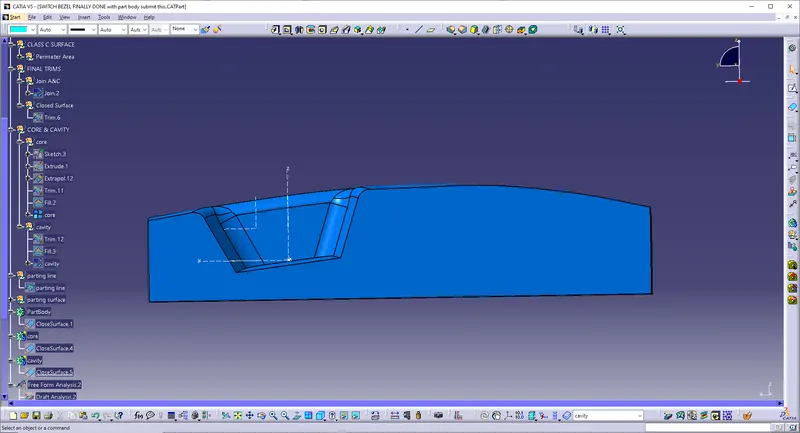
TRANSPERENT VIEW OF CORE:
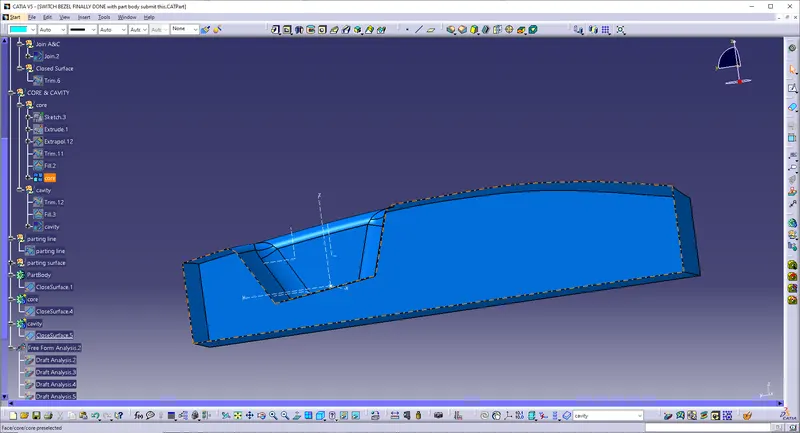
CAVITY:
cavity is fixed part,which is not available.A mold is a hollow form typically made from stainless steel that has plastic injected into it to manufacture a plastic part.The plastic is inserted into the mold cavity,which is a hole in the mold shaped like the desired part
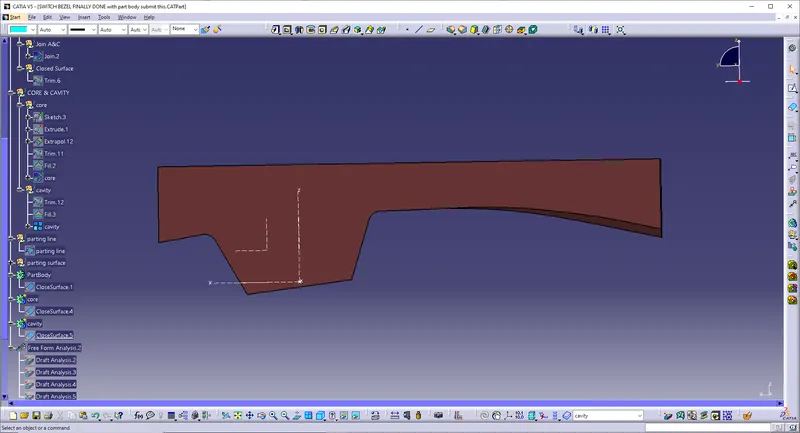
TRANSPERENT VIEW OF CAVITY:
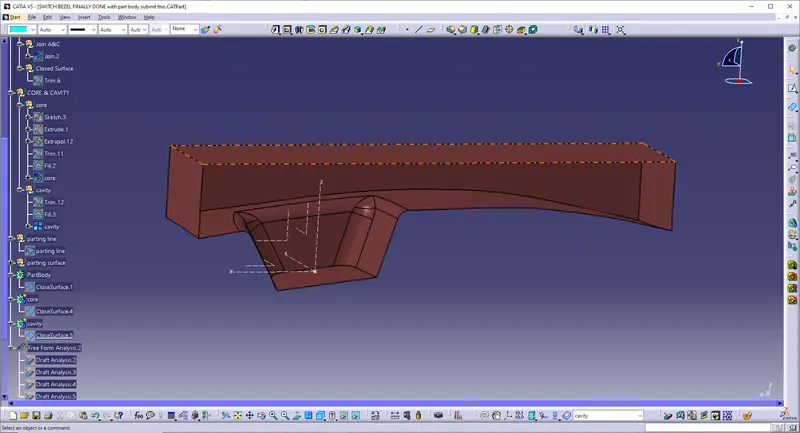
CORE&CAVITY:
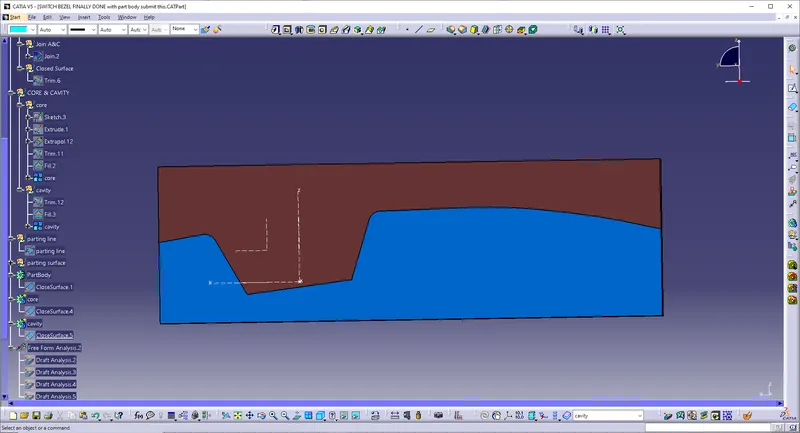
TRANSPERENT VIEW OF CORE & CAVITY:
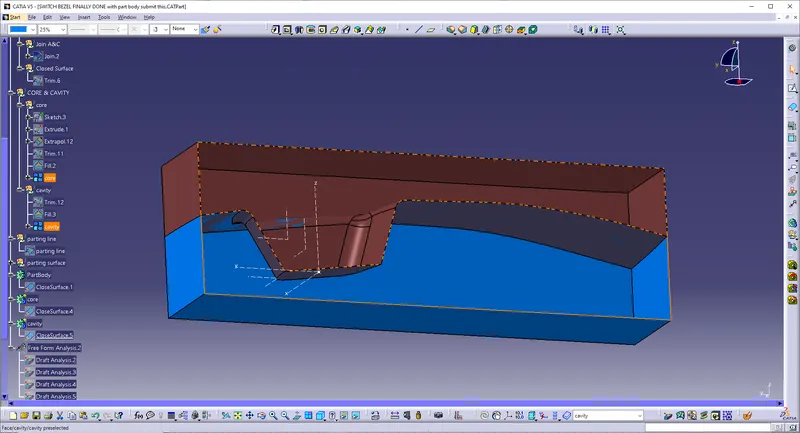
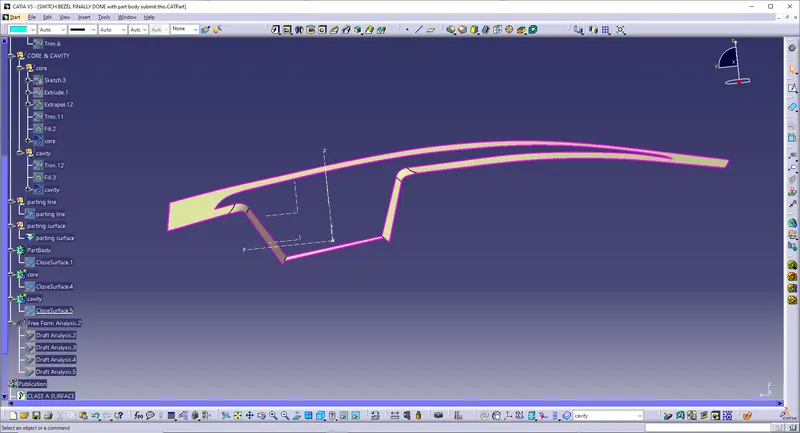
PARTING SURFACE:
- Generally Injection Molding has 2 major components: the Movable Half and the Fixed Half.
- During Injection Molding process, these 2 halves are pressed together tightly to form a sealed hollow to avoid the melt flow leakage and maintain certain holding pressure.
- The pressed surface is called the Parting Surface.
- Usually the parting surface are the biggest projection outline of the part.
- Parting Surface directly affects the Product Quality, Ease of Construction and Operation of the Injection of the Mold, the Mold Design is one of the key factors to the success.
- Design of Parting Surface should follow the following Design Principles:
- Designing the Mold Structures as simple as possible.
- Avoid or reduce side parting as much as possible to reduce complexity of mold making.
- Ease of De-Molding. The plastic component must stay at the fixed half in most cases and ejected by the Ejection System and avoid side De-molding action.
- Ensure Dimensional Acccuracy of the molded parts and try to make parts with similar dimensional accuracy requirements in the same module to reduce manufacturing and assembly errors.
- Ensure Appearance Requirement of the molded parts.
- Flash or mismatch usually occurs on the Parting Surface, so it shoul not be designed on a High quiality requirement Surface.
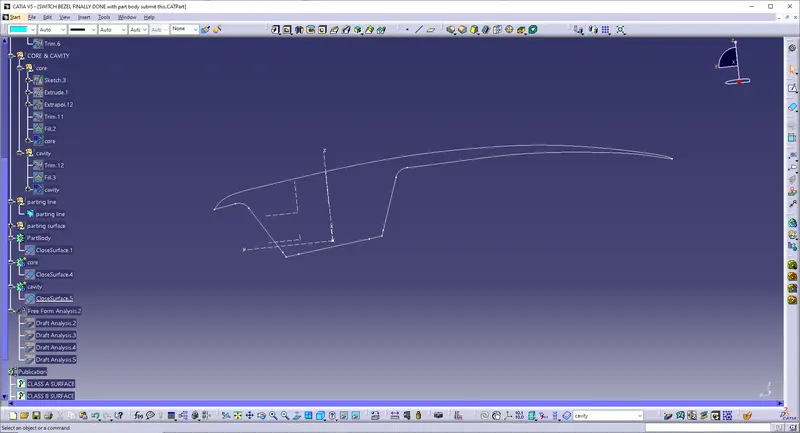
PARTING LINE :
- Intersection of the Plastic Component with the Parting Surface is called the Parting Line.
- It is the Bordered Outline of the Component along the Parting Surface.
- Parting line are where the two halves of the mold meet. This generally create a physical line on a part that is both visible and noticeable to the touch. These lines however can be hidden or minimized when placed along edges of the part. It is represented by dotted line in the below picture
DRAFT ANALYSIS FOR CLASS A
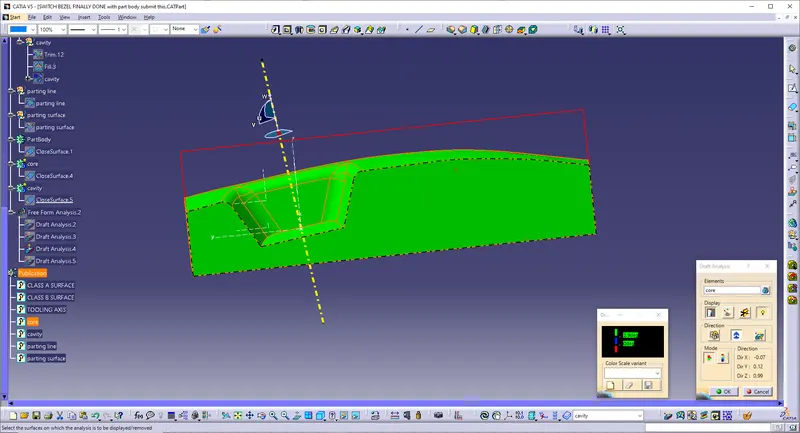
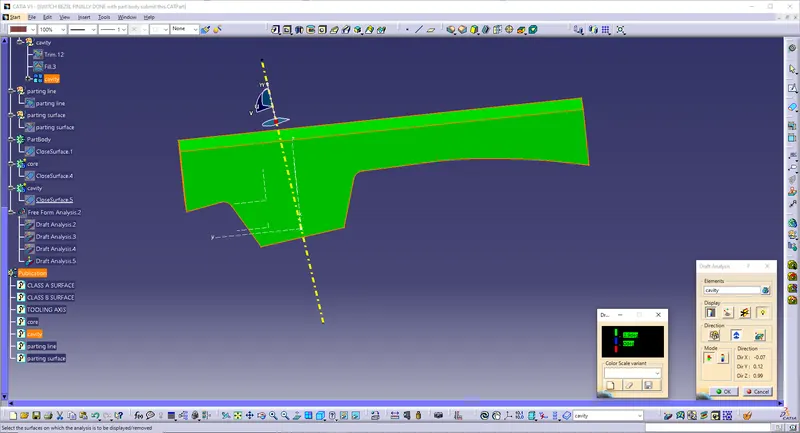
Draft analysis enables you to detect the part we drafted will be easily removed. This type of analysis performed on the base of color ranges identifying the zones on the analyzed element where the deviation from the draft direction at any points, corresponds to specified values.
- Go to insert
- Click on the compass icon and align it with the tooling axis and click on the surface, we will get our result
- Before going to drat analysis go to customized view parameter >under mesh >check material and then click ok.
- Now for draft analyses go to insert » analysis » feature draft analysis.
- Use the compasss to define the draft direction.
- In the colour scale change the draft angle to 3 degree.
- The component changes to green in indication of passing draft angle.
- Use running point to check the angle on the component.
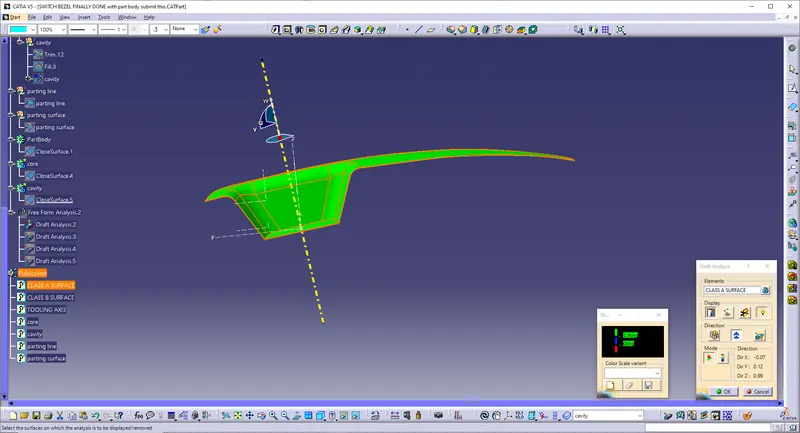
DRAFT ANALYSIS OVERALL:
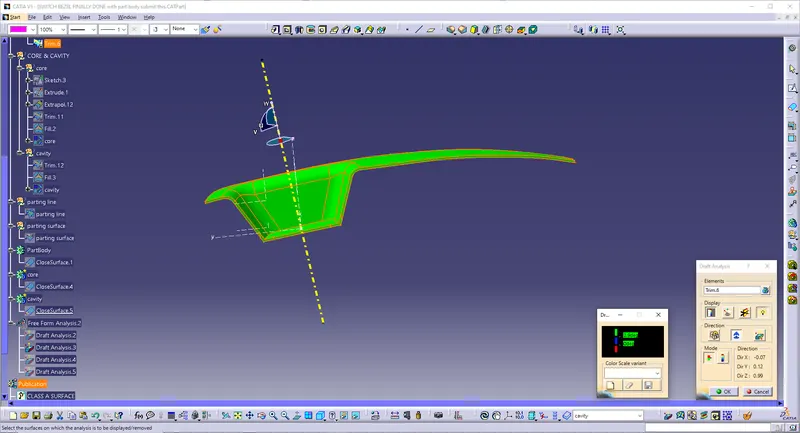
DRAFT ANALYSIS FOR CORE:
DRAFT ANALYSIS FOR CAVITY:
FINAL SOLID BODY: This ia the final stage of the plastic product model,where the final close surface will converted into a solid body.Once the final close surface is created we have to shift to part workbench from surface workbench. In part workbench by using close surface commond the close surface will converted in to solid body.
Once the solid body will created again do the draft analysis for the solid body.
Procedure for creating Closed Body
- Join the Class A and Class C surfaces.
- Trim those joined surfaces with Class B surfaces.
- Go to Part Design and insert a Body.
- Create a closed surface.
part body for cavity
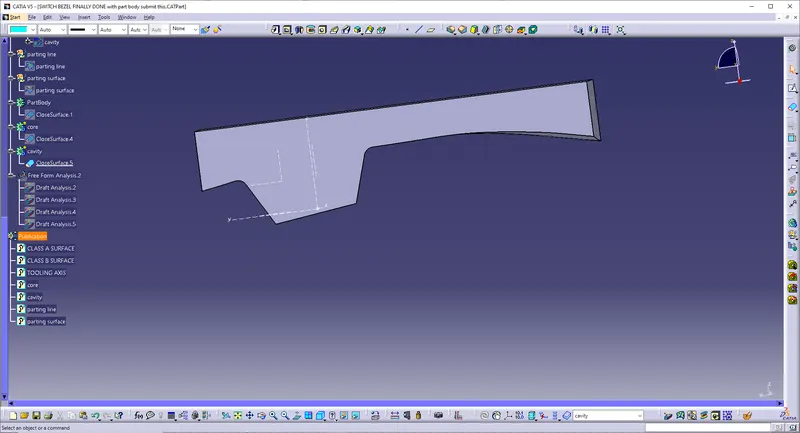
part body for core
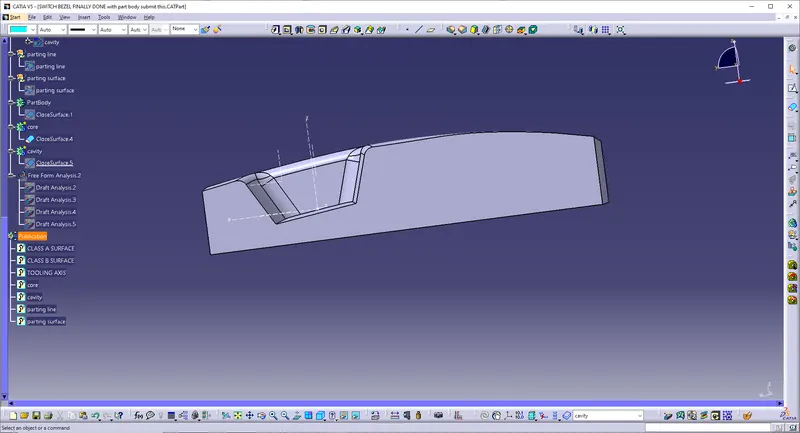
part body for core&cavity
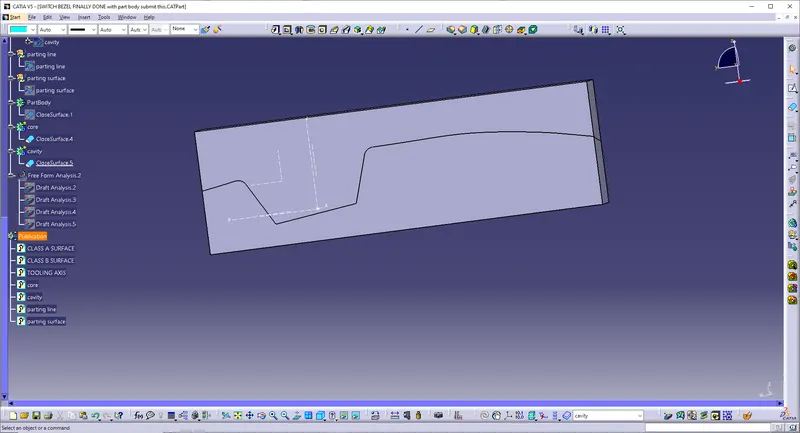
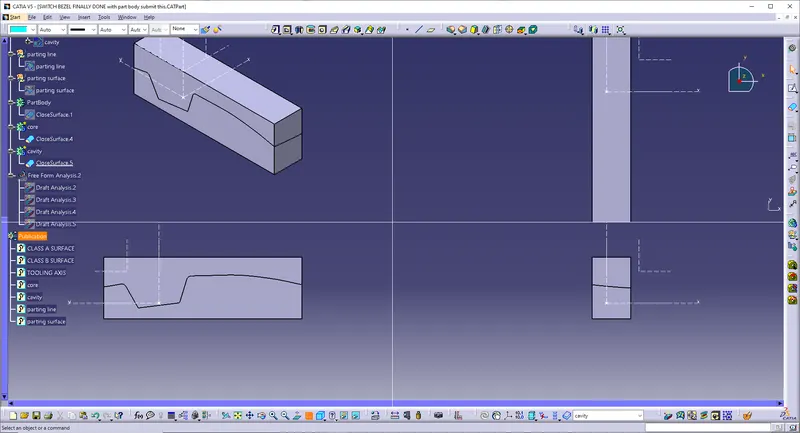
family tree
