Week 8 - Challenge 5 - Door Trim Lower
Requirement
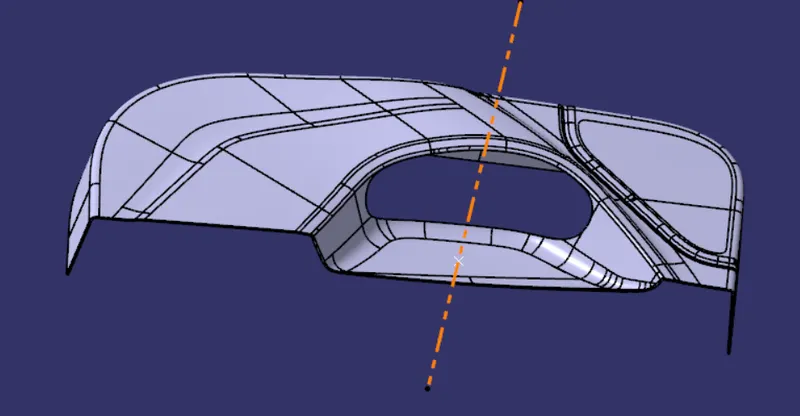
To make a model from the provided class-A surface.
INTRODUCTION:
OFFSET SURFACE:
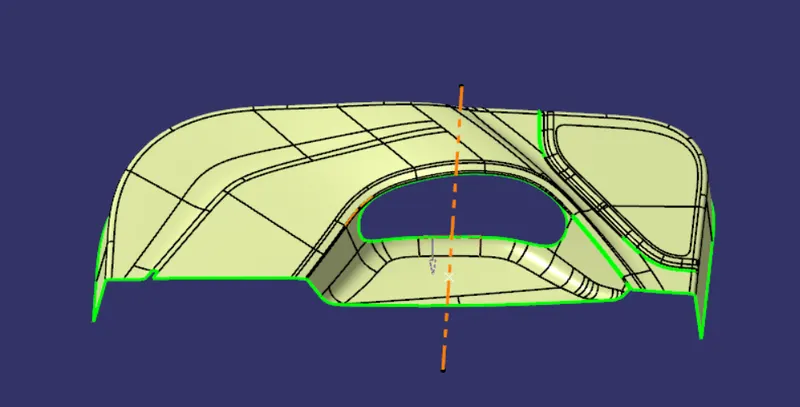
CLASS-A SURFACE: a surface made by the designer which is given as input to the plastic modeler to work on. It is an aesthetic surface
and the outermost surface.
CLASS-B SURFACE: a surface below a certain thickness from the class-A surface is a class-B surface. This is the surface that contains
engineering aspects of a model.
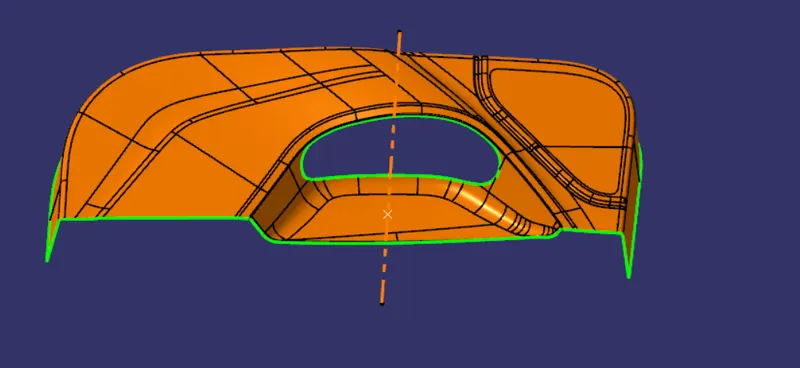
CLASS-C SURFACE: a surface that joins class-A and class-B surfaces is a class-C surface.
METHODOLOGY:
In this model we have focused on the following things:
Tooling axis,Draft analysis,Class-B surface,Class-C surface,
Making a solid model from the surface.
The following tools were used to reach the final step:
Extract,Un-trim,Trim,Extrapolate,Offset,Edge fillet,Boundary,Sweep,Join,Close (part design)
FOR DRAFT ANALYSIS:
First, we analyze the model and then choose a dummy axis in the x and y directions.
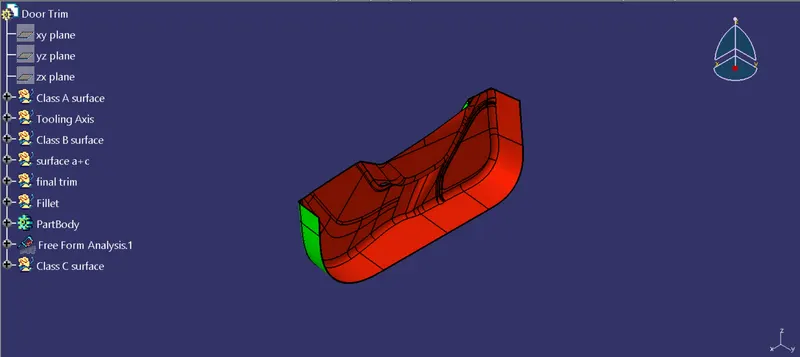
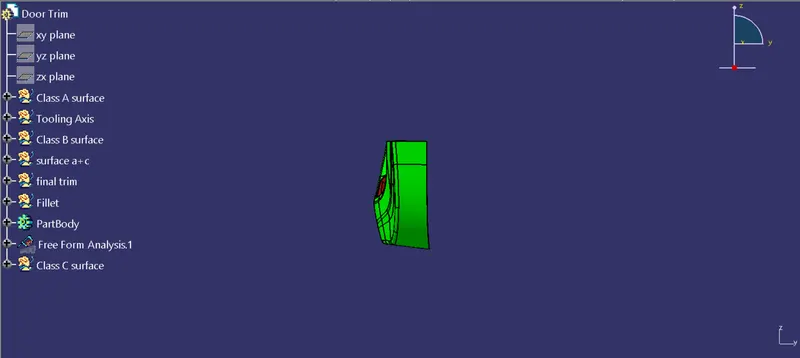
As we intersected to proceed we observed that the side walls are not given any draft. Hence we assume the axis normal to the base surface and parallel to the side walls. This surely will create problems because a minimum draft has to be provided.
As the class-A surface is made by other designers only he is authorized to make changes, so we look over this to complete the coin holder for practice.
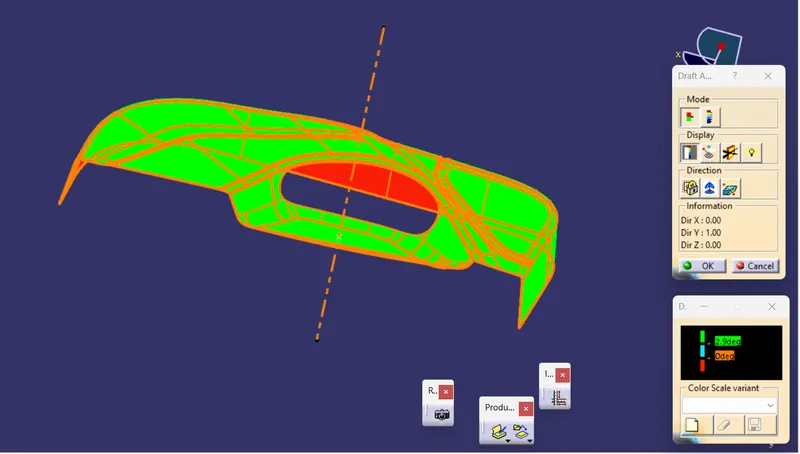
Now we go to insert< analysis< draft analysis and follow the usual procedure to do the analysis.
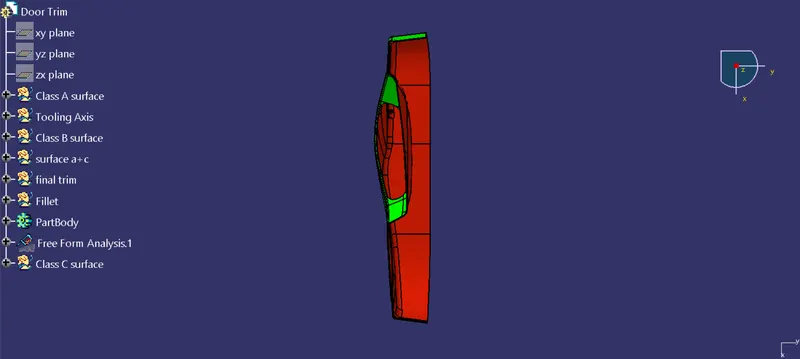
Align the compass and click on the surface and as expected the model is mostly in red color i.e. negative draft with respect to the axis.
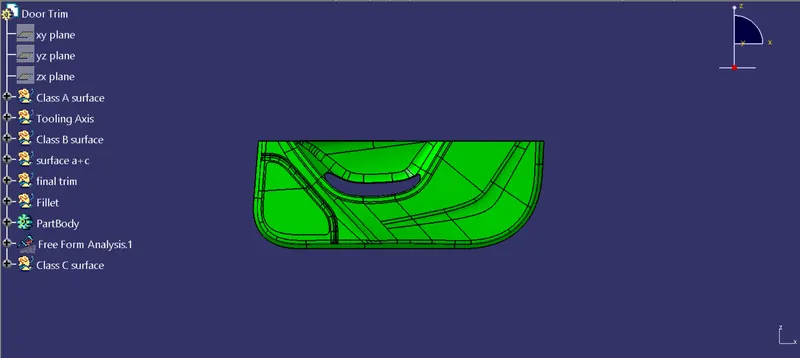
To correct it as best as we can we moved the compass a bit till we got most of the surfaces in green and lock that position.
After hitting ok, we change the direction of the line from the z-axis to the compass direction. The axis will align itself accordingly.
NOTE: as the side wall does not have a draft, this result was expected and a few areas need correction. But still, we are moving forward to
complete the model.
FOR CLASS-B SURFACES:
We have divided the entire model into the base, side walls, inside side walls, and outer flange and worked on them one by one
Everywhere we follow the same procedure i.e. extract, un-trim, extrapolate, trim and offset.
First base, then side walls. To avoid confusion, we trimmed both together and made them one. Also, the fillet was given.
FOR CLASS-C SURFACES:
In this model, unlike the earlier models, we have used a parallel tooling axis. Hence we cannot use the ‘with draft direction’ option under
sweep.
The C surfaces will mostly be created as shown below.
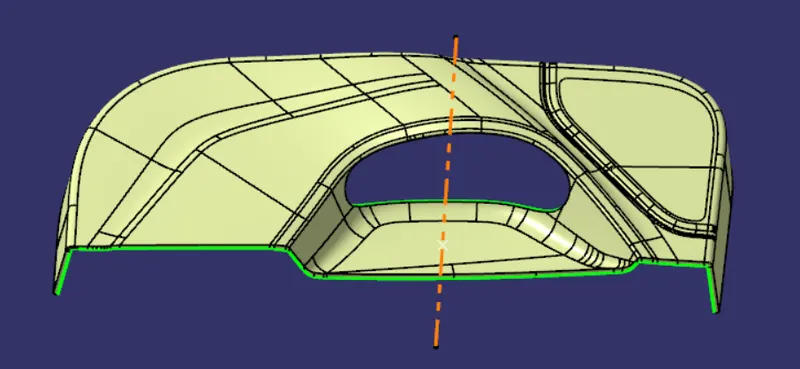
Go to the part design and close the feature:
Regard by
SURENDHAR G