Week 8 - Challenge 2 - Switch Bezel Design
Aim
The aim of this project is to develop the product design of the switch bezel with the help of the class A surface following the OEM standard.
The Thickness of the component is Considered as 2.5 mm
MATERIAL USED:
Polyester:
It is a category of polymers that contain the ester functional group, in every repeat unit of their main chain. As a specific material, it most commonly refers to a type called polyethylene terephthalate (PET). Polyesters include naturally occurring chemicals, such as in plants and insects, as well as synthetics such as polybutyrate. Natural polyesters and a few synthetic ones are biodegradeable, but most synthetic polyesters are not. Synthetic polyesters are used extensively in clothing.
Polyester fibers are sometimes spun together with natural fibers to produce a cloth with blended properties. Cotton-polyester blends can be strong, wrinkle- and tear-resistant, and reduce shrinking. Synthetic fibres using polyester have high water, wind and environmental resistance compared to plant-derived fibers. They are less fire-resistance and can melt when ignited.
Liquid crystalline polyesters are among the first industrially used liquid crystal polymers. They are used for their mechanical properties and heat-resistance. These traits are also important in their application as an abradable seal in jet engines.
USES AND APPLICATIONS:
Fabrics woven or knitted from polyester thread or yarn are used extensively in apparel and home furnishings, from shirts and pants to jackets and hats, bed sheets, blankets, upholstered furniture and computer mouse mats. Industrial polyester fibers, yarns and ropes are used in car tire reinforcements, fabrics for conveyor belts, safety belts, coated fabrics and plastic reinforcements with high-energy absorption. Polyester fiber is used as cushioning and insulating material in pillows, comforters and upholstery padding. Polyester fabrics are highly stain-resistant since polyester is a hydrophobic material, making it hard to absorb liquids. The only class of dyes which can be used to alter the color of polyester fabric are what are known as disperse dyes.
Polyesters are also used to make bottles, films, tarpaulin, sails (Dacron), canoes, liquid crystal displays, holograms, filters, dielectric film for capacitors, film insulations for wire and insulating tapes. Polyesters are widely used as a finish on high-quality wood products such as guitars, pianos, and vehicle/yacht interiors. Thixotropic properties of spray-applicable polyesters make them ideal for use on open-grain timbers, as they can quickly fill wood grain, with a high-build film thickness per coat. It can be used for fashionable dresses, but it is most admired for its ability to resist wrinkling and shrinking while washing the product. Its toughness makes it a frequent choice for children's wear. Polyester is often blended with other fibres like cotton to get the best of both worlds. Cured polyesters can be sanded and polished to a high-gloss, durable finish.
PROCEDURE
The steps involved in creation of this project are:
1. Bringing the class A surface of the switch bezel in Catia v5 software
2. Determining the tooling axis for the switch bezel
3. Creation of class B surface
4. Creation of class C surface
5. Joining all the class A, class B and class C surfaces of the switch bezel
6. Building closed surface after joining all the surfaces
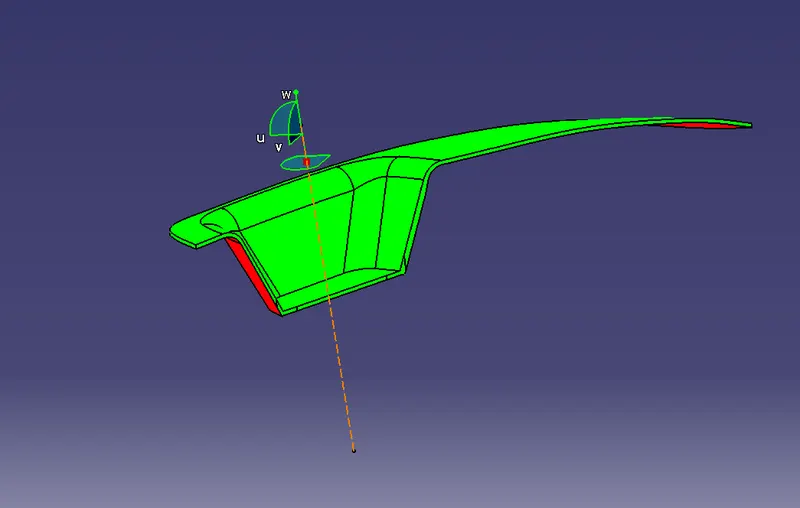
7. Draft analysis on the switch bezel.
Tooling axis :
It is defined as the direction in which the molds opens or core and cavity, with the help of tooling axis created along x and Y axes are used for creating the Main Tooling axis by using bisecting method.
Procedure for creating Tooling Axis:
- A Reference Point is created along the Surface zero and new Axis system is created
- The X Direction along the Class A and Y direction along the Class A were used to create Tooling direction
- Finally the Tooling axis is created by bisecting the two lines and it is published. Class A Surface as input using surface operation commands Class B is developed
- The tooling Axis determines the direction of Class C boundary swept with draft direction.
- When viewing from tooling direction normal all the parts that are drafted should be visible so it gives an rough idea to determine product manufacturing in Injection molding.
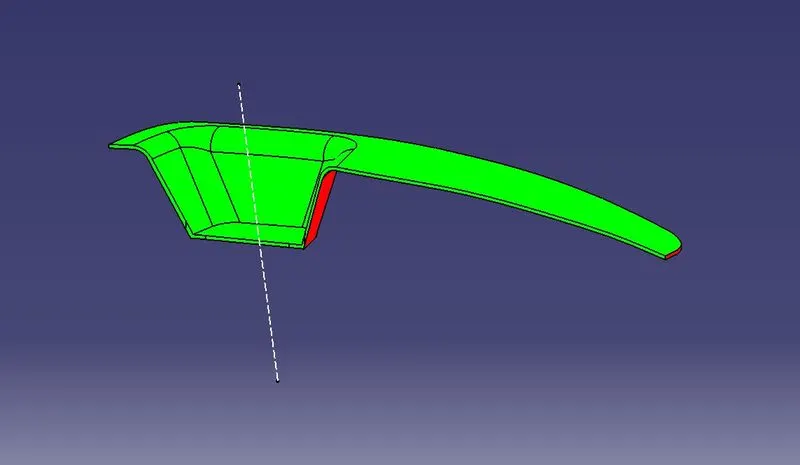
Draft:
A draft angle is a slant that is applied to each side of most features of an injection molded part. In other words Draft is providing tapers on the product features such as walls ribs posts and bosses that lie parallel to the direction of the release from the mold part ejection.
The nominal draft is 3mm for plastic components and for automotive sheet metal components is 7mm.
Class A:
Class A surface is the term mainly used in automotive design industry. It describes the final production surface data for the aesthetic parts of the car.
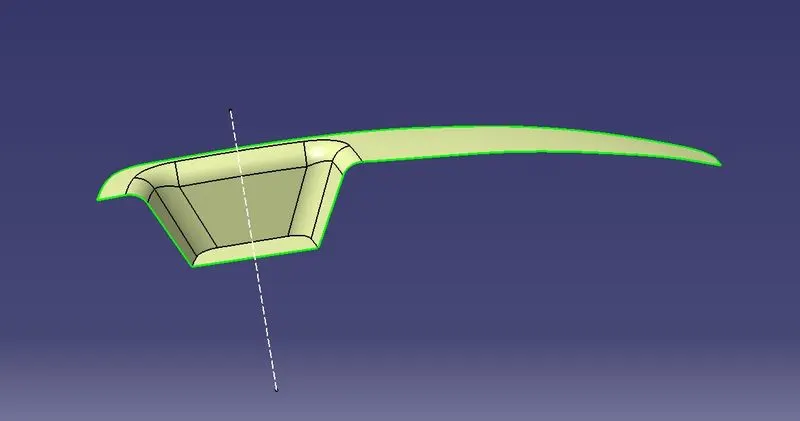
Class B:
Class B surface is the secondary surfaces which is not visible normally. These must be smooth and "error-free" as well, but are not held to the standards that class A surfaces are.
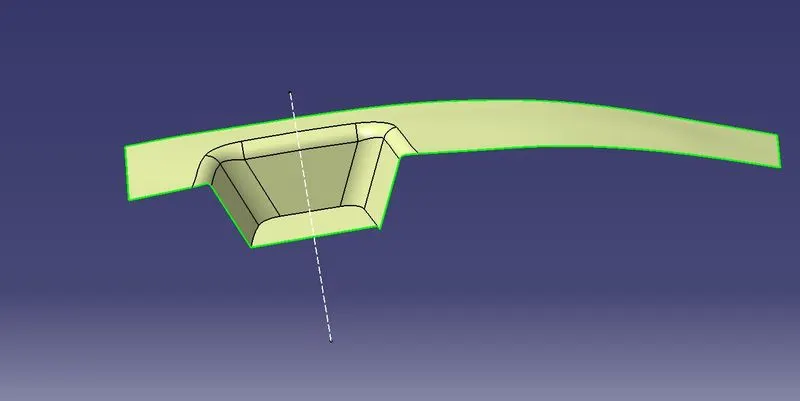
Class C:
Class C surfaces are the backside surfaces that can have tool marks, flash and other imperfections without hurting appearance, function, etc..
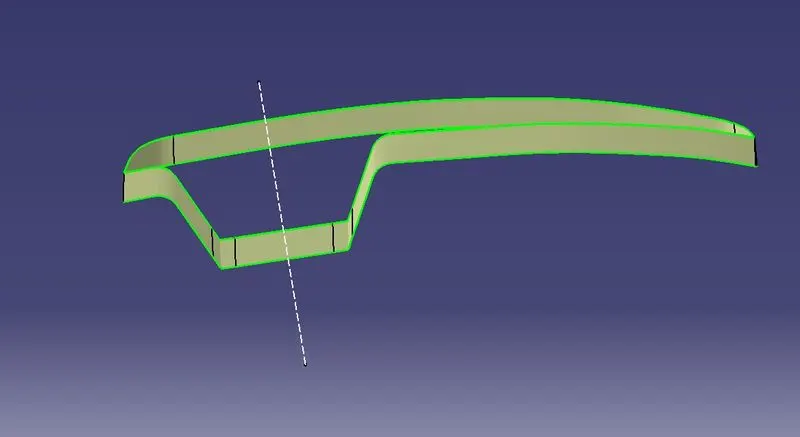
Creating a closed surface and forming a solid part from it:
- Use the Trim Tool to form a closed surface from B-Surface and C-Surface.
- Create a solid part from this closed feature using the Surface based feature in part workbench.
Draft Analysis of Solid Part:
Following the similar steps performed for draft analysis of Class-A surface we obtained the following result.
Conclusion:
We have successfully created a Switch Bezel ( Basic ) using given Class - A Surface.