Week 7 State of charge estimation
Aim:-
1.Simulate the 3 test cases from harness dashboard and write a detailed report on the results
2.What is coulomb counting? Refer to the above model and explain how BMS implements coulomb counting for SOC estimation ?
Study 1:-Simulate the 3 test cases from harness dashboard and write a detailed report on the results
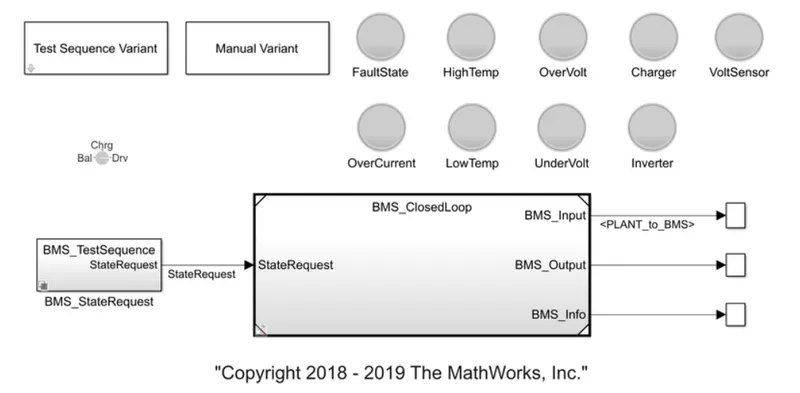
Now,at first we have to simulate 3 test cases from harness dashboard. We need to, select the harness dashboard from project file which we downloaded with the reference link https://in.mathworks.com/matlabcentral/fileexchange/72865-design-and-test-lithium-ion-battery-management-algorithms . The battery model harness dash board is represented below.
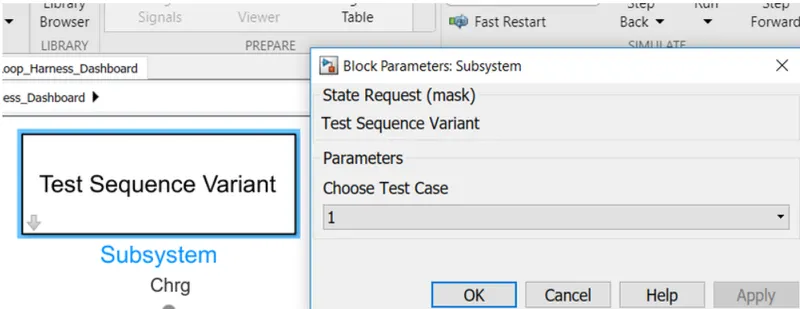
1)Click on the Test Sequence Varient Block and select test case as 1
Now by clicking on the BMS Sequence block we get the chart
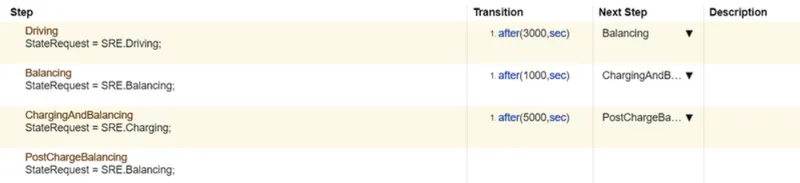
When simulation will start, the model will be in driving condition. After 3000 seconds it will be in standby mode and after 1000 seconds it will be in charging mode. Now by Running the simulation.
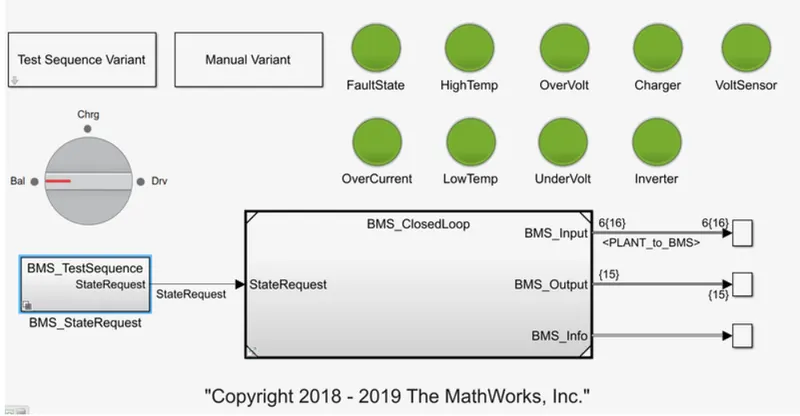
Results:-
Here all the indicators are green. So we can see no errors and we check the plot for this model and is shown below.
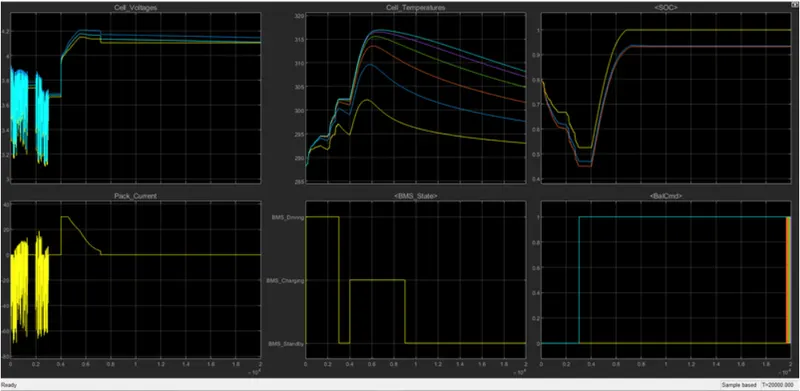
From the plot we can see the vehicle is initially in driving state and charging was done till 90%. After charging it reaches to standby mode. It can be seen in BMS state plot.Battery temperature increases in driving and charging. Battery voltage was increased to 4.2V while charging. Current plot shows the value of current supplied to vehicle while driving. SOC decreased up to 50% in driving condition and it was increased while charging.
2) Now change the test sequence varient in case two.
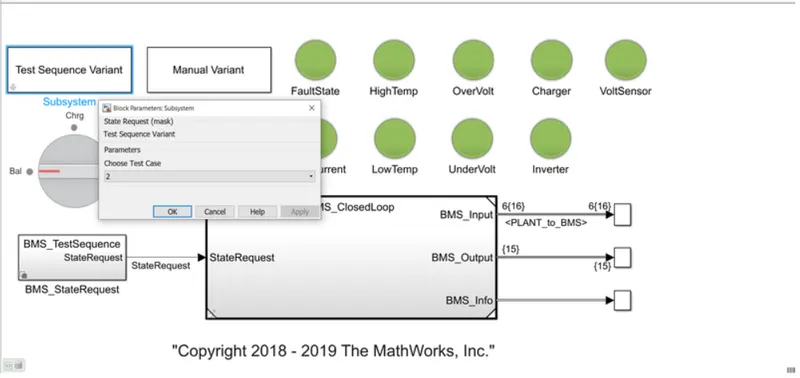
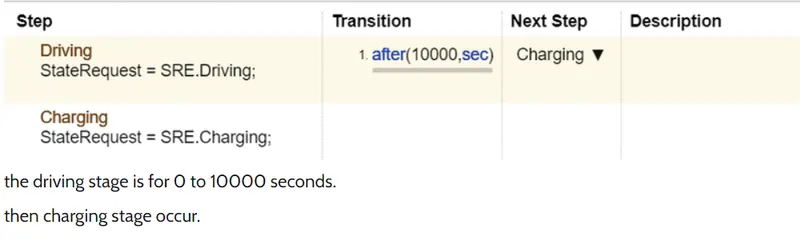
Now by clicking on the BMS state request block
Result:-
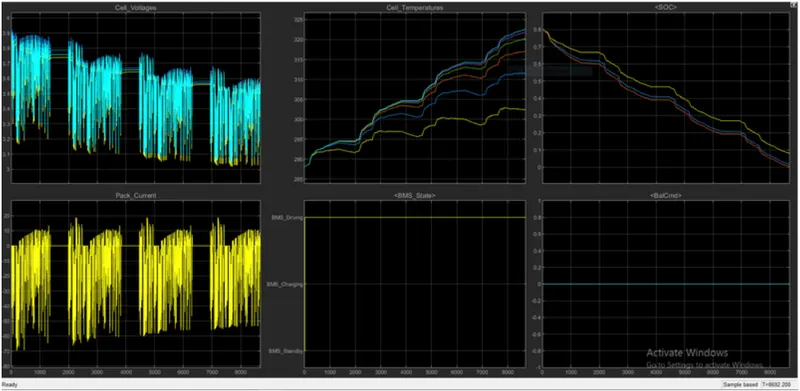
From the above graph , a fault condition occured in second case. So even after charging was started, the soc didnt increase. It continue to decrease.
3) Now by changing the test Sequence Value to 3
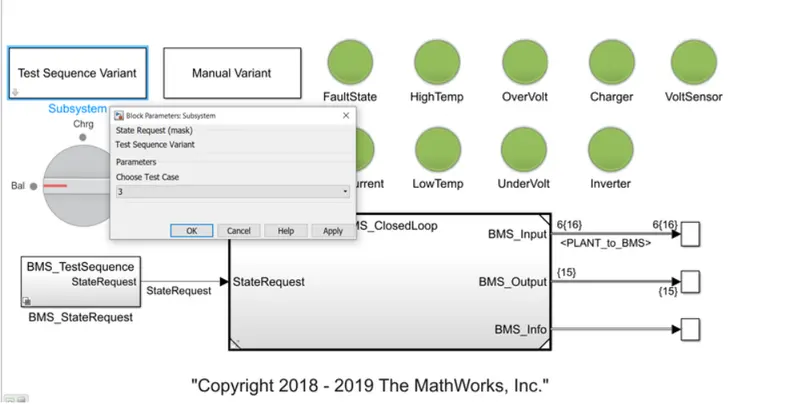

This condition has only one phase and that is charging.Thus 0 to 20000 seconds simulation runs.
Result:-
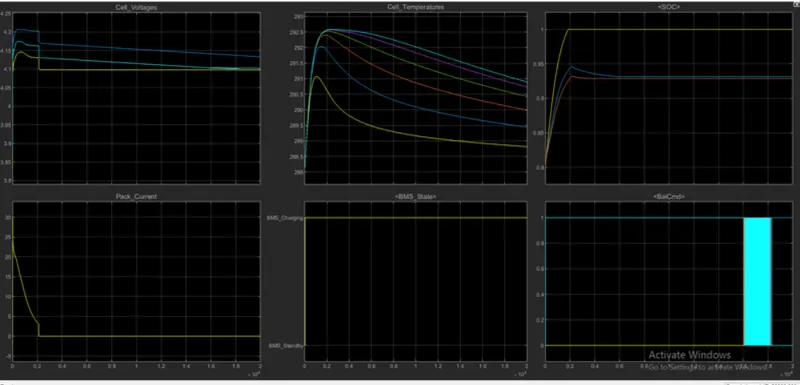
- Here we can see that the soc reached 100% in charging and remained in stand by mode. Cell temperature also decrased when stsndby mode was acheived.
From the 3 cases we observer that only charging takes place thus SOC was 80% at first , then SOC increases to 100% in 2000 seconds then SOC remains constant at 100%.
Study 2:-What is coulomb counting? Refer to the above model and explain how BMS implements coulomb counting for SOC estimation ?
coulomb counting:-
The Coulomb counting method measures the discharging current of a battery and integrates the discharging current over time in order to estimate SOC . Coulomb counting method is done to estimate the , which is estimated from the discharging current, , and previously estimated SOC values, . SOC is calculated by the following equation:

But there are several factors that affect the accuracy of Coulomb counting method including temperature, battery history, discharge current, and cycle life.
Modified Coulomb Counting Method
To improve the Coulomb counting method, a new technique called modified Coulomb counting method is proposed. The modified Coulomb counting method uses the corrected current to improve the accuracy of estimation.
The corrected current is the function of discharging current. There is a quadratic relationship between the corrected current and discharging current of battery. By practice of experimental data, corrected current is calculated by the following form:

where
In modified Coulomb counting method, SOC is calculated by the following equation:
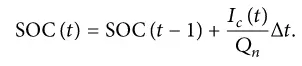
The experimental results show that the accuracy of the modified Coulomb counting method is superior to the conventional Coulomb counting method.
But there are several factors that affect the accuracy of Coulomb counting method including temperature, battery history, discharge current, and cycle life .
For example we can look into the project file we downloaded. A BMS system in the file is represented below.
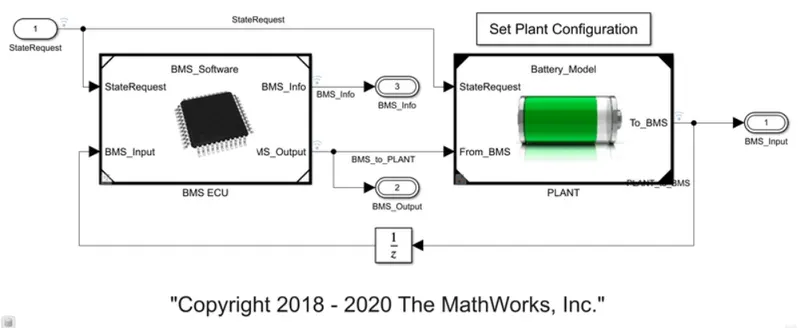
BMS algorithm models , protects , reports the measurement from battery pack.
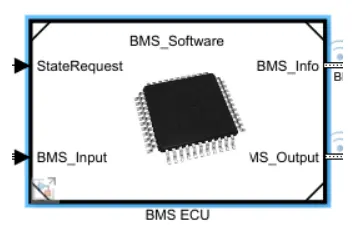
By Clicking on the BMS ECU we get the Subsystem
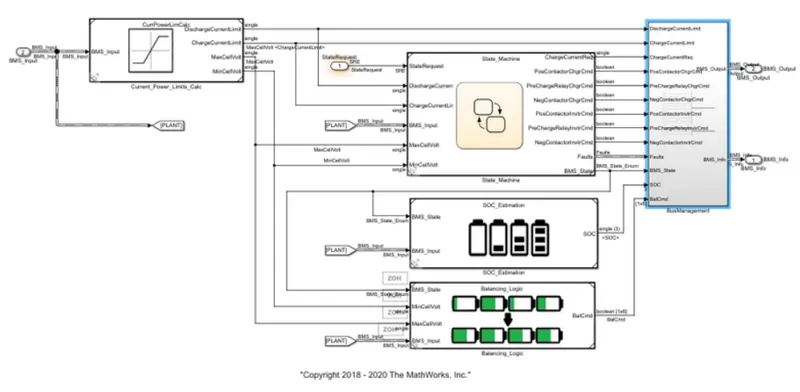
By clicking on the SOC estimation block we get
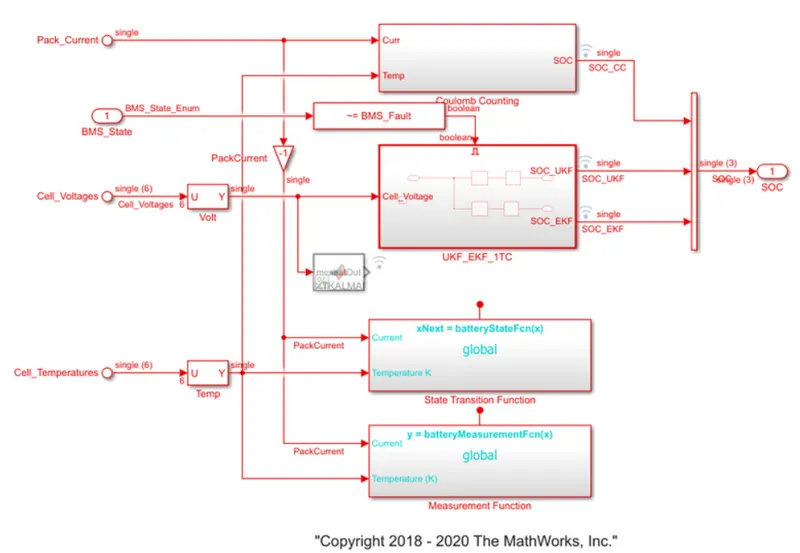
From above figure we observe the Coulomb Counting block.
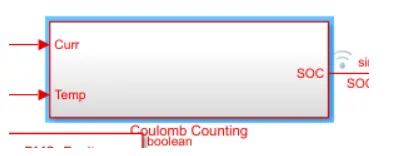
A subsystem opens when we click on the Coulomb Counting
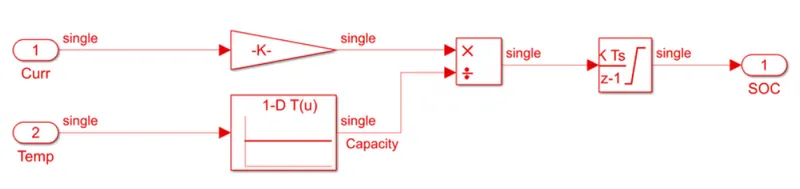
- This system does the estimation by coulomb counting equation mentioned above.
- Advantage of coulomb counting method is its simplicity and low computational cost.
- Temperature and current from the battery is given as inputs.
- Current signal is given to a gain block and temperature is given to capacity since it varies according to temperature.
- These inputs are given for integration where current will be integrated with respect to time.
- This outout is given to another block where it is divided by capacity.
- Hence the SOC is estimated.
-
SOC estimators working for SOH
The well-known techniques used for measuring the battery state-of-charge can just as well work for the SOH estimation. These include:
- Coulomb counting. The decrease in the state-of-health and the loss of rated capacity occur simultaneously in a battery. Thus, you can find out the SOH once you know the rate at which the capacity fades over time. The coulomb counting method is here at your service.
- Kalman filtering. The Kalman filter can lean on a variety of battery parameters, including internal resistance, which is essential for SOH estimation. The algorithm can track the behavior of a battery in real-time and predict its wear and aging.
- Neural networks. Neural networks can process both linear and non-linear data. By analyzing battery internal parameters, neural networks can estimate the SOH under various conditions.
- Fuzzy logic. Fuzzy logic models can use internal resistance, impedance, and other parameters as input data to evaluate the battery SOH. To apply the fuzzy logic method, you don’t necessarily need complete and comprehensive data about your battery.
Like with the SOC estimation, the SOH is normally defined by blending several measuring practices. This approach allows BMS developers to view the battery from many different perspectives and determine its state with high accuracy. For example, you can achieve greater results by integrating the coulomb counting with neural networks or combining internal resistance and impedance measurements with fuzzy logic.
Also, you should bear in mind that some SOH or SOC estimation methods are not suitable for certain applications. For example, to extend the battery life in electric vehicles (EVs), it is strongly recommended not to fully charge or discharge the battery. That is why the cycle calculation and coulomb counting techniques do not fit EV battery SOH evaluation.
In the next part of this article, we’ll share hands-on experience in measuring the state-of-charge of batteries installed in an industrial battery energy storage solution. We opted for Kalman filtering as a basic method for this project, supporting it with additional estimation techniques.
Alternative SOC estimators
There are a host of other techniques that can estimate the SOC of battery cells. Some of them have already been put into practice, the others are still in the research stage or exist as concepts. When investigating the SOC determination solutions, you can come across the following methods:
- Terminal voltage method. This method consists in measuring the terminal voltage of a battery that decreases during discharge. The SOC is calculated based on the proportional relationships between the electromotive force (EMF) of a battery, its terminal voltage, and the state-of-charge. There can be a serious error in the calculations due to a sharp drop of the terminal voltage at the end of discharge.
- Impedance method. This builds upon the measurements of a battery’s internal impedance that changes throughout charge and discharge cycles. The main challenges here are measuring impedance during the battery’s operation and obtaining correct data with allowances made for the temperature.
- Neural networks. A neural network can estimate the SOC by learning from large amounts of a battery’s input data, such as voltage, current, and temperature, and reproducing the non-linear relationships between these parameters.
- Fuzzy logic. To build a fuzzy logic model, you can use any battery data available to you even if it’s abstract and approximate. After analyzing the data, the model can determine battery characteristics, including the state-of-charge. The key requirement of both fuzzy logic and neural networks is the high performance of a microcontroller.
- Ultrasonic detection. This method lies in estimating the SOC using ultrasonic guided wave technology. Owing to its sensitivity, wave signals can help understand the battery structure and thus evaluate its capacity and overall condition. Implementing this practice requires significant investments of time and effort.
The application of a single SOC estimation approach is rarely found in present-day battery management systems. To improve your calculations, you can put different techniques together using so-called hybrid methods. For example, combined with fuzzy logic or Kalman filtering, coulomb counting can better measure accuracy than the current integration method alone.
Conclusion:
- The 3 test cases from harness dashboard were simulated and discussed successfully along with the coulomb counting done by BMS for SOC estimation.