Week 7 State of charge estimation
What is coulomb counting? How BMS implements coulomb counting for SOC estimation
ANS:
SOC: SOC stands for the state of charge of a battery. SOC represents the amount of energy left inside the battery with respect to the total amount of energy in a battery at the Fully charged condition. SOC can help a user to determine when to charge the battery or stop charging and how much energy he can extract from a battery at that time. There is no direct method to calculate SOC for a Li-ion battery but there are several ways in which we can calculate SOC with the help of some additional parameters. The easiest method to calculate the SOC of a battery is by using a battery voltage translation method. This method is not accurate but helps to approximately and quickly calculate SOC and can be used in devices like power banks where SOC is shown in range and not the exact percentage. For example, a typical power bank shows SOC in the range from 0-25%, 25-50%, 50-75%, 75-100%. There are several limitations to this method and hence more accurate methods are needed like the Coulomb counting method, the Fuzzy logic method, the Kalman filter, the RBF Neural network, the Fuzzy neural network, the Hybrid methods, etc. Each method has its limitations, accuracy, and complexity and hence proper decision should be made while selecting methods for SOC estimation.
Coulomb Counting:
Coulomb counting is a technique used to track the State of Charge of a battery pack. It works by integrating the active flowing current (measured in amps) over time to derive the total sum of energy entering or leaving the battery pack. This produces a capacity that is typically measured in Amp-hours.
The coulomb counting method is also known as the battery current integration method. In this method, a discharging/charging current I(t) is measured and integrated over time to calculate the amount of energy remaining inside the battery. In this method, SOC is taken at the previous time step SOC(t-1) and the amount of energy removed/added at the current time step is subtracted/added from the SOC of the previous time step SOC(t-1) to obtain the amount of energy present in the battery at the present instant.
The SOC estimation in the coulomb counting method is done using the below equation,
`SOC(t)=SOC(t−1)⋅∫tt−1It⋅ηQn⋅dt`
SOC(t-1) = SOC at previous time step
η">ηη = efficiency
t = current time step
t-1 = previous time step
Q = Charge capacity of the battery
Implementation in BMS:-
Coulomb counting method can be implanted in BMS with a suitable algorithm. The following chart is giving a general idea, how SOC estimation is going to work. This algorithm can be implemented with the state machine in Simulink, which can be further uploaded in the flash memory of BMS hardware using the code generation option.
Below is the basic proposed flow chart for SOC estimation.
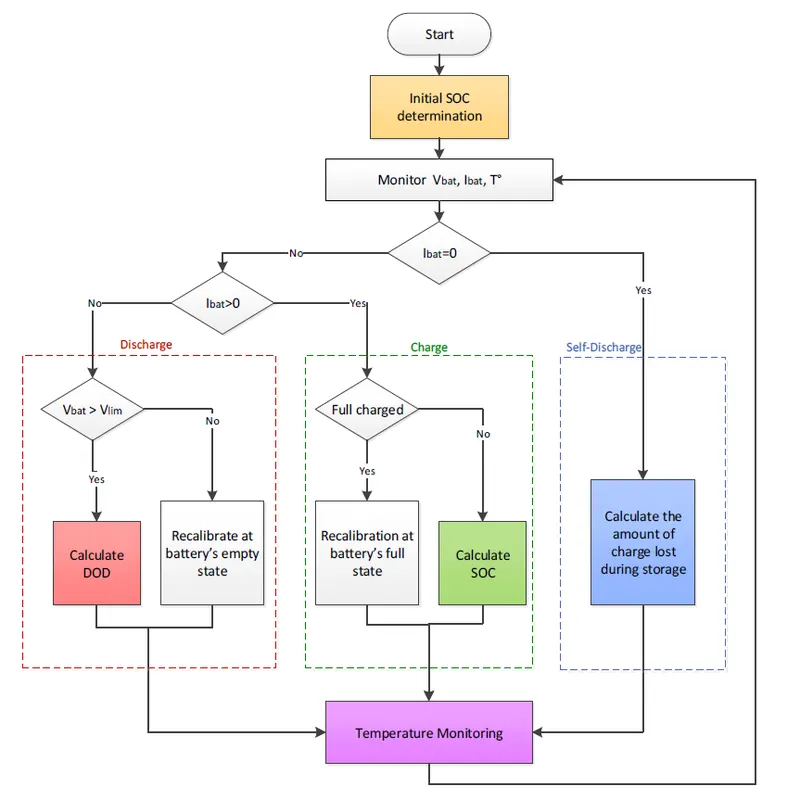
Fig:-Flowchart of the proposed algorithm
Flow chart Explain:
A. Charge Mode-
In this mode, the coulomb counter is presented by `Qgained` as expressed in the following, which represents the quantity of charges accumulated during τ">ττ.

So the variation of the state of charge gained in this same operating period is obtained by the following relation

By cumulating the previous state of charge indication and the obtained one we can have the instantaneous value of SOC:

Knowing the relationship indicated in the following relation the value of depth of discharge DOD is updated in every charging operation in order to get it back every switching to discharging mode.
 .....................(1)
B. Discharge Mode-
In the discharging mode, the coulomb counter is presented by Qlost">Qlost , which represents the amount of charges losses in the operating period τ">ττby the following equation:

The depth of discharge variation is calculated according to the following first eq and used in the following 2nd eq to calculate the value of DOD.


The SOC indication then is done by applying the equation (1).
C. Self-Discharge Mode-
At the battery storage periods, the percentage of monthly self-discharge is converted to the amount discharged per hour; this amount is designed by the constant `qperhourq`. Considering a 5% rate of self-discharge per month is approximated to 0.0016 Ah. So the quantity of charges dissipated in the open circuit period is calculated by the following equation representing the accumulative losses during the store hours.

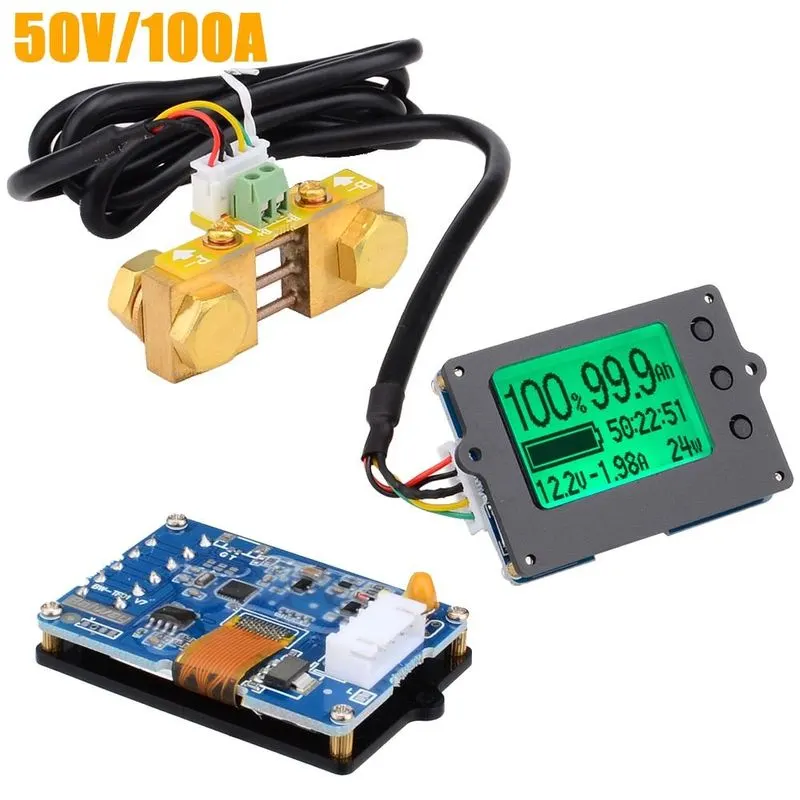
Fig: Coulomb Counter
The only time that the correct SoC is known is when the battery is fully charged or discharged. In the operation of the vehicle, these two conditions are rarely encountered. Also, such methods require that the current measurement is perfect, but no current sensor is immune from noise, component-to-component variations, and other effects. Therefore small errors always exist in every measurement and these errors may cause the estimates to wander away from the true value. Thus, Coulomb counting is not a preferred method for SoC estimation when a battery must be operated for a long time without full charge or discharge. Nevertheless, if the initial condition is known and the battery is operated for a relatively short period of time, then this method does provide a reliable measurement. This is important because, in order to design any SoC estimator, a true measurement must exist for purposes of comparison.
Below is the table of comparisons to measure the SOC with different methods.
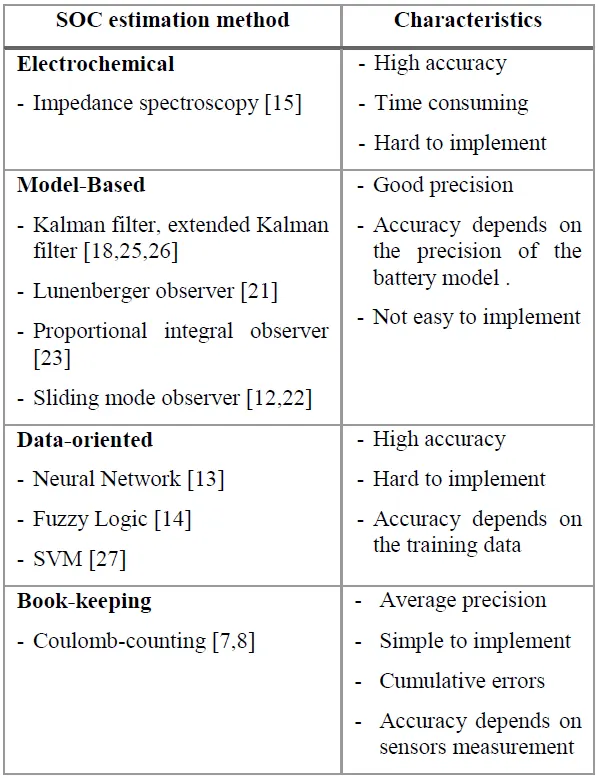
Now, look at the inside of a Simulink model of the battery management system. In this model, SOC is estimated with different methods – Kalman filter and coulomb counting. Coulomb counting method is taking pack current values and divided by capacity values, which is given by a look-up table to show the variation of capacity with temperature. Further values are integrated to estimate the charge.