Week 7 State of charge estimation
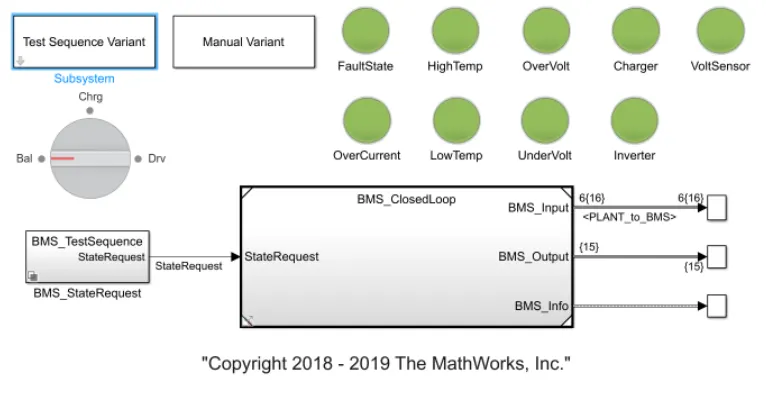
At first we have to simulate 3 test cases from harness dashboard we need to select the harness dashboard from project file which we downloaded with the reference link given above
the battery model harness dashboard:
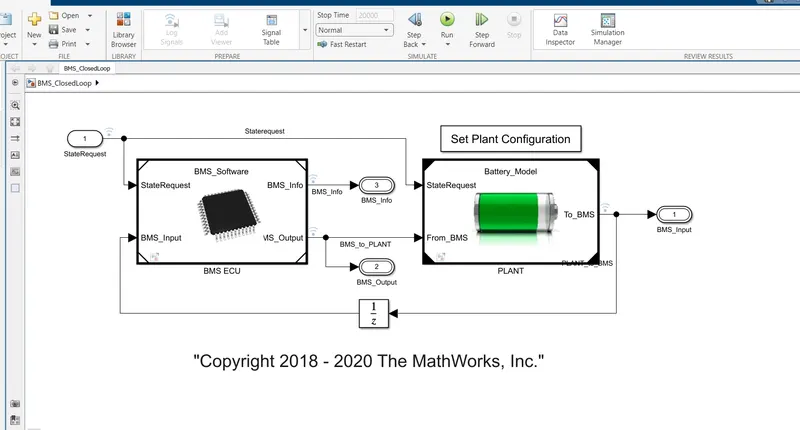
in test sequence varient block select test case as 1
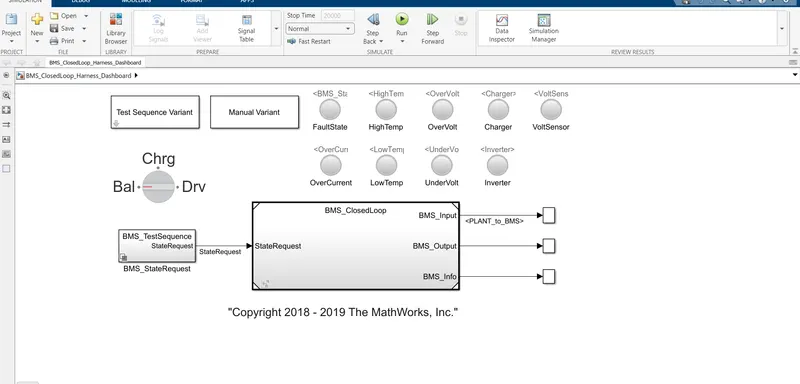
now by clicking bms sequence block we get the chart
when simulation will start the model will be in driving condition .after 3000 sections it will be in standby mode and after 1000seconds it will be in charging mode
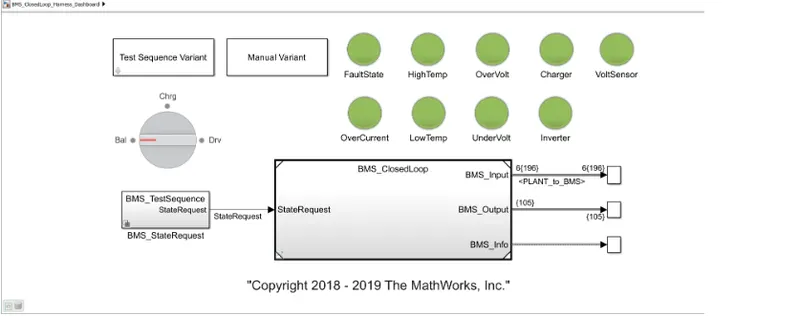
here all the indicators are green so we can see no errors and we check the plot for this model and is shown below
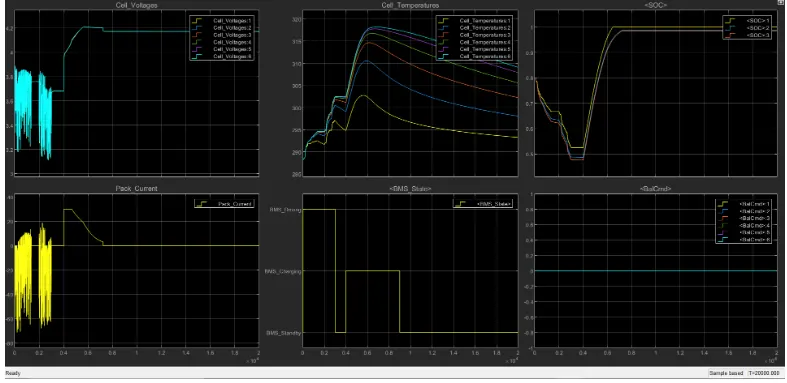
from the plot we can see the vehicle is intially in driving state and charging was done till 90% after charging it reaches to stand by mode seen in bms state plot battery temperature increases in driving and charging .battery voltage was increased to 4.2v while charging current plot shows the value of current supplied to vehicle while driving .soc decreased to vehicle while upto 50% in driving condition and it was increased while charging.
now the test sequence varient b in case 2:
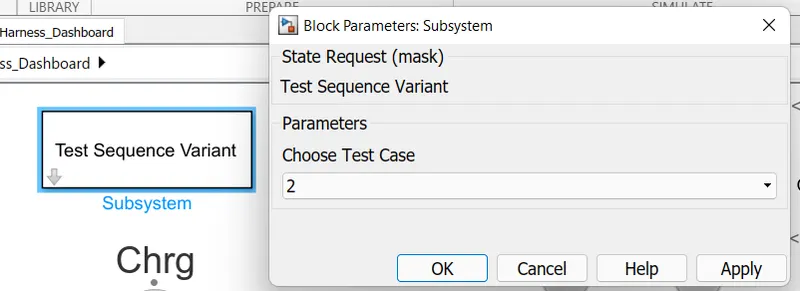
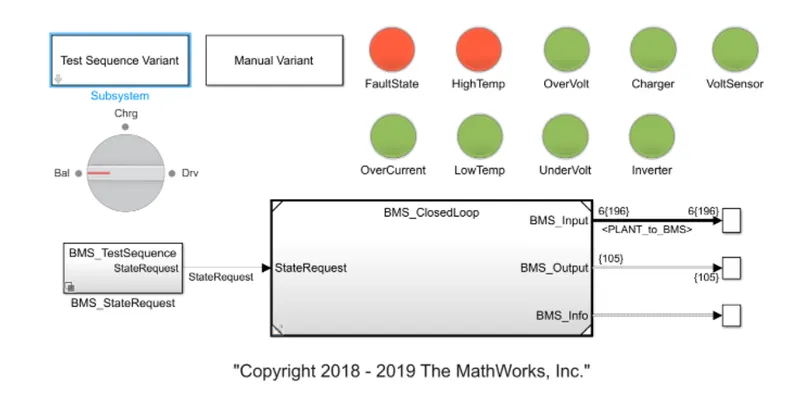
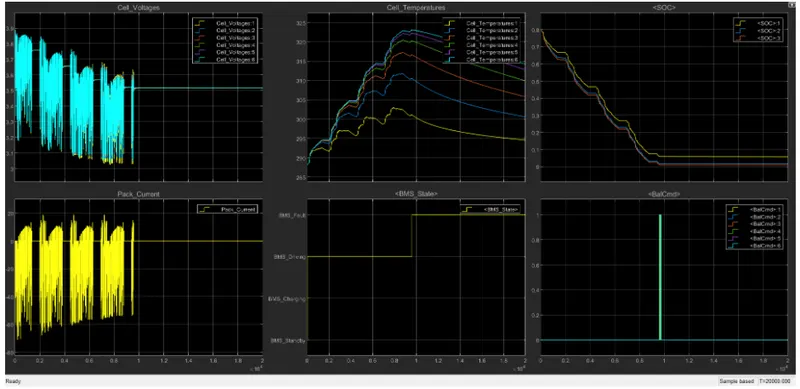
from the above graph a fault condition occured in second case so even after charging was started the soc didnt increase it continue to decrease
now by changing test sequence value 3:
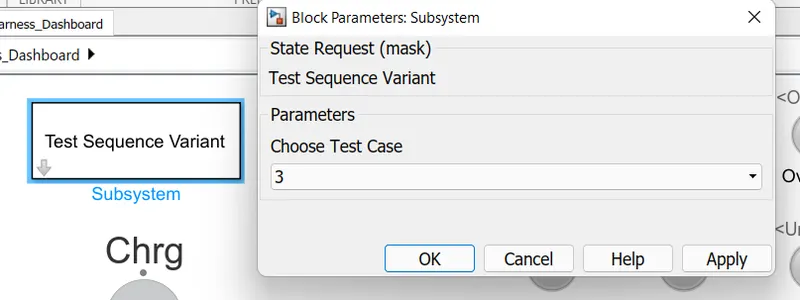
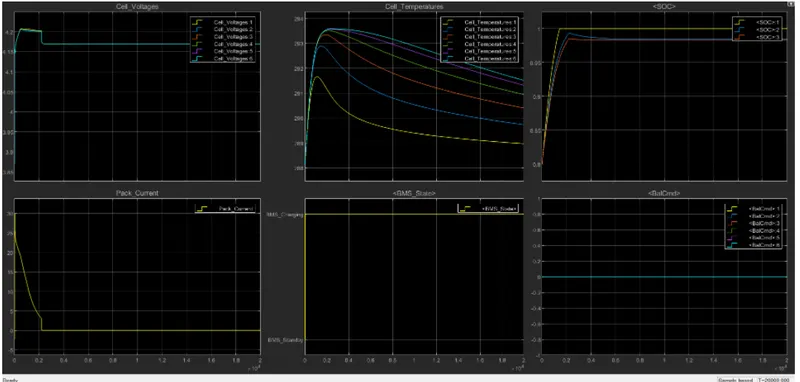
here we can see the soc reached 100% in charging and remained in started 100% in charging and remained in stand by mode .cell temperature also decreased when standby mode was achieved
from the three cases we obseve that only charging takes place thus soc was 80% at first then soc increases to 100% in 2000 seconds then soc remains constant at 100%
Q2)What is coulomb counting? Refer to the above model and explain how BMS implements coulomb counting for SOC estimation ?
Coulomb counting is a technique used to track the State of Charge of a battery pack. It works by integrating the active flowing current (measured in amps) over time to derive the total sum of energy entering or leaving the battery pack. This produces a capacity that is typically measured in Amp-hours.
To determine available capacity, coulomb counting relies on the integration of the current drawn from and supplied to a battery over time, τ∈[t0 t], as given by
where I is the current and η is the efficiency during charge and discharge operations . Coulomb counting is advantageous in terms of a simple structure and its ease of implementation. However, some problems make it difficult to accurately estimate battery SOC by coulomb counting. Because battery capacity and efficiency are significantly influenced by operating temperature and current direction, these factors should be considered to correct for battery SOC. Sensor accuracy is also important because accumulated errors can lead to a drift in the estimated battery SOC. Furthermore, one of the main problems in coulomb counting is that it is necessary to calibrate the initial battery SOC.
In order to improve SoC estimation, coulomb counting and voltage-based methods can be combined. In this method, a cumulative error of the counting integrator can be removed by a counter calibration based on the OCV characteristics. The calibration can only be done if the battery is not in use. Otherwise, the current is integrated to get the relative charge in and out of the battery.
An illustrative state diagram of this method . A cell or battery can be in one of six states. A change of the state is detected by monitoring voltage and current. The coulomb counting method is used in almost all states with exception of “Equilibrium state” and “Fully charged”. In equilibrium state, the battery voltage is stable and OCV voltage characteristic is used to calibrate the state-of-charge. A calibration is also done when the cell is fully charged because this state is well determined and easy to detect during the constant-voltage charging mode. In this mode, a maximum voltage is applied to the battery and current decreases with time. When the current reaches a minimal value, defined as end of charging current (EoCC), the charging process is complete and the battery is fully charged. An example of cell voltage and current in three different states
.
In general the SOC of the battery is the ratio of its present capacity (µ(t)) to the nominal capacity (µn) of the battery . The SOC can be defined as
The Coulomb counting method measures the charging/discharging current of a battery and integrates it over time in order to estimate SOC . The SOC can be calculated as
where ψ(t) and ψ(t−1) are the SOC of the battery at time instant t and t−1, i(t) is the battery current at time instant t, and Δt is the time interval (considered 1 minute).
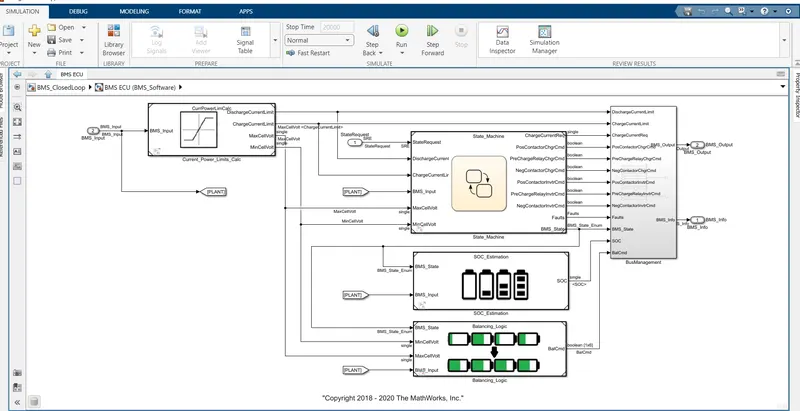
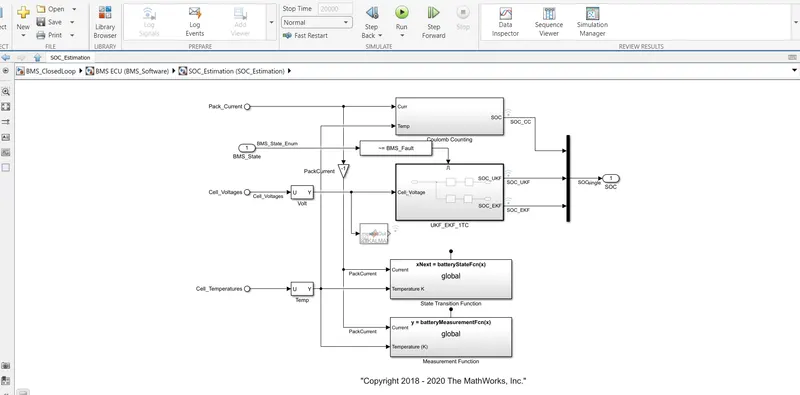
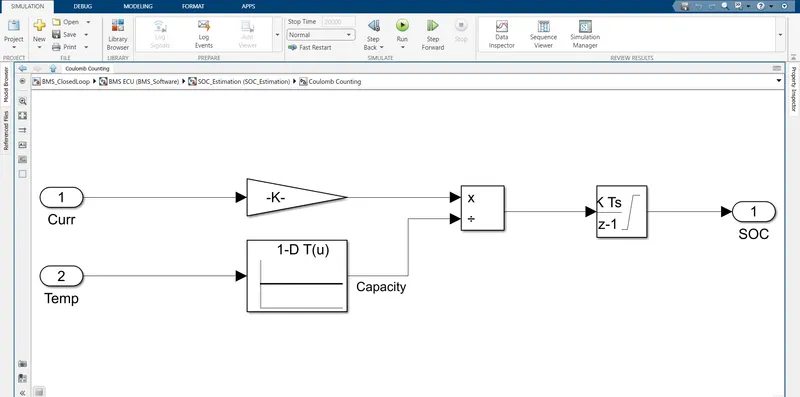
This system does the estimation by columb counting equation mentioned above.advantages of columb countingmethod is its simplicity and low coputational cost temperature and current from the battery ais given as inputs.current signal is given to capacity since it varies according to temperature.these inputs are given for integration where current will be integrated with respect to time .this output is given to another block where it is divided by capacity.hence the SOC is estimated.