Week 7 State of charge estimation
1.Simulate the 3 test cases from harness dashboard and write a detailed report on the results
2.What is coulomb counting? Refer to the above model and explain how BMS implements coulomb counting for SOC estimation ?
Hint :(Download the file from the link and go to SOC estimation model-ECU block)
Answer:
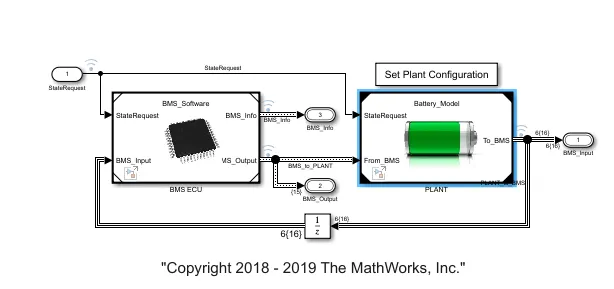
1) To simulate the 3 test cases from harness dashboard first we download the model from matlab. The model is as show below.
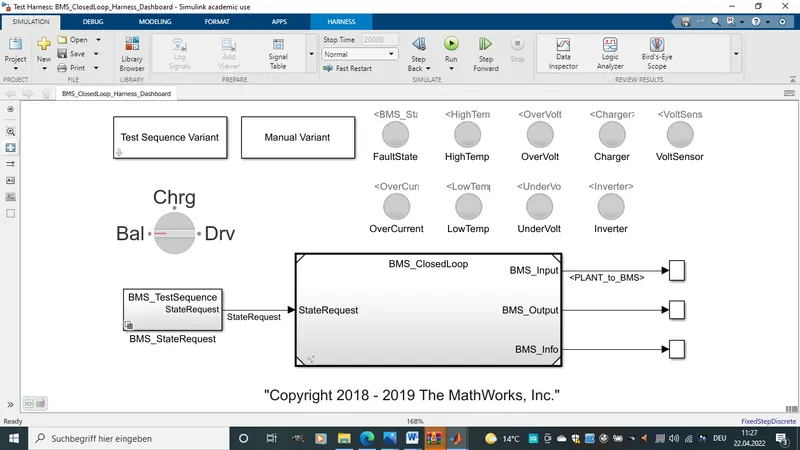
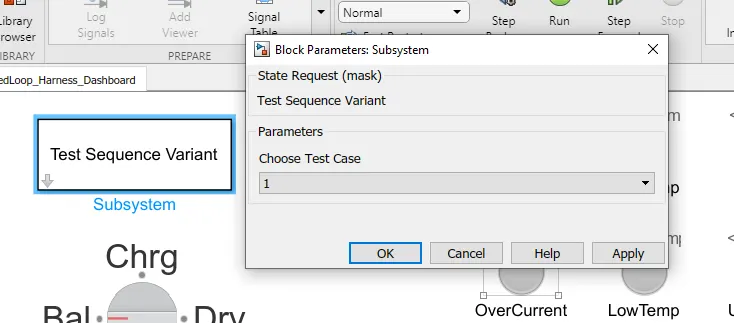
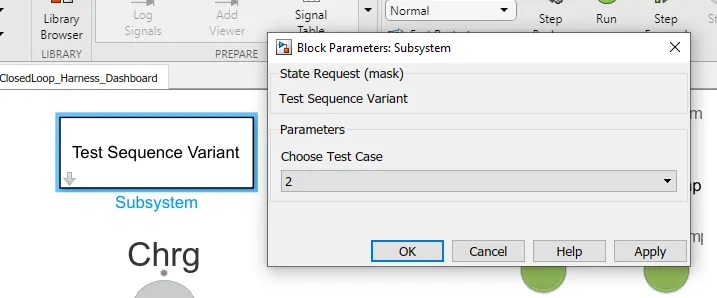
-secondly in oder to run the various test cases we select from the "Test Sequence Variant" block by double clicking on it and select the first test.
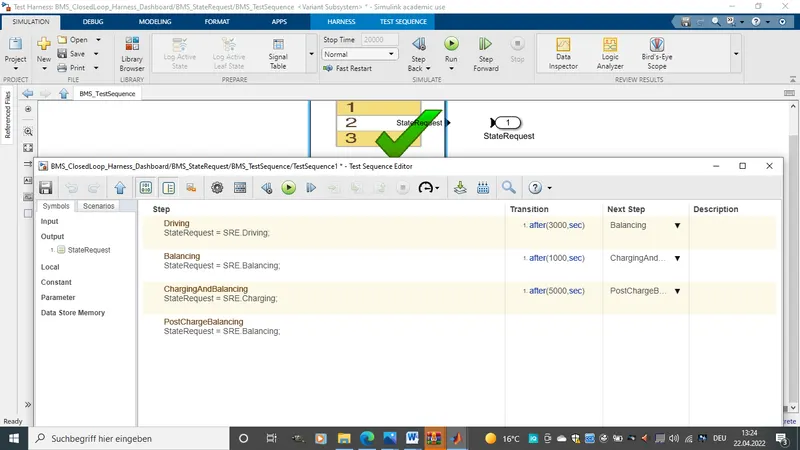
*In the BMS Sequence block we are given the following informations,
-At the start of the simulation the model is in driving condition.
-After 3000 seconds it is in balancing mode.
-Then afterwards it will be in charging and balancing mode.
-Then after 5000 secs it will be in post charge balancing mode.
*All of the lamps turn green meaning thier test was succesfuly run.
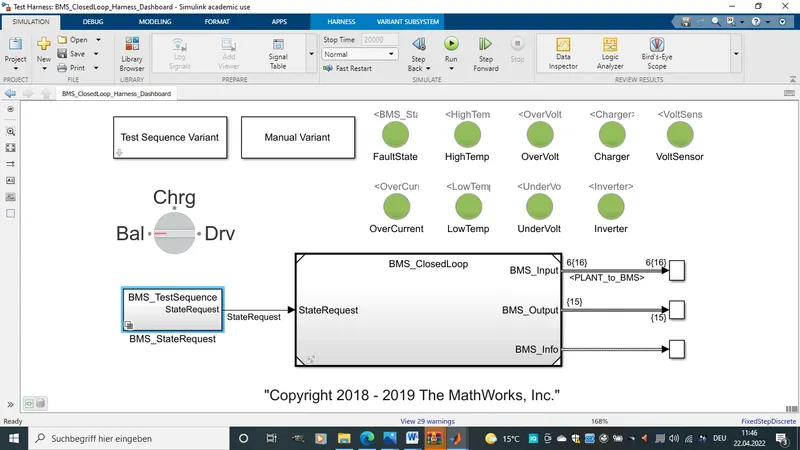
Results:
The below plot was given out as ther results.
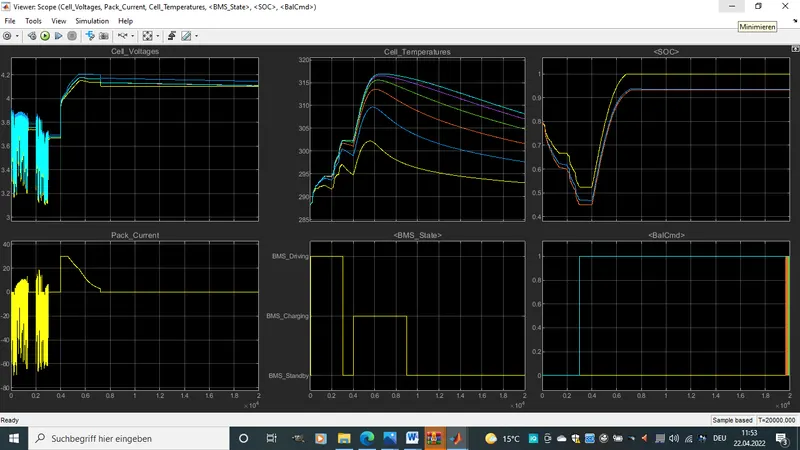
-We can see from the plot that the battery SOC decreases drasticaly down to almost 50% before its start charging again this is because during the first 3000 sec the vehicle was in driving mode as seen in the BMS state, then later charging from 4000sec till 9000sec. Later is the vehicle is on standby. During the first 3000sec we could observe constant fluctuation in the Value of the Battery pack Current, voltage and temperature. This means during driving the vehicle use curent depending on the power demand of the vehicle and battery gets heat up in the process.
Test 2:
*So we go back to the Test Sequence Variant block to runout the second test.
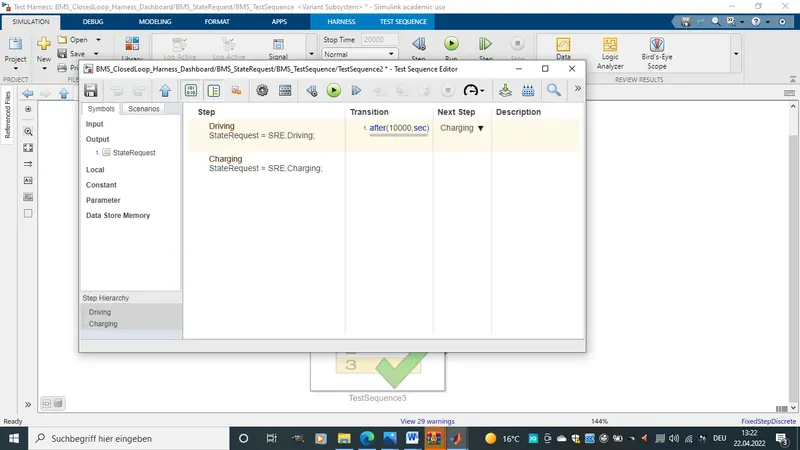
*In this state the vehicle will drive for 10000sec before charging.
Results:
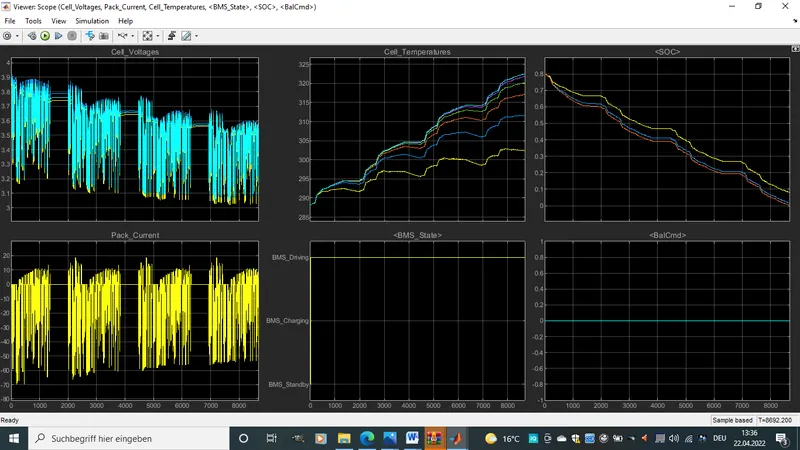
-From the results we see that the vehicle was not able to run the complete 10000sec drive cycle. We aslo see that from the state of battery it was some sequence of acceleration and deceleration hance the constant rice and fall in current, voltage and temperature. The Battery capacity and regenerative braking energy during braking was not able to run the vehicle for 10000sec and battery went to 0%.
Test 3:
Going back to the Test sequence Variant block and change the test to 3
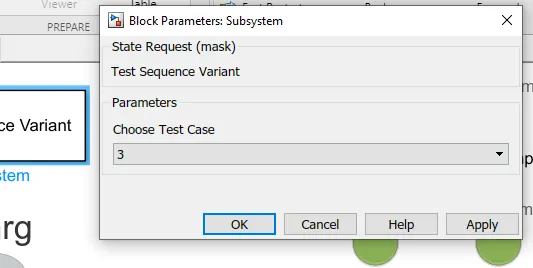
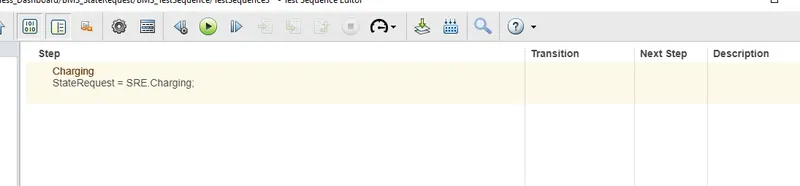
In this test the vehicle is in constant charging mode.
Results:
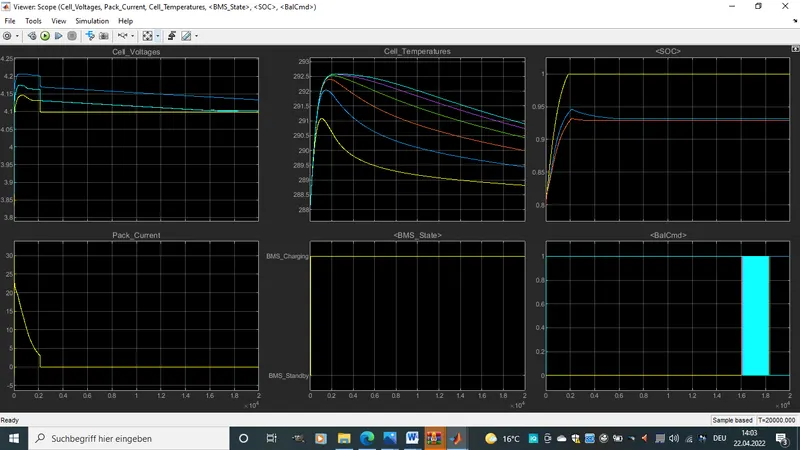
*After 2000sec the battery is fully charged but still stays on charge mode. during this 2000sec we observe a rapide rice in temperature then later gradualy drops when battery is fully charged. After 2000sec the battery current drops to 0 meaning there is no more enery intake by the battery.
2)
Coulomb counting is a technique used to track the State of Charge of a battery pack. It works by integrating the active flowing current (measured in amps) over time to derive the total sum of energy entering or leaving the battery pack. This produces a capacity that is typically measured in Amp-hours. A coulomb counter is like an odometer for current. It constantly monitors the current your circuit is using, adds it up, and gives you a pulse each time a given amount of amp-hours have been used.
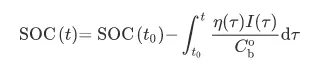
where I is the current and η is the efficiency during charge and discharge operations. Coulomb counting is advantageous in terms of a simple structure and its ease of implementation. However, some problems make it difficult to accurately estimate battery SOC by coulomb counting. Because battery capacity and efficiency are significantly influenced by operating temperature and current direction, these factors should be considered to correct for battery SOC. Sensor accuracy is also important because accumulated errors can lead to a drift in the estimated battery SOC. Furthermore, one of the main problems in coulomb counting is that it is necessary to calibrate the initial battery SOC.
An example of a model which and explain how BMS implements coulomb counting for SOC estimation. The below model explains it.
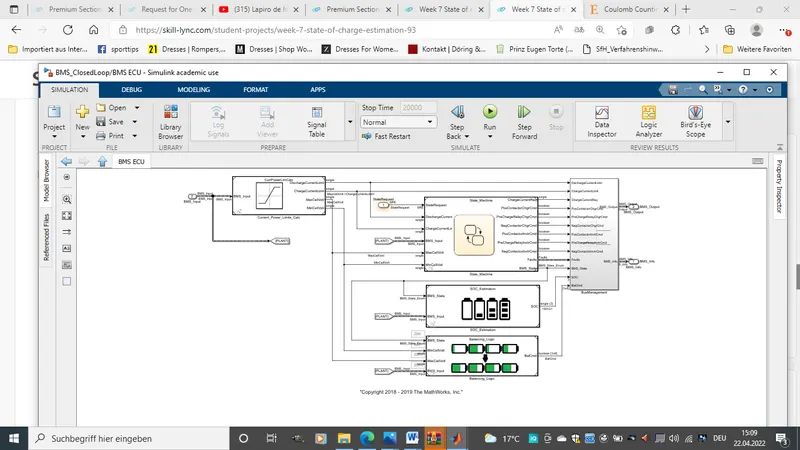
In the BMS ECU subsystemwe observe the following.
*Now going into the SOC estimation block to observe the coulombs counting
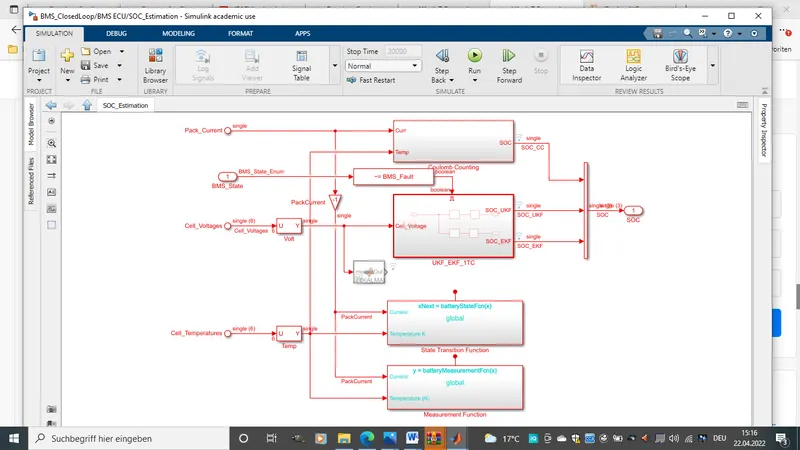
*In this subsytem we can observe several other subsystems, amongst which is the coulombs counting block. When we go into this subsystem we get the below model.However, some problems make it difficult to accurately estimate battery SOC by coulomb counting. Because battery capacity and efficiency are significantly influenced by operating temperature and current direction, these factors should be considered to correct for battery SOC.
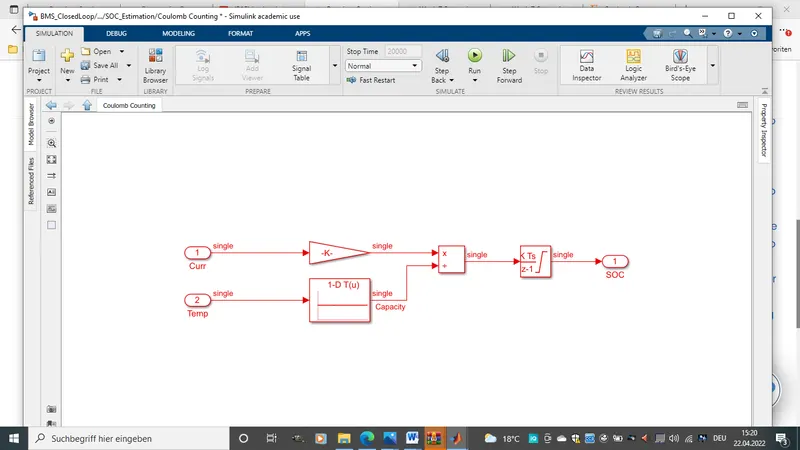
This system carries out the estimation by coulomb counting equation mentioned earlier. The main advantage of coulomb counting is that of its simplicity and low cost. We see in the model the incoming current ist bean divided by the value on the lookup table before getting discretly intergrated over time.