Week 7 State of charge estimation
1.Simulate the 3 test cases from harness dashboard and write a detailed report on the results
2.What is coulomb counting? Refer to the above model and explain how BMS implements coulomb counting for SOC estimation ?
1.Simulate the 3 test cases from harness dashboard and write a detailed report on the results
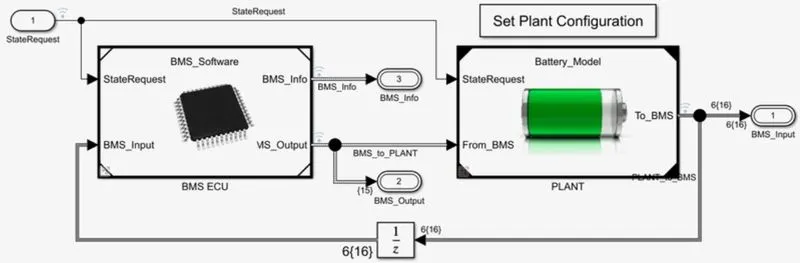
Study 1:-Simulate the 3 test cases from harness dashboard and write a detailed report on the results Now,at first we have to simulate 3 test cases from harness dashboard. We need to. select the harness dashboard from project file which we downloaded with the reference link https:/fin.mathworks.com/matlabcentral/fileexchange/72865-design-and-test-lithium-ion-battery-management-algorithms . The battery model harness dash board is represented below.
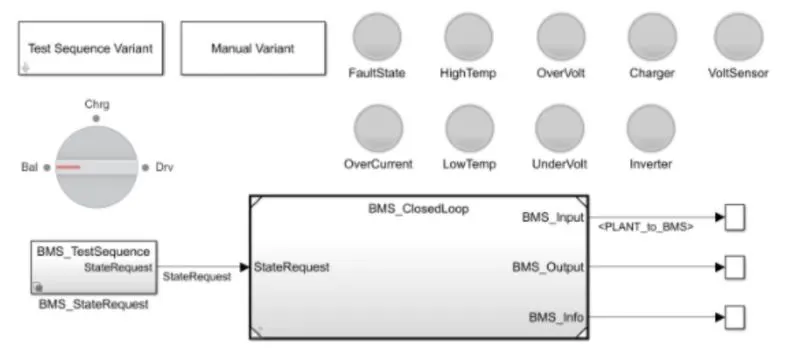
1)Click on the Test Sequence Varient Block and select test case as 1
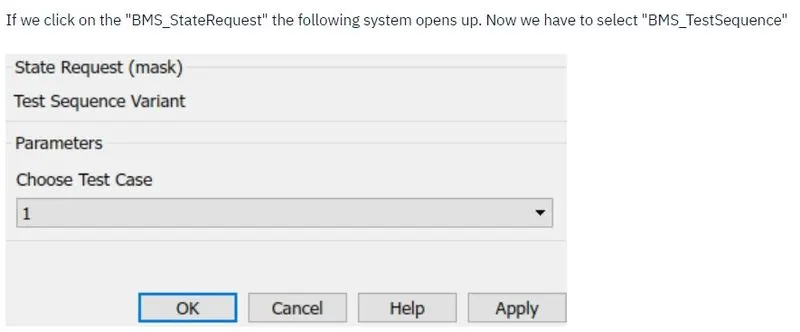
Now by clicking on the BMS Sequence block we get the chart
Now by clicking on the BMS Sequence block we get the chart
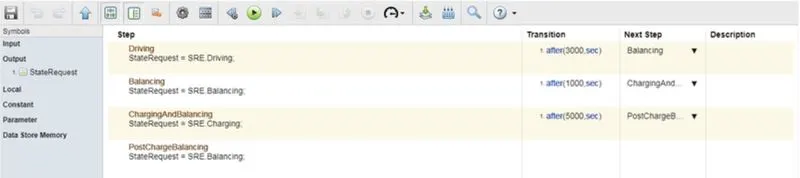
When simulation will start, the model will be in driving condition. After 3000 seconds it will be in standby mode and after 1000 seconds it will be in charging mode. Now by Running the simulation
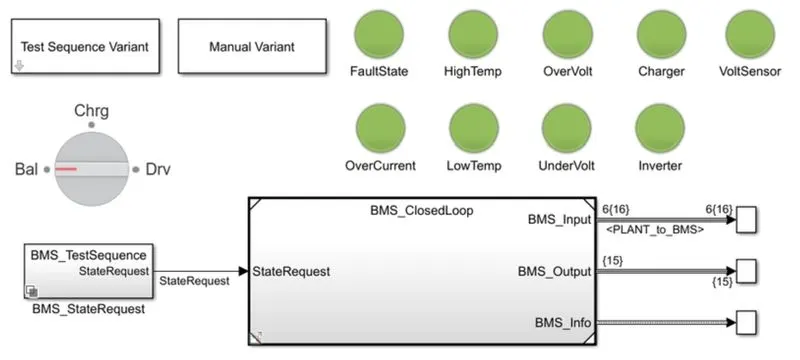
Results:-
Here all the indicators are green. So we can see no errors and we check the plot for this model and is shown below.
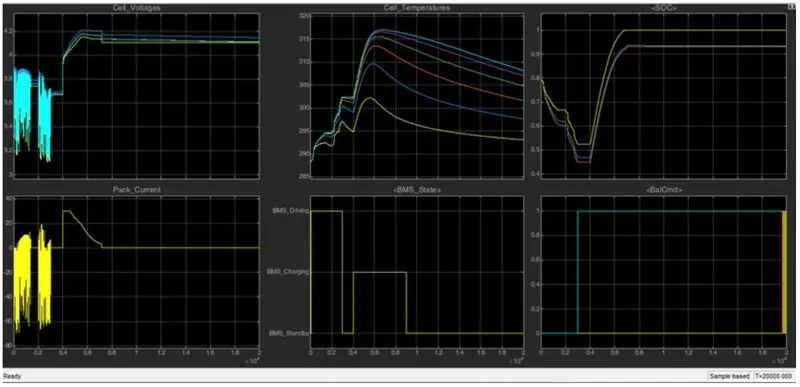
From the plot we can sec the vehicle is initially in driving state and charging was done till 90%. After charging it reaches to standby mode. It c. be seen in BMS state plot.Battery temperature increases in driving and charging. Battery voltage was increased to 4.2V while charging. Current plot shows the value of current supplied to vehicle while driving. SOC decreased up to 50% in driving condition and it was increased while charging.
Now change the test sequence varient in case two:-
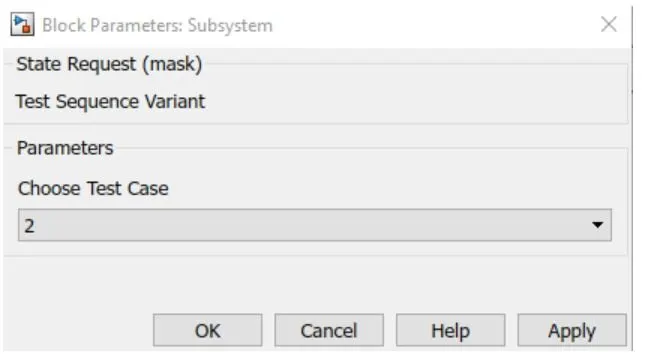

the driving stage is for 0 to 10000 seconds. then charging stage occur.
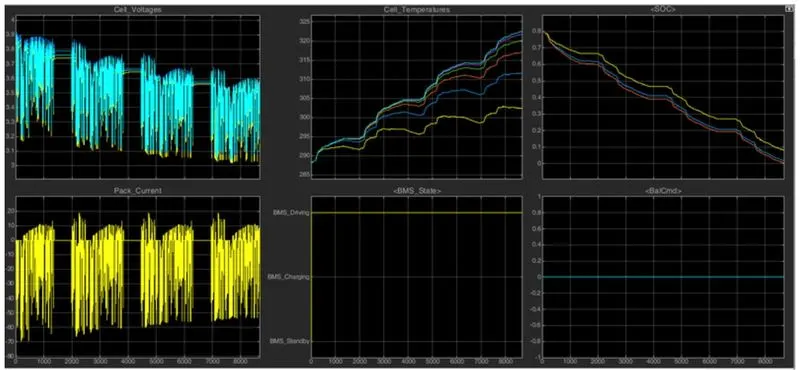
From the above graph , a fault condition occured in second case. So even after charging was started, the soc didnt increase. It continue to decrease.
3) Now by changing the test Sequence Value to 3
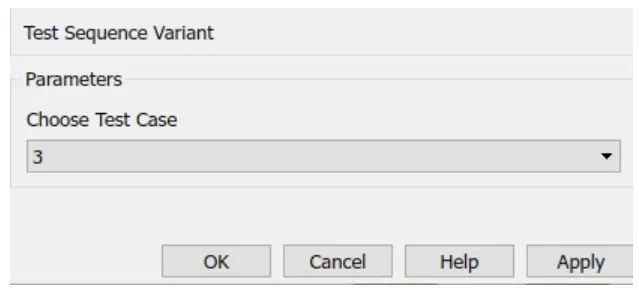
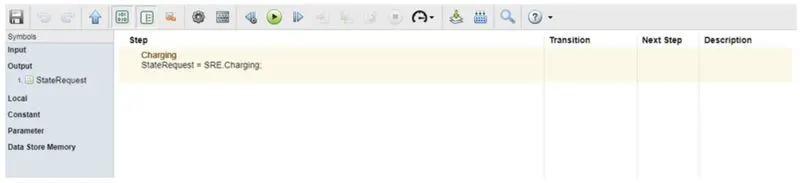
This condition has only one phase and that is charging.Thus 0 to 20000 seconds simulation runs.
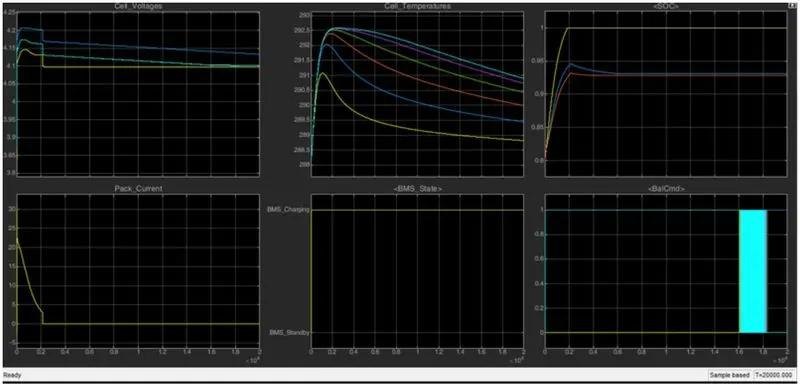
Results:-
Here all the indicators are green. So we can sec no errors and we check the plot for this model and is shown below.
• Here we can see that the soc reached 100% in charging and remained in stand by mode. Cell temperature also decrased when standby mode was acheived.
From the 3 cases we observer that only charging takes place thus SOC was 80% at first , then SOC increases to 100% in 2000 seconds then SOC remains constant at 100%.
2.What is coulomb counting? Refer to the above model and explain how BMS implements coulomb counting for SOC estimation ?
Rechargeable batteries are becoming an integral part of the future energy strategy of the globe. The use of rechargeable batteries is steadily on the rise in wide-ranging applications, such as electric vehicles, household equipment, robotics, power equipment, consumer electronics, aerospace, and renewable energy storage systems. Accurate estimation of a battery’s state of charge (SOC) is crucial for battery management that is safe, efficient, and reliable [1–4]. It was found that there are three different methods for the SOC estimation of the lithium–ion battery [5]:
(i) The current-based method.
(ii) The voltage-based method.
(iii) The fusion of voltage/current-based approaches. The fusion-based approaches seek to retain the benefits of both voltage-based and current-based approaches by employing non-linear filters, such as the extended Kalman filter, in order to fuse the information obtained through the voltage and current measurements. The voltage-based SOC estimation approach is basically a table look-up method. Battery terminals’ voltage is matched with the SOC according to the OCV-SOC characterization curve [6]. In more generic terms, we have the following:
voltage-measurement = f(SOC) | {z } OCV-SOC model + g(parameters, current) | {z } voltage drop
(i) OCV-SOC modeling error. The OCV-SOC relationship of a battery can be approximated through various models [6]: linear model, polynomial model and combined models are a few examples. Reducing the OCV-SOC modeling error is an ongoing research problem—in [11], a new modeling approach was reported that resulted in the “worst case modeling error” of about 10 mV.
It must be mentioned that the OCV modeling error is not identical in all voltage regions of the battery.
(ii) Voltage-drop modeling error. Voltage-drop models account for the hysteresis and relaxation effects in the battery. Various approximations were proposed in the literature in order to represent these effects [7,12].
(iii) Voltage measurement error. Every voltage measurement system comes with errors; this translates into a SOC estimation error. In order to reduce the effect of uncertainties in voltage-based SOC estimation, it is often suggested to rest the battery before taking the voltage measurement for SOC lookup [9]—when the current is zero for sufficient time the voltage-drop also approaches zero. However, all the other sources of errors mentioned above (OCV-SOC modeling error, hysteresis, and voltage measurement error) cannot be eliminated by resting the battery. Coulomb counting method is the well-known term that is used for the current-based method [9].
In this method, SOC can be calculated as the ratio between the remaining Coulombs and the battery capacity that is assumed to be known. The Coulomb counting approach to SOC estimation can be approximated as follows
SOC(k) = SOC(k − 1) + ∆k i(k) 3600Cbatt (2) where SOC(k) indicates the SOC at time k, ∆k is the sampling time, i(k) is the current through the battery at the at time k, and Cbatt is the battery capacity in ampere hours (Ah). The Coulomb counting method does not require offline OCV-SOC characterization [6]; however, it is susceptible to the following sources of errors:
1. Initial SOC: This methods requires initial SOC to start with.
2. Current measurement error: The measurement error will affect the computed SOC.
3. Current integration error: The Coulomb counting method uses a very simplified approximation to integration, which will result in errors.
4. Uncertainty in the knowledge of battery capacity [13]: Battery capacity changes due to temperature, age, etc. [14,15]. The uncertainty in battery capacity will affect the SOC computed by the Coulomb counting method.
5. Timing oscillator error: Any error in the timing oscillator will affect the computed SOC. The fusion-based approach seeks to retain the best features of both voltage and currentbased
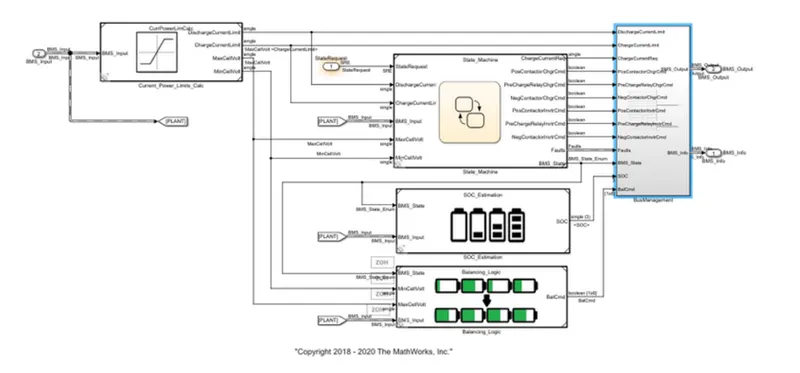
For example we can look into the project file we downloaded. A BMS system in the file is represented below.
BMS algorithm models . protects , reports the measurement from battery pack.
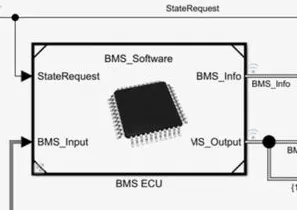
By Clicking on the BMS ECU we get the Subsystem
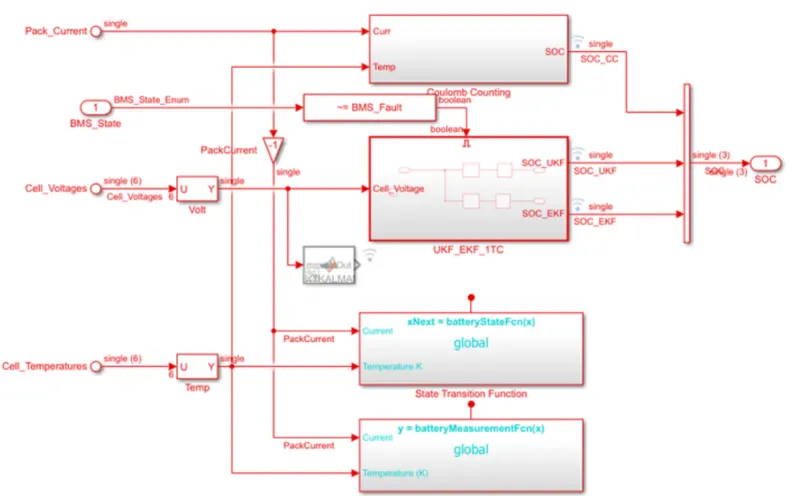
By clicking on the SOC estimation block we get
A subsystem opens when we click on the Coulomb Counting
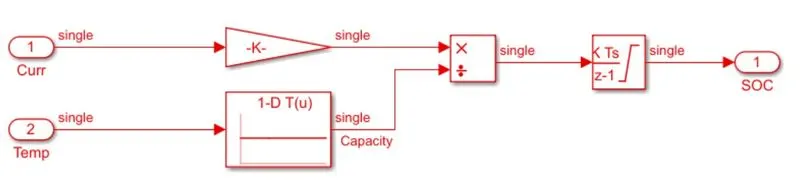
It accepts two input signals: current and temperature, with the current signal going to the gain block and the temperature signal going to the battery time and current lookup tables. Both blocks are linked to the split block. and these signals are sent to the discrete-time integrator to track the charge, which then aids in the calculation of the state of charge.
The positives of this are its simplicity and cheap capital cost. while the disadvantages include a buildup of current sensor error and its inability to recover from the erroneous start condition. due to a lack of voltage measurement feedback
• This system does the estimation by coulomb counting equation mentioned above.
• Advantage of coulomb counting method is its simplicity and low computational cost.
• Temperature and current from the battery is given as inputs.
• Current signal is given to a gain block and temperature is given to capacity since it varies according to temperature.
• These inputs are given for integration where current will be integrated with respect to time.
• This outout is given to another block where it is divided by capacity.
• Hence the SOC is estimated.