Week 7: Shock tube simulation project
Introduction
Main goal of this challenge is to simulate shock tube problem, to see what happens when diaphragm is ruptured in the shock tube channel and to capture how the flow will be induced. Furthermore, we intend to understand how the "Events" work in "Converge Cfd".
Theory
The shock tube is an instrument to direct blast waves at a sensor or a model to simulate actial explosions and their effects. shock tubes, for instance, are used to study aerodynamics under a wide range of temperatures and pressures, also it is used to see compressible flow phenomena and gas phase combustion reactions. Recently, this devise is used in biomedical research to investigate how biomedical speciments are affected by blast waves.
A shock wave inside a shock tube could be generates by a little explosion (blast-driven) or by high pressure which causes a diaphragm to rupture (compressed-gas driven)
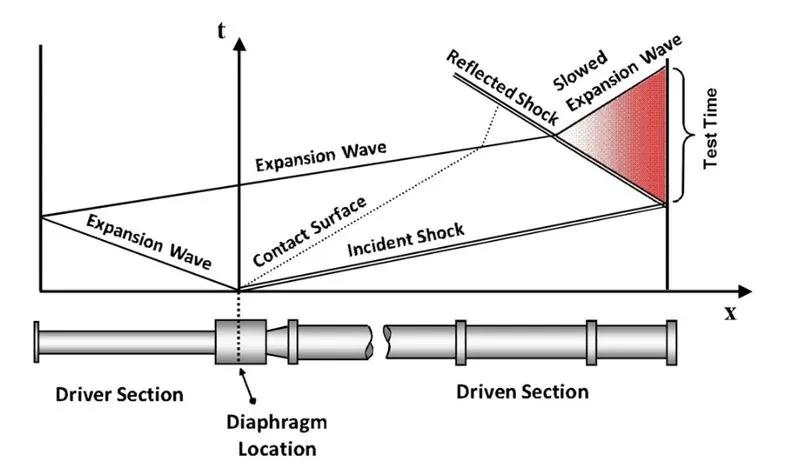
A simple shock tube is rectangular or circular in cross-section made of metal, in which low pressure and high pressure gas regions are separates by a diaphragm.
Low pressure gas region is called "driven", which is subjected to the shock wave. High pressure gas region is known as a "driver". The driver gas is usually chosen with low molecular weight (e.g Helium or Hydrogen) for safety reasons, but using these substances may slightly diluted to interface conditions across the shock. To achieve strongest shocks, pressure of the driven gas is well below to atmospheric pressure.
To start operating of the shock tube we need to rupture the diaphragm.
there are some methods bursting the diaphragm.
- A mechanically-driven plunger or explosive charge.
- Another way is to build up enough pressure in high pressure region to burst the diaphragm.
Exploding the diaphragm induses pressure waves, each increasing the speed of sound behind them. This shock wave increases pressure and temperature of the driven gas and produces a flow in the direction of the shock wave but at a lower velocity than the lead wave, Immediately, a rarefaction wave occurs, which is referred to as a Prandtl-Meyer expansion waves. This wave travels back to the driver gas region.
PROCEDURE :-
First of all Open Converge and upload the File (drag or drop ) the file and assign the boundaries.
Then setup the case as per given below : -
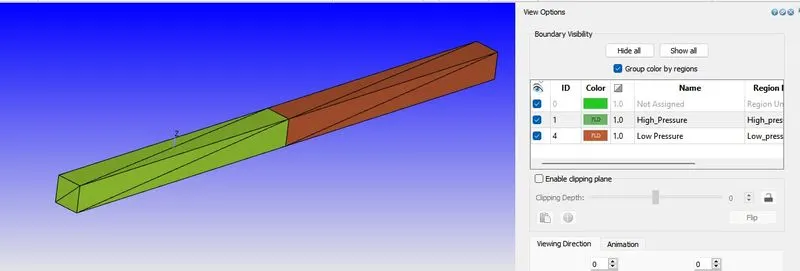
As we can see that we have two region : The green one is High pressure and the brown one is the Low pressure zones, which are seperated from each other.
CASE SETUP :-
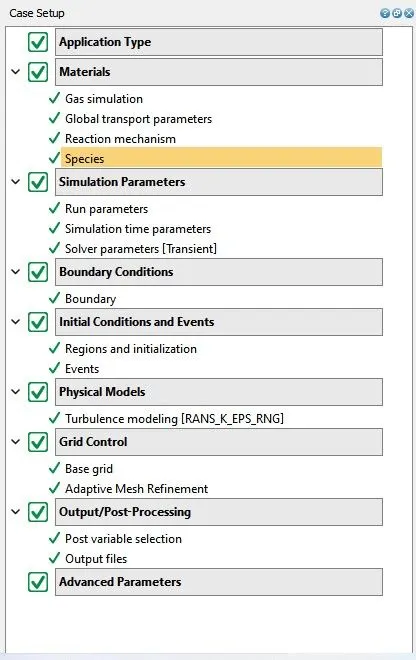
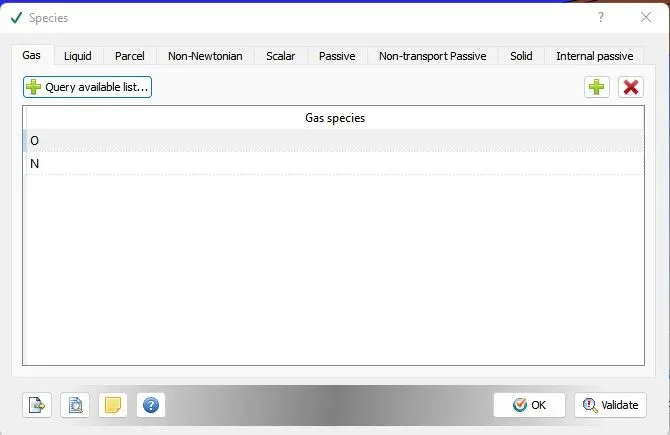
Species :
Run Parameters :-
Our case is Transient Full hydrodynamic compressible flow
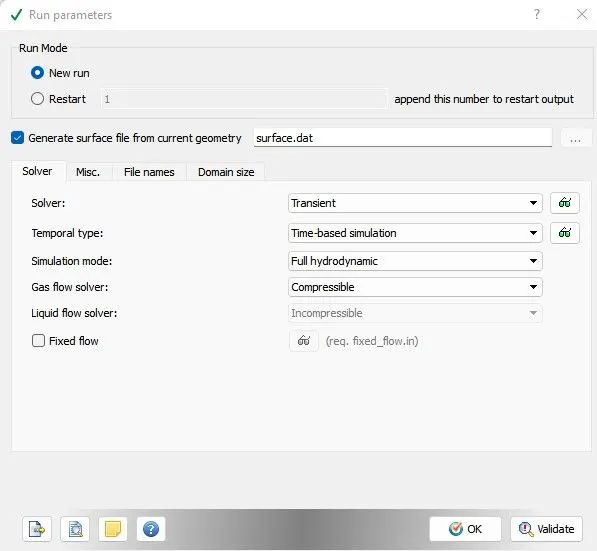
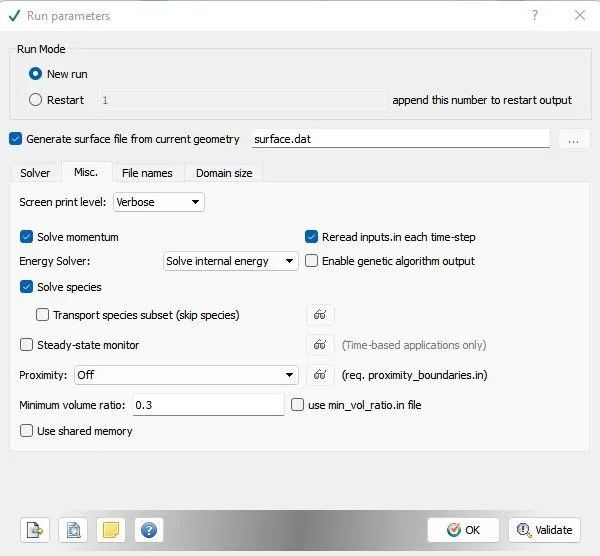
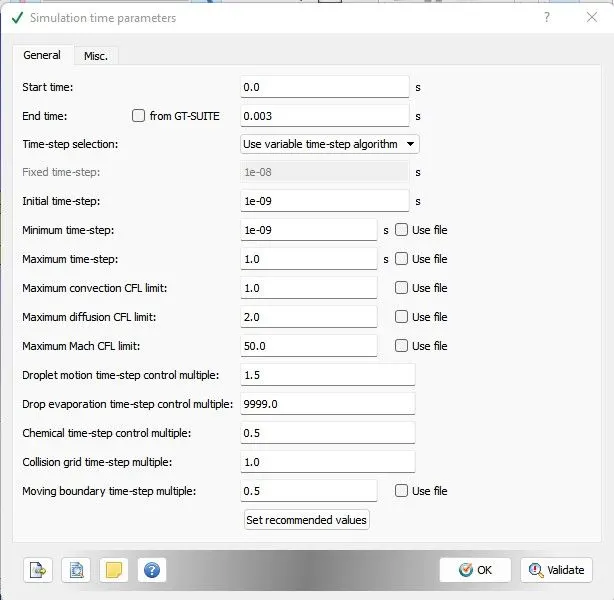
Simulation Time Parameters :-
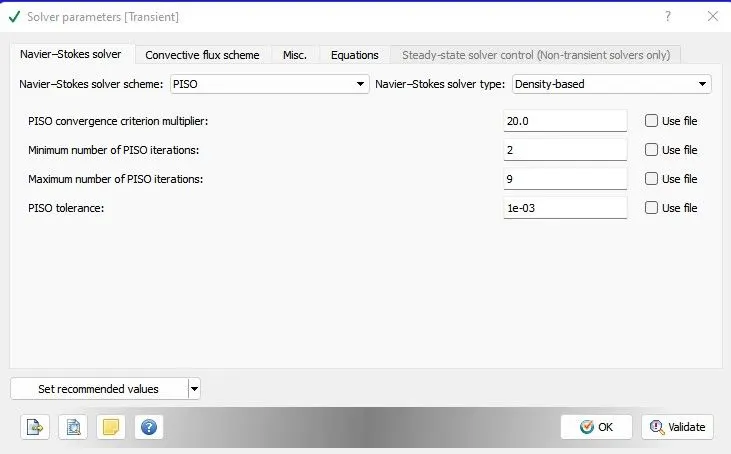
Solver Parameters [Transient]
Boundary :-
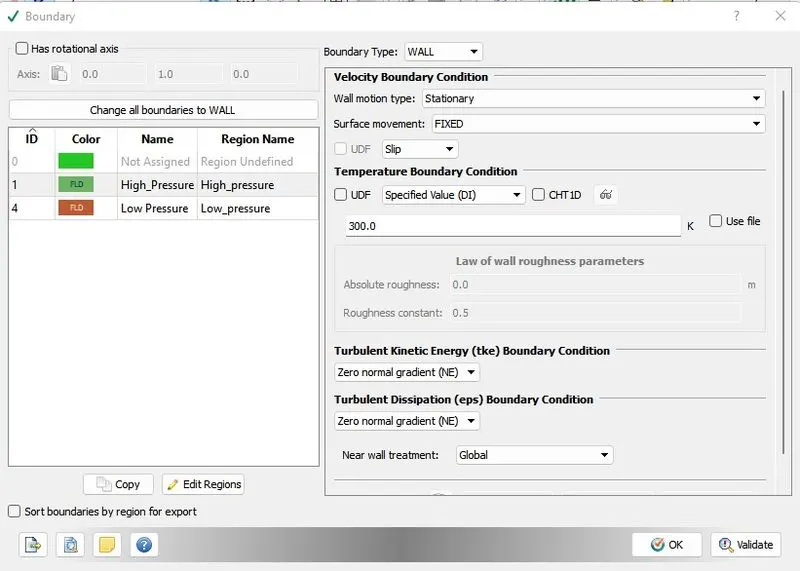
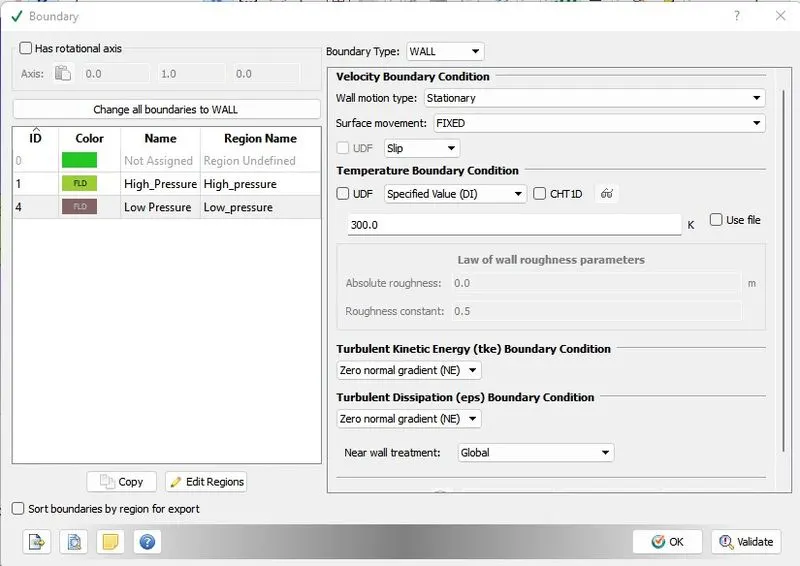
Region and Initialization :-
In High pressure zone we have N2 with the mass fraction of 1 and in the Low pressure region there is O2 with the mass fraction of 1 as well.
And in High pressure zone Initial pressure is set to be 6 bar and in the low pressure zone it is an atmospheric pressure (1bar)
Events :-
In order to eliminate seperation between the high pressure and the low pressure zones are use 'Events' in order to imitate(copy) a diaphragm explosion.
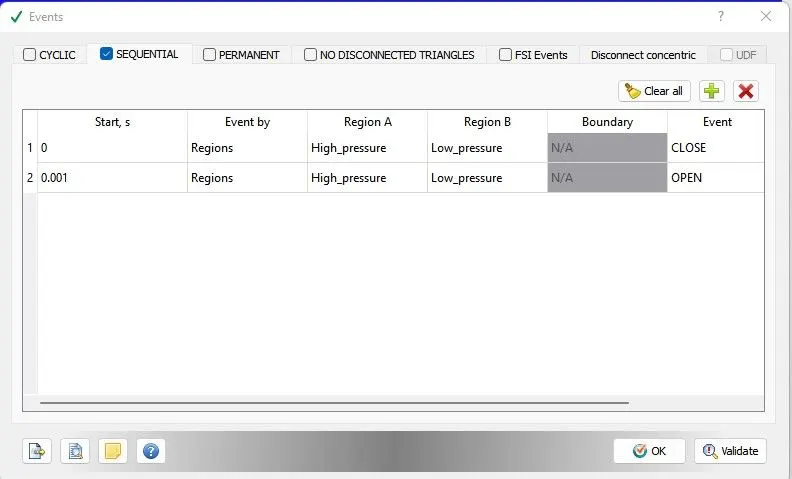
As we see at the begining of the simulation pressure zones are seperates and when time reaches to 0.001 sec. the "virtual diaphragm " is Opened.
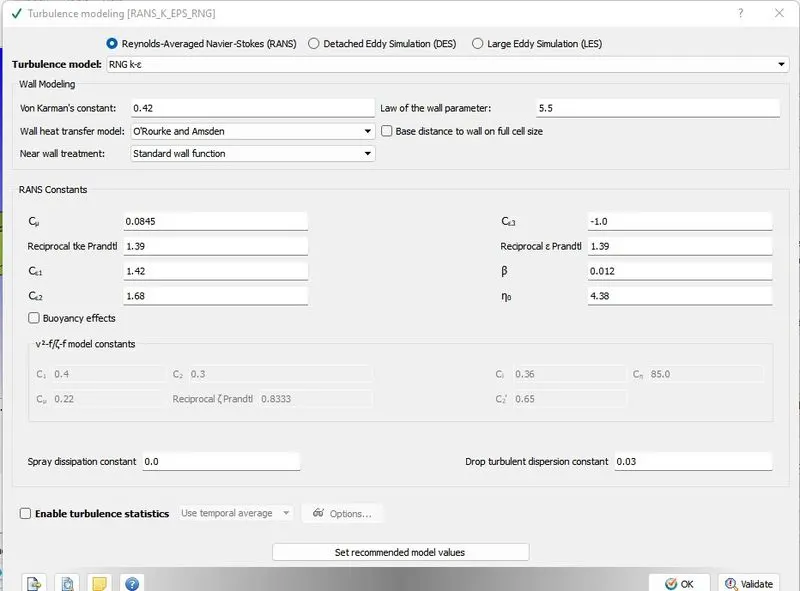
Turbulence Modelling :-
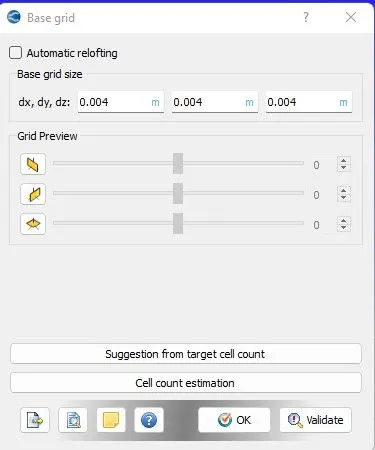
Base Grid :-
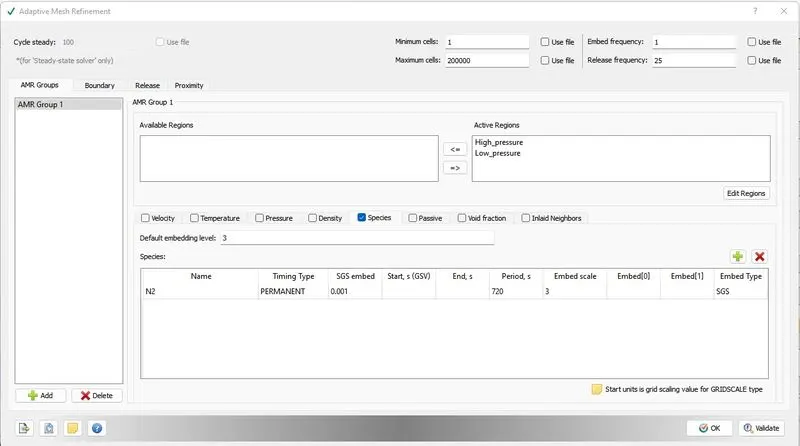
Adaptive Mesh Refinement :
In order to accurately capture mixing process we are using adaptive mesh refinement (AMR)
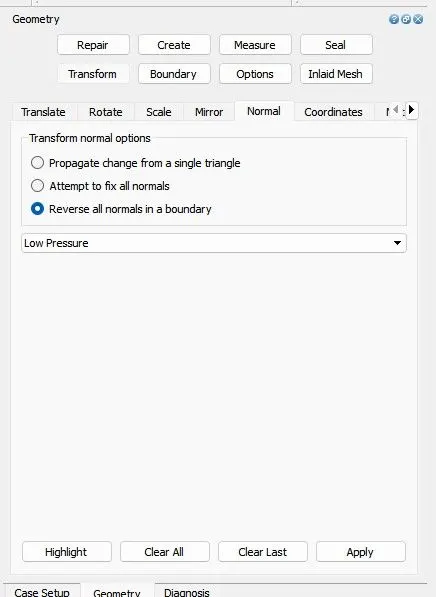
After setup the case check out the diagnosis and check the arrow must be in the inward direction of the geometry if they are in the outwrad direction
Go to geometry ---> Transform --> Normal --> Reverse all normal in the bounadry and select the region of HP and LP and select the figure and then they goes to inward.
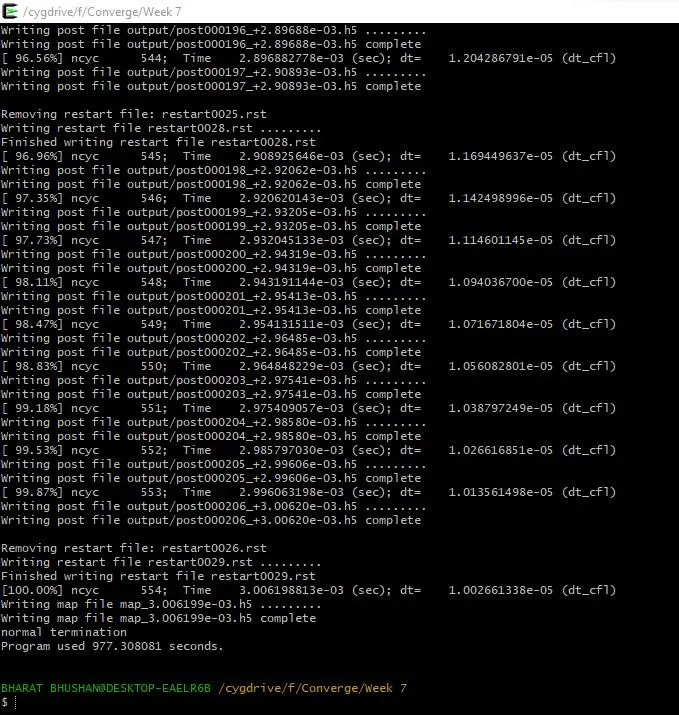
Now, export the files to the destination folder and copy the 2 files such as Converge and mpiexe. from the C drive (where we installed Converge software) and put into the folder where we export the input files .
So Go to CYGWIN and Run the Simulation with the help of Commmand name " mpiexec.exe -n 3 converge.exe restricted "
Again go to Converge and run the post processing as per given setup
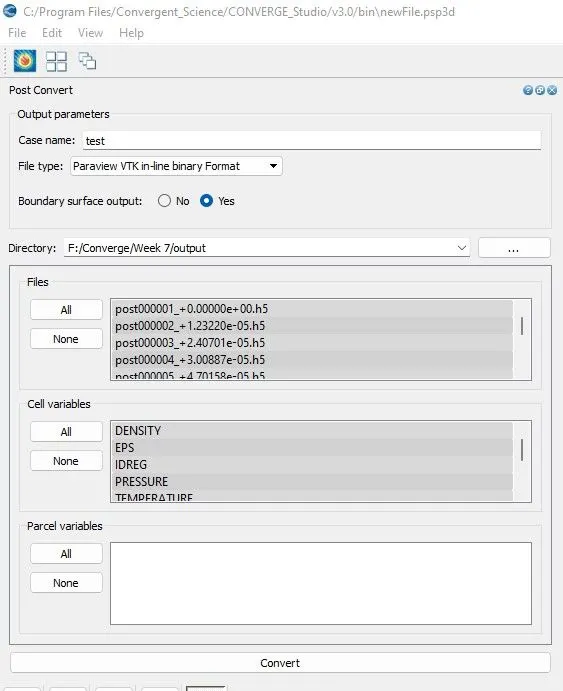
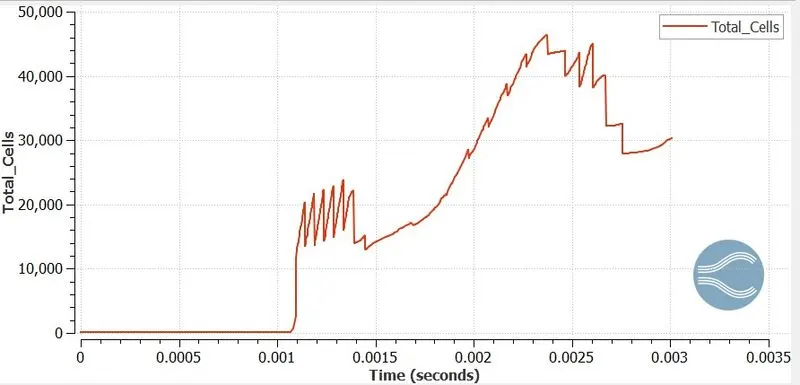
After completion of post processing left swipe click by mouse here we can see plotting window ,here plot the graph of Total cells as function of time as given below :
TOTAL CELLS
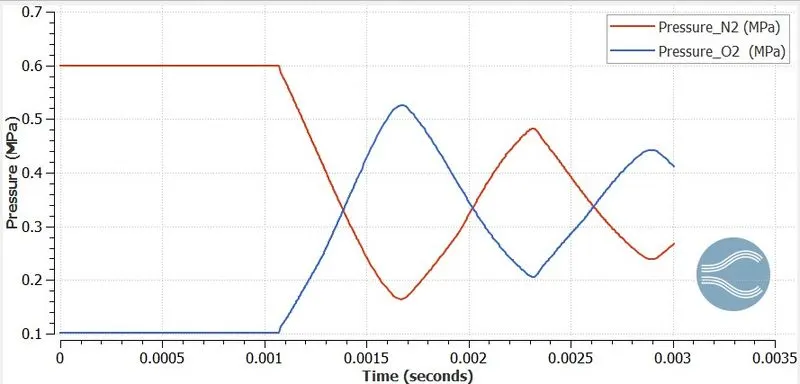
PRESSURE PLOT
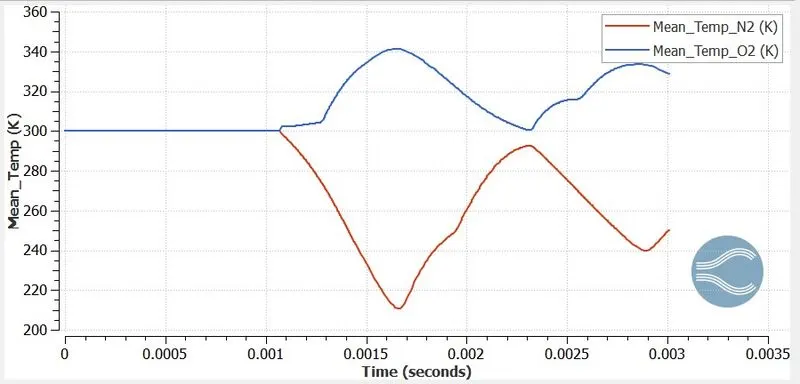
MEAN TEMP. PLOT
Now, i will shift my mouse to PARAVIEW Application to launch Contour's and Animation's .
CONTOURS :-
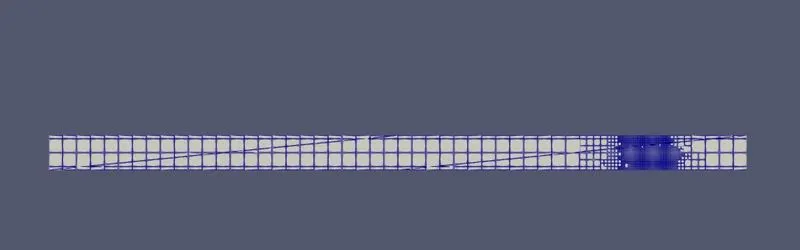
Surface with Grid
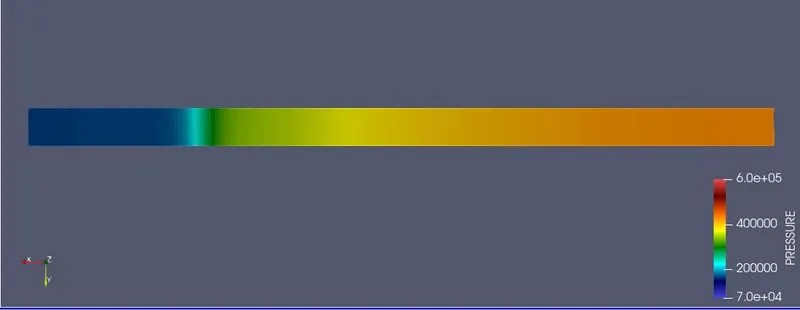
Pressure Contour
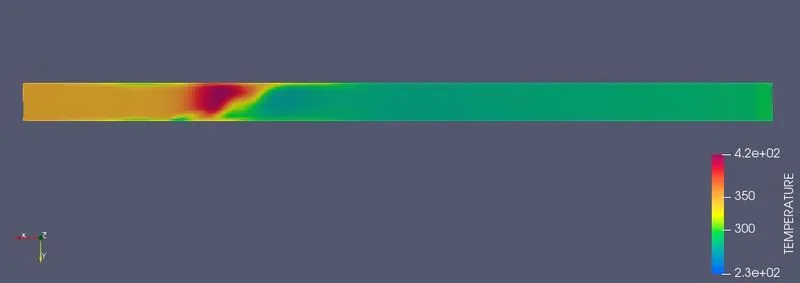
Temperature Contour
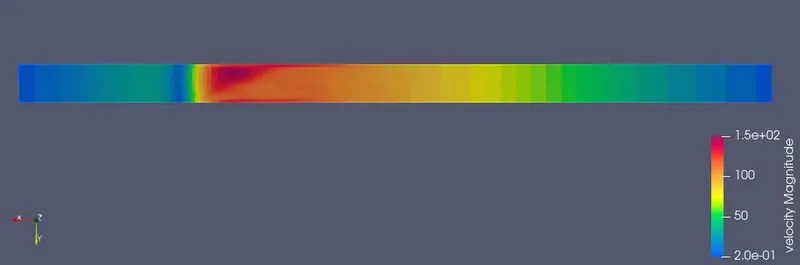
Velocity Contour
ANIMATIONS :-
Temperature_Animation
Pressure_Animation
Velocity_Animation
Velocity Animation with Array
Conclusion:
- High-Pressure N2 gas compresses the low-pressure O2 then after some compression a recirculation takes places and the low-pressure gas passes the N2.
- From this problem, we can understand the compressibility of gas and study the flow.
- Due to adaptive mesh refinement, the cell count is varying all the time when the expansion and contraction are taking place inside the shock tube.
- From the pressure plot, it can be concluded that after some time both the species will have common pressure as one pressure is increasing and the other is decreasing wrt time.
- The temperatures first fluctuate then will attend the equilibrium position after some time.
- The process of generation of shock and expansion waves continues till the pressure difference in the domain dies out.
- Moreover, the shock increases the temperature, and the expansion wave decreases the temperature.
References
https://www.grc.nasa.gov/WWW/wind/valid/stube/stube.html
https://www.thermopedia.com/content/1124/
Google drive link :
https://drive.google.com/file/d/1wvtDz9lK6anS6-I8mUYyjBLFwFkAKisQ/view?usp=sharing