Week 7-Long Piston With Cam
Long Piston with Cam Assignment
Objective
Transient Structural Analysis is performed on a Long Piston and Cam model for different contact conditions. The objective here is to understand the difference in the behaviour of the Piston and Cam for different contact conditions.
Design Model and Meshing
There are 3 main bodies in the model – barrel, cam and follower. The barrel and cam are modelled as rigid bodies.
Fixed joint is defined for barrel
Revolute Joint for Cam
Translational Joint between barrel and follower
Models is meshed finer to element size of 3mm on the contact faces.
Analysis
The transient analysis is performed using the 9 step incremental joint rotation on the cam
The different cases are for different contact conditions keeping the geometric properties and the rotation as same.
The results are as shown below and tabulated after the snapshots
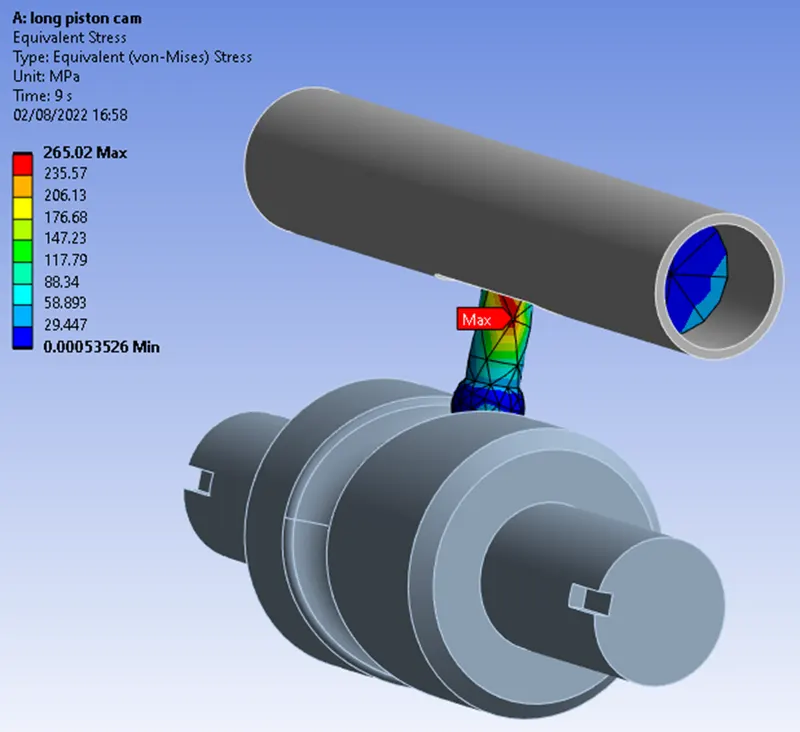
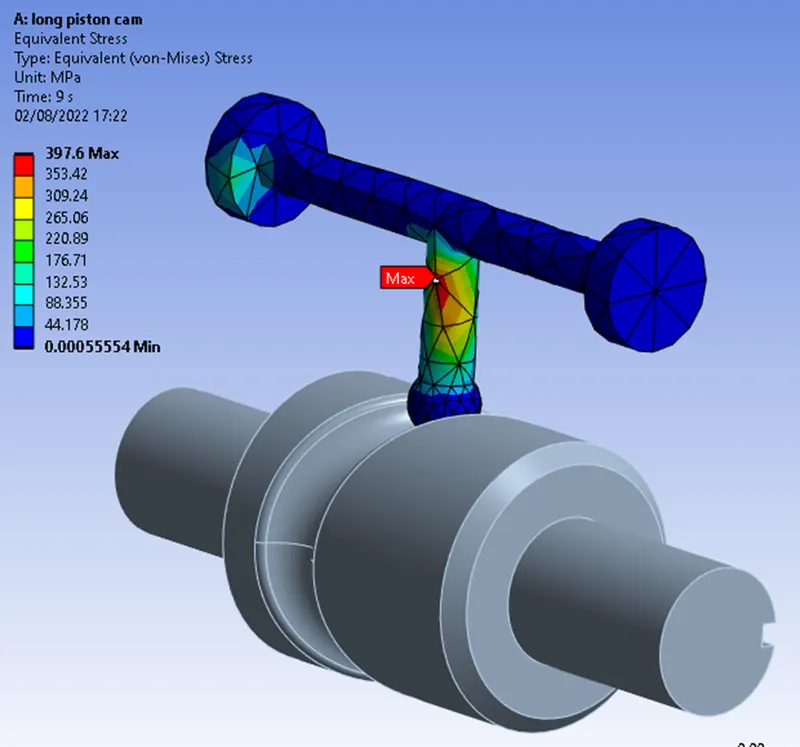
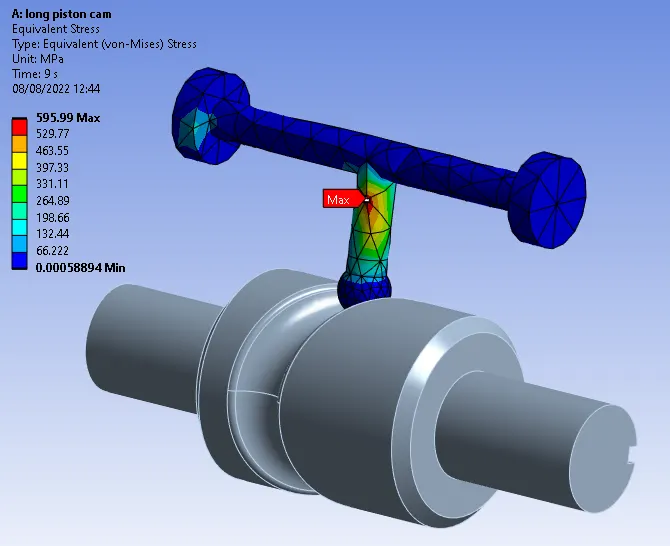
- Equivalent Stress
Case 1 – Frictionless Contact
Case 2 – Frictional Contact – 0.1 as friction coefficient
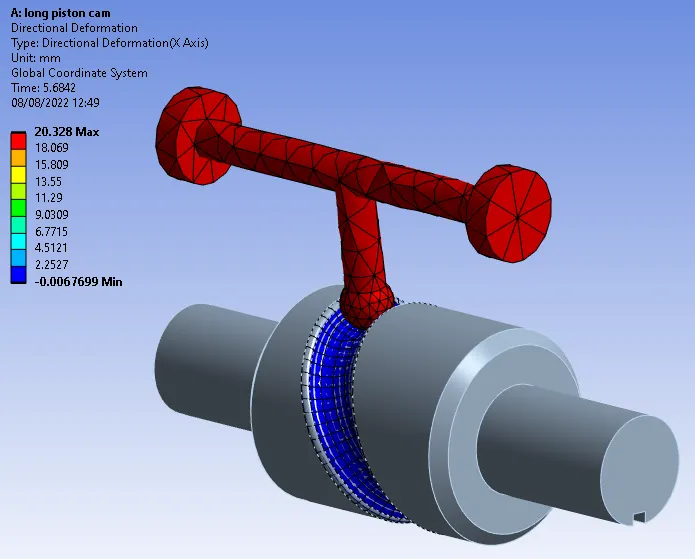
Case 3 – Frictional Contact – 0.2 as friction coefficient
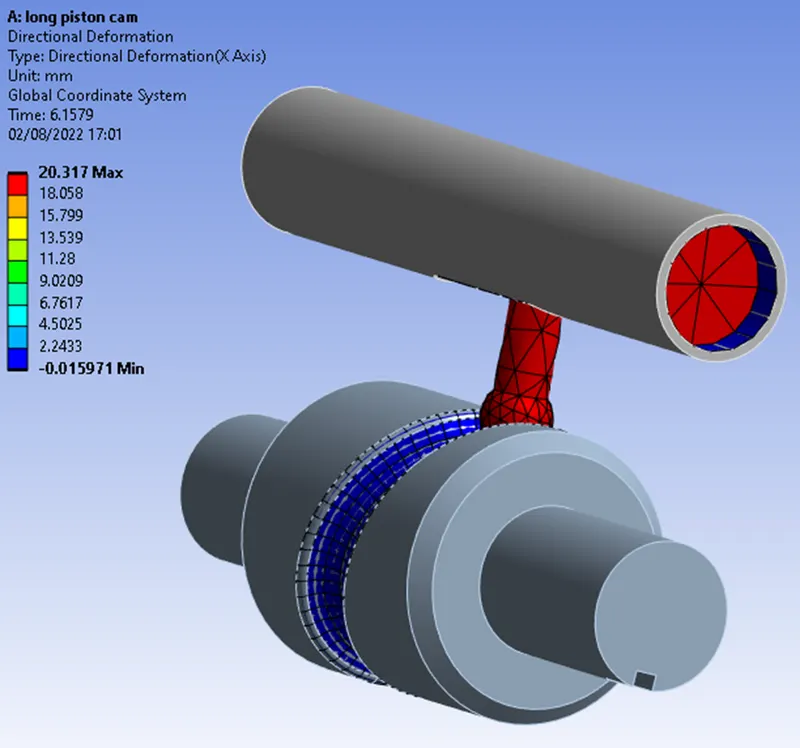
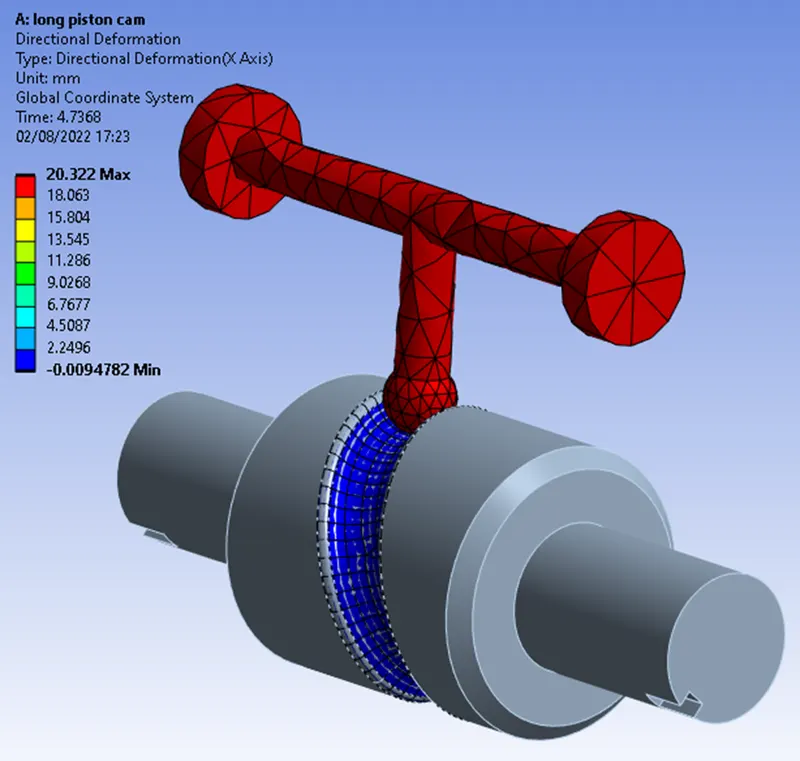
- Directional Deformation
Case 1 – Frictionless Contact
Case 2 – Frictional Contact – 0.1 as friction coefficient
Case 3 – Frictional Contact – 0.2 as friction coefficient
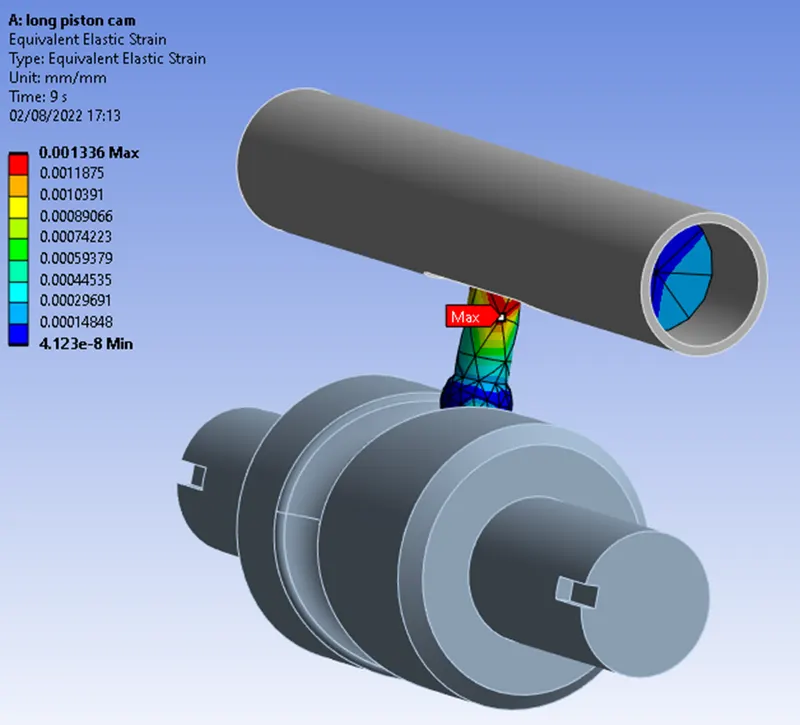
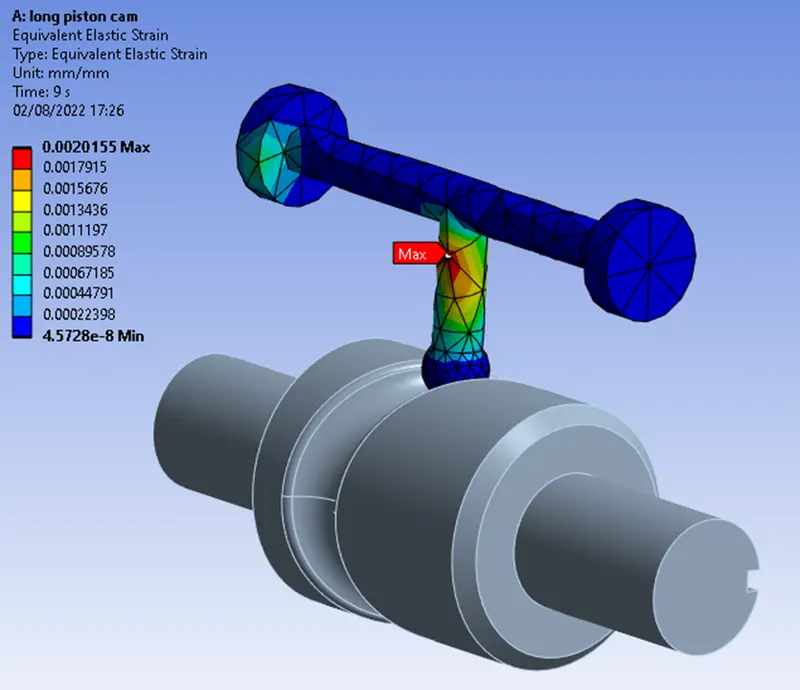
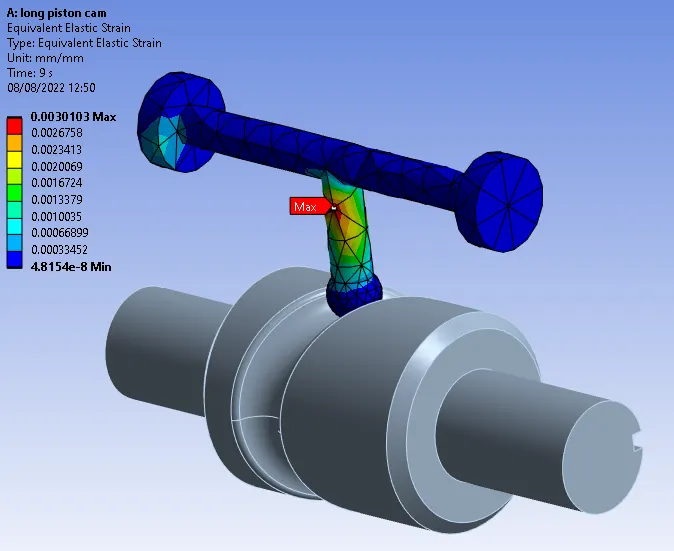
- Equivalent Elastic Strain
Case 1 – Frictionless Contact
Case 2 – Frictional Contact – 0.1 as friction coefficient
Case 3 – Frictional Contact – 0.2 as friction coefficient
Results and Conclusion
|
Simulation Cases |
Max. Equivalent Stress (MPa) |
Max. Equivalent Strain |
Max. X Direction Deformation (mm) |
|
Frictionless Contact |
265.02 |
0.00133 |
20.317 |
|
Frictional Contact - 0.1 Frictional Coefficient |
397.6 |
0.002 |
20.322 |
|
Frictional Contact - 0.2 Frictional Coefficient |
595.99 |
0.003 |
20.328 |
- The frictionless contact between the cam and the piston follower produces the lowest stress in the piston, as the frictional contact coefficient becomes higher the stress in the piston follower increases.
- The frictionless contact between the cam and the piston follower produces the lowest strain in the piston follower, as the frictional contact coefficient becomes higher the strain in the piston follower increases.
- The above implies it is always advisable to have lubricated contact surface between piston follower and cam to generate frictionless contact and keep the stresses within the allowable limits.
- The deformation of the piston is fairly consistent for all the 3 contact simulation cases as the cam is rotated through 360 degrees.