Week-7 Head Impact
AIM:
To perform the Head Impact Simulation and calculate the Head Impact Criterion (HIC) value for the following cases,
i) Simple head model impacting against rigid wall.
ii) Child headform dummy model impacting against rigid wall.
iii) Child headform dummy model impacting against hood.
THEORY:
Pedestrain protection CAE is a part of vehicle saftey engineering from a crash perspective. In pedestrain protection, we look for imparting minimum injury to head, upper leg and lower leg in case of an accident with a human subject.
These tests are usually done at a lower velocity from 20-40 kmph as accidents tend to result in more severe circumstances above these velocities and braking in case of an accident often results in collision at low velocities.
Head Injury Criterion is a quantification of head injury. A small HIC value doesn't mean that the head injuries will be of low levels. The HIC is the maximum value over the critical time period t1 to t2 for the expression.
HIC = max(t1,t2){[1/t2-t1∫a(t)dt]^2.5 (t2-t1)}
HIC(d) = 0.75446 + 166.4
At HIC = 650
Abbreviated Injury Scale:
1.Slight damage to brain with headache,dizziness,no loss of consciosness, confusions.
2.Concussion with or without skull fracture less than 15 minutes of unconsiousness, detached retina, face and nose fracture.
3.Multiple skull fracture with severe neurological damage.
PROCEDURE:
CASE-1 (Simple Head Model Impacting against Rigid wall):
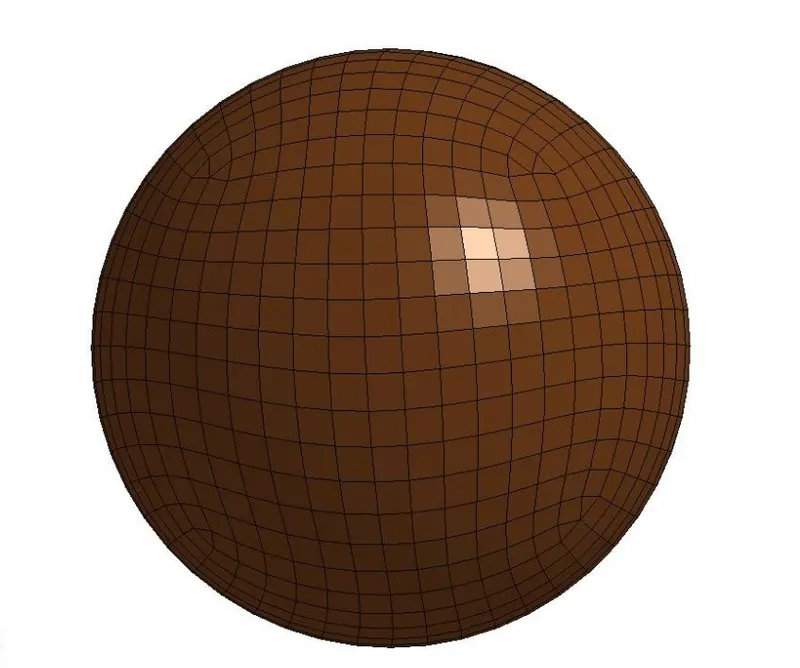
1.Import the given model.
PART DEFINITON:
Section Properties:
1.The section properties of simple head are assigned as shell element with 2.5 mm thickness and ELFORM=2.
Material Properties:
1.MAT24 material card is used to assign the steel material properties to the simple head model. The MAT24 represent piecewise linear isotropic plasticity. With this material model it is possible to consider the effect of the strain rate.
Boundary Condition:
Initial Velocity:
1.The simple head model is assumed to be impacting the rigid wall at a velocity of 40kmph i.e 11.1 mm/ms in negative z-direction towards rigid wall.
Rigid Wall Planar:
1.The rigid wall is created at a distance of 15mm from the bottom of simple head model.
Control Function:
1.The control termination function is enabled to specify the end time of simulation. The termination time is set for 20ms.
Database Options:
1.The keyword file is created is checked for errors using the option Keyword manager > Model check. The keyword file is saved using .k extension.
Case:2(Child Headform dummy model impacting against rigid wall):
Part Definition:
1.Import the model.
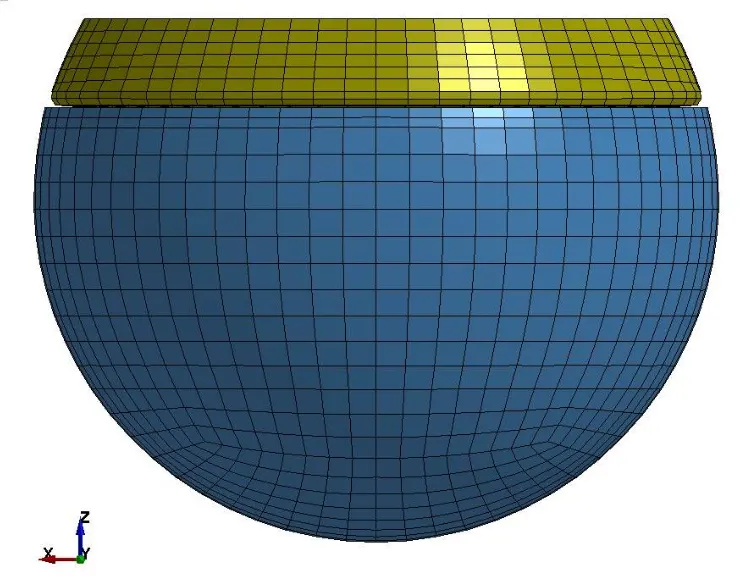
2.The provided standard dummy model of child headform has to be rotated about 50 degree along y-axis to replicate the Euro NCAP impact simulation.
3.Using Define_Transformation card with TRANID=1 the dummy headform model is rotated by option > Rotate along y-axis by 50 degree.
4.Include transform card is used to pull the rotated standard dummy headform model file to the main file.
Boundary Condition:
Initial Velocity:
1.The initial velocity is taken as 40 kmph i.e, 11.11 mm/ms at an angle 50 degree. The vertical and horizontal components of the velocities are -7.14 mm/ms and -8.51 mm/ms respectively.
2.The rigid wall is created at a distance of 15mm from the bottom of standard dummy headform model.
Control function:
1.The termination is set for 20ms.
Database Option:
1.The keyword file created is checked for errors using the option keyword manager > model check. The key word file is save to main file.
Case-3(Child Headform Dummy Model Impacting Against Hood):
Part definition:
Section Property:
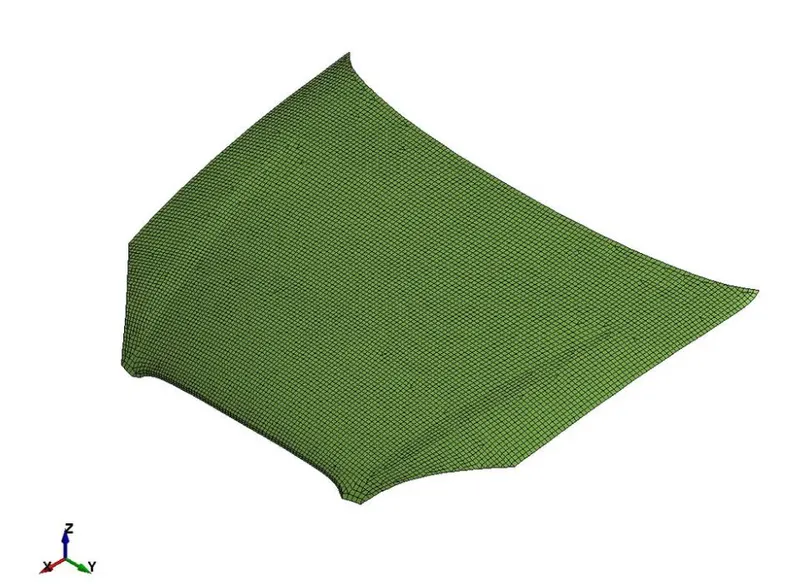
1.The section property of hood are assigned as shell element with 1.5 mm thickness and ELFORM =16, Fully integrated shell element.
Material Properties:
1.The MAT24 represent piecewise linear isotroppic plasticity. With this material model it is possible to consider the effect of strain rate.
Boundary Condition:
Initial Velocity:
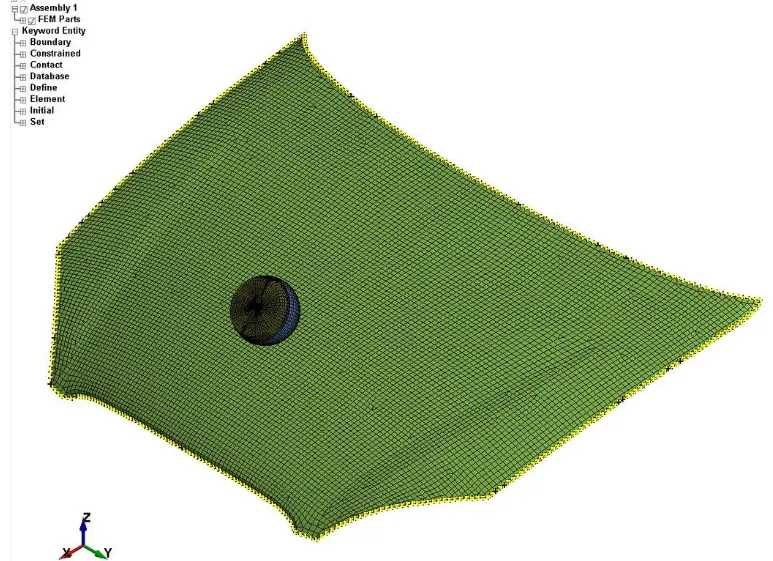
1.The initial velocity is taken as 40 kmph i.e, 11.11 mm/ms at an angle 50degree. The vertical and horizontal components of the velocities are -7.14 mm/ms and -8.51 mm/ms respectively.
Control and Database Options:
1.The keyword file is created is checked for errors using the options keyword manager > model check. The keyword file is saved to main file.
OUTPUT:
1.Von-mises stress and effective plastic strain contour:
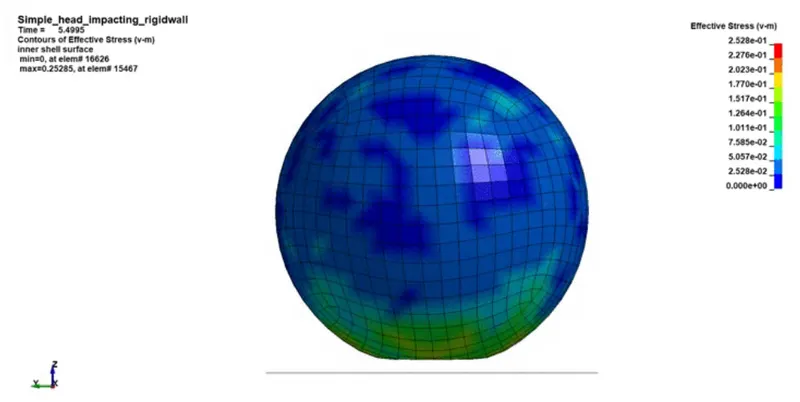
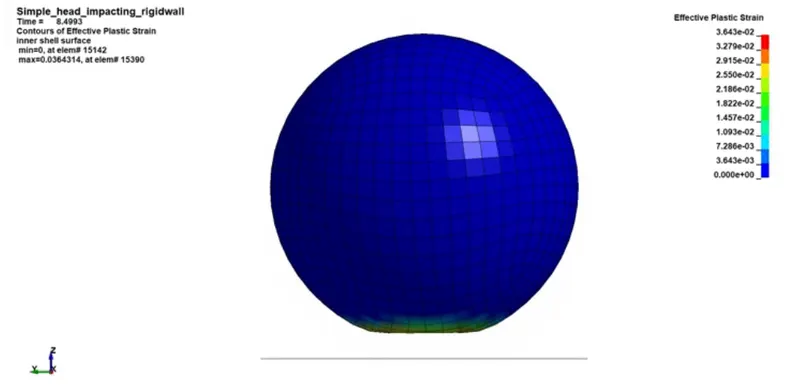
Case-1:
i)v-m stress contour:
ii)Effective plastic strain contour:
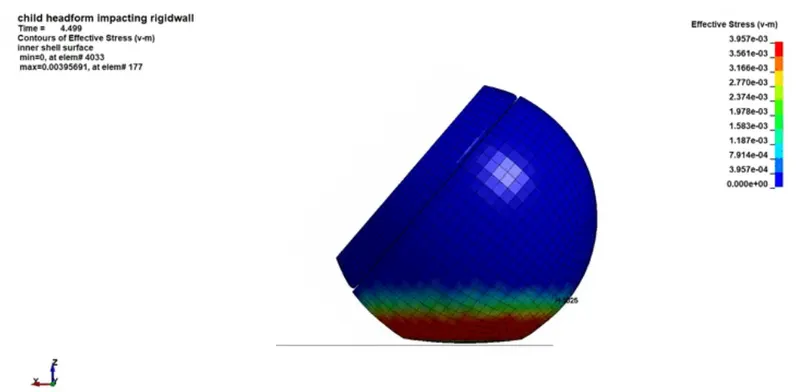
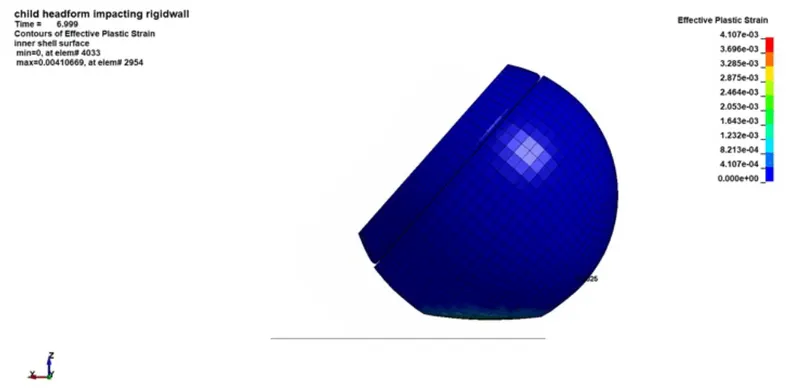
Case-2:
i)v-m stress contour:
ii)Effective plastic strain contour:
Case-3:
i)v-m stress contour:
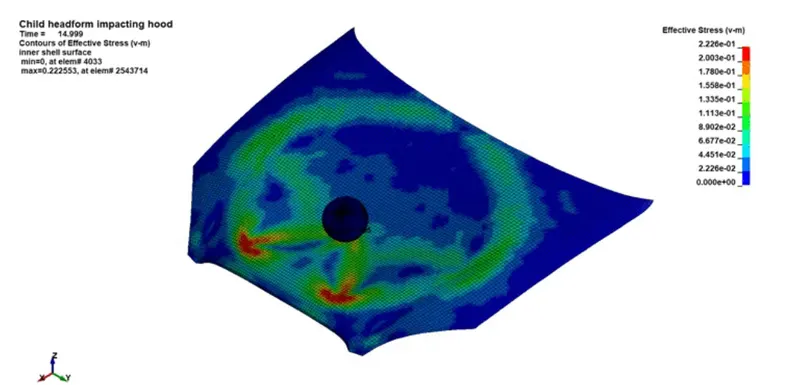
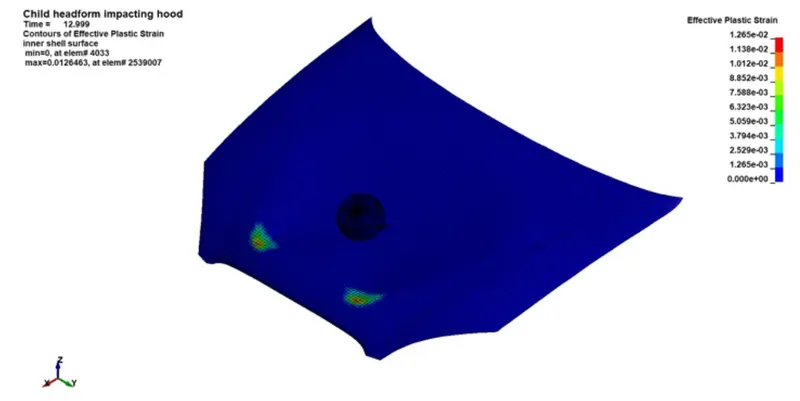
ii)Effective plastic strain contour:
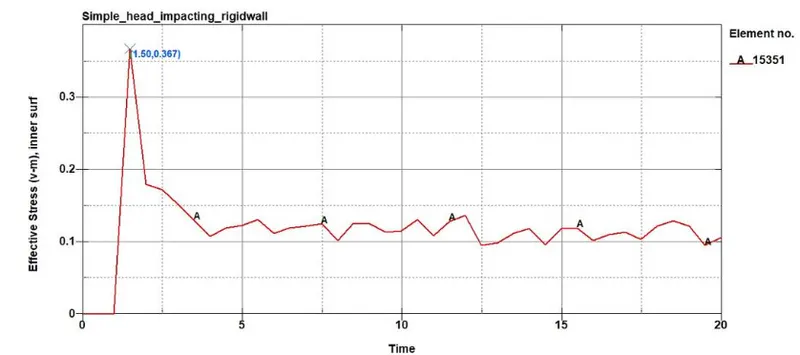
2.Stress Plots:
Case-1:
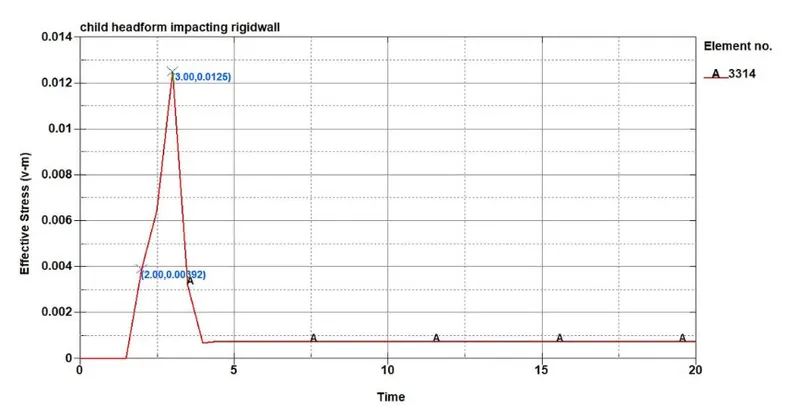
Case-2:
Case-3:
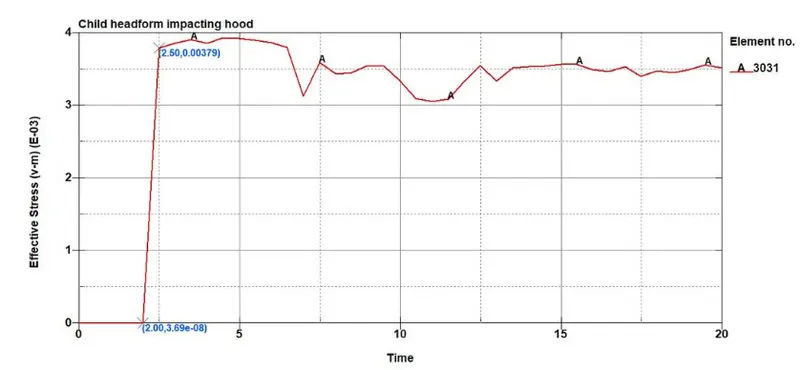
1.For the first case, during the instant of impact the maximum v-m stress developed is 3.672 MPa in the element 1535 which is beyond the yield stress value of 355MPa.
2.For the second case,during the instant of impact the maximum v-m stress developed is 3.916 MPa in the element 3314and reaches a peak value of 12.5MPa at 3ms and later the value of v-m stress reduces due to the bouncing back of the headform from rigid wall.
3.For third case, during the instant of impact the maximum v-m stress developed is 3.793 MPa in the element 303 and later it fluctuates steadily until the headform bounces back from the hood.
3.Head Injury Criteria:
Case-1: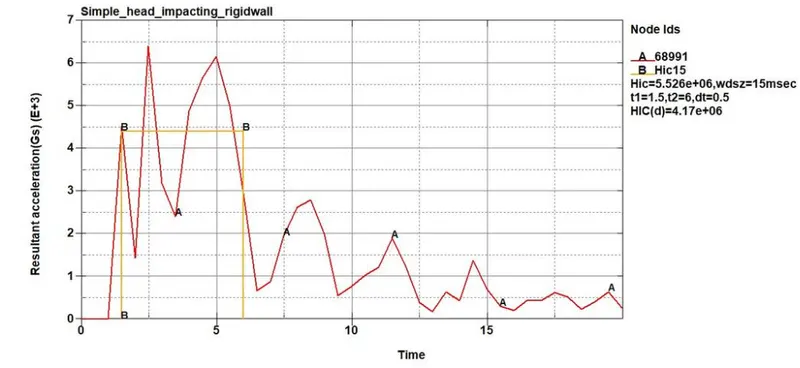
Case-2:
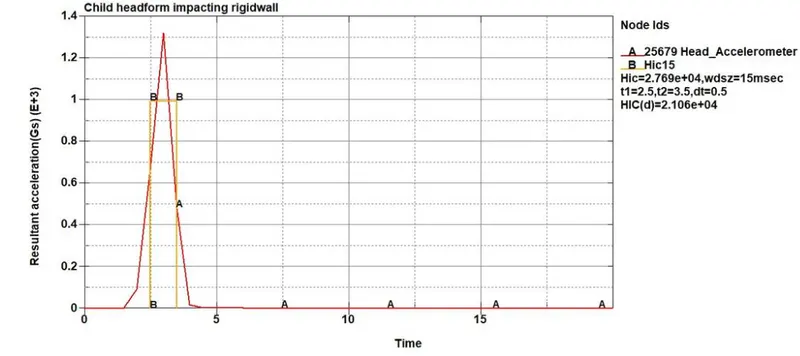
Case-3:
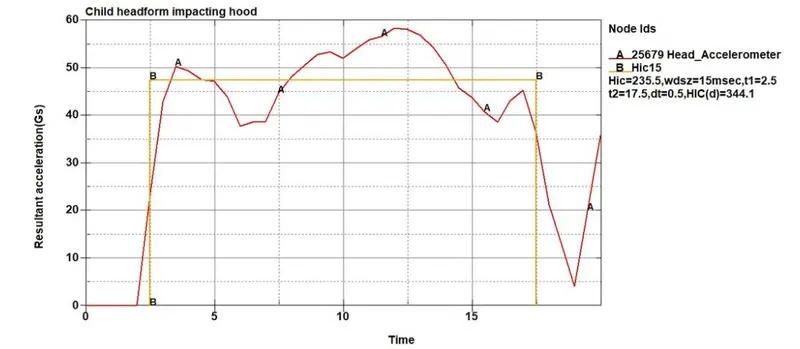
The value obtained from the third case is 235.5 and HIC value is 344.1 which is less than the safe HIC value of 650.
Calculation of HIC VALUE:
HIC = max(t1,t2){[1/t2-t1∫a(t)dt]^2.5 (t2-t1)}
From the plot,
The average value of acceleration for the time interval of t1=2.5ms and t2 = 17.5 ms is [1/t2-t1∫a(t)dt]^2.5 = 48.
Therefore, Hic = 239.438.
HIC(d) = 0.75446 + 166.4
= 0.75446*239.438+166.4
= 347.046.
RESULT:
Thus the Head Impact Simulation and calculate the Head Impact Criterion (HIC) value is performed sucessfully.