Week-7 Challenge: DC Motor Control
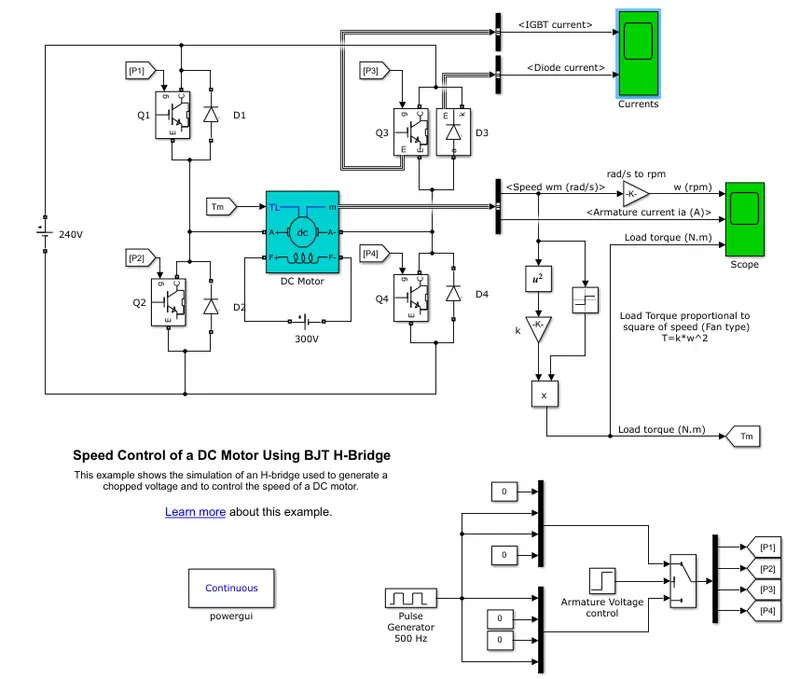
Ans:-1 a) The BJT is used for power switching application and operates as an IGBT. When it is opearted in saturation region a forward voltage is developed between collector and emitter. The H bridge consist of 4 diode/ BJT pairs Q1 and Q4 are fired positive voltage is applied to motor and D2 and D3 act as a freewheeling diode while Q2 and Q3 are off. When Q2 and Q3 are fired a negative voltage is devloped and D1 and D4 act as freewheeling diode while Q1 and Q4 are off.
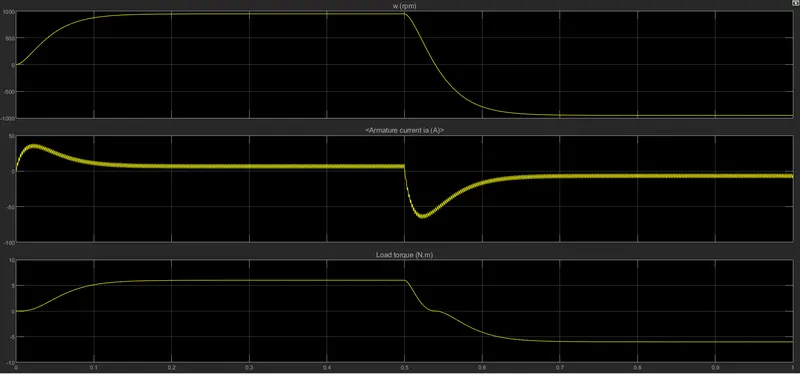
b) The motor starts in positive direction for half a seconds and at t=0.5 sec the armature current is reversed and runs in negative direction.
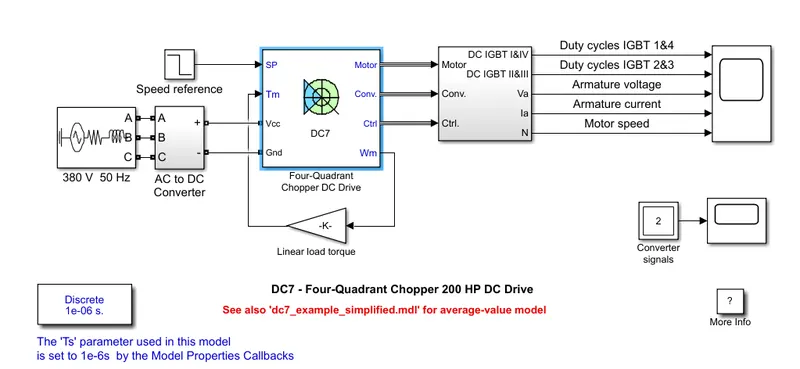
c) The Chhoper is DC to DC converter. It converts fixed DC to variable DC. In the model 200hp drive is excited with 150V DC voltage source. The converter is fed with 380 V AC suppply 50 Hz which was obtained by 525V DC .In order to limit the DC bus voltage during dynamic braking mode a braking chopper has been added to between diode rectifier and DC7 block. The speed reference outputs the armature current reference used by controller in order to reach the desired speed. The current regulator controls the current by applying appropriate duty ratio of 5KHz pulse of four IGBT device. The instantenous pulse values of IGBT device 1 and 4 are oppposite of IGBT devices 2 and 3. This generates the average armature voltage needed to obtain the desired armature current. A inductance is places for smoothing current oscillation.
H- Bridge circuit is used to change the direction of currrent flowing in the circuit.
Ans:-3 Brushless DC motor is PM synchronous motor driven by direct current. Here no brush contact is present which make contact with commutator to form an electric path between source and rotor armature windings. But in BLDC motor it employs electrical connection with permanent magnets rotor and stator with series of coil. In this PM rotates and conductor carrying current is fixed. The coils are swtiched electronically by transistor at correct rotor position in such a way that armature field is in space quadrature with field poles. Hall sensors are placed around the stator to determine the position of rotor. The feedback from rotor haelps to determine when to switch armature current.
Due to absence of brushes in BLDC they are able to run at high speed and less noisy operation is obtained. There are wide vairities of BLDC motor avaliable from small power range to high power range. The difference between the brushed and brushless DC motor is replacement of mechanical commutator with an electric switch
BLDC motor consist of
i) Stator
ii) Rotor
iii) Permanent Magnets
iv) Hall effect sensors
Working Of BLDC motor
BLDC motor works on the principle similar to that of a conventional DC motor, i.e., the Lorentz force law which states that whenever a current carrying conductor placed in a magnetic field it experiences a force. As a consequence of reaction force, the magnet will experience an equal and opposite force. In case BLDC motor, the current carrying conductor is stationary while the permanent magnet moves.
When the stator coils are electrically switched by a supply source, it becomes electromagnet and starts producing the uniform field in the air gap. Though the source of supply is DC, switching makes to generate an AC voltage waveform with trapezoidal shape. Due to the force of interaction between electromagnet stator and permanent magnet rotor, the rotor continues to rotate.
Consider the figure below in which motor stator is excited based on different switching states. With the switching of windings as High and Low signals, corresponding winding energized as North and South poles. The permanent magnet rotor with North and South poles align with stator poles causing motor to rotate.
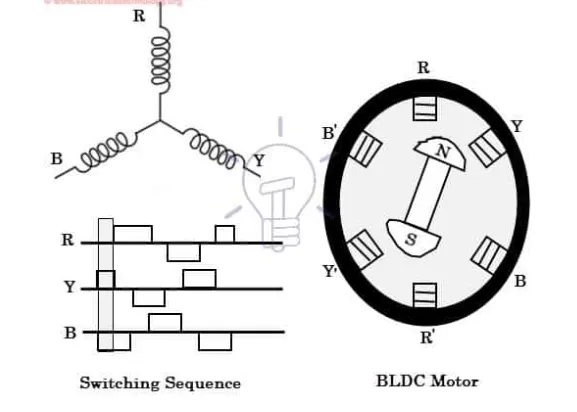
Based on this signal from sensor, the controller decides particular coils to energize. Hall-effect sensors generate Low and High level signals whenever rotor poles pass near to it. These signals determine the position of the shaft.