Week-7 Challenge: DC Motor Control
Student of EV LIVE BATCH 16
Solution for Question 1:
A)Speed control of DC motor using BJT H-bridge :
Simulink model:
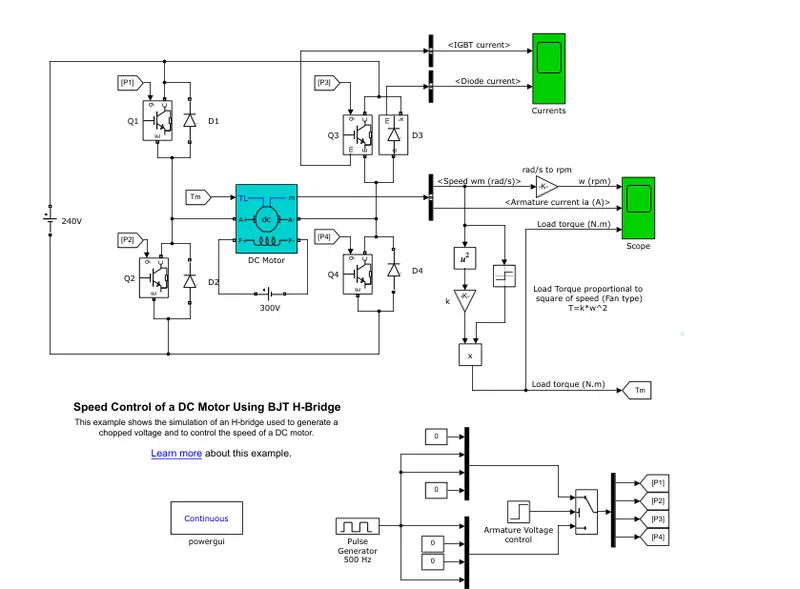
Explanation:
The H-bridge consists of four BJT/Diode pairs (BJT simulated by IGBT models).
Two transistors are switched simultaneously like Q1 and Q4 or Q2 and Q3.
When Q1 and Q4 are ON , a positive voltage is applied to the motor and diodes D2 and D3 operate as free wheeling diodes, this will cause a current flow from source , through Q1 and then through the load (DC motor) and then through Q4, then to the ground.This is known as Forward Motoring.
When Q2 and Q3 are ON ,a negative voltage is applied to the motor and diodes D1 and D4 operate as free wheeling diodes,this will cause a current flow from source , thoroiugh Q3 and then load and then though Q2 then to the ground . This is known as Reverse Motoring.
If Q1 and Q3 or Q2 and Q4 are ON, then both sides of the motor have same voltage and this is called as Braking mode.
If Q1 and Q2 or Q3 and Q4 are ON , then it will cause a short and burn out the H-bridge.
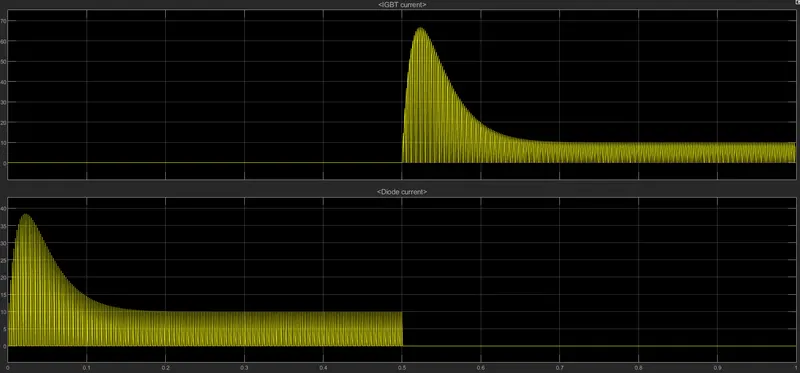
As shown in the above simulink we have two currents as output currents . one is diode current and another one is IGBT current.
RESULTS:
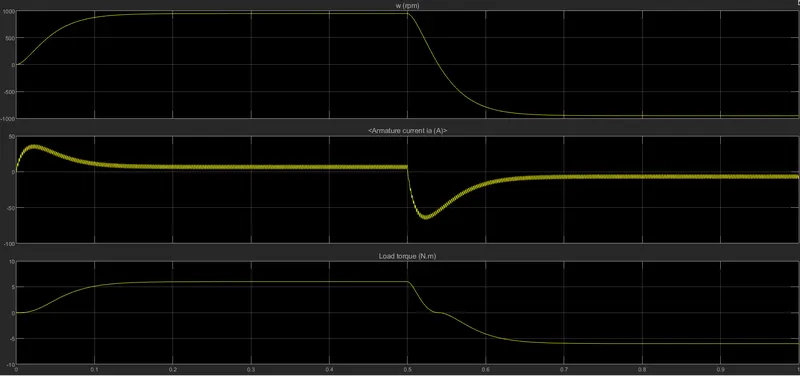
Scope:
Currents:
B)Armature Current Shoot-up
We can observe that armature current shooted up from the above results of scope.
At starting there is sudden spike increase in Armature current from 0 and at 0.5 sec alos means at transistion fro positive to negative direction of rotation we observe a high surge in current, this is due to the transient switching occuring in the circuit.
As there is already current flowing in the circuit and on changing of switches after 0.5 sec, the current in the circuit adds to the changed direction of current and we can see that surge in current.
The surge in the current can be reduced by reducing the duty cycle.
C)Comparison of H bridge and Four Quadrant chopper DC drive.
H bridge
1.Only two quadrants of operation is possible.they are Foward motoring and reverse motoring.
2.Fixed DC voltage source
3.Less control
4.Higher armature current ripple.
5.Simulation is continous and simulation time is more is more,
widely used in Robotics.
Four Quadrant chopper DC drive
1.It can operate in in all four quadrants. they are forward motoring,reverse regeneration,reverse mototing and forward regeneration.
2. AC source
3. Better control
4.Lower armature current ripple due to high switching freqauency of DC-DC converters.
5.Discrete and Simulation time is less and Widely used in Automobile.
Solution for Question 2:
Simulink model for 2 Quadrant chopper:
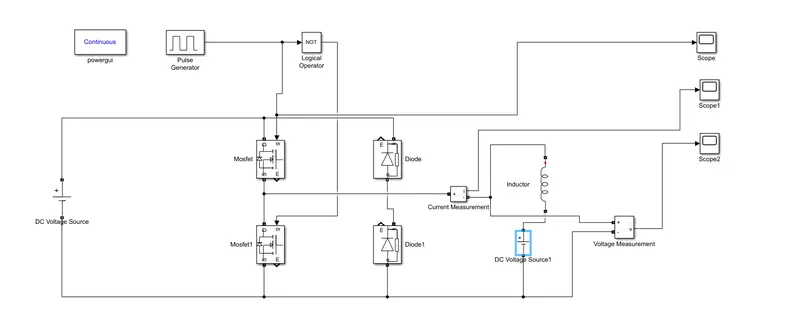
Input values :
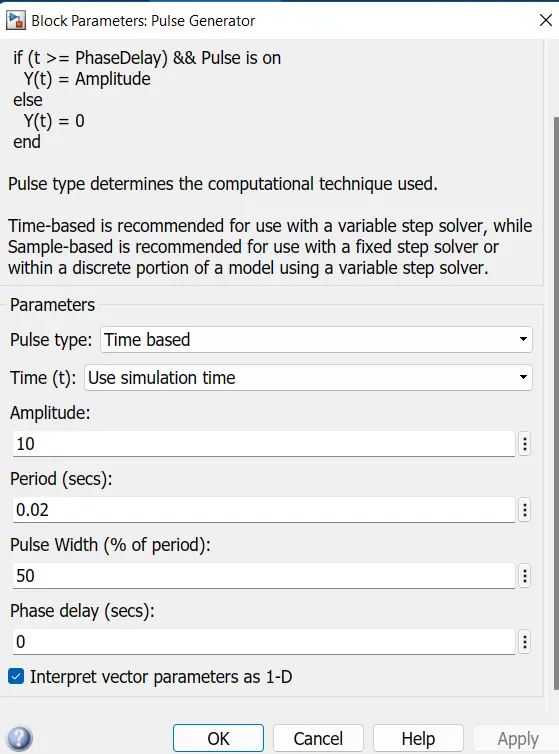
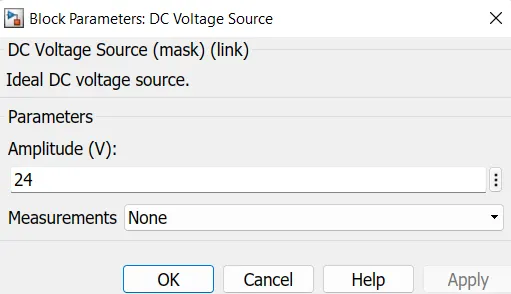
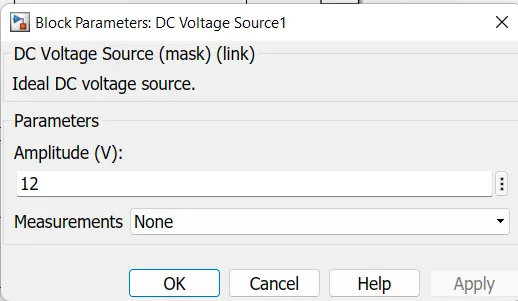
RESULTS:
Pulse generator plot
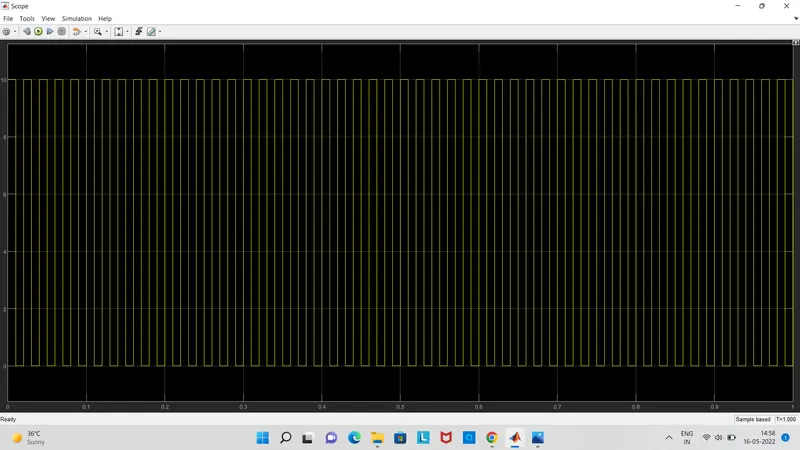
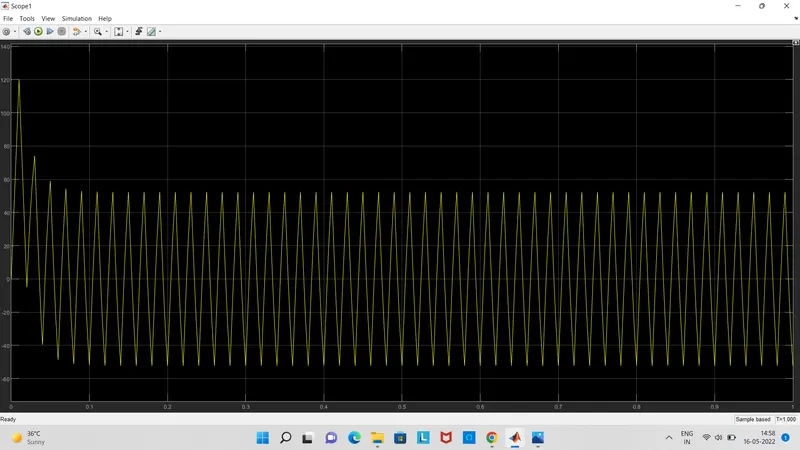
Current Waveform
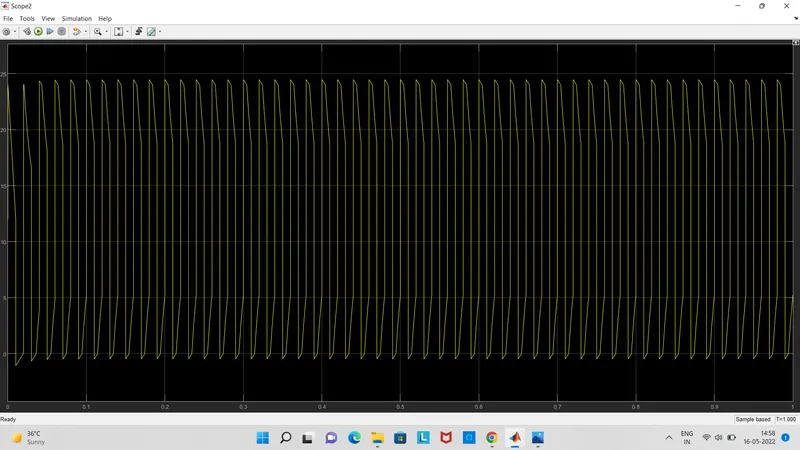
Voltage waveform
Solution for Question 3:
Operation of BLDC (Brush Less DC ) Motor
BLDC motor works on the principle similar to that of a conventional DC motor , i,e.. the Lorentz force law which states that whenever a current carrying conductor placed in a magnetic field it experiences a force. As a consequence a reaction force, the magnet will experience an equal and opposite force. In case of BLDC motor, the current carrying conductor is stationary while the permanant magnet moves.
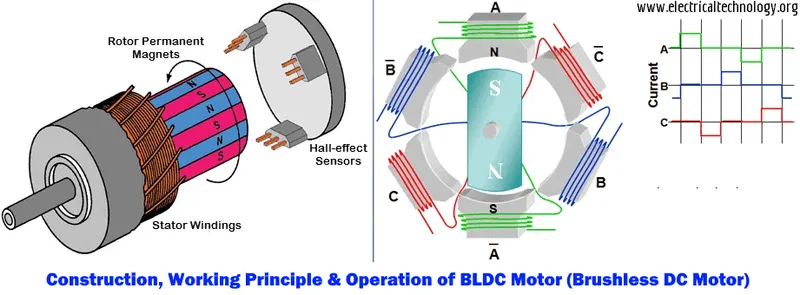
- When the stator coils are electrically switched by a supply source, it becomes electromagnet and starts producing the uniform field in the airgap.
- Though the source of supply is DC, switching makes to generate an AC voltage waveform with trapezoidal shape.
- Due to the force of interaction between electromagnet between electromagnet stator and the permanant magnet rotor, the rotor continues to rotate.
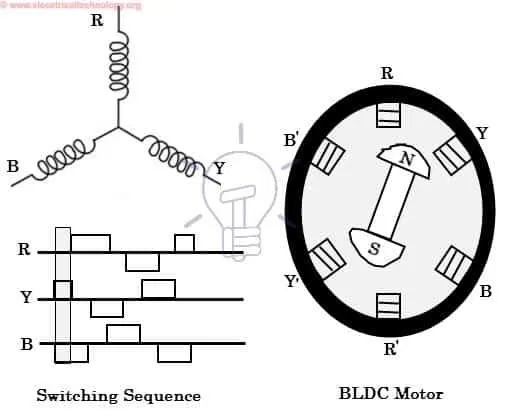
Motor stator is excited based on different switching states. with the switching of windings as High and Low signals, corresponding winding is energized as North and South poles. The permant magnet rotor with North and South poles align with stator poles causing motor to rotate.