Week-7 Challenge: DC Motor Control
Q1-
A. Explain a MATLAB demo model named ‘Speed control of a DC motor using BJT H-bridge’.
The bipolar junction transistor(BJT) when used for power switching application,operate as an IGBT.
When its conducting a forward voltage Vf is developed between collector and emitter.
Therefore,IGBT block used to model the BJT device.
The H-bridge consist of four BJT/Diode .two transistor are switched simultenously-Q1 and Q4 or Q2and Q3 .When Q1 and Q4 are fixed a positive voltage is applied to the motor and diode D2-D3 operate as free –wheeling diode when Q2and Q3 are switch on then diode D1-D4 operate as free-wheeling diode.
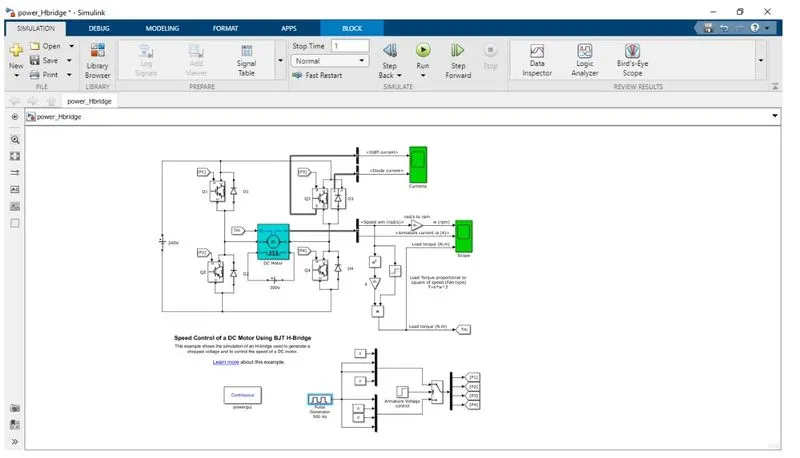
After Running a model we have scope under the armature current when pole are reversed.
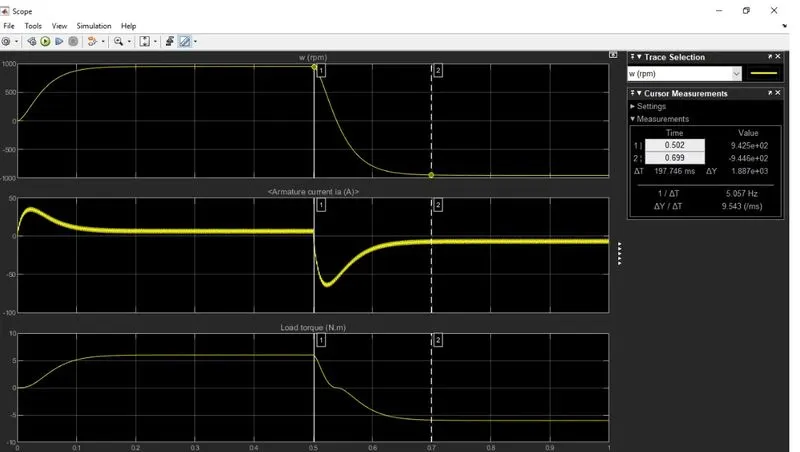
B. Comment on the armature current shoot-up from the scope results.
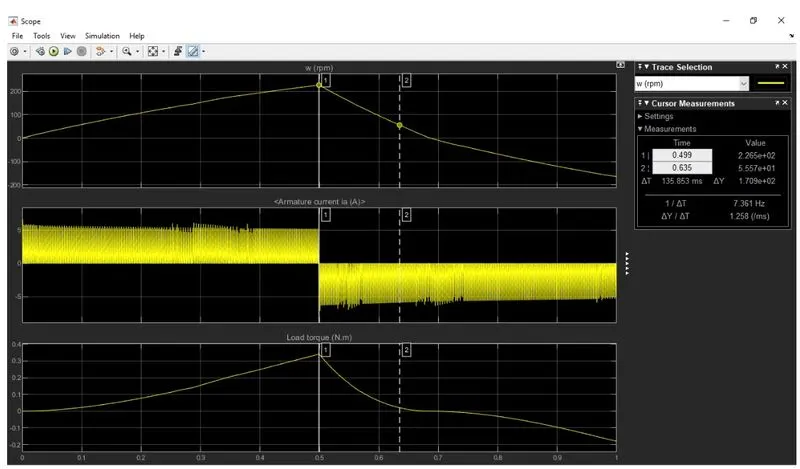
The motor start a positive direction with duty cycle 75%.At t=0.5s the armature voltage is suddenly reversed and the motor runs in negative directon.
Scope show motor speed ,armature current and load torque and current show flowing in BJT Q3 and diode D3
C. Refer to the help section of ‘The Four-Quadrant Chopper DC Drive (DC7) block’. Compare it with the H-bridge model.
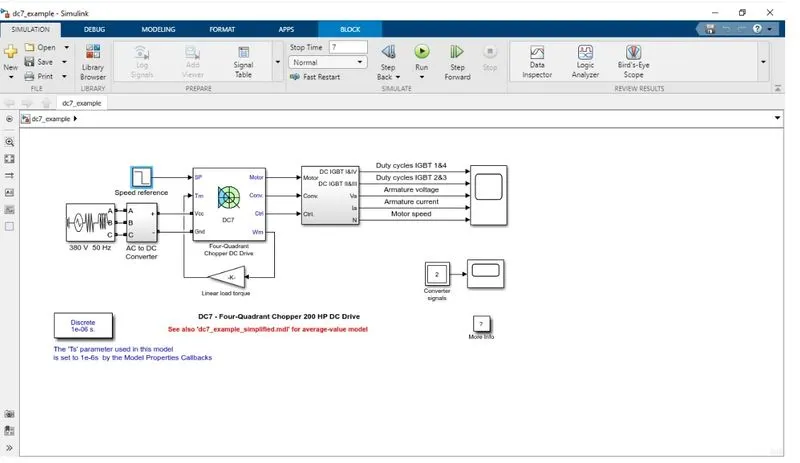
Compare the H-bridge and Four Quadrant DC chopper
1.In H-bridge we need to reverse the polarity to change the direction but in Four quadrant DC drive use reference speed to change the direction of motor rotation.
2.PI controlled are used for speed and current control in four quadrant DC drive which is absent in H-bridge.
3.Forward and reversed motoring are the only two operation that the H-bridge can perform. The four quadrant DC drive operate four model as forward motoring, reverse motoring, forward braking and reverse braking.
Q2.Develop a 2-quadrant chopper & explain the working of the same with the relevant results. (Refer to article - Multiquadrant operation of motor )
In this type chopper ,the average voltage will always positive but the average load current might be positive or negative .The two switch CH1 and CH2 should not be turn on simultenously as the combined action may cause a short circuit in supply lines.For regenerative braking this type chopper used
Q3. Explain in a brief about operation of BLDC motor.
Brushless DC motors are common in industrial applications across the world. At the most basic level, there are brushed and brushless motors and there are DC and AC motors. Brushless DC motors, as you may imagine, do not contain brushes and use a DC current.
These motors provide many specific advantages over other types of electrical motors.
A brushed DC motor has permanent magnets on the outside of its structure, with a spinning armature on the inside. The permanent magnets, which are stationary on the outside, are called the stator. The armature, which rotates and contains an electromagnet, is called the rotor.
In a brushed DC motor, the rotor spins 180-degrees when an electric current is run to the armature. To go any further, the poles of the electromagnet must flip. The brushes, as the rotor spins, make contact with the stator, flipping the magnetic field and allowing the rotor to spin a full 360-degrees.
A brushless DC motor is essentially flipped inside out, eliminating the need for brushes to flip the electromagnetic field. In brushless DC motors, the permanent magnets are on the rotor, and the electromagnets are on the stator. A computer then charges the electromagnets in the stator to rotate the rotor a full 360-degrees.
Use For Brushless DC Motor-
Brushless DC motors typically have an efficiency of 85-90%, while brushed motors are usually only 75-80% efficient. Brushes eventually wear out, sometimes causing dangerous sparking, limiting the lifespan of a brushed motor. Brushless DC motors are quiet, lighter and have much longer lifespans. Because computers control the electrical current, brushless DC motors can achieve much more precise motion control.
Because of all these advantages, brushless DC motors are often used in modern devices where low noise and low heat are required, especially in devices that run continuously. This may include washing machines, air conditioners and other consumer electronics. They may even be the main power source for service robots, which will require very careful control of force for safety reasons.
Brushless DC motors provide several distinct advantages over other types of electric motors, which is why they’ve made their way into so many household items and may be a major factor in the growth of service robots inside and outside of the industrial sector.