Week 7 Challenge
To calculate the water current forces on the bridge, we need to consider the hydrodynamic pressure exerted by the flowing water. The hydrodynamic pressure depends on the velocity of the water and the area exposed to the flow.
To calculate the water current forces on the bridge as per IRC 6, we will use the formula:
P = 52 * K * V^2
where: P is the water current force in kN/m^2, K is a coefficient specific to the shape of the pier, and V is the velocity of the water in m/s.
Given: K = 0.66 (for a circular pier) High flood level = 2 m above the foundation level
Span of the bridge = 45 m
Mean velocity of the river = 3 m/s
First, let's calculate the water current force at the high flood level.
Maximum Velocity V = √2 * VMean Velocity
Maximum Velocity V = √2 * 3
Maximum Velocity V = 4.242
P1 = 52 * K * V^2 = 52 * 0.66 * (4.242^2) = 617.57 kN/m^2
Since the high flood level is 2 m above the foundation level, the water current force will act on the vertical projection of the bridge. Therefore, the total water current force acting on the bridge is calculated by multiplying the force at a high flood level by the width of the bridge.
The total force on the bridge = P1 * Width of the bridge = 617.57 * 45 = 277.91 kN/m^2
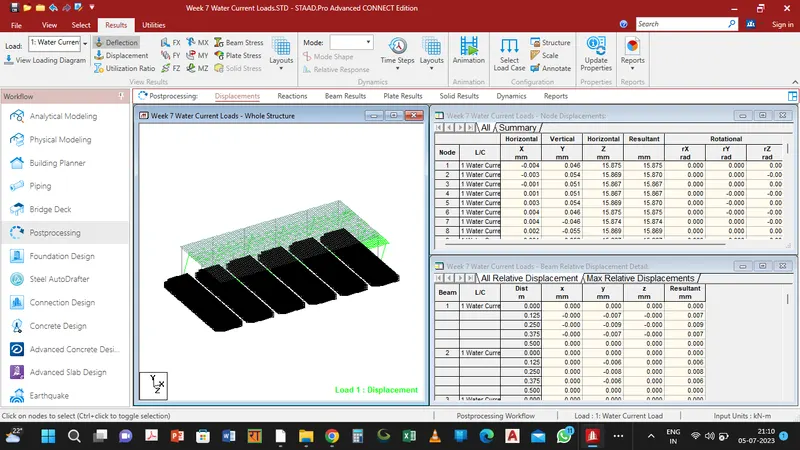
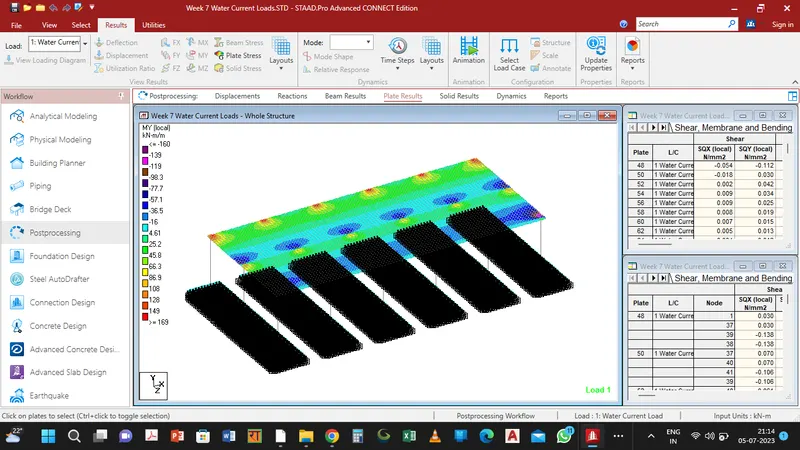
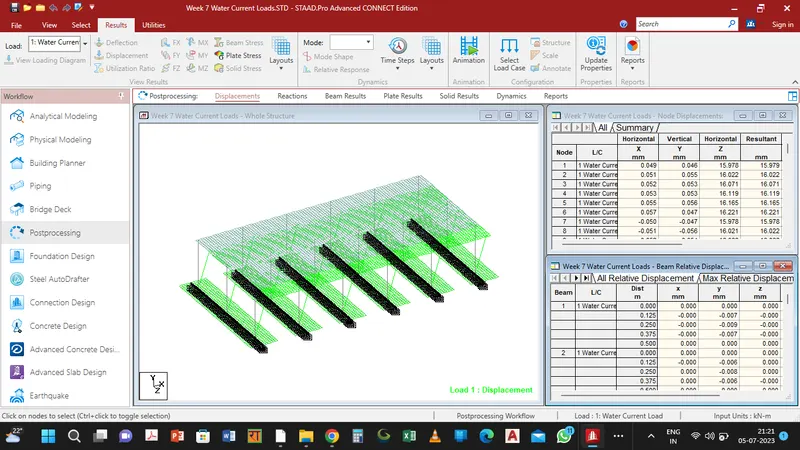
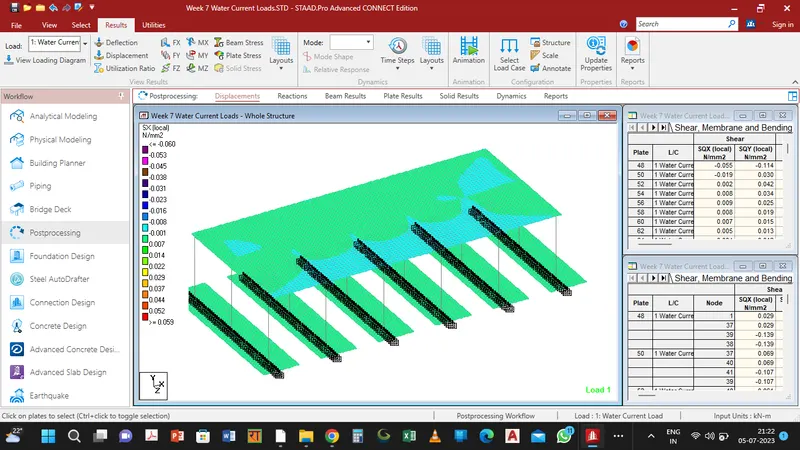
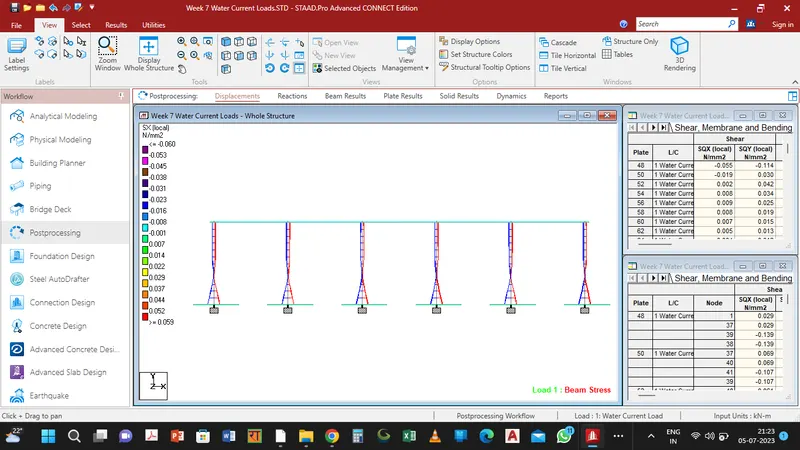
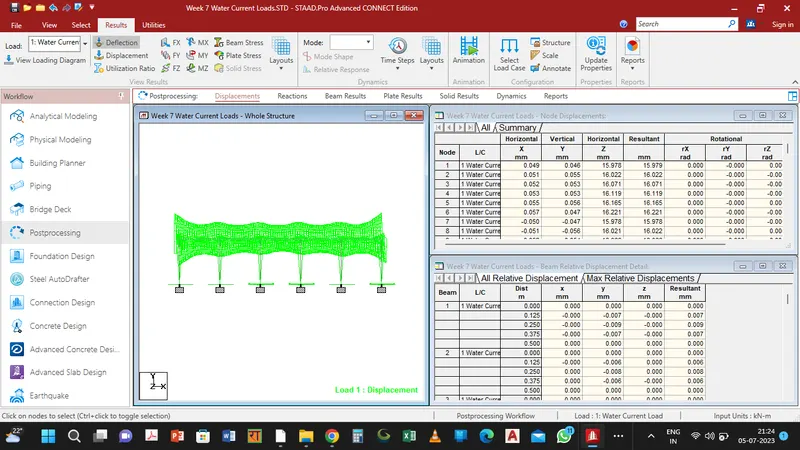
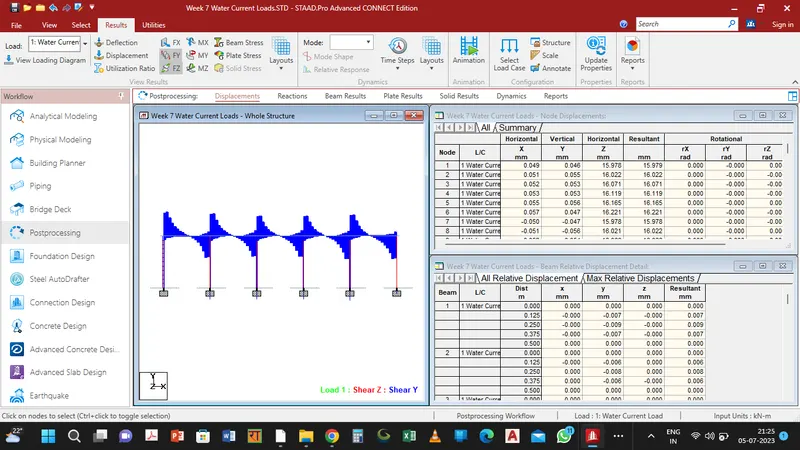
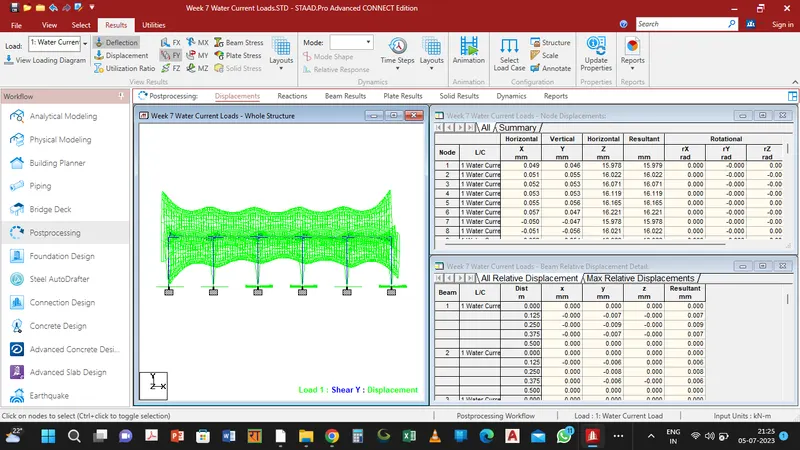
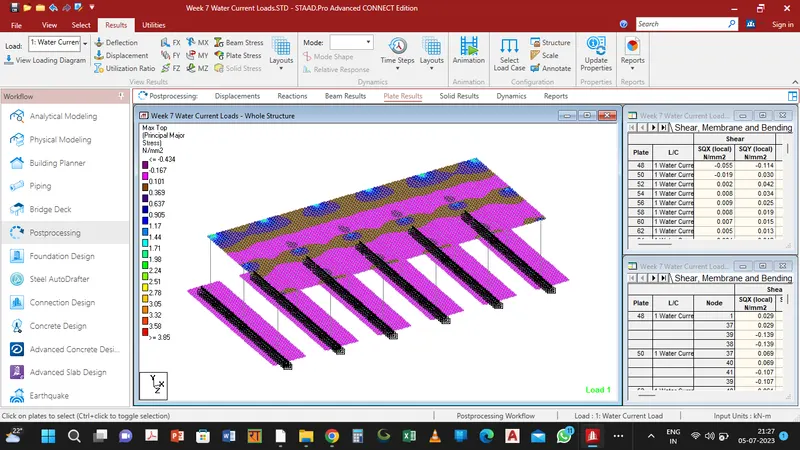
Now we can apply this total force of 277.91 kN/m^2 as a uniformly distributed load along the bridge in the Staad Pro. The load distribution should be such that the force is evenly distributed over the entire pier of the bridge.