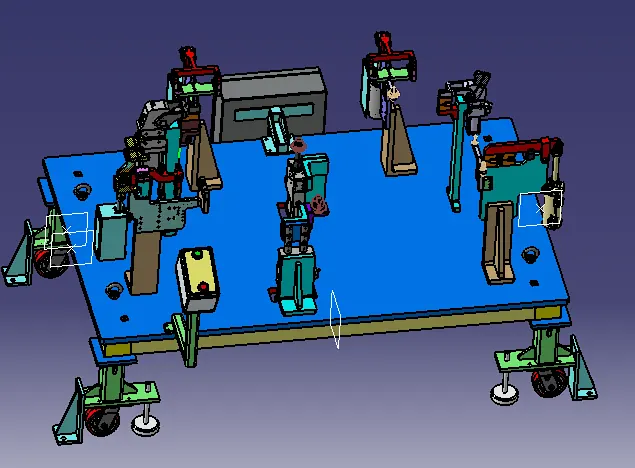
Week 7- Base Unit Design Challenges 2
AIM:
To Design a base unit for the Pin units,Clamp units,Swivel clamp units with all weldments for the given Car panel.
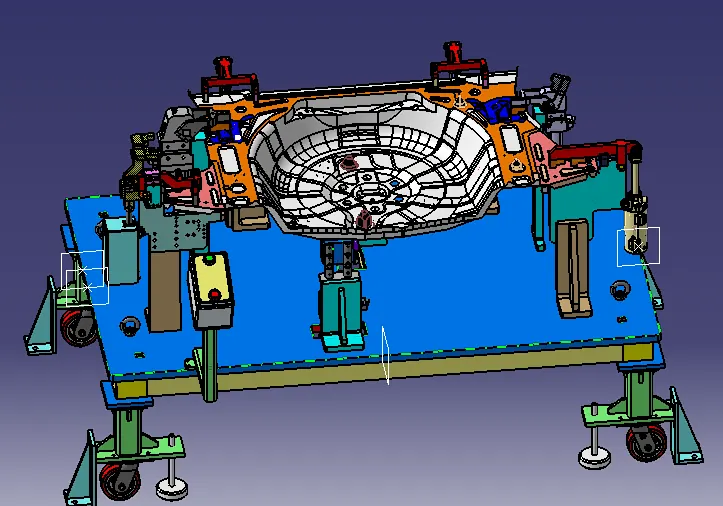
INTRODUCTION:
Base Unit:
A base unit is the unit designed to mount all the other units of the tool,also other parts necessary for a tool like pneumatic valve box, cable tray, liting hook, etc will mounted on to a base unit.
Below are the some parts of a base unit in general.
- Base plate
- Pedestal
- Trunking channel
- Valve box
- Eye bolt
- Floor plate
- Red bin
- HMI
- Edge finder
- Name plate
- BL, TL & WL(co-ordinates)
- FRL
- operator pendant
- wheel assembly.
BASE PLATE:
Base plate is a machined plate of 25 to 40mm thickness made of steel and aluminum on which the holes are drilled to mount individual units like clamp unit, pin unit, rest unit etc.
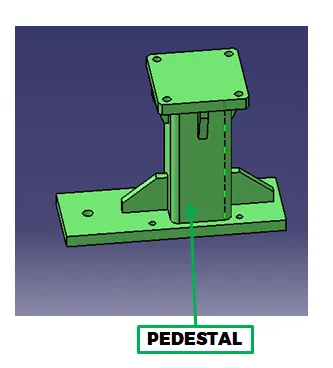
PEDESTAL:
A pedestal is a part which connects the base plate to the floor plate. A pedestal is a standard part in general and in some cases it can be a welded frame integrated with the base plate.
- A standard pedestal can be of different height and different sizes.
- Depending on the size of the base plate, the number of pedestal varies for load distribution.
- Pedestals are of different types with different inclinations.
3. Trunking Channel/ C Channel :
Trunking Channel is a duct that carries all the electrical and pneumatic connections(wires and pipes) for units of the tool. It has a thickness of few millimetres.
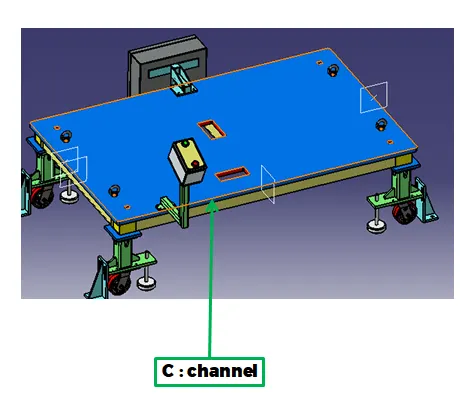
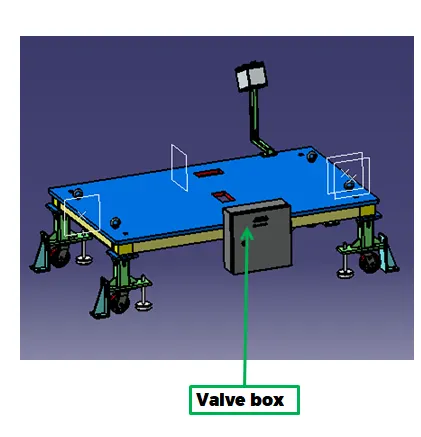
4. Valve Box:
Valve Box is a standard part which contains all the valves for the pneumatic units. The valve box is the box which includes different solenoid valves. The pneumatic fixtures work on air pressure provided to it. So the arrangement of air pressure inlet & outlet is done within this valve box.
The trunking channel includes all the pressure inlet cables going to the pneumatic parts of the fixture & protects them from damaging while operation is in process.
5. Eye Bolts:
Eye bolts are used for the transporting of the tool, using lift hooks, fork lift holes will also be provided in some cases for transporting purpose. For example, we usually use M20 bolts that are bolted on the base plate.
When installing lifting eye bolts it is critical to ensure face is in firm contact with the mating surface. These lifting rings are intended for linear pulling loads in the direction of the thread.
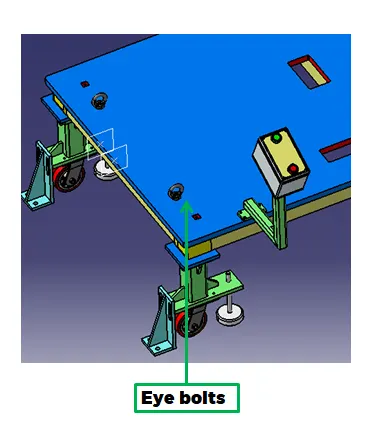
They are not intended for use where the load is perpendicular to the thread. This is because in these instances the bolt could unscrew and move or it could be twisted and break.
6. Floor Plate:
Floor plate is grouted to the floor with fixed bolt on the ground. Floor plates are also called as foundation plates.
- There will be a clearance of 10 mm maintained between the pedestal base plate & floor plate.
- This clearance will be used by the leveling screws, for leveling the entire tool.
- Weld bars are be used to weld the positions permanently after leveling is done.
- A weld bar is a plate along the sides of the base plate of the pedestal.
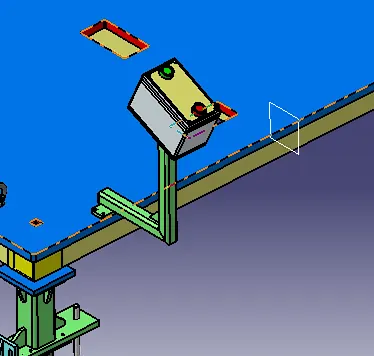
7. Operator Pendant : Operator pendant is very important part in base unit in which operator will clamp & de-clamp the cylinder by push button & operation will start very easily & safely. It is very imp in terms od DAP.
-
Points to be considered while designing a base plate:
1)Working height:
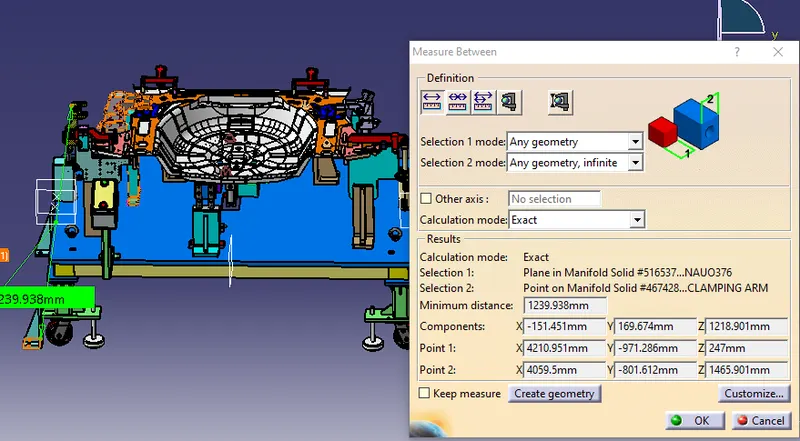
The general working hieght o robotic mig & spot welding fixture is 950mm. Manual fixture we need to consider the working height 850-1100 mm, depending upon the working height of the worker standard of a specific country will apply (in few countries human height is higher or lower e.g. (US, Japan).If base structure is made with base plate having tubular structure welded below it we can reach to height 400 mm to 550 mm. In this case to reach the working welding height we need to provide additional some leg structure which may have top & plate welded to the tube.The total working height of this unit is 1250mm.The Dimensions of the Base Plate are obtained as 1800x1100x25mm.
-
3-2-1 Principle:
A work-piece free in space can move in an infinite number of direction. For analysis, this motion can be broken down into 12 directional movements or "degrees of freedom". All 12 degrees of freedom must be restricted to ensure proper referencing of a work-piece.
The 12 degrees of freedom all relate to the central axis of the work-piece. Notice the 6 axial degrees and 6 radial degrees of freedom. The axial degrees of freedom permit straight-line movement in both directions along the 3 principle axis shown as X, Y & Z.
The radial degrees of freedom permit rotational movement, in both clockwise & counterclockwise radial directions around the same three axis.
For a rigid body in plane has 6 degrees of freedom (i.e) The motion of a ship at sea has the 6 degrees of freedom .
- X+
- X-
- Y+
- Y-
- ZCW
- ZCCW
Now try to understand 3-2-1 principle of fixture. The purpose of Fixture is
- Resting
- Locating
- Orienting
- Clamping
Resting:
In a fixture the work piece should rest in such a way that it dosen’t move or vibrate on the resting blocks.
Locating:
The fixture should locate the work piece such that all the operations to be performed on it are performed without any problem and all of them are performed effectively.
Orienting:
The fixture should orient the work piece such that all the operations to be performed on it are within the reach of the work piece.
Clamping:
A clamp is a fastening device used to hold or secure objects tightly together to prevent movement or separation through the application of inward pressure.There are many types of clamps available for many different purposes. Some are temporary, as used to position components while fixing them together, others are intended to be permanent.
Achievement of 3-2-1 Principle:
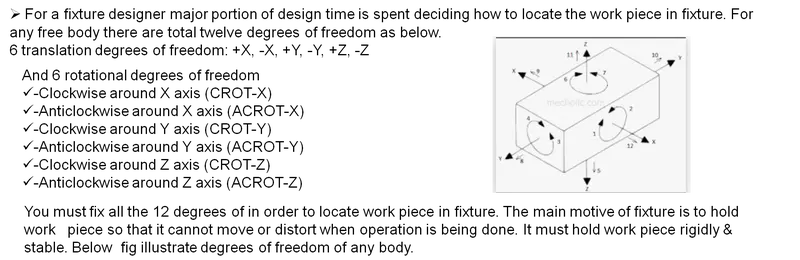

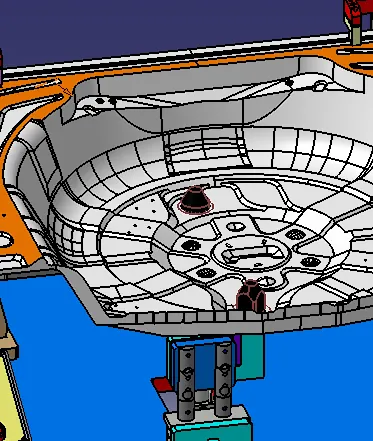
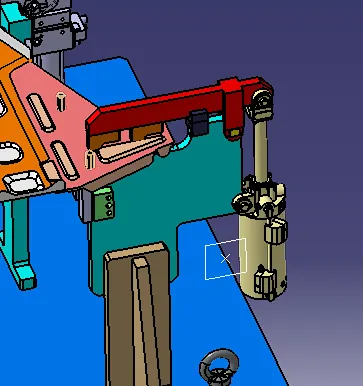
- THIS UNIT IS SYMMERTICAL LH & RH