Week 6 - CHT Analysis on a Graphics card
Aim:-
- Perform a steady-state conjugated heat transfer analysis on a model of a graphics card.
- Select the appropriate materials for the simulation.
- Mesh the geometry with a desirable combination and Explain the mesh setting used on this model.
- Simulate by varying the velocity from 1m/s to 5m/s for at least 3 velocities and discuss the results.
- Find out the maximum temperature and heat transfer coefficient attained by the processor.
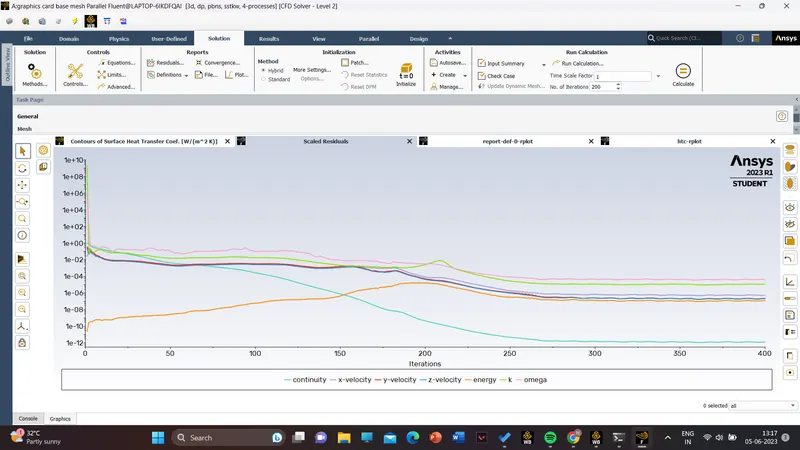
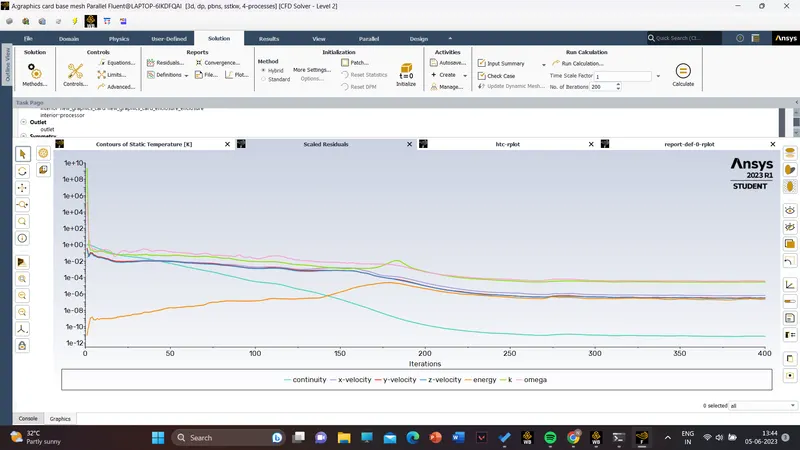
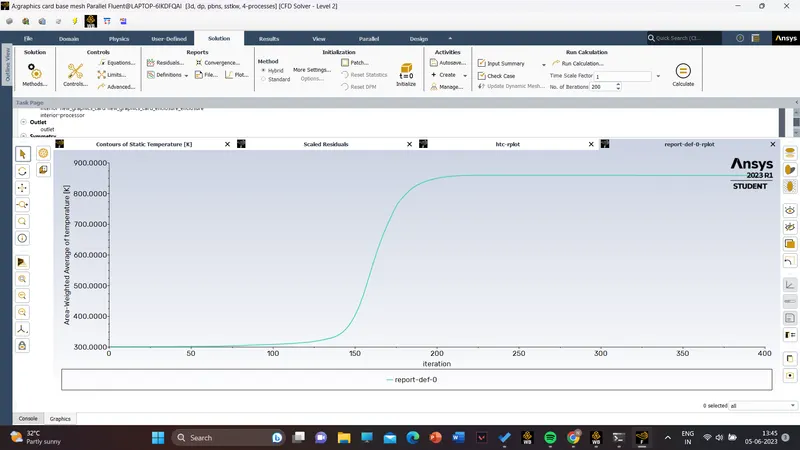
- Prove that the simulation has achieved convergence with appropriate images and plots.
- Identify potential hot spots on the model.
Objectives:-
- Import graphics card model in the space claim and active share topology.
- Mesh the model using proper inflation layer and face sizing.
- Open fluent setup and perform steady-state conjugated heat transfer simulation on meshed model.
- Prove that the simulation has achieved convergence with appropriate images and plots.
- Check the mesh independence of the model by performing the same simulation with different densities of mesh.
- Try simulating solution using different velocity between range 1m/s to 5m/s
- Find out the maximum temperature and heat transfer coefficient attained by the processor.
- Identify potential hot spots on the model.
Conjugate Heat Transfer Analysis
- theory:
- Conjugate heat transfer:
The Conjugate Heat Transfer (CHT) analysis type allows for the simulation of heat transfer between solid and fluid domains by exchanging thermal energy at the interfaces between them. Typical applications of this analysis type exist as, but are not limited to, the simulation of heat exchangers, cooling of electronic equipment, and general-purpose cooling and heating systems.
Examples:
HVAC, Heat Exchanger, Tank, Internal Combustion Engine, Heat Sink, Boiler, Reactor, Heat Pipe, Turbocharger.
- Heat Transfer in a Solid - Conduction: Diffusion of heat due to temperature gradients in solids. A measure of the amount of conduction for a given gradient is heat conductivity. Conduction is described by Fourier’s law defining the conductive heat flux, q, proportional to the temperature gradient
- Heat Transfer in a Fluid - Convection: When heat is carried away by moving fluid. The flow can either be caused by external influences, forced convection or by buoyancy forces, natural convection.
Due to the fluid motion, there are three contributions to the heat transfer:
1. Convective contribution: Depending on the properties of the fluid and its region of flow, the domination of conduction and convection varies.
2. Viscous effects: Due to the fluid flow, the viscosity creates heat. This effect is often neglected due to its negligible value but should be taken into account for high-velocity cases.
3. Density effects: When the density becomes related to the temperature, the domain will have different densities at different locations based on the temperature distribution. This variation in density can cause the compression which in-turn generates the heat.
The contemporary conjugate convective heat transfer model was developed after computers came into wide use in order to substitute the empirical relation of proportionality of heat flux to temperature difference with heat transfer coefficient which was the only tool in theoretical heat convection since the times of Newton. This model, based on a strictly mathematically stated problem, describes the heat transfer between a body and a fluid flowing over or inside it as a result of the interaction of two objects. The physical processes and solutions of the governing equations are considered separately for each object in two subdomains. Matching conditions for these solutions at the interface provide the distributions of temperature and heat flux along the body–flow interface, eliminating the need for a heat transfer coefficient. Moreover, it may be calculated using these data.
- Applications:
Starting from simple examples in the 1960s, the conjugate heat transfer methods have become a more powerful tool for modelling and investigating natural phenomena and engineering systems in different areas ranging from aerospace and nuclear reactors to thermal goods treatment and food processing, from complex procedures in medicine to atmosphere/ocean thermal interaction in meteorology, and from relatively simple units to multistage, nonlinear processes. A detailed review of more than 100 examples of conjugate modelling selected from a list of 200 early and modern publications shows that conjugate methods are now used extensively in a wide range of applications. That also is confirmed by numerous results published after this book appearance (2009) that one may see, for example, at the Web of Science. The applications in specific areas of conjugate heat transfer at periodic boundary conditions and in exchanger ducts are considered in two recent books.
procedure
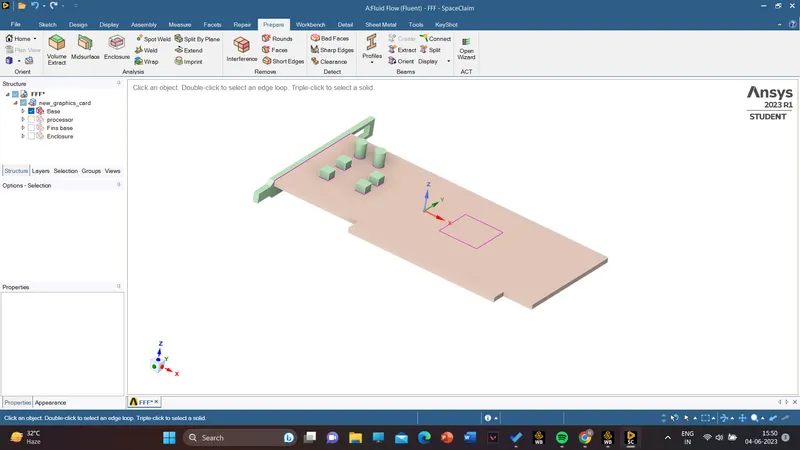
import geomerty
base
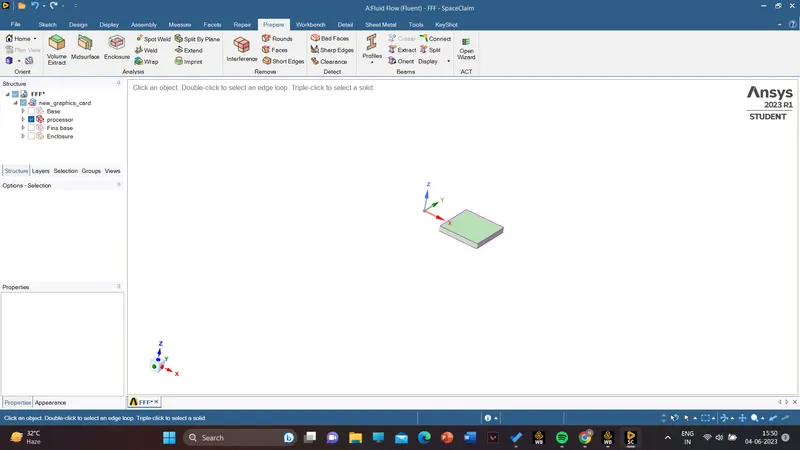
processor
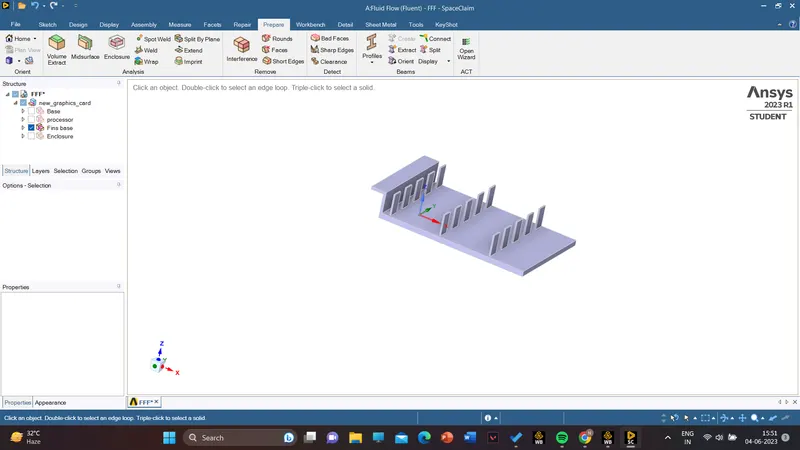
fins
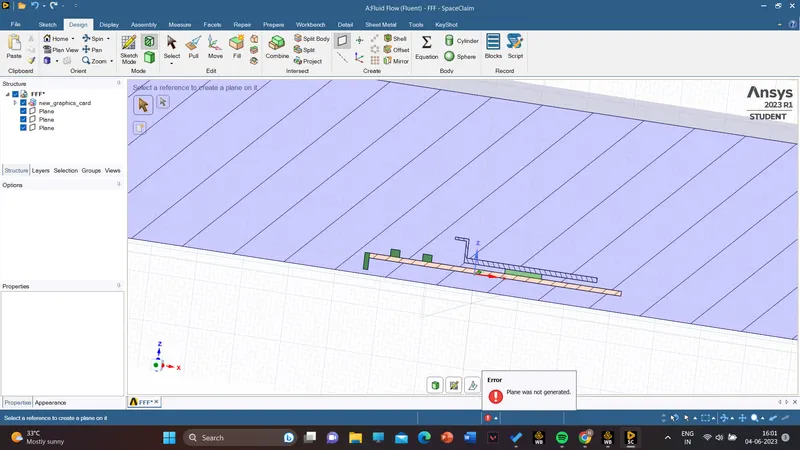
share the topology to get the required geometry for meshing
go to mesh
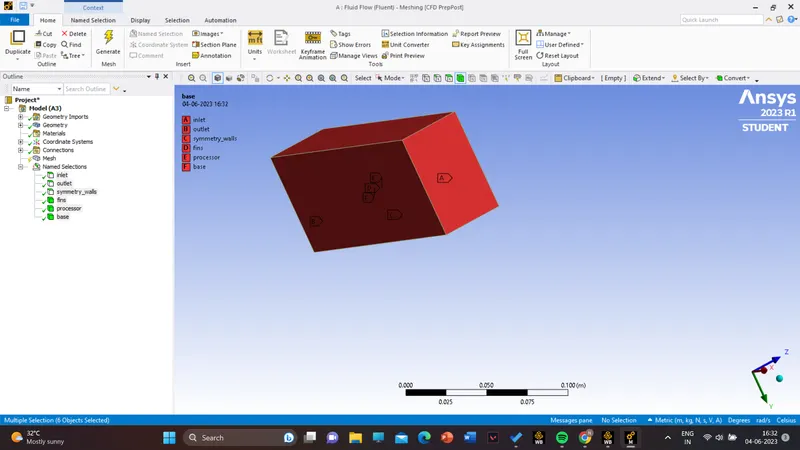
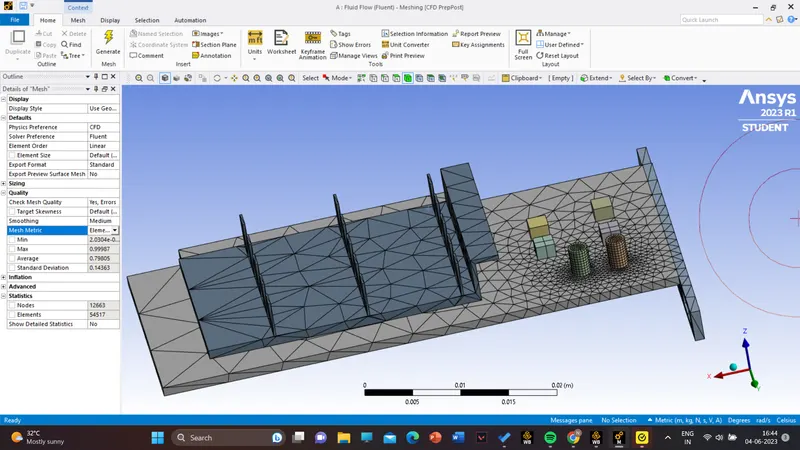
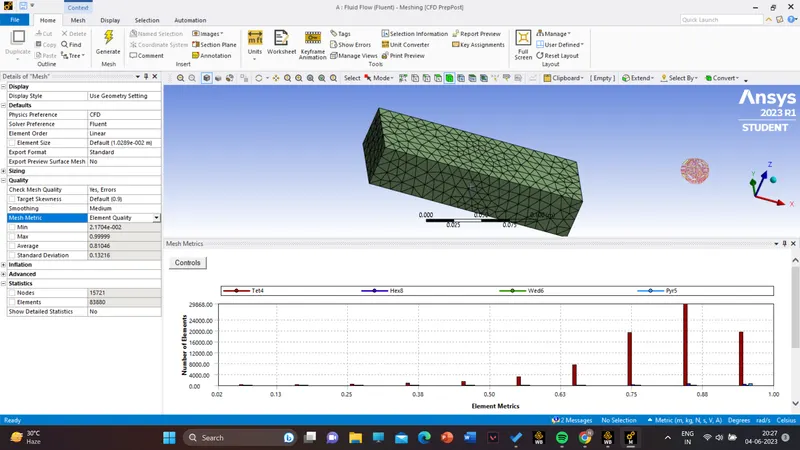
go to fluent
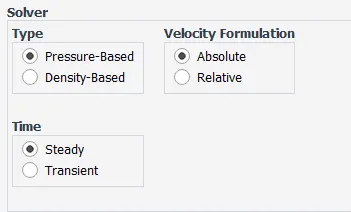
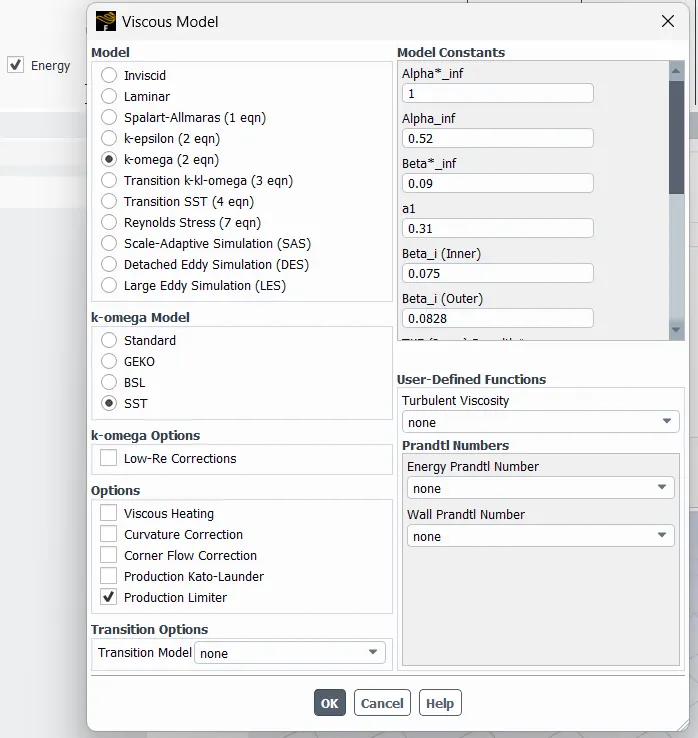
material
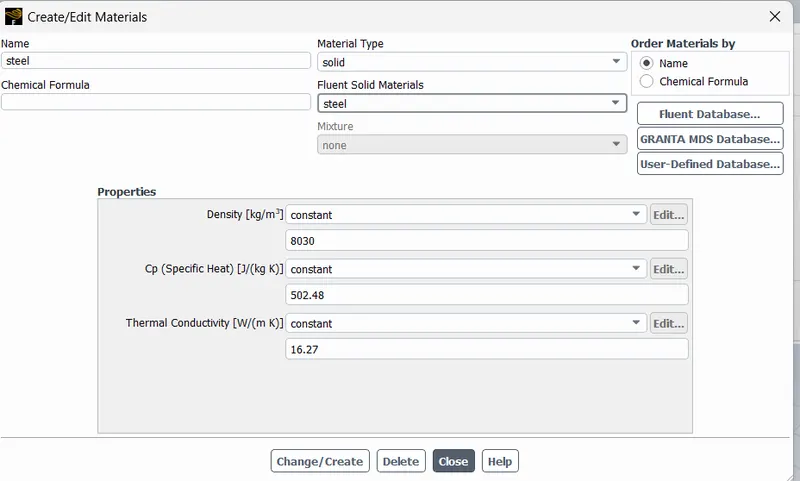

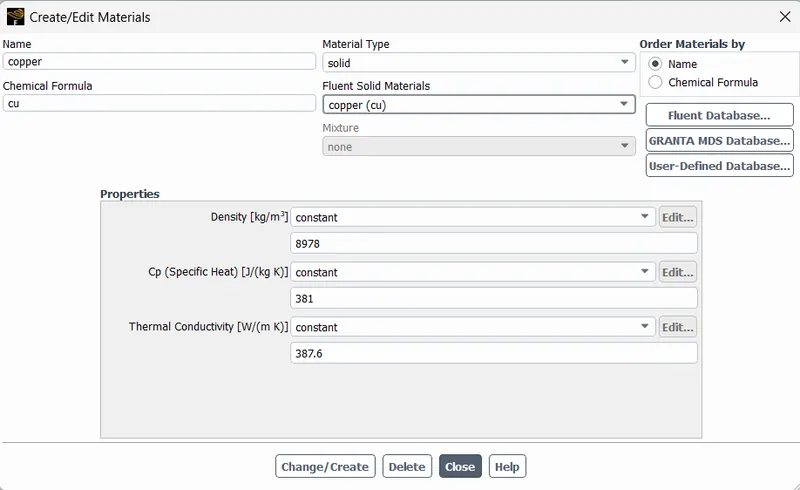
fins=copper
enclosure=air
base=steel
processor=gold
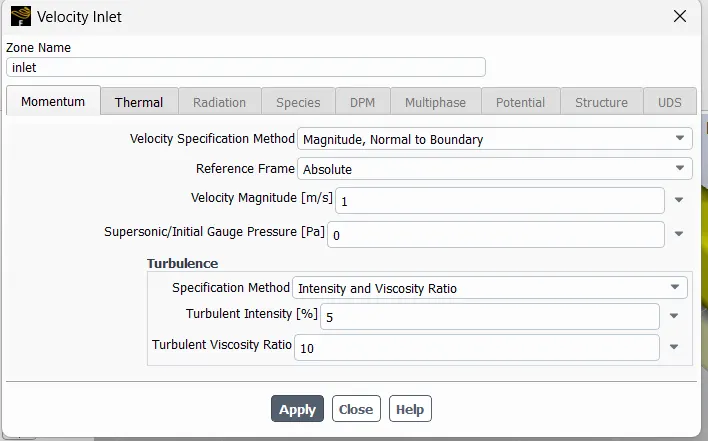
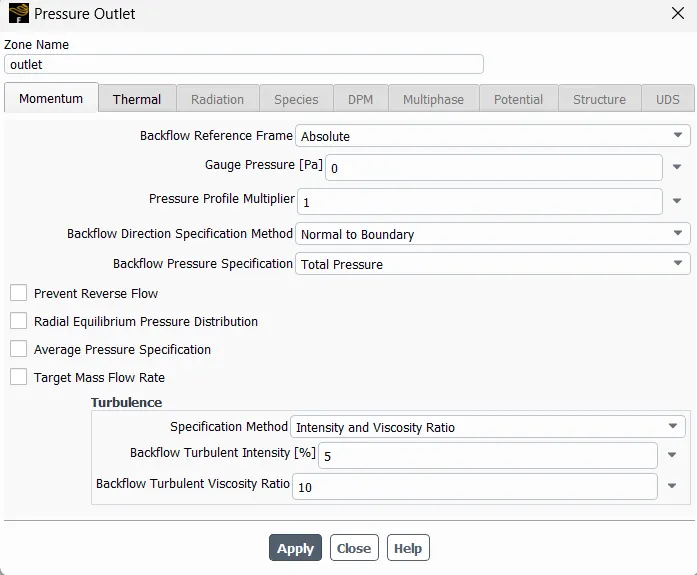
result for base mesh
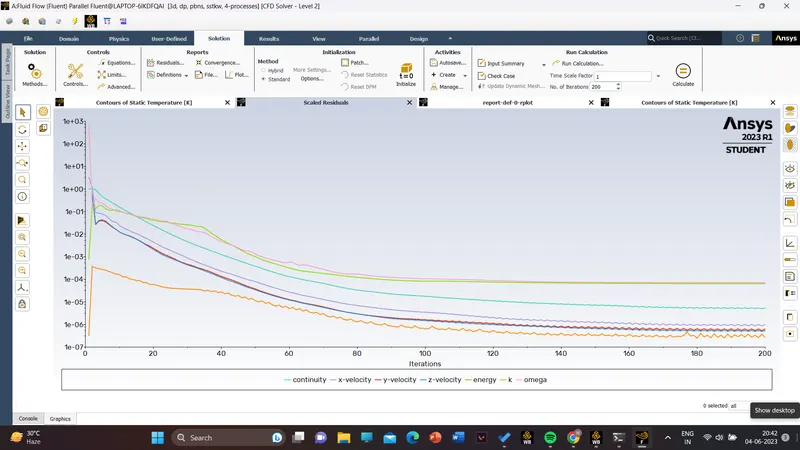
residuals
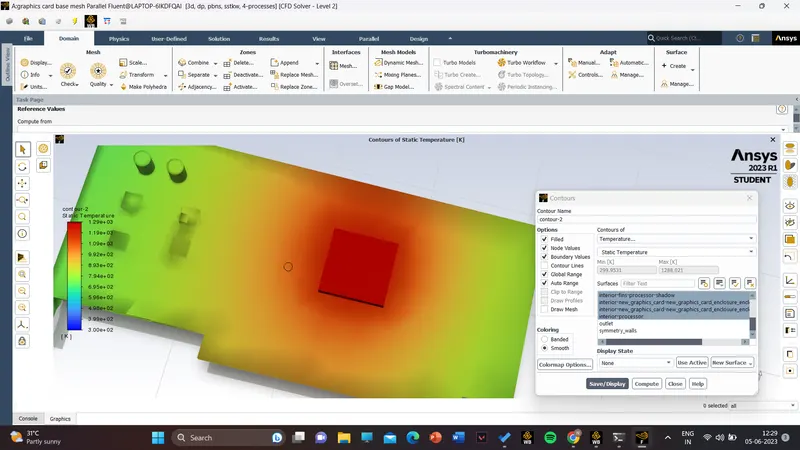
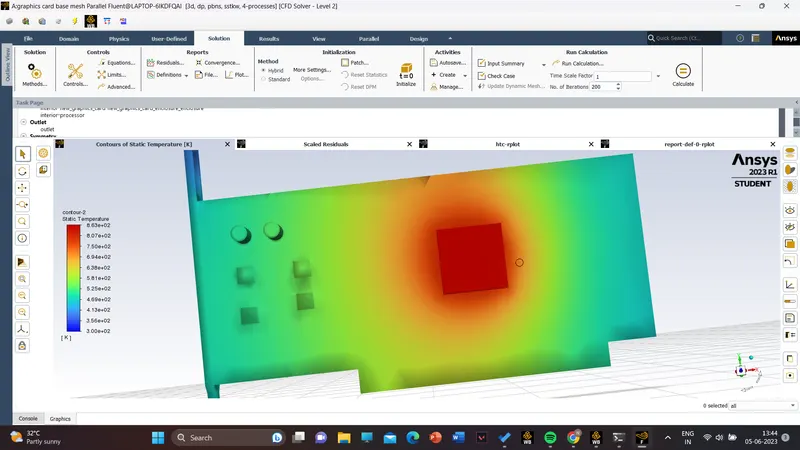
temperature contour around processor
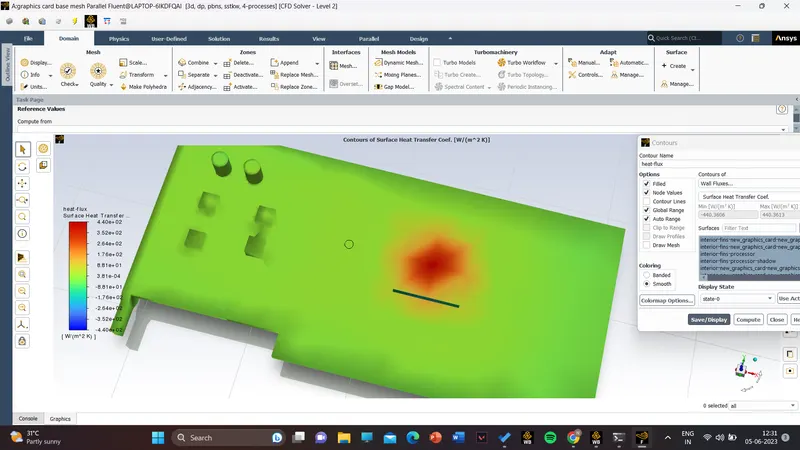
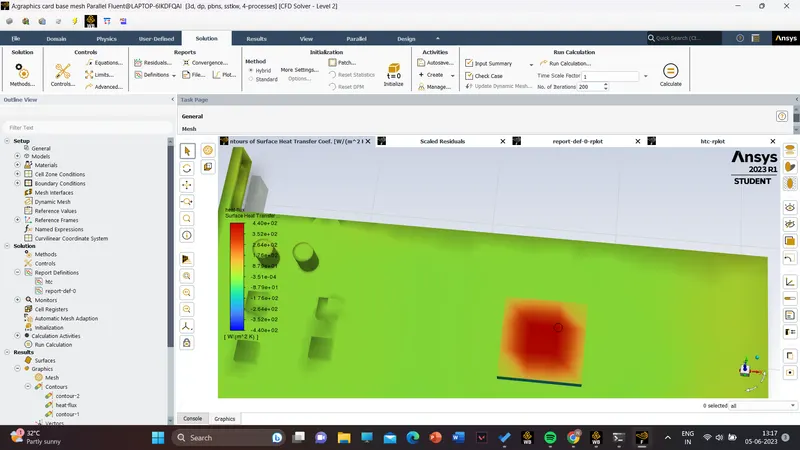
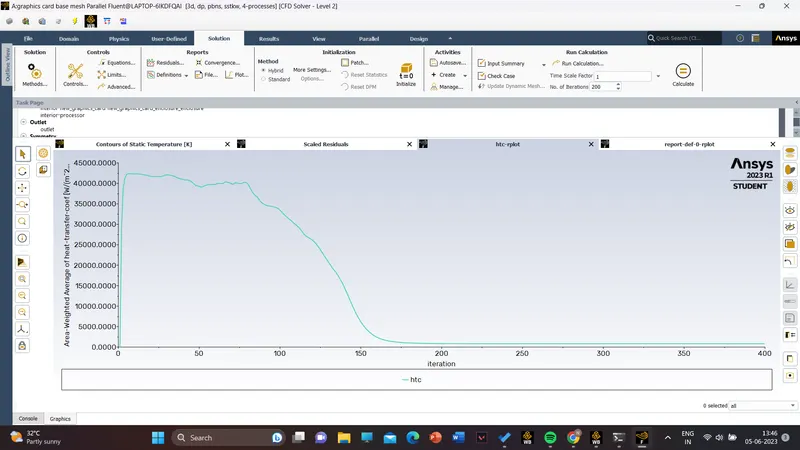
HTC around processor
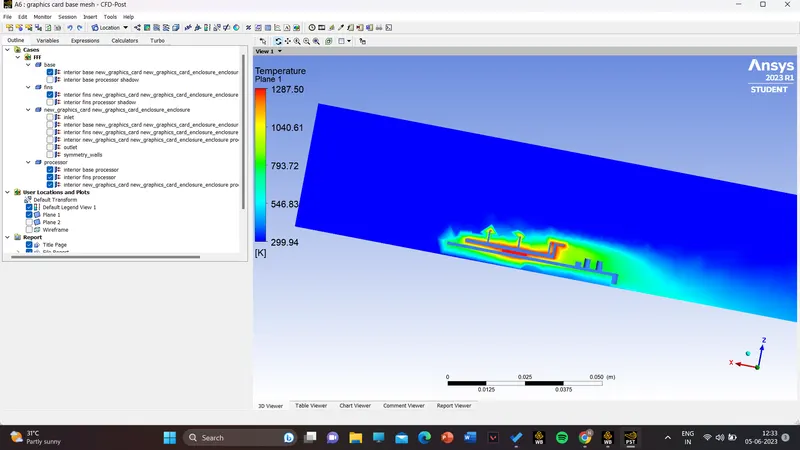
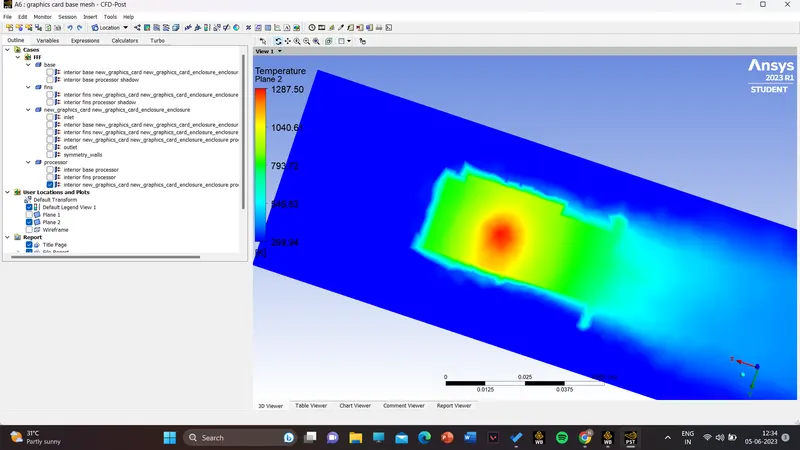
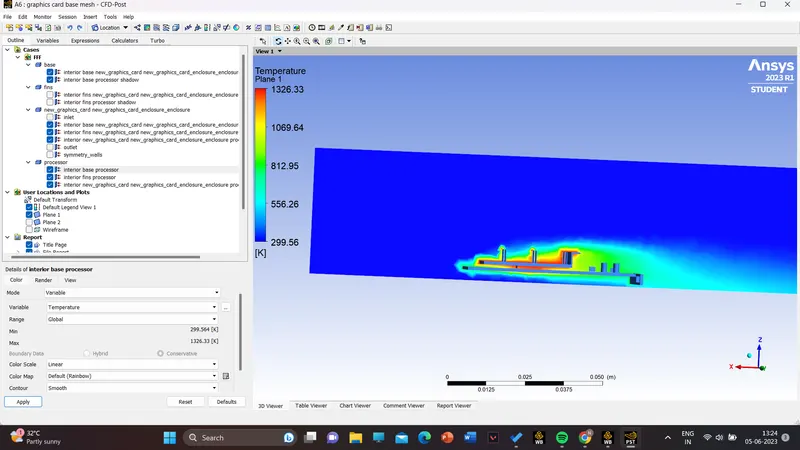
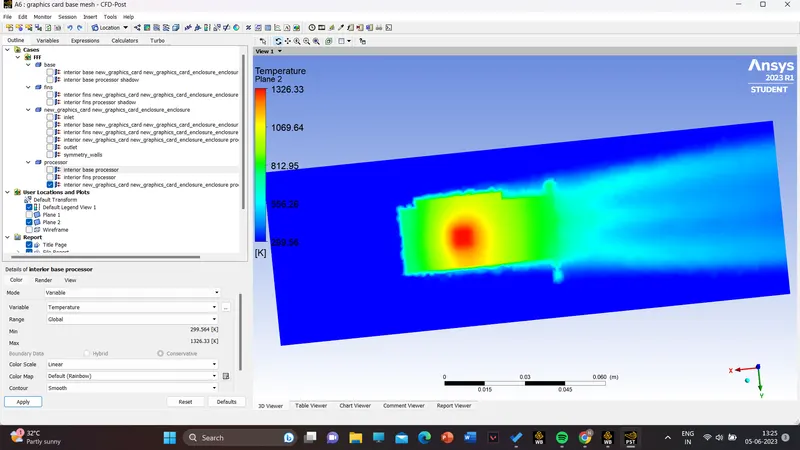
refined mesh results for velocity of 1m\s
residuals
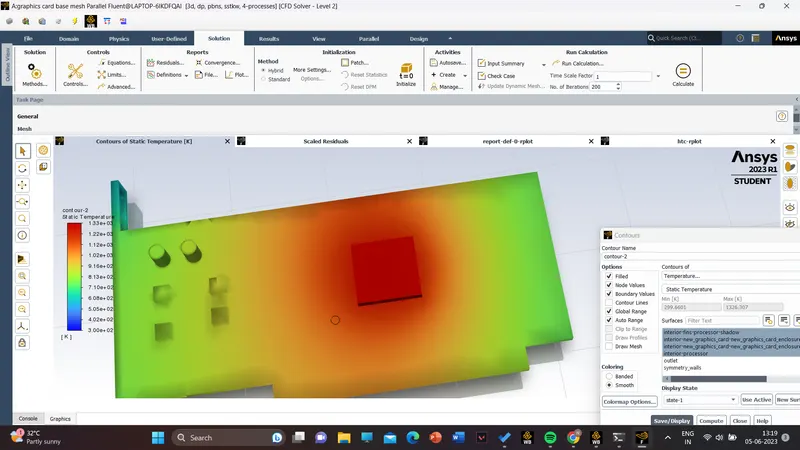
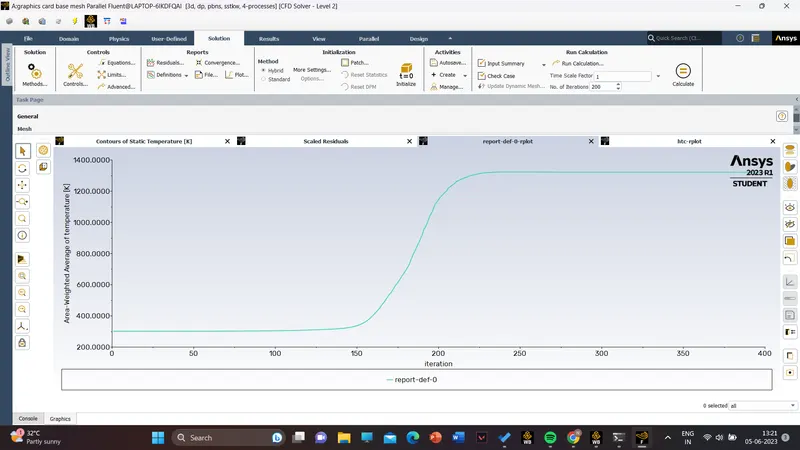
temerature in processor
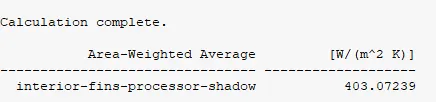
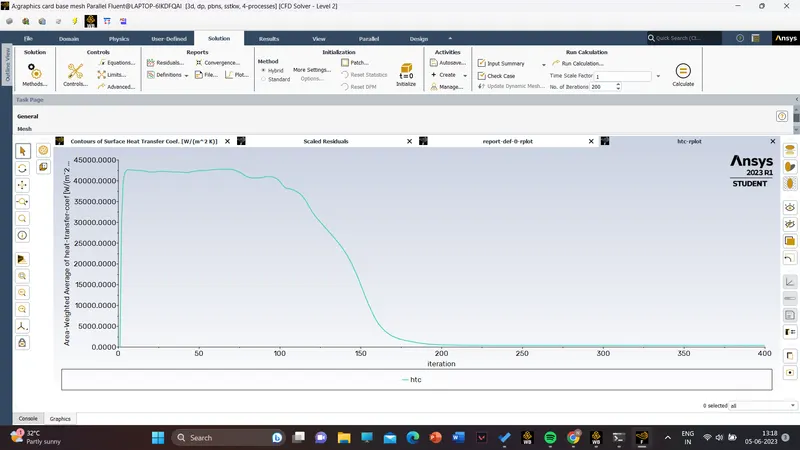
htc
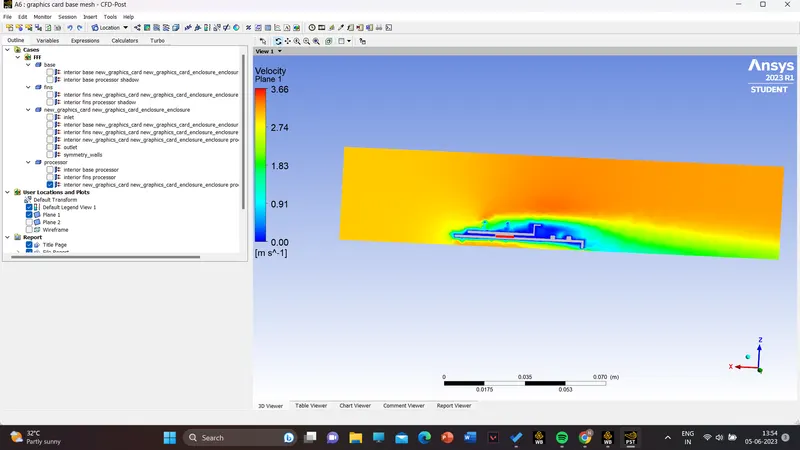
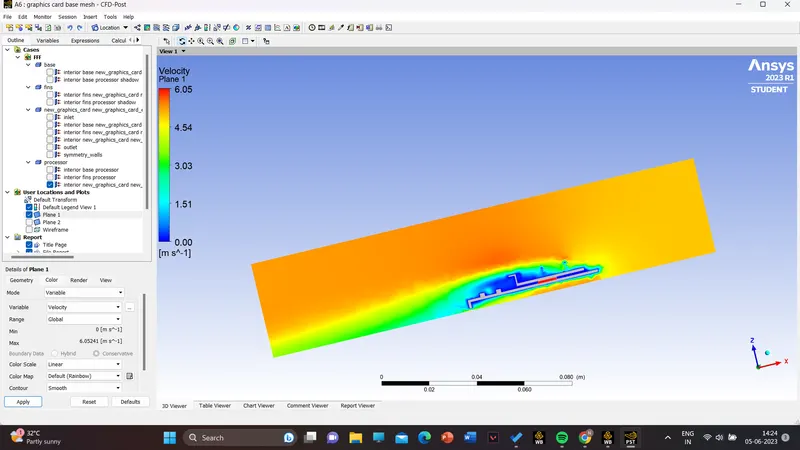
velocity
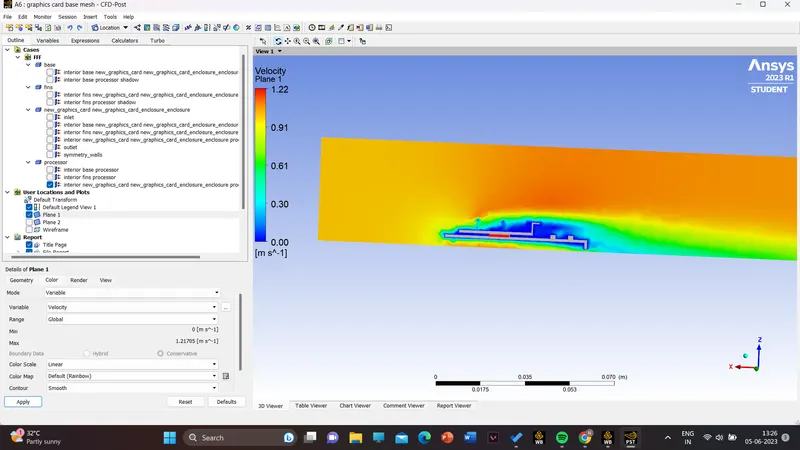
now result of refined mesh with 3m/s velocity
residuals
temperature contour of processor
tempertaure plot
HTC
velocity contour
temperature contour
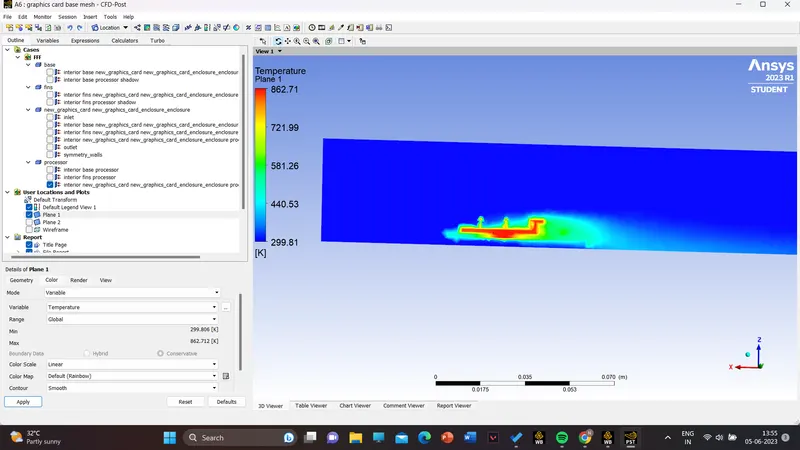
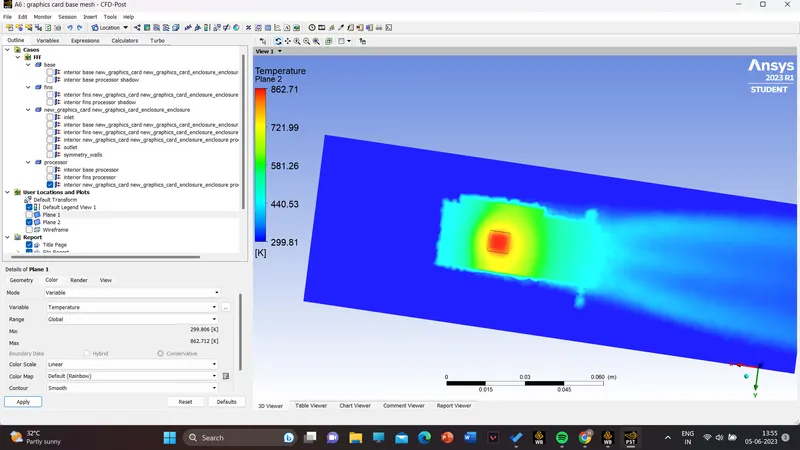
result of refined mesh with 5m/s velocity
residuals
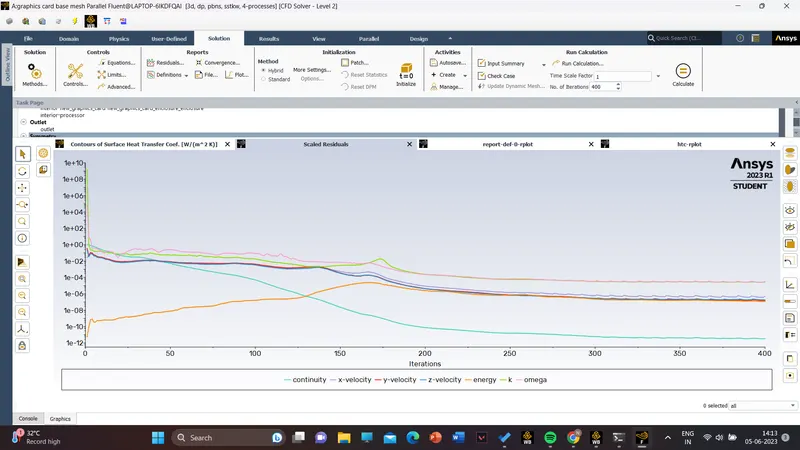
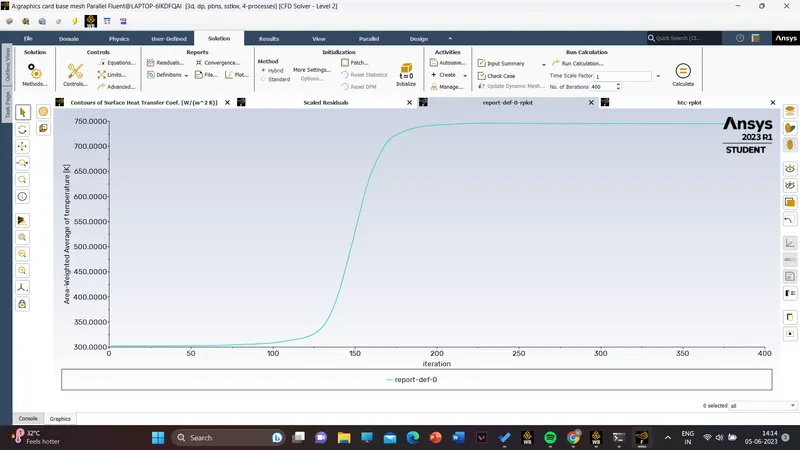
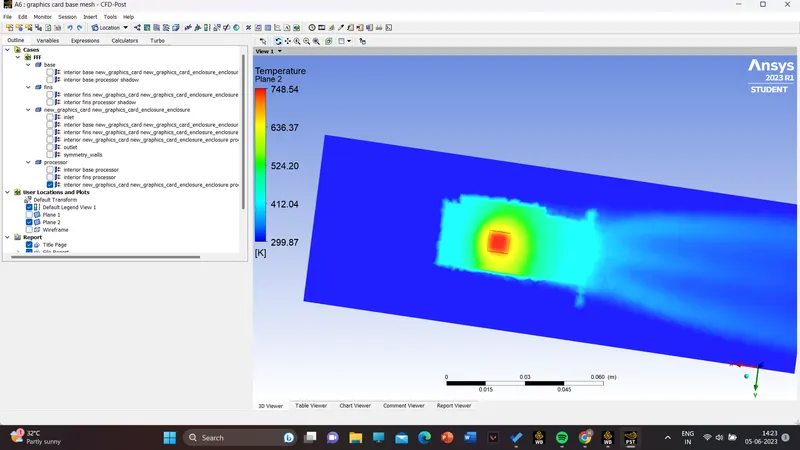
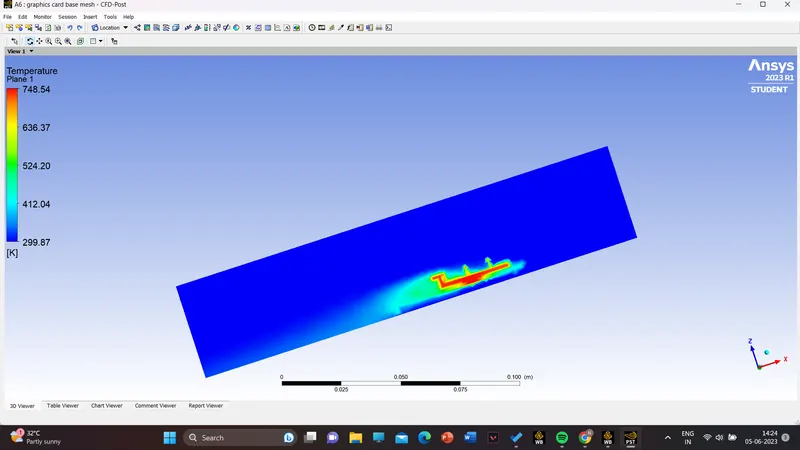
temperature plot
htc
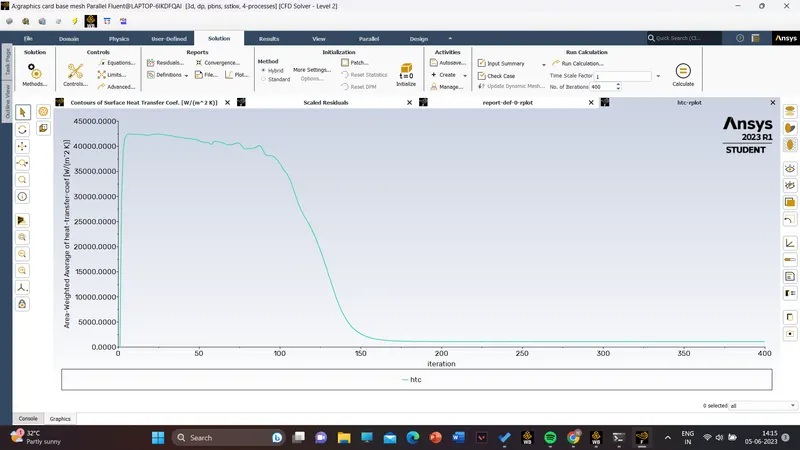
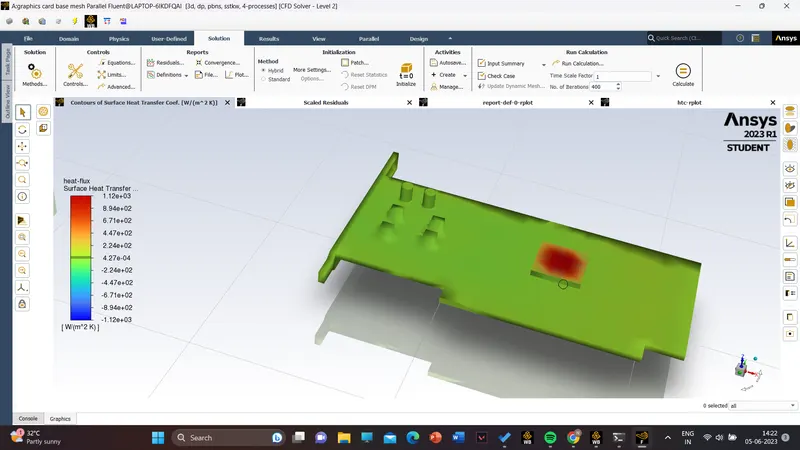
tempertaure contour
velocity contour
| baseline mesh (1m/s) | refined mesh (1m/s | refined mesh (3m/s) | refined mesh(5m/s) | |
| max temperature of processor | 1284.14 K | 1326.33 K | 862.04 K | 748 K |
| HTC of processor | 440 W/M2K | 403 W/M2K | 675.8 W/M2K | 1023 W/M2K |
Conclusion
A converged solution for the given sets of input was observed on the basis of repetitive plots in the Residual plot. The processor acted as a source of heat input and thus one of the hotspots for such study
With an increase in velocity, we saw a considerable drop in temperature and a substantial rise in heat transfer coefficient which shows that high-velocity air can be an effective mode of heat dissipation in graphics card
From the temperature distribution, we can see hotspots in the fin and base near the surface that is in contact with the processor. Based on the thermal conductivity of the material this temperature is distributed accordingly amongst the component. We see a few high-temperature zones on fin away from processor depicting their high susceptibility to heat due to their geometry.
Also, the difference in baseline and refined mesh is considerable and thus we can conclude that more refined mesh provides a better solution and can be used in optimizing the design for such applications.From the residual plot, the change in the gradients is very small with which we can conclude that the solution has converged.
From the temperature plot of the coarse mesh, the high-temperature points are found at fins, processor, and base area near the processor. As the wall heat transfer coefficient is a wall phenomenon and fins dissipate a large amount of heat which results in higher heat transfer co-efficient but the coarse mesh heat transfer for fins and other components in the graphics card has the same values. Hence refinement of mesh is done for fins and base of the fin and base of the graphic card in order to calculate the wall heat transfer coefficient at the fins and base.
The high-temperature regions are found at the center of the fins, base, and the processor walls. With further iterations, the temperature is distributed to other regions in the graphics card in the direction of the inlet airflow. Conduction occurs where there is a contact region between the solids in this case it is between processor and fins and processor and base. Convection occurs when the heat generated in the components of the graphic card is removed by the inlet airflow. The maximum temperature in the components is inversely proportional to the inlet airflow velocity. With the increase in the airflow velocity, the heat removal process by convection is faster. And also recirculation of air (vortex) at appropriate places will increase the heat transfer efficiencies hence greater amount of heat is removed by convection.