Week-6 Challenge: EV Drivetrain
Q.1
- Types of power converter circuits.
This technology involves managing the flow of electrical energy to deliver voltages and currents tailored for specific devices. Illustrated in the diagram, it comprises an energy source, a power electronic circuit, a control system, and an electric load. The converter alters electrical energy from one form to another. The power electronic circuit handles both power transmission and control, utilizing switches, transformers, chokes, capacitors, fuses, and occasionally resistors. Meanwhile, the control system oversees the components within the power circuit, employing sophisticated low-power electronics, which can include digital or analog circuitry.
a) AC to DC converter which is called "Rectifier" - It converts AC into Unipolar DC current.
b) DC to AC converter which is called "Inverter" - It converts DC into AC of desired voltage and frequency.
c) DC to DC converter which is called "Chopper" - It converts High voltage DC to low voltage DC (Step down) or Low voltage DC to High voltage DC (Step-up)
d) AC to AC converter which is called "Cycloconverter" - It converts the AC of the desired frequency and desired voltage magnitude from the AC supply.
The rectifier is employed to convert AC to DC, facilitating the charging of the traction battery, which stores DC voltage. Subsequently, the DC output from the battery is directed to two distinct converters: the inverter (DC-AC converter) and the chopper (DC-DC converter).
The inverter typically sits between the battery and the DC induction motor, which directly drives the wheels for traction. During regenerative braking, this motor functions as a generator, converting mechanical energy from the wheels and axles into electrical energy for storage in the traction battery.
The DC-DC converter receives its input from the traction battery, providing power for various components of the EV/HEV such as the Human Machine Interface (HMI), headlights, and air conditioning system.
Q.2
Q.3
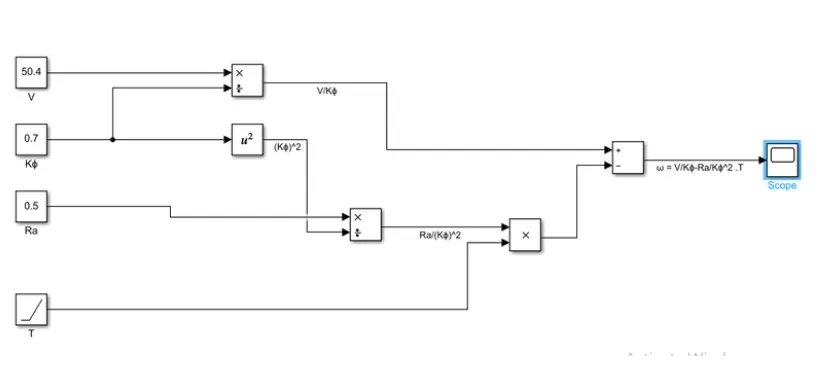
Model-
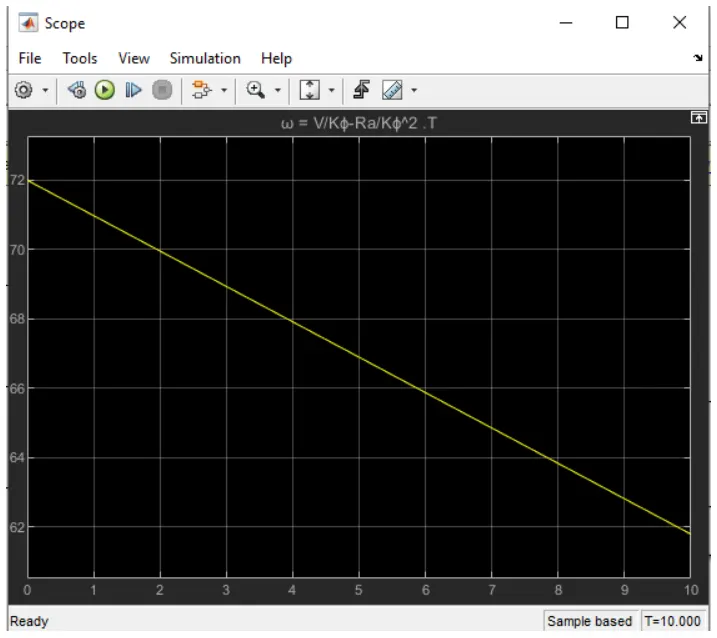
Result-
Q.4
-Working principle of BLDC motor,
1. Constructed from thin, stacked laminations, the stator engages with the current coursing through its windings, resulting in a torque interaction with the rotor.
2. The rotor incorporates two or more permanent magnets, generating a DC magnetic field. As the rotor turns, it's crucial to continually adjust the magnitude and polarity of the stator current to maintain consistent torque and ensure efficiency.
3. A DC brushless motor necessitates an inverter for its operation; without it, the motor cannot function.
-Working principle of Induction Motor
1. The stator in this context shares similarities with that of an induction motor, differing primarily in the rotor design compared to a DC brushless motor. Unlike the DC brushless motor, the induction motor lacks permanent magnets. While an inverter is not essential for the operation of an induction motor, employing a small inverter can enhance its efficiency.
2. In this setup, the rotor consists of stacked steel laminations featuring embedded peripheral conductors forming a short-circuited structure. The rotating magnetic fields produced by currents in the stator windings penetrate the rotor.
-Pros and Cons of DC Brushless:
Pros
i) Heat generated from the rotor is less, hence rotor cooling is easy and peak point efficiency is higher than the DC Brushless.
cons
i) Inverter (whose phase is maintained in a step with the angular position of the rotor) is mandatory without which DC Brushless motor is useless.
ii) Magnetic field strength cannot be easily adjusted because of the permanent magnets.
iii) In DC Brushless motor, as its size increases the magnetic losses also increase.
iv) Permanent magnets are expensive.
Pros and Cons of Induction Motor:
Pros
i) No need for Inverter, the motor has the ability to start under load.
ii) Since they do not have any magnets, controlling the Magnetic field here is easy. Hence Magnetic losses (Eddy+Hysterisis+current resistance losses) are minimized and the efficiency is maximized.
iii) Induction drives may be the favored approach where high-performance is desired; peak efficiency will be a little less than with DC brushless, but average efficiency may actually be better.
iv) Induction Motors are less expensive when compared to DC Brushless.