Week-6 Challenge: EV Drivetrain
Q1: Which types of power converter circuits are employed in electric and hybrid electric vehicles?
A power converter serves as an essential component in electrical engineering, facilitating the transformation of electric energy from one form to another, tailored to meet specific load requirements. These converters perform various functions, altering the output from the input, whether by adjusting voltage magnitude, inverting polarity, or generating multiple output voltages of the same or different polarities. Their function is critical as they bridge the gap between the power source and the output supply, ensuring optimal compatibility with user loads.
Power converters are broadly categorized based on input and output voltage configurations, falling into four main types:
1. AC-DC Converter (Rectifier)
2. DC-DC Converter (Chopper)
3. DC-AC Converter (Inverter)
4. AC-AC Converter (Cycloconverter or Frequency Changer)
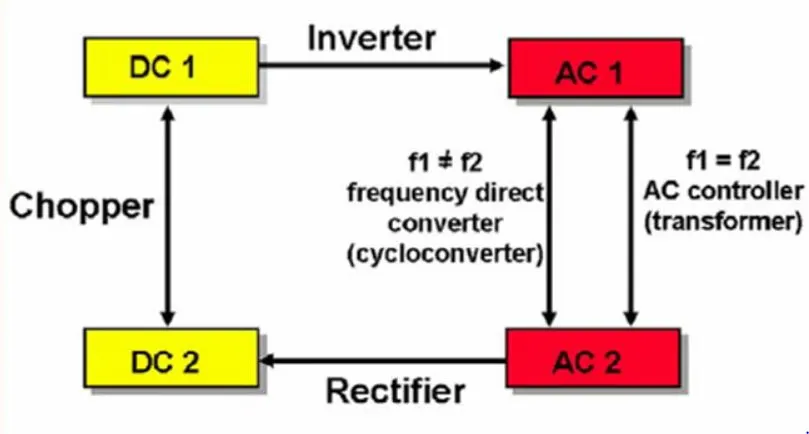
It's worth noting that electric and hybrid electric vehicles typically do not utilize AC-AC converters in their construction.
AC-DC Converter (Rectifier):
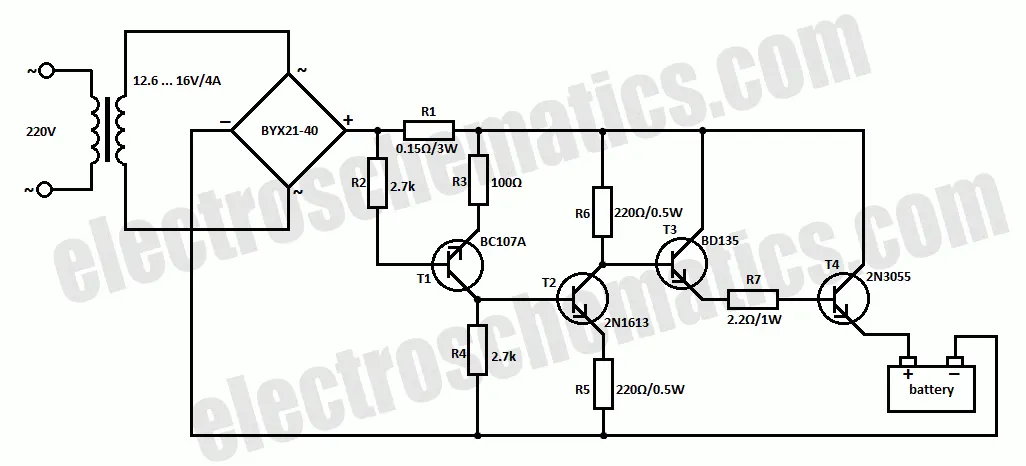
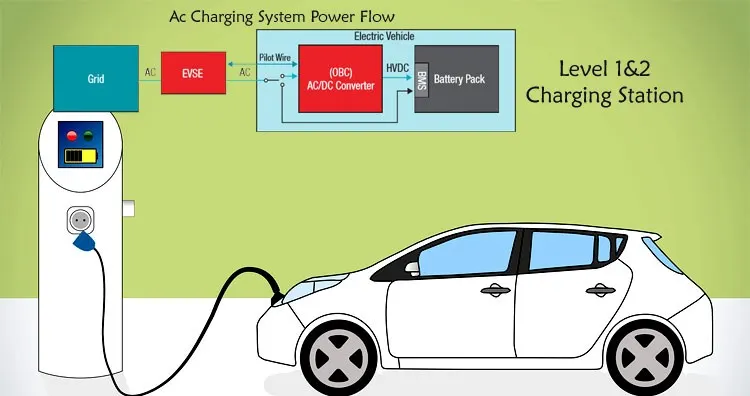
Electric power transmission occurs either as direct current (DC) or alternating current (AC), with AC being the predominant method due to its advantages such as lower distribution costs and ease of voltage level conversion using transformers. AC power, transmitted at high voltages over long distances, is later converted to lower voltages for safer and more efficient use in homes. In AC-DC converters, a transformer followed by rectification produces DC power. In electric vehicles (EVs) and hybrid electric vehicles (HEVs), rectifiers within onboard chargers convert AC power from charging stations to DC power for battery charging.
DC-DC Converter (Chopper):
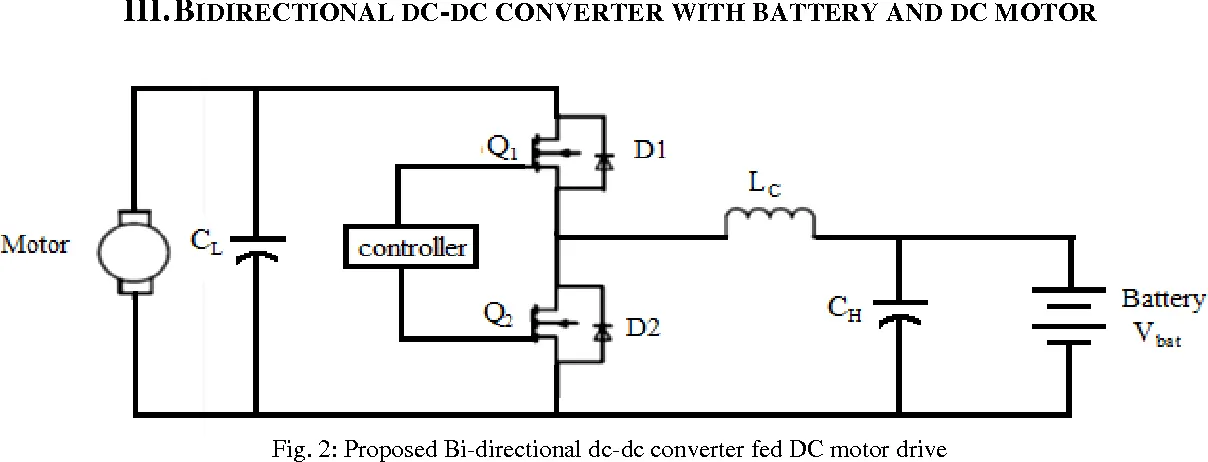
A DC-DC converter converts DC from one voltage level to another. These converters are crucial in portable electronic devices like cell phones and laptops powered by batteries, as various sub-circuits often require different voltage levels. DC-DC converters can be categorized into step-up (increasing voltage) and step-down (decreasing voltage) types. In EVs and HEVs, step-down choppers adjust voltage levels for auxiliary devices powered by the car battery. Additionally, choppers are employed in vehicles equipped with DC brushed motors to modulate power delivery to the motor.
DC-AC Converter (Inverter):
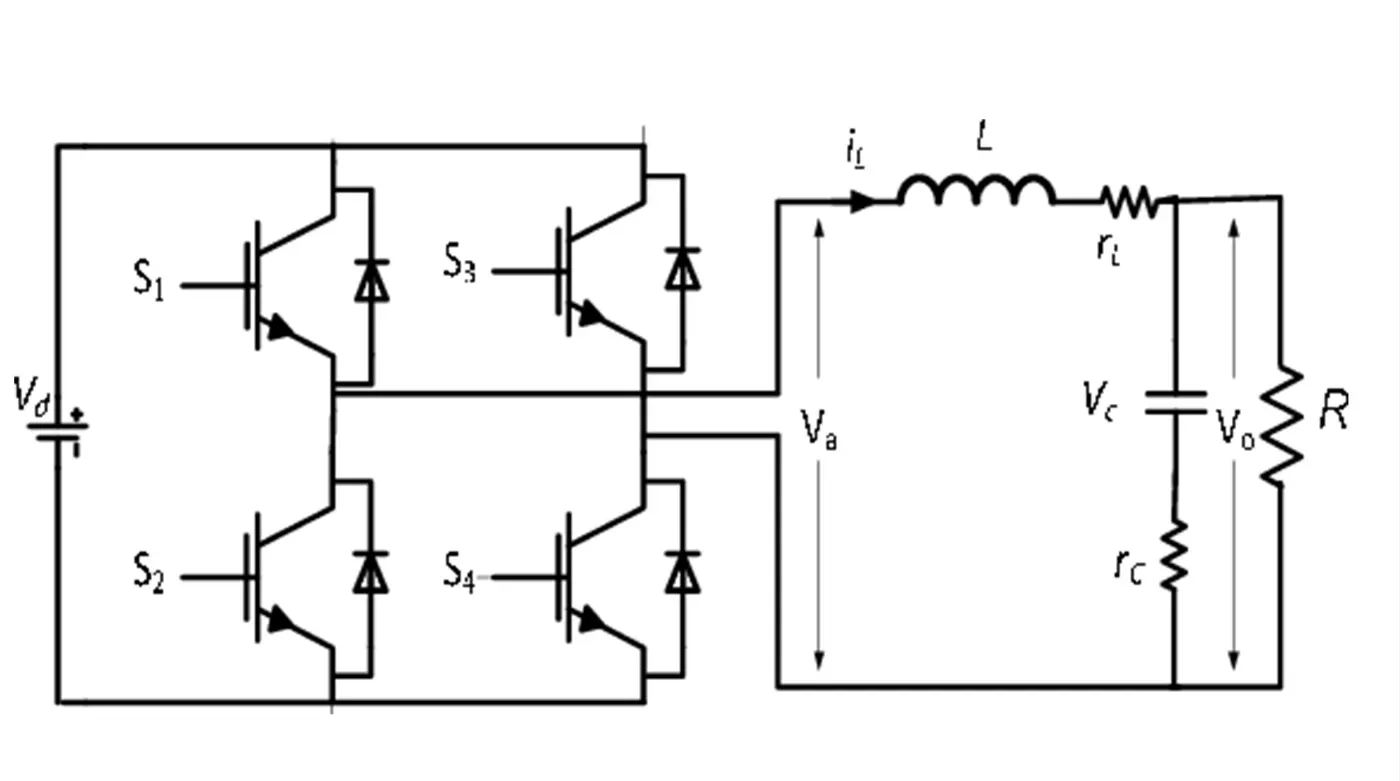
Power inverters transform DC power, typically from batteries, into AC power, used in homes and larger electronic devices. In EVs and HEVs, where DC brushless induction motors are prevalent, inverters play a vital role. While the torque-speed characteristics of these motors resemble those of DC brushed motors, their internal operation relies on AC power. Hence, inverters convert DC power from the car battery into AC for the operation of induction motors.
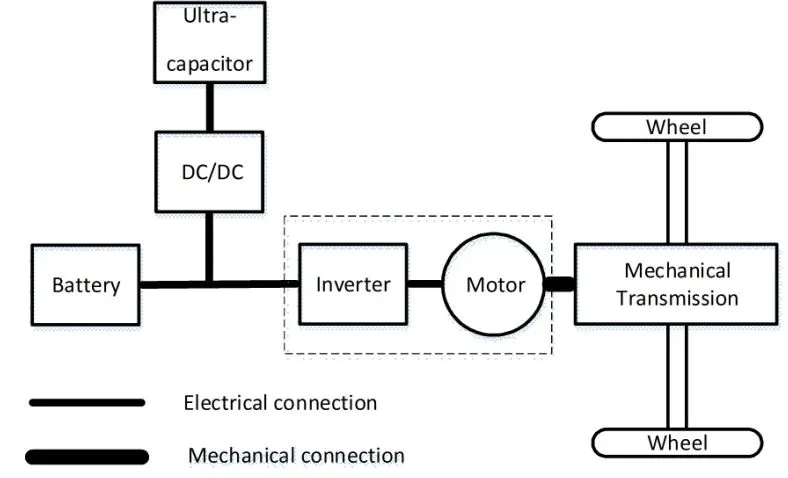
In conclusion, power converters play a crucial role in electrical systems, enabling efficient energy conversion to meet diverse application requirements. Understanding their functions and applications is essential for designing and optimizing electrical systems, especially in the context of electric and hybrid vehicles.
Q2: An Electric Vehicle's powertrain with 72V battery pack in shown in the diagram below. The duty ratio for acceleration operation is 'd1' and for the braking operation the duty ratio is 'd2'.
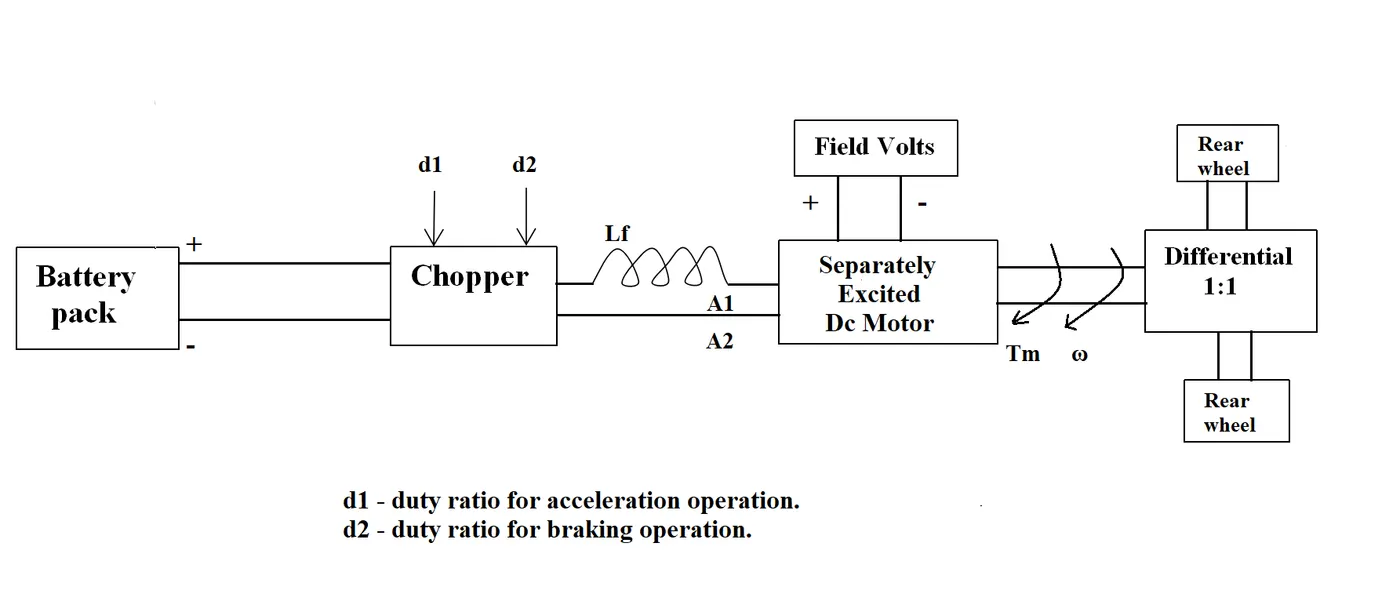
The other parameters of the electric vehicle is given below,
Motor and Controller Parameters:
Rated Armature voltage= 72 V
Rated armature current= 400 A
Ra= 0.5Ω, KΦ= 0.7 Volt second
Chopper Switching frequency= 400 Hz
The vehicle speed-torque characteristics are given by the below equation

What is EV steady state speed if duty cycle is 70%?
The primary equation governing the motor's Speed-Torque characteristics is provided as follows:
T = (kϕ)2/Ra (d.V/kϕ − ω)
Where:
l T represents the motor torque (N-m)
l kϕ signifies the motor constant (Volt-s or Weber)
l Ra denotes the armature resistance (ohms)
l d represents the duty cycle
l V represents the rated armature voltage (Volts)
l ω signifies the motor speed (rad/s)
By substituting the given values into this equation, we obtain:
T = (72−ω) × (0.98)
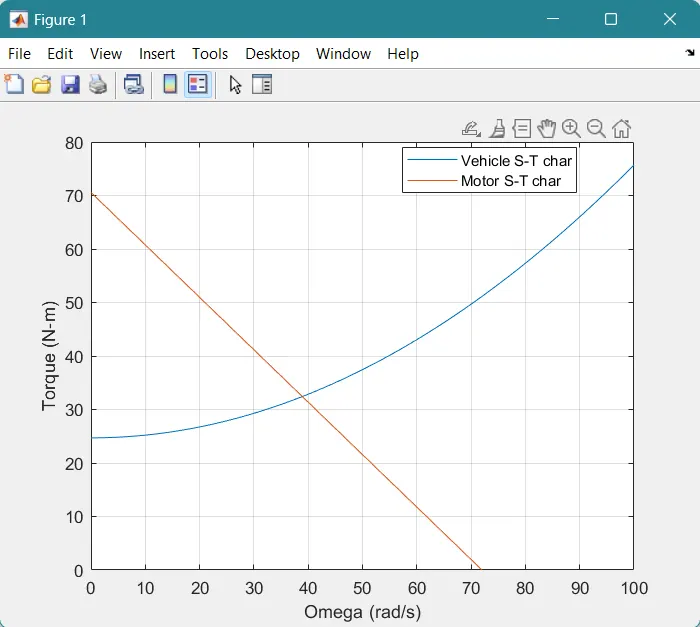
The steady-state speed of the electric vehicle (EV) corresponds to the speed at which the vehicle's Speed-Torque characteristics align with the Electric Motor's Speed-Torque characteristics.
Hence, we have:
24.7 + (0.0051)ω2 = (72−ω) × (0.98)
This equation simplifies to:
0.0051ω2 + 0.98ω − 45.86=0
Upon solving the quadratic equation, we obtain two potential solutions:
ω=38.91 rad/s (or) ω=−231.07 rad/s
Given that the vehicle is assumed to be accelerating and not braking, we consider the positive value as the required steady-state speed.
Hence, ω=38.91 rad/s, which translates to ω=371.5 rpm.
This can be visualised with the help of MATLAB too -
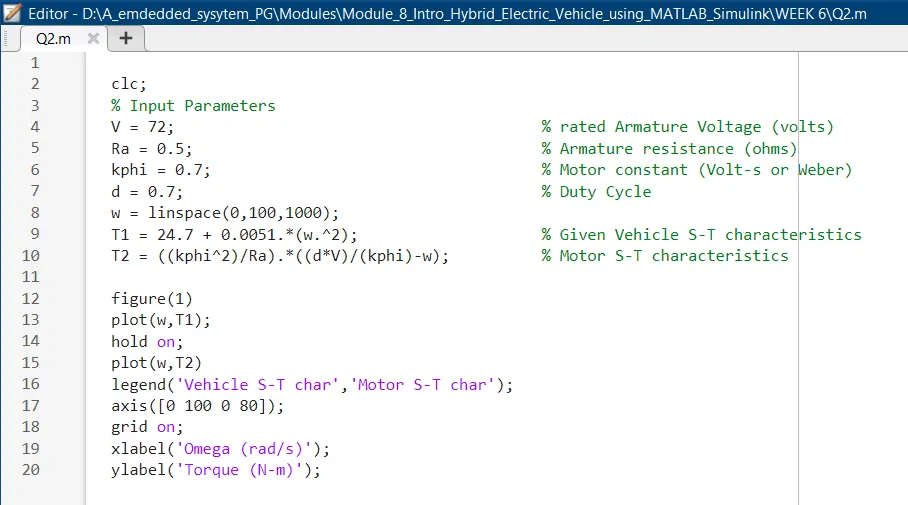
Output Graph:
Q3: Develop a mathematical model of a DC Motor for the below equation using Simulink.
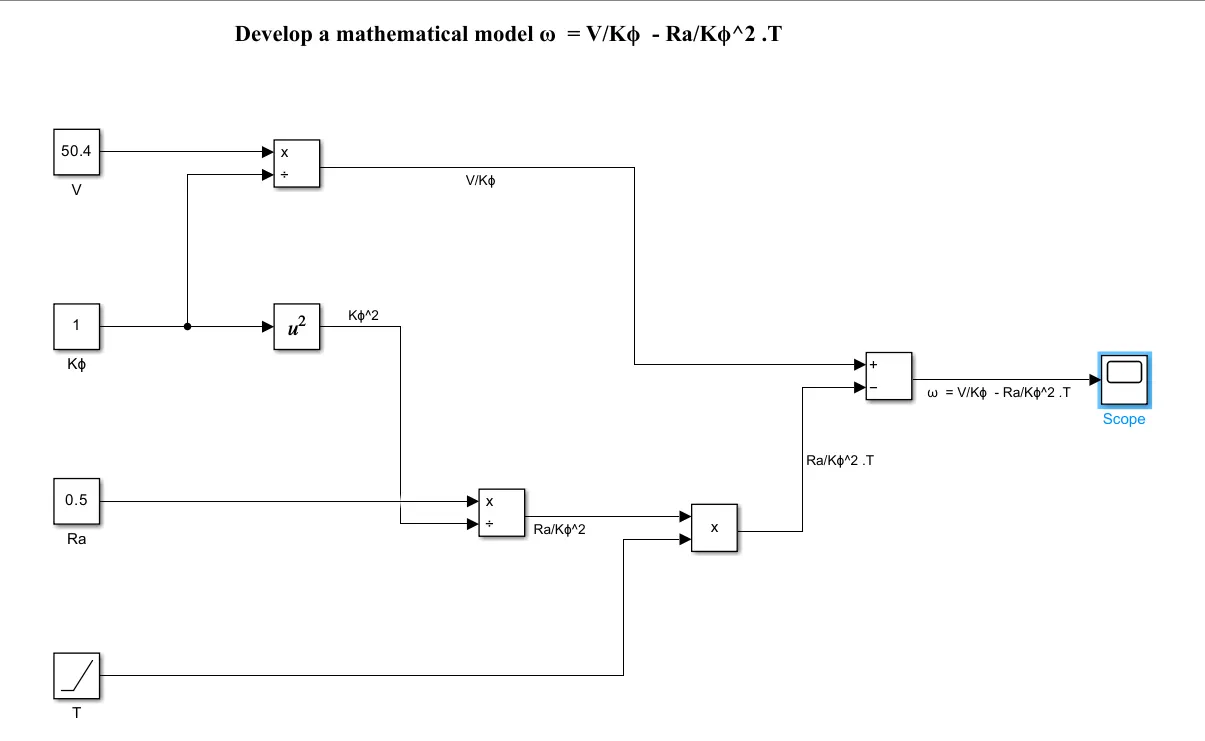
ω = V/Kϕ - Ra/Kϕ^2 .T
Let us draw a model for the above equation.
Let V = 50.4 Volts, Kϕ = 0.7, Ra = 0.5Ω
and also let consider torque as a linearly increasing signal.
The simuLink Model:
Output Graph:
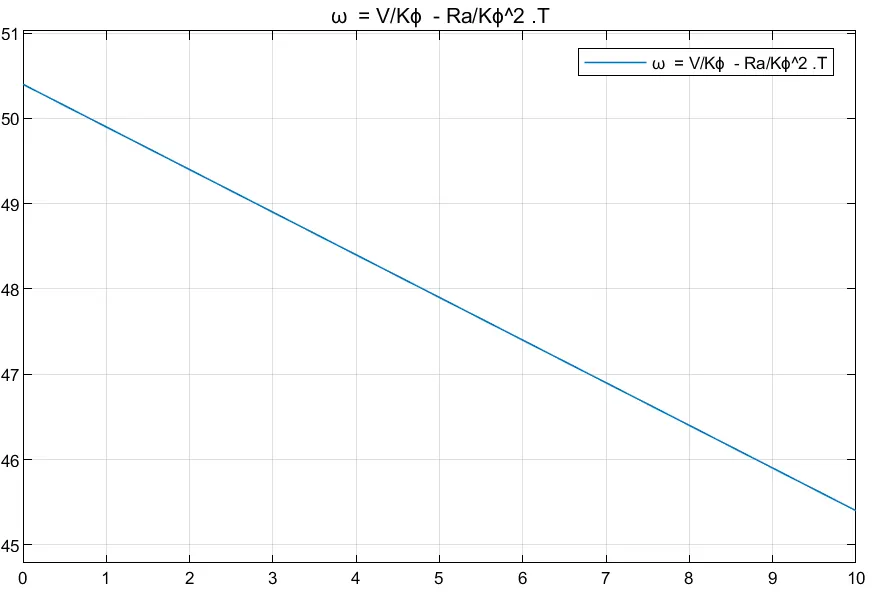
This result show torque speed curve for DC motor
Q4: Refer to the blog on below topic:
Induction Versus DC brushless motors by Wally Rippel, Tesla
Explain in brief about author’s perspective.
In the provided blog post authored by Wally Rippel, an experienced Power Electronics engineer, the author explores the evolution and future prospects of DC Brushless and Induction motors in the automotive industry. Having contributed significantly to the development of the EV1 for General Motors, Rippel possesses deep insights into electric vehicle (EV) components.
Rippel begins by reflecting on the transition from lead batteries to lithium-ion batteries in electric vehicles and the concurrent shift from conventional DC brushed motors to DC Brushless or Induction motors. He addresses the question of whether these motor types will stabilize or become obsolete in the automotive industry.
To shed light on this inquiry, Rippel elucidates the working principles and construction of both motor types. He explains that while both motors share similarities in the stator design, the key distinction lies in their rotors. Brushless DC motors feature permanent magnets generating a magnetic field interacting with stator currents to produce torque, necessitating an inverter for current control. In contrast, induction motors have rotor conductors producing currents induced by the rotating magnetic field from the stator, eliminating the need for an inverter.
Rippel presents a balanced view by highlighting the utility advantages of induction motors, such as not requiring DC power and producing less heat compared to brushless DC motors. However, he acknowledges their complexity and challenges in torque-speed control. Despite slightly lower peak power efficiency, brushless DC motors are favored for their simpler control and higher efficiency, albeit at a higher cost due to permanent magnets.
After a comprehensive comparison, Rippel concludes that brushless DC motors are likely to dominate the hybrid market, while induction motors will prevail in the pure EV market. This conclusion underscores the nuanced considerations surrounding motor selection in the automotive industry, balancing factors like efficiency, cost, and application suitability.
Conclusion:
Power converters are crucial in electric and hybrid electric vehicles, facilitating efficient energy conversion for diverse applications. The use of AC-DC, DC-DC, and DC-AC converters optimizes power management, enhancing overall vehicle electrical system performance. Understanding different converter types enables engineers to design vehicle powertrains for desired performance and energy efficiency.
Simulink's DC motor model offers insights into motor behavior under various conditions, aiding in optimization for specific applications. Wally Rippel's comparison of induction versus DC brushless motors highlights evolving motor technologies, guiding informed motor selection based on efficiency, cost, and control complexity.
Key Learnings:
1. Power converters are essential components in electric and hybrid electric vehicles, facilitating efficient energy conversion for various electrical systems and components.
2. Different types of power converters, including AC-DC converters, DC-DC converters, and DC-AC converters, are employed in vehicle powertrains to manage power flow and optimize energy usage.
3. Simulink provides a powerful platform for developing mathematical models of DC motors and simulating their behavior under different conditions, enabling engineers to analyze and optimize motor performance.
4. The comparison between induction and DC brushless motors highlights the importance of considering factors such as efficiency, cost, and control complexity when selecting motors for automotive applications.
5. Understanding the unique characteristics and requirements of different motor technologies is crucial for designing and manufacturing electric and hybrid vehicles that meet performance, efficiency, and cost targets.