Week-6 Challenge: EV Drivetrain
Question 1:
Power electronic circuits:The field of power electronics mainly deals with the conversion of power from one form to another and the change from one voltage level to another by using different power electronic converters.
Types of Converters:
1) AC to DC converter: A type of converter that changes input AC signal into a DC is known as AC to DC converter also called as rectifiers.
2) DC to DC converter: The converters that convert the dc signal of fixed frequency present at the input into a variable dc signal at the output are also known as choppers.
3) DC to AC converter: The devices that are designed to convert the dc signal into ac signal are known as inverters. The applied input is a fixed dc voltage that can be obtained from batteries but the output obtained is variable ac voltage.
4) AC to AC converter: An ac to ac converter is designed to change the ac signal of fixed frequency into a variable ac output voltage. These are basically of two types:
a) Cycloconverters: A cycloconverter is a device used for changing ac supply of fixed voltage and single frequency into an ac output voltage of variable voltage as well as different frequency. However, here the obtained variable ac signal frequency is lower than the frequency of the applied ac input signal. It adopts single-stage conversion.
b) AC Voltage Controllers (AC voltage regulators): The converters designed to change the applied ac signal of fixed voltage into a variable ac voltage signal of the same frequency as that of input.
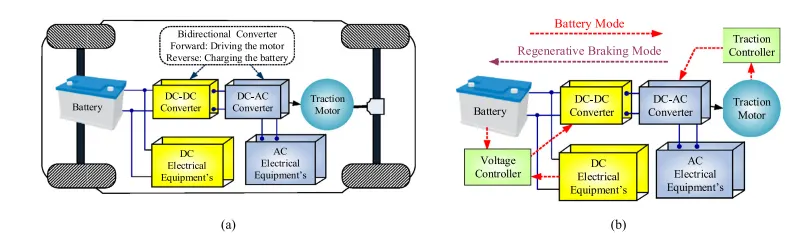
The above picture depicts the use of the DC-DC and DC-AC converter in the case of the Electrical vehicle.
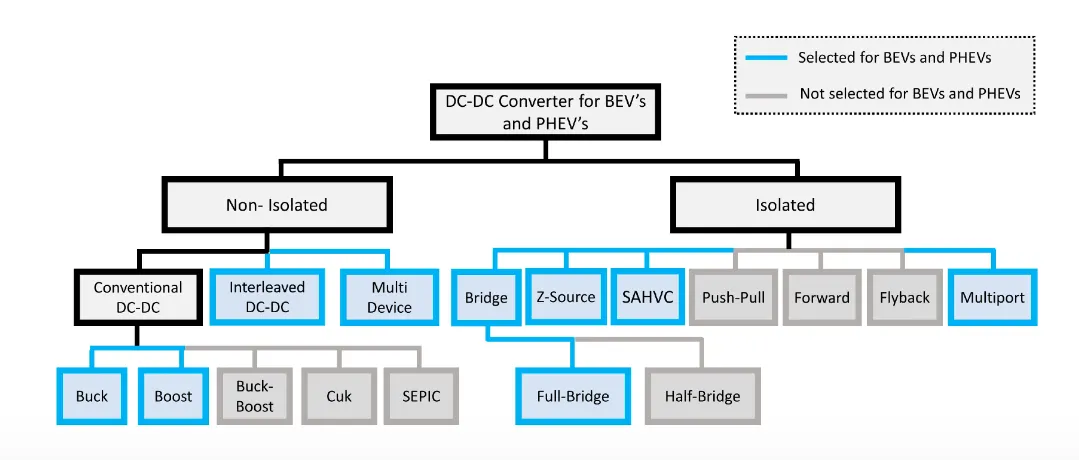
The above shown DC DC converters are being used in the case of plug in and battery electrical vehicles.
An inverter serves the same kind of function in a hybrid or EV car, and the theory of operation is relatively simple.2 DC power, from a hybrid battery, for example, is fed to the primary winding in a transformer within the inverter housing. Through an electronic switch (generally a set of semiconductor transistors), the direction of the flow of current is continuously and regularly flip-flopped (the electrical charge travels into the primary winding, then abruptly reverses and flows back out). The in/outflow of electricity produces AC current in the transformer's secondary winding circuit. Ultimately, this induced alternating current electricity provides power for an AC load—for example, an electric vehicle's (EV) electric traction motor.
A rectifier is a similar device to an inverter except that it does the opposite, converting AC power to DC power.The most common use of a converter is to take a relatively low voltage source and step-it-up to high voltage for heavy-duty work in a high power consumption load, but they can also be used in reverse to reduce voltage for a light load source.
Question 2:
Given:
Battery voltage (Vbat) = 72V
Armature voltage (Va) = 72V
Armature current (Ia) = 400A
Armature resistance (Ra) = 0.5 Ω
KΦ = 0.7 V sec
frequency (f)= 400 Hz
The torque equation is given as follows
Tv= 24.7+(0.0051)w^2
The speed equation is as follows:
wm=((Vo/KΦ)-(Ra*Tm/(KΦ)^2))
Tm=((Vo*KΦ)/Ra)-((KΦ)^2*wm)/Ra)
Here
Vo= d*Vs = 0.7*72=50.4
Substituting the values the equation is as follows:
Tm = ((50.4*0.7)/0.5)-((0.7)^2)*wm)/0.5)
Tm=70.56-(0.98)wm
So from above torque the solution is as follows
24.7+0.005=1*w^2=70.56-0.98w
0.0051w^2+0.98w-45.89=0
The speeds of the machine is
w1=38.94 rps ; w2=-231.094 rps
Question 3:
Simulink model:
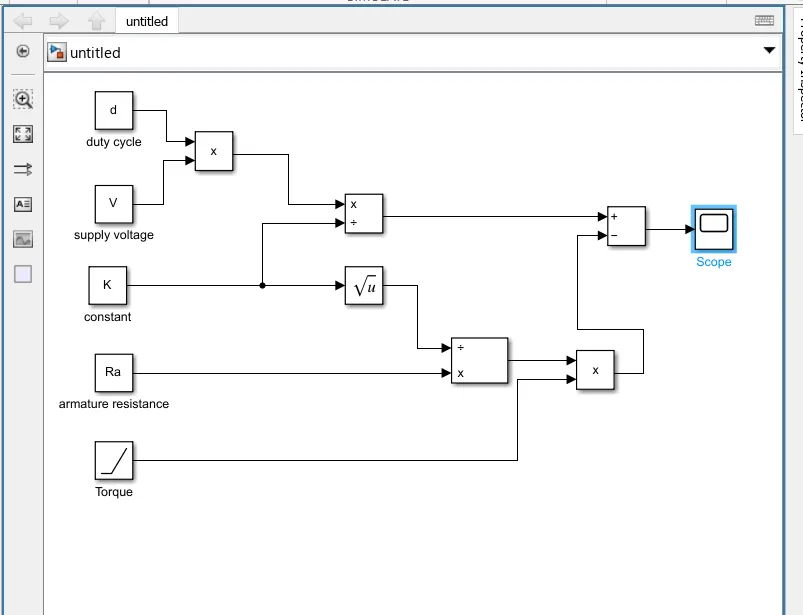
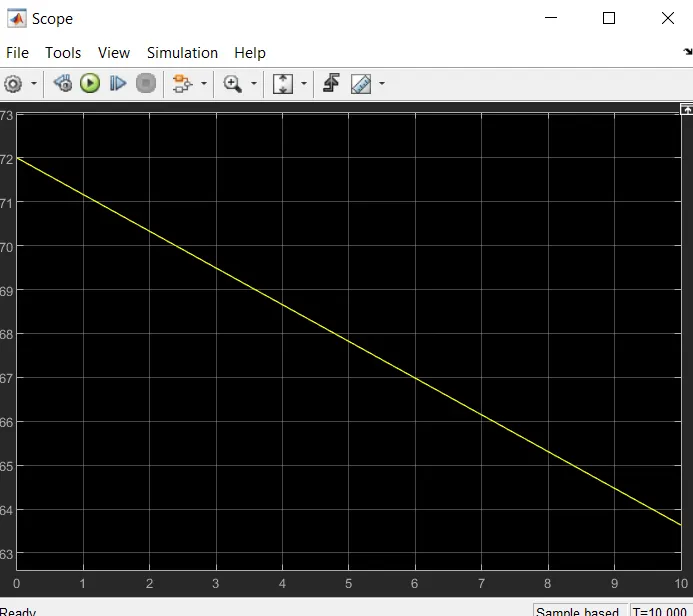
The above is the model for the speed torque characteristics of DC motor.
Question 4:
Induction VS DC Brushless motors:The article is being published by Wally Rippel on Jan 9, 2007. He was an engineer in AeroVironment, Jet Propulsion Laboratory and Tesla company.HE built an electric car and won the Great Transcontinental Electrical Car Race against MIT
In the past years there was lead acid batteries, DC brush motors and contractor controllers. And then litium and DC by either DC brushless or induction.
DC Brushless machine:
- The rotor includes two or more permanent magnets that generate a DC magnetic field.
- In turn, this magnetic field enters the stator core (a core made up of thin, stacked laminations) and interacts with currents flowing within the windings to produce a torque interaction between the rotor and stator.
- As the rotor rotates, it is necessary that the magnitude and polarity of the stator currents be continuously varied – and in just the right way - such that the torque remains constant and the conversion of electrical to mechanical energy is optimally efficient.
- The device that provides this current control is called an inverter. Without it, brushless motors are useless motors.
Induction motor:
- The induction rotor has no magnets – just stacked steel laminations with buried peripheral conductors that form a “shorted structure.” Currents flowing in the stator windings produce a rotating magnetic field that enters the rotor.
- In turn, the frequency of this magnetic field as “seen” by the rotor is equal to the difference between the applied electrical frequency and the rotational “frequency” of the rotor itself.
- Accordingly, an induced voltage exists across the shorted structure that is proportionate to this speed difference between the rotor and electrical frequency. In response to this voltage, currents are produced within the rotor conductors that are approximately proportionate to the voltage, hence the speed difference
- Finally, these currents interact with the original magnetic field to produce forces – a component of which is the desired rotor torque.
| Brushless DC motor | Induction motor |
| Motor requirs absolute position sensor | It requires speed sensor. |
| Rotor heat is less compared to Induction motor | Rotor heat is little more in DC brushless motor |
| Operate at unity power factor | The power factor is about 85%. |
| This has magnets. | It has no magnets. |
| If size increases magnetic losses will increase | If size increases the losses won't change. |
| The control is easy | The control loss are more comlex and difficult to understand. |
Conclusion:
DC brushless motor is better used in the hybrid and upcoming plug in hybrid markets.
Induction motor are likely used for high performance pure electrics. The both motors have theirs own specifications and paly the roles in their own respective ways.