Week-6 Challenge: EV Drivetrain
SOLUTION [1]:
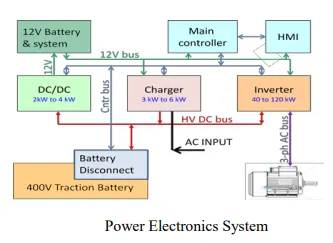
Vehicle Power Electronics primarily process and control the flow of electrical energy in hybrid and plug-in electric vehicles,
including plug-in electric vehicles. They also control the speed of the motor, and the torque it produces. Finally, power electronics convert
and distribute electrical power to other vehicle systems such as heating and ventilation, lighting, and infotainment. Power electronics
components include inverters, DC/DC converters, and chargers (for plug-in electric vehicles).
The power conversion systems can be classified according to the type of the input and output power
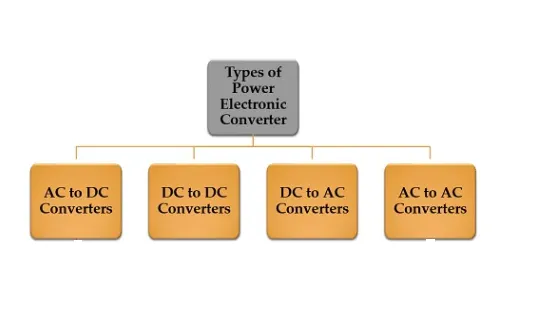
1-AC to DC (Rectifier):A rectifier is an electrical device comprised of one or more diodes that allow the flow of current only in one direction. It basically converts alternating current into direct current. Rectifiers can be mold in several shapes as per necessity like semiconductor diodes, SCRs (silicon controlled rectifiers), vacuum tube diodes, mercury-arc valves, etcIn EV/HEV Rectifier used for charging the traction battery.
2-DC to AC (Inverter): The DC-to-AC Converters are used to charge the batteries in the vehicles. These circuits are mainly used for driving low-power AC motors and are used in a solar power system. The DC to AC converters can be used in dc transmission lines for transmitting power to loads.
3-DC to DC (Chopper):DC-to-DC converters are devices that temporarily store electrical energy for the purpose of converting direct current (DC) from one voltage level to another.In automotive applications, they are an essential intermediary between systems of different voltage levels throughout the vehicle.DC-DC converter takes the DC source from the traction battery. The output from this DC-DC converter is used to power all the other components of the EV/HEV like HMI, Headlamps, AC
4-AC to AC (Cycloconverter):AC to AC converters is used for converting the AC waveforms with oneparticular frequency and magnitude to AC waveform with another frequency at another magnitude.This conversion is mainly required in case of speed controlling of machines, for low frequency and variablevoltage magnitude applications as well.
SOLUTION [2]:
The parameters of the electric vehicle is given below,
Motor and Controller Parameters:
Rated Armature voltage= 72 V
Rated armature current= 400 A
Ra= 0.5Ω, KΦ= 0.7 Volt second
Chopper Switching frequency= 400 Hz
The vehicle speed-torque characteristics are given by the below equation
 ....... eq(1)
To Find what is EV steady state speed if duty cycle is 70%?
Solution: Duty cycle is 70% of v
Hence actual voltage=0.7*72
=50.4 v
Speed of motor Wm=(v/KΦ)-((Ra/KΦ^2)*T)
Re-arranging the Above equation to get Toque
T=(v*KΦ)/Ra-(Wm*KΦ^2)/Ra
Now by Substituting the above values
T=70.56-Wm*0.98 ....eq(2)
Now by comparing equation 1 and equation 2 and we get
24.7+(0.0051)*W^2= 70.56-W*0.98
(0.0051)*W^2+W*0.98=70.56-24.7
(0.0051)*W^2+W*0.98-45.86=0
Wm=38.91 rad/s . Hence this is EV steady state speed.
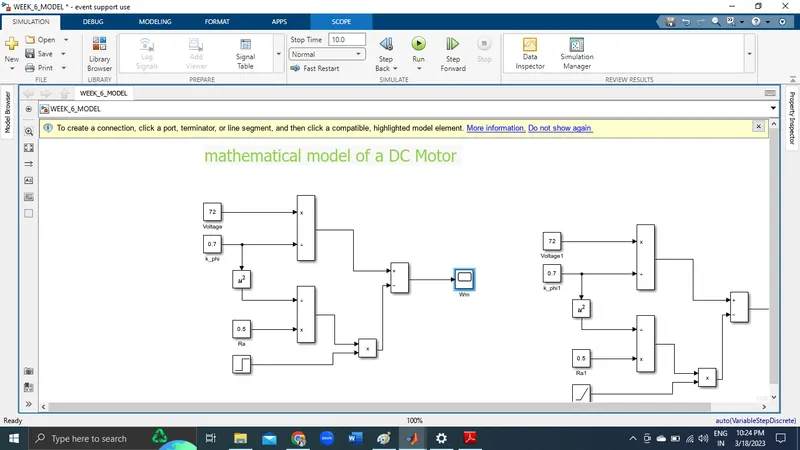
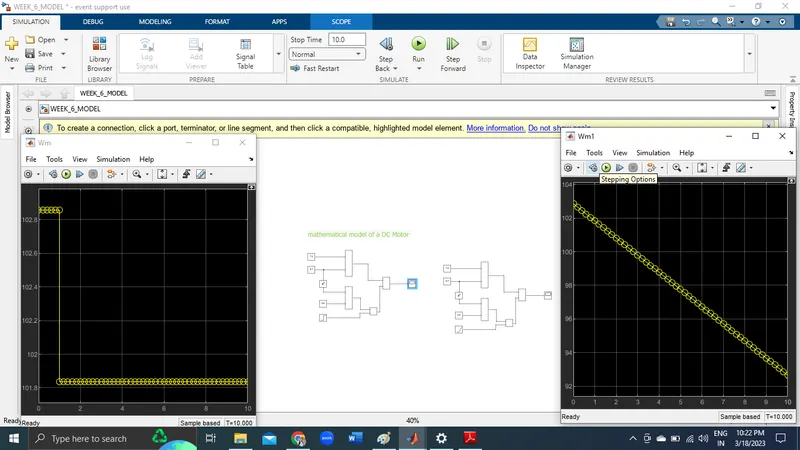
SOLUTION [3]: Mathematical model of a DC Motor
SOLUTION [3]:
According to authors perspective, Firstly he talked on previously used system of Battery & Drive system,Earlier used lead acid battery,Dc brushed motor,contact controllers now replaced by Lithium ion battery,Dc brushless motor or Induction motor and modulating inverter drives.
He discussed diffrences of DC Brushless motor and induction motion Which are written below
|
DC BRUSHLESS MOTOR |
INDUCTION MOTOR |
|
1. It has no starting torque when directly connected to fixed frequency utility power 2. It needs inverter whose phase is maintained in step with angular position of rotor
3. Drives require position sensor- less heat is released,rotor cooling is easy,peak point efficiency is high 4. It can work at 100% power factor
5. In ideal BLDC drives strength of magnetic field produced by permanent magnet is adjustable 6. magnetic field cant be adjusted because PM is used 7. As machine size increases looses efficiency due to high losses but it has good stability over torque - Speed region and less heat is emitted 8. It will Dominates in HEV,PHEV
|
1. It has the ability to start underload 2. In IM inverter not needed 3. shaft speed ∝ line frequency 4. with ultility power constant speed machines having limited starting torque , limited running peak torque when compared to DC machines 5. Using inverter feed back looops produces the exact frequency the motor needs.By adjusting the inverter frequency we can vary speed 6. Drives require speed sensor only 7. Best working when pf = 85% 8. Magnetic field is adjustable by changing voltage or frequency B∝v/f 9. With smart inverters IM has advantage over DC brushless 10. Less losses ,peak efficiency is less but average efficiency is high 11. It will Dominates in high performance pure EVs
|
Hence all the tasks are Performed .