Week-6 Challenge: EV Drivetrain
Q1) Which types of power converter circuits are employed in electric and hybrid electric vehicle?
solution :-
1. Power converter circuits :
This technology deals with processing and controlling the flow of electrical energy in order to supply voltages and currents in a form that is optimally suited for the instruments.
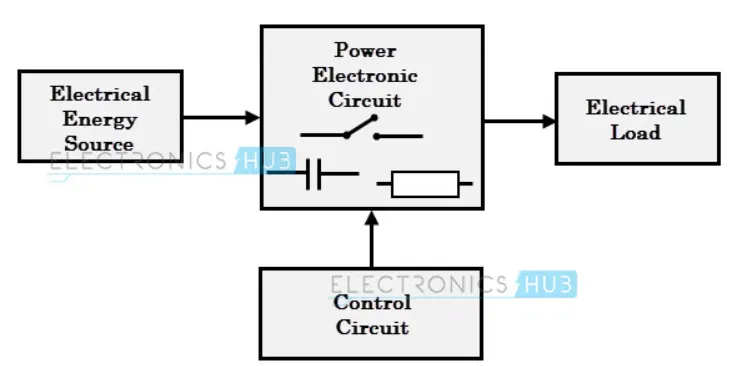
It consists of an electrical energy source, a power electronic circuit, a control circuit, and an electric load, as illustrated in the block diagram above. This converter converts one type of electrical energy into another type. Both the power and the control functions are carried out by the power electronic circuit. The power portion, which includes power electronic switches, transformers, electric chokes, capacitors, fuses, and occasionally resistors, moves energy from the source to the load. The elements in the converter's power section are controlled by the control circuit. This block is constructed using a sophisticated low power electronic that can be either an analogue or digital circuit assembly.
- Depending upon the functions performed, the following are the 4 different classifications
a) AC to DC converter which is called "Rectifier" - It converts AC into Unipolar DC current.
b) DC to AC converter which is called "Inverter" - It converts DC into AC of desired voltage and frequency.
c) DC to DC converter which is called "Chopper" - It converts High voltage DC to low voltage DC (Step down) or Low voltage DC to High voltage DC (Step up)
d) AC to AC converter which is called "Cycloconverter" - It converts the AC of the desired frequency and desired voltage magnitude from the AC supply.
Except for the AC to AC converter the other 3 are predominantly used in both the HEV and EV.
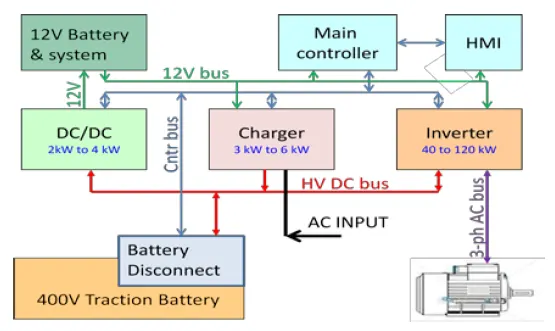
The traction battery is charged via an AC to DC converter, or rectifier. because the voltage stored in the traction battery is DC and the source of current is AC.
Following that, two distinct converters—a DC-AC converter (inverter) and a DC-DC converter—receive the DC current from the battery (Chopper).
The inverter is often situated between the battery and the DC induction motor, which provides traction by being directly coupled to the wheels. When braking using regenerative technology, this motor acts as a generator, transforming mechanical energy from the wheels and axles into electrical energy that is subsequently stored in the traction battery.
The traction battery serves as the DC source for the DC-DC converter. All other EV/HEV components, such as the HMI, headlamps, AC, etc., are powered by the output of this DC-DC converter.
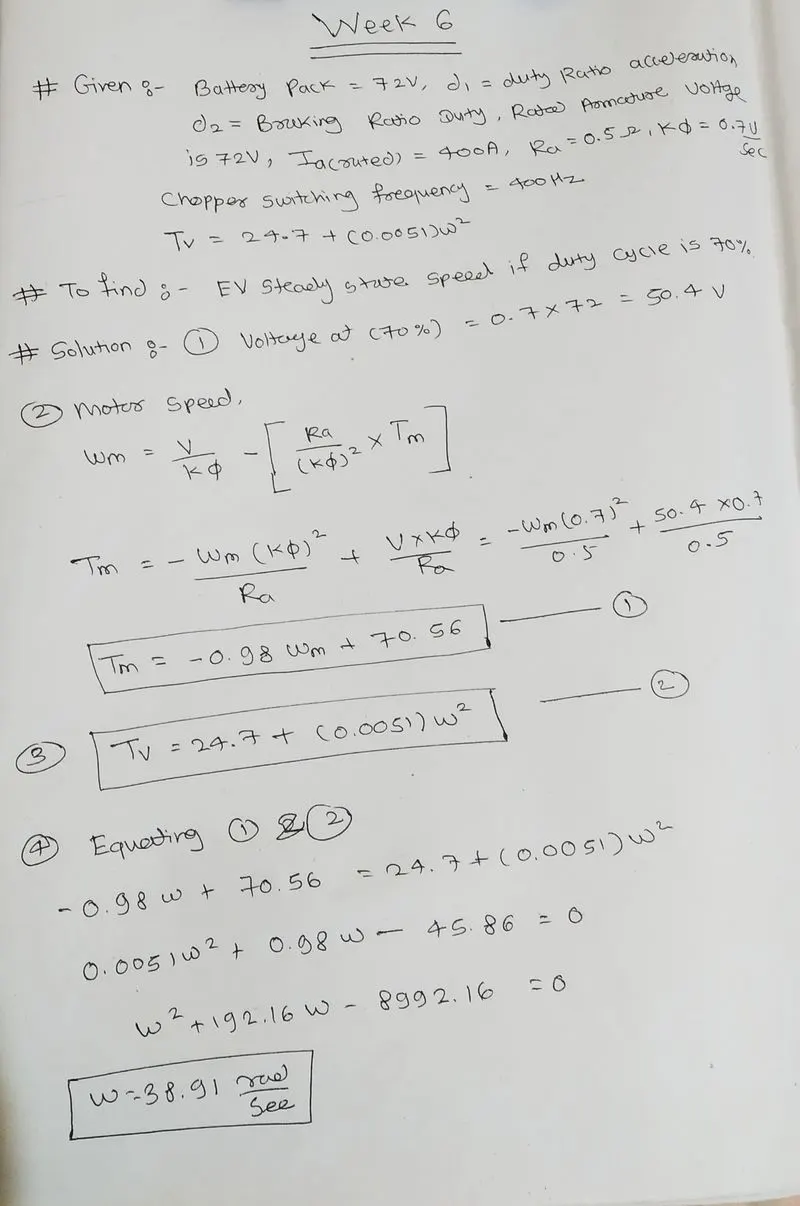
Q2 ) An Electric Vehicle's powertrain with 72V battery pack in shown in the diagram below. The duty ratio for acceleration operation is 'd1' and for the braking operation the duty ratio is 'd2'.
solution :-
please check below calculation :-
Q3) Explain in brief about author’s perspective
solution :-
Both the induction and DC brushless motors' operating principles were described by author Wally Rippel in his blog. Even though induction motors are an older technology, he emphasised their major advantages over DC brushless motors in pure EVs. However, he also discussed the importance of DC brushless motors in hybrid and plug-in HEVs, which are currently the most popular vehicles on the market. Although induction motors were just recently discovered in the General Motor EV1, the author predicted that induction motors and DC brushless motors would be commonly employed side by side depending on the needs of individual vehicles.
- Working Principle of DC Brushless Motor:
1. The Stator is constructed from thin, stacked laminations. To generate a torque between the stator and the rotor, the stator interacts with the current flowing through its windings.
2. A DC magnetic field is produced by one, two, or more permanent magnets inside the Rotor. It is crucial to continuously change the stator current's size and polarity while the rotor rotates in order to maintain consistent torque and maximise efficiency.
3. A DC brushless motor requires an inverter to operate; without one, it is unable to do so.
- Working Principle of Induction Motor:
1. The stator is identical to that of an induction motor. When compared to the DC Brushless, the rotor is the only difference. Permanent magnets are not used in induction motors. The efficiency of the induction motor will enhance with the aid of a small inverter, even if one is not strictly necessary for the induction motor to work.
2. A shorted structure is created by the Rotor's stacked steel laminations and buried outside conductors. Rotating magnetic fields are created in the stator windings by current flow, and they enter the rotor.
- Merit and Demerit of DC Brushless:
Merit
i) Because there is less heat generated by the rotor, cooling it down is simple, and its peak point efficiency is higher than that of a DC Brushless motor.
Demerit
i) A DC Brushless motor cannot function without an inverter (whose phase is maintained in step with the angular position of the rotor).
ii) Permanent magnets prevent the magnetic field strength from being easily altered.
iii) Magnetic losses in DC Brushless motors grow together with the motor's size.
iv) The cost of permanent magnets is high.
- Merit and Demerit of Induction Motor:
Merit
i) The motor can start under load, eliminating the requirement for an inverter.
ii) Since they lack magnets, manipulating the magnetic field in this area is simple. As a result, magnetic losses (Eddy, Hysteresis, and current resistance losses) are reduced to a minimum and efficiency is increased.
iii) When high performance is sought, induction drives may be the preferred strategy; while peak efficiency will be slightly lower than with DC brushless, average efficiency may actually be superior.
iv) Induction Motors are more affordable than DC Brushless Motors.
Demerit
i) They cannot be powered by DC; an AC supply is required.
ii) Compared to DC type machines, they have less starting torque and somewhat less running peak torque when powered by utility power. Even with the inverter added, the torque performance is inferior than a DC motor.
Conclusion:
- Despite the fact that DC Brushless continues to dominate the market and is found in every EV and HEV, induction motors won't go out of style since, as was already noted, they have a unique usage and significance when compared to DC Brushless. He came to the conclusion that, in accordance with the characteristics of EVs, applications for both DC Brushless and Induction motors will expand concurrently.