Week-6 Challenge: EV Drivetrain
Q01. Which types of power converter circuits are employed in electric and hybrid electric vehicle?
Ans :-
Power Electronic Converters:
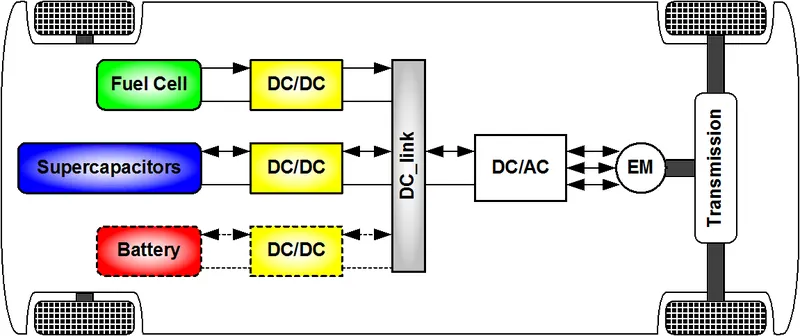
In EV’s and HEV’s, the power electronic converters are considered as the key elements that interface their power sources to the drivetrain of EVs. In order to design highly efficient converters for EV power system, advanced AC/DC and DC/DC converters are required to adapt the output voltage and current levels with high power quality.
The 3 types of converters which are widely used in an electric vehicle are:
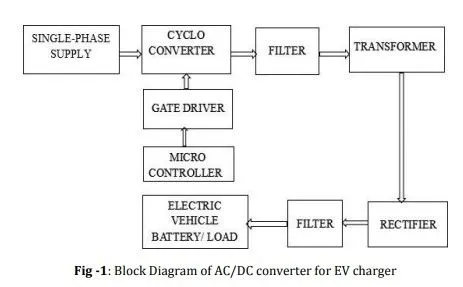
AC – DC Converter:
AC to DC convertors are most commonly used in PHEVs and BEVs. The battery needs to charge with DC current so AC to DC converter is used.
DC – DC Converter(Chopper):
DC – DC Converters can be used to interface the elements in the electric power train by boosting or chopping the voltage levels. By introducing DC/DC converter one choose the voltage variation of the devices and the power of each device can be controlled. The power of the DC/DC converter depends on the characteristics of the vehicle such as top speed, acceleration time from 0 to 100 kmph, weight, maximum torque and power profile
The main dc-dc converter changes dc power from an on-board 200-800V high voltage battery into lower dc voltages (48V or 12V) to power headlights, interior lights, wiper and window motors, fans, pumps and many other systems within electric vehicles (EV) and hybrid electric vehicles (HEV).
DC - AC Converter(Inverter):
The DC/AC converter is required to convert the dc power to a suitable ac power for the electric machine. The power output from the battery pack(DC current) is converted using inverter to be used in electric motor(AC current).
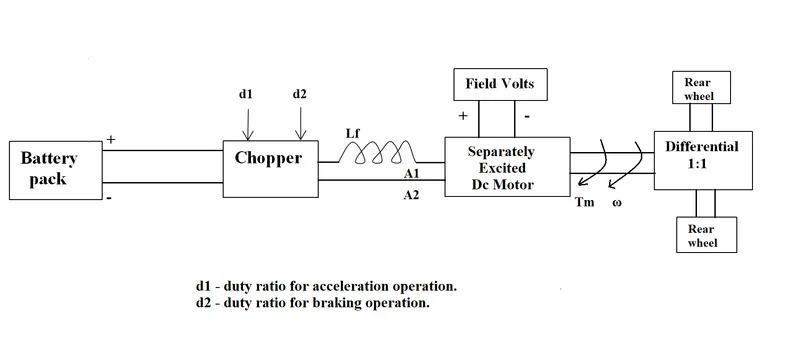
Q02. An Electric Vehicle's powertrain with 72V battery pack in shown in the diagram below. The duty ratio for acceleration operation is 'd1' and for the braking operation the duty ratio is 'd2'.
The other parameters of the electric vehicle is given below,
Motor and Controller Parameters:
Rated Armature voltage= 72 V
Rated armature current= 400 A
Ra= 0.5Ω, KΦ= 0.7 Volt second
Chopper Switching frequency= 400 Hz
The vehicle speed-torque characteristics are given by the below equation
 Eq (1)......
Solution :
Duty Cycle = 70% = 0.7
Actual Voltage = 0.7*72= 50.4V
Torque Speed Characteristics of DC Motor
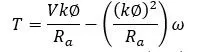
= 50.4*0.7/0.5 - (0.7^2/0.5)w
T= 70.56-0.98w ......eq(2)
Equating (1) & (2)
24.7 + 0.0051 w^2 = 70.56 -0.98w
0.0051w^2 +0.98w -8992.156 = 0
on the solving of quadratic equation , roots of equation are
w= 38.915 rad/s or w= -231.718 rad/s
Speed of EV (w) = 38.915 rad/s
Q03.
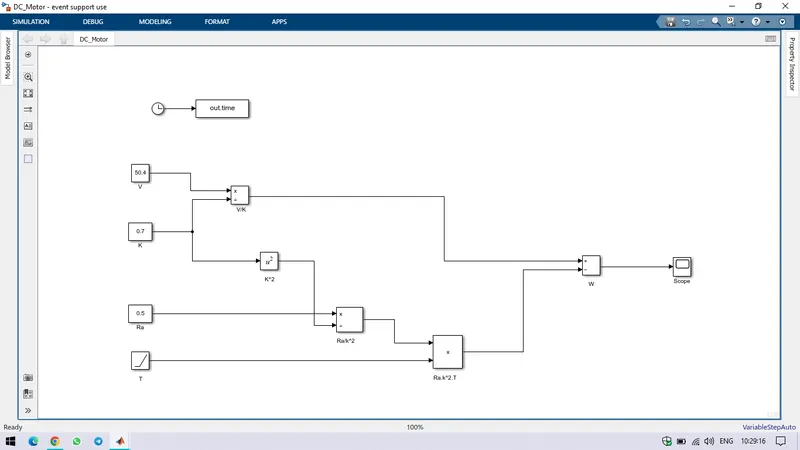
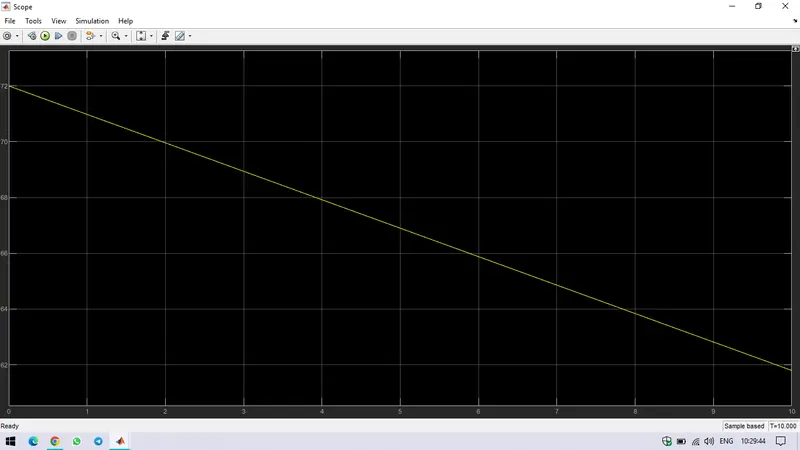
Develop a mathematical model of a DC Motor for the below equation using Simulink.

Q04. Induction Versus DC Brushless Motors
DC Brushless Motors
With brushless machines, the rotor includes two or more permanent magnets that generate a DC magnetic field (as seen from the vantage point of the rotor). In turn, this magnetic field enters the stator core (a core made up of thin, stacked laminations) and interacts with currents flowing within the windings to produce a torque interaction between the rotor and stator. As the rotor rotates, it is necessary that the magnitude and polarity of the stator currents be continuously varied – and in just the right way - such that the torque remains constant and the conversion of electrical to mechanical energy is optimally efficient. The device that provides this current control is called an inverter. Without it, brushless motors are useless motors.
Induction Motor
When a 3-phase induction motor is connected to utility type 3-phase power, torque is produced at the outset; the motor has the ability to start under load. No inverter is needed. (Were an inverter needed, Tesla’s invention would have been useless until sometime in the 1960s.) The fact that induction motors are directly compatible with conventional utility power is the main reason for their success. In contrast, a brushless DC motor produces no starting torque when directly connected to fixed frequency utility power. They really need the aid of an inverter whose “phase” is maintained in step with the angular position of the rotor.
Conclusion:
When it comes to hybrid or plug in hybrid vehicle market dc brushless motor will dominate. However, Induction motor drive will always dominate for high performance and pure electrics. So, author have not mentioned who is clear winner among two rather he emphasis on advantage and disadvantages of one drive over another.