Week-6 Challenge: EV Drivetrain
- 1) A power electronic converter is an electronic device made of high power semiconductor switches that use different switching states to change the magnitude and waveform of voltage between input and output. Power converter circuits are used to control flow of energy by supplying right amount of current and voltage with help of power semiconductor switches. They can be uni or bidirectional. In an hev and ev following types of power convertors are used:
- a) AC-DC-Rectifier
- b) DC-DC-Chopper
- c) DC-AC-Inverter
- A typical HEV configuration is :
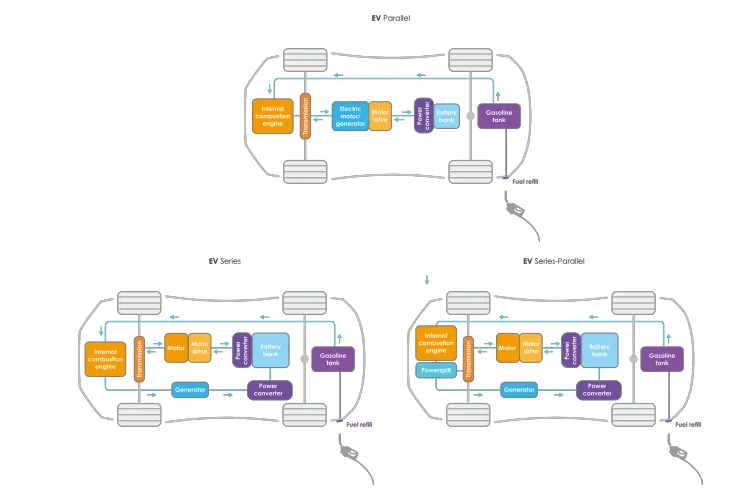
- The link between the DC/DC power converter of the battery
and DC/AC converters of the motor drive is called DC voltage link. It is in the form of a energy storage. - The used DC-DC power convertor is bidirectional in nature.While accelerating the power converter has to step up called as boost mode where more power has to be discharged from battery acting as a peak power source.Flow of energy from battery to dc link. While retardation the battery must be charged hence dc link must be stepped down.
- The motor drive also makes use of a dc-dc convertor so that the required torque is only applied
- DC-AC Converter for motor drive in case of a induction motor
- A typical battery-electric drive train configuration is represented below:
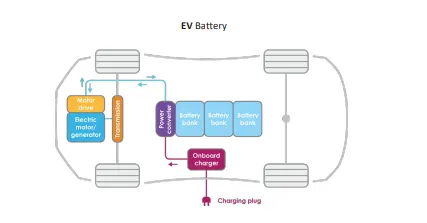
- It contains DC/DC converters, DC/AC as well as AC/DC converter. The usage of power converters are represented below.
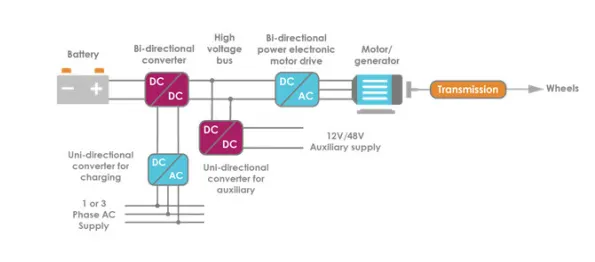
- A power convertor of dc dc type is needed for regenerative breaking where the battery is charged.
-
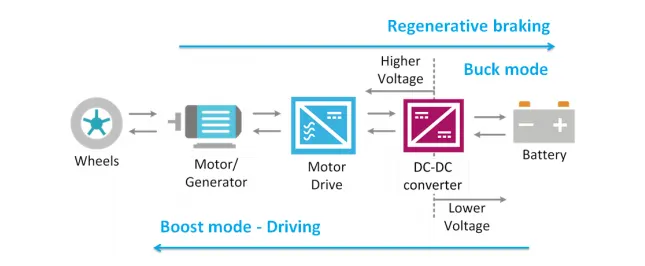
- During regenerative mode, the device operates is buck mode
recovering the kinetic energy from the vehicle, the device operates in buck mode where voltage has to be stepped down to something that is suited to battery rated voltage. During accelration the device operates in boost mode and the DC voltage is regulated to output a higher voltage level. This is called as boost mode - 2) Rated voltage=70 v
- Duty cycle=70%
- So supplied volatge for the combinedmotion=70/100*70=50.4V
- Torque equation,T=(V_t*k_phi)/(R_a)-(W_m.((k_phi)^2)/R_a)
- Substituting values'
- T=(50.4*0.7)/(0.5)-(W*((0.7)^2)/0.5)- equation (1)
- At steady state condition
- Equation (1) = 24.7 + (0.0051)*w^2
- 70.56-0.98w=24.7+0.0051w^2
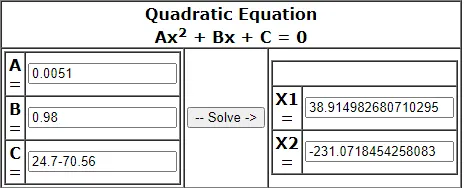
- The steady state speed is 38.91 m/s
- 3) In the blog the author has compared about pros and cons of both induction and brushless dc motors. In a DC the rotor is not connected externally. But is a permanent magnet. Stator windings are given external supply. The magnetic field from the rotor enters the stator winding. As the stator is externally powered a current flows through it. To obtain a satisfactory torque the polarity of the current in stator winding must be varied. The author has commented that 3 phase induction motos and dc brushless motors are synonymous. The stator core of both consists of distributed windings. But the large difference is at the rotor. An induction motor is devoid of magnets. A rotating magnetic field is produced by the stator windings that are connected to a 3 phase supply. It is possible to vary the voltage to increase and decrease the current in the stator windings. There is a difference in applied electrical frequency and the rotational frequency of the magnetic field as perceived by the rotor. Corresponding to this a voltage is induced that is proportional to this difference. A current is produced in the rotor. The current will be responsible for another magnetic field that links with the rotating magnetic field. A torque is obtained instantaneously in an induction motor which is absent is a dc brushless motor. The heat generated is less in a dc brushless motor. Rotor cooling is more difficult in induction motor. The permanent magnets used in dc brushless motors are costly.The ideal power is unity, or one (1.0) which indicates that all the energy supplied by the source is consumed by the load. This is indicative of fact that a dc drive that has unity power factor has higher efficiency that dc brushless drives. As permanent magnet produces uniform magnetic field the hysterisis and eddy current losses cannot be minimized in a brushless motor where as in an induction motor a control can be established by having a control over voltage and frequency. The author has not favoured any type of motor as he believes its win win situation for both type of motors. He has hinted that brushless will be more suited for hybrid and plug in hybrids where as induction motors will find usgage when there is need of higher performance.