Week-6 Challenge: EV Drivetrain
1.Which types of power converter circuits are employed in electric and hybrid electric vehicle?
The switching technique is adopted from power Electronic to control voltage and current for the electric motor. The avoids a high volume of losses by replacing the resistor with a power switch. These motor modules are operated with a high frequency where the rated battery voltage can be reduced to the desired voltage by ON-OFF of the module
The switching frequency will be in such a way that it utilizes high and low switching to maintain the average desired voltage.
This ON-OFF frequency is termed as Duty-ratio
By changing the duty ratio of the power module, we can vary the voltage from one level to another level
According to the respective function performed, the power electronic converter is categorized in the following types
AC to DC - Rectifier, it convert AC to unipolar (DC) current.
DC to AC - Inverter, it converts DC to AC of desired frequency and voltage.
DC to DC - Chopper, it converts to variable DC or variable DC to constant DC.
AC to Ac - Cycloconverter, matrix converter - it converts AC of desire frequency or desire voltage magnitude from AC supply.
Ac to Dc converter (Rectifier)
The power electronics converter converts the AC supply from the mainline to DC supply or the load
The essential components of the rectifier include a transformer, control block, filter, and switching unit.
The transformer adjusts the primary AC source supply to the input of the Rectifier stage. Usually, it is the stepped-down transformer that reduces the supply voltage to a circuit operating range.
The rectifier converts the low voltage Ac supply into DC supply. It consists of diode/ thyristors based on the type of rectifier, the output of the rectifier is of pulsed DC, and hence it is filtered using a filter circuit which is usually made with a capacitor or a choke.
The control block controls the firing angle of thyristors in the case of phased controlled rectifiers. Since Diode is not a controllable divide, a control block is not needed in case of diode rectifiers.
DC to AC Converter (inverter)
These converters are connected between the DC source of fixed input and variable AC load. Most commonly this DC to AC converter is called an inverter.
An inverter is a static device that converts fixed DC supply voltage to variable AC supply voltage.
Fixed DC voltage is obtained from Batteries or by DC link is most power electronic converters. The output of the inverter can be a variable electronic converter. The output of the inverter can be variable or fixed Ac voltage with variable or fixed frequency.
This conversion from DC to AC along with the variable supply is produced by varying the triggering angle of thyristors. Most of the thyristors used in the inverter are employed with forced communication techniques. These can be single-phase or three-phase inverters depending upon the supply voltage.
Dc to DC converter (step-up chopper)
Many DC-operated applications need a different level of DC voltage from a fixed DC source.
A DC chopper is a static device that converts a fixed input DC voltage to variable DC output of a different magnitude than the input value.
The chopper circuit is connected between the DC input source and the DC load. The chopper consists of a power electronic switching device such as a pulse with modulation control.
DC chopper is mainly used in DC drive i.e EVs and HEVs.
In this chopper, the voltage is always greater than the input voltage, and a switch is also used connected in parallel with the load the switch is a thyristor or an SCR.
A diode is placed in series with the load that allows the load current to flow when the thyristor is turned OFF.
When the Thyristor is turned ON the diode is reversing biased and hence it isolated the load circuit from the source. So the inductor charges to the maximum input voltage source.
When Thyristor is turned OFF, the load gets the voltage from the inputs as well as from the inductor. So the voltage appearing across the converter output will be more than the input.
Ac to Ac Converter
This type of power electronics converter is used to convert an alternating current waveform of specific magnitude and specific frequency into an alternating current waveform with different magnitudes and different frequencies, as the signal remains AC hence this is termed an AC to AC converter.
To operate a few devices and machines we required some specific voltage with a specific frequency that can be obtained with AC -Ac converter and by regulating AC power using AC -AC converter we can regulate the speed of induction motors.
2.An Electric Vehicle's powertrain with 72V battery pack in shown in the diagram below. The duty ratio for acceleration operation is 'd1' and for the braking operation the duty ratio is 'd2'.
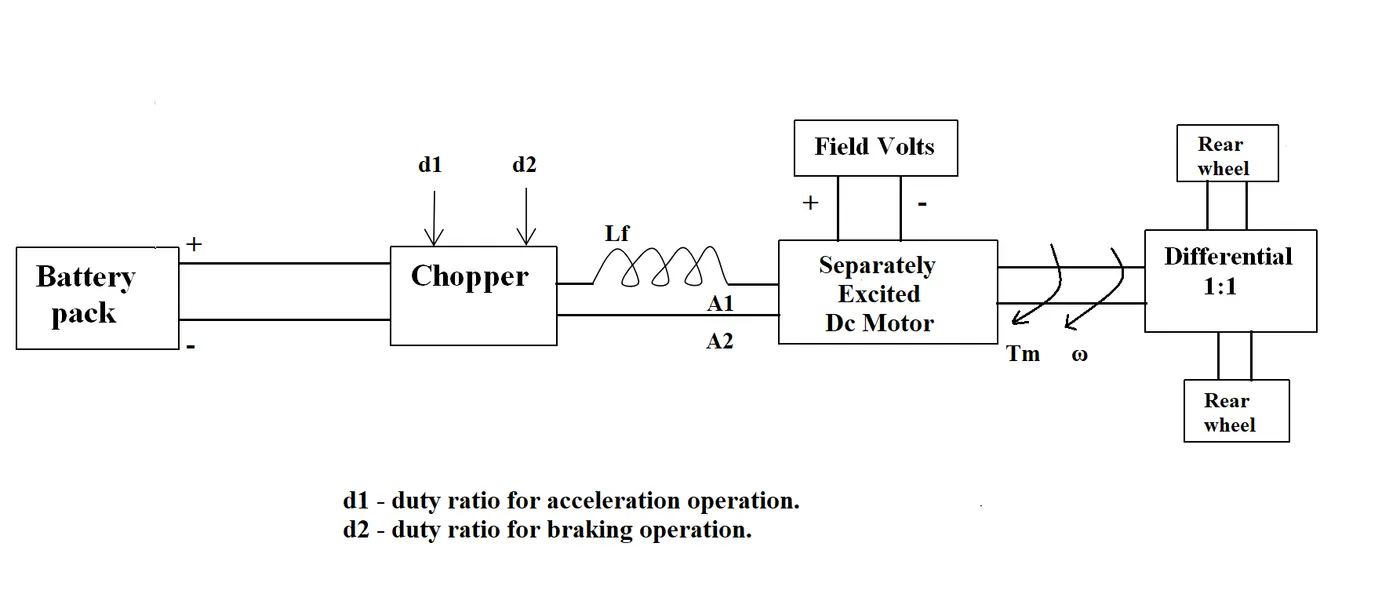
The other parameters of the electric vehicle is given below,
Motor and Controller Parameters:
Rated Armature voltage= 72 V
Rated armature current= 400 A
Ra= 0.5Ω, KΦ= 0.7 Volt second
Chopper Switching frequency= 400 Hz
The vehicle speed-torque characteristics are given by the below equation

What is EV steady state speed if duty cycle is 70%?
Solution
Given
Battery packed in EV drivetrain = 72 v
Armature current = 400A
Motor constant = 0.7 v-s
Armature resistance Ra = 0.5 ohm
Chopper switching frequency = 400Hz
speed torque equation of motor
w = (v/k)-(Ra/k^2)*Tm
where
Tm = torque
v = voltage
Ra = Armature resistance
N(w) = Motor speed
k = motor constant
deriving the formula for motor speed- torque relationship
Tm = (v/Ra)*k-(k^2/Ra)*w----------------1
After substituting the input vales we get
Tm = 70.56-0.98w-------------------2
We have been given the vehicle speed and torque characteristic equation
Tv = 24.7-0.0051w^2--------------3
At steady state
Tm = Tv-----------------------4
24.7-0.0051w^2 = 70.56-0.98w
0.0051w^2+0.98W-45.85 = 0
After solving the quadratic equation we will be getting two values of w
w = 38.907rad/sec, w = -231.06rad/sec
selecting the positive value
hence w = 38.907 rad/sec
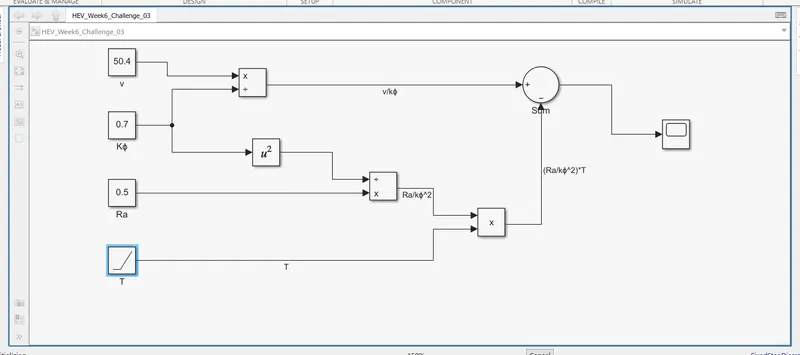
3.Develop a mathematical model of a DC Motor for the below equation using Simulink.
ωω= V/Kϕϕ -Ra/Kϕϕ^2 .T
We will be drawing the Simulink model for the equation
V = 50.4 Volts
Ko = 0.7
Ra = 0.5 Ohm
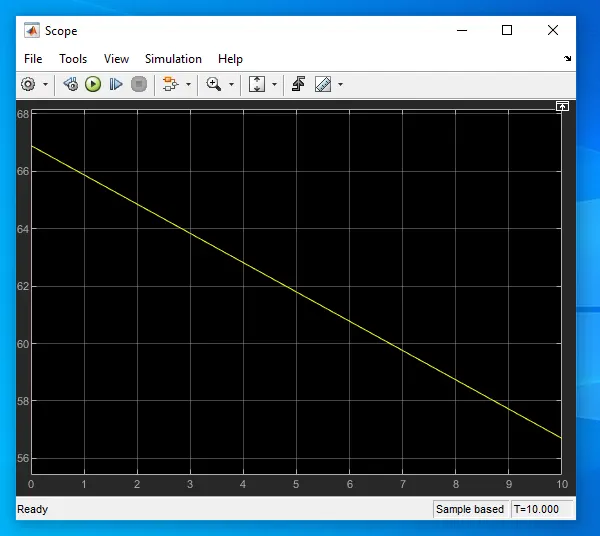
Let torque be an increasing signal using the ramp
4. Refer to the blog on below topic:
Induction Versus DC brushless motors by Wally Rippel, Tesla
Explain in brief about author’s perspective.
Wally Rippel before joining tesla was an engineer at the AeroVironment. Here he helped develop the EV1 for General Motors and even got featured in a documentary movie Who Killed the Electric car?
During the past many years, gas-powered vehicles had gone a lot of changes. Right from the flat-head, Hemis, straight, opposed, and V configuration. By today's time, we should have selected the best from all these variables. But it is very difficult to select one configuration. This mainly depends on the price and the performance of the car, and the personal need of the user
The old technology is getting replaced by the new one. Lead-acid battery by lithium batteries, and DC brush motor with DC brushless motors and inductions motors. These developing technologies are very hard to predict whether will this technology will sustain or will be replaced with some better ones. So far, the guess is the induction and the brushless machines will keep fighting for a few more years to come
Brushless DC motors include 2 permanent magnets which generate the DC magnetic field which interacts with the current flowing through the winding to produce the torque. To produce continuous torque, the magnitude and polarity of the stator and rotor must be changed continuously. This ensures the steady torque and the device used for the conversion of electrical to mechanical energy is inverted.
The advantages of a DC brushless motor are that there is low heat generation in the rotor, and its cooling capacity is better than compared to an induction motor drive. Also, peak power efficiency is high. Another difference is that DC brushless drive can also operate at a unity power factor, whereas the best induction drive is about 85%, this means that the peak point energy efficiency for a DC brushless drive will typically be a few% points higher than for an induction drive.
On the other hand, the induction motor has steel plates instead of permanent magnets. It is the current in the stator winding that generates the rotating magnetic field that interacts with the rotor. The induction motor is compatible with the power source. An induction motor cannot operate from DC voltage it always requires AC voltage.
The induction motor uses power directly and does not require an inverter to start and generate the power and torque. In an induction motor, the B field is proportional to V/f. this technology is used to reduce the magnetic losses and conduction, losses due to which efficiency will maintain at maximum peak. This leads to an increase the performance; an induction motor is very useful and efficient for high performance. In an induction motor, the peak efficiency is led but it works smoothly better. The controlling of the induction motor or mechanism is more complex. Also, the torque generated is low and the motor temperature increase when it works at high speed.
Now the question is which one is the best brushless DC motor or induction motor. Both the drives mean DC and induction motor using 3-phase modulation inverters. The only difference is in the rotor and inverter. The only difference is in the rotor and inverter controller of the motors. According to the sensor the DC brushless motor requires absolute position sensors whereas the induction motor only needs speed sensors. Another factor is related to the cost of a permanent magnet it is costly in kg. also, the permanent magnet rotor needs more careful maintenance, and it's difficult to handle. So, the cost of the induction motor is less.
The conclusion according to the author is that induction motor drives in only best for pure high-performance EV whereas, whereas DC brushless drives are beneficial for all hybrid as well as plug-in hybrid vehicles.