Project - Speed Control of a Direct Current (DC) motor
1.
A common actuator in the control system is the DC motor. it directly provides rotary motion and coupled with wheels or drums and cables can provide translational motion.
In general, the torque generated by a DC motor is proportional to the armature current and the strength of the magnetic field. We will assume that the magnetic field is constant. and therefore, that the motor torque is proportional to only the armature current i, by a constant factor kt. this is referred to as an armature-controlled motor.
T = kt*i
The back emf, vb is proportional to the angular velocity of the shaft by the constant factor.
vb = km*dθ/dt
The motor torque and back emf constant are equal that is kt = km, we will use k to represent both the motor torque constant and the back emf constant.
We will apply newton's law and Kirchoff's law
Jd^2θ/dt = T - B*dθ/dt
T = kt*i
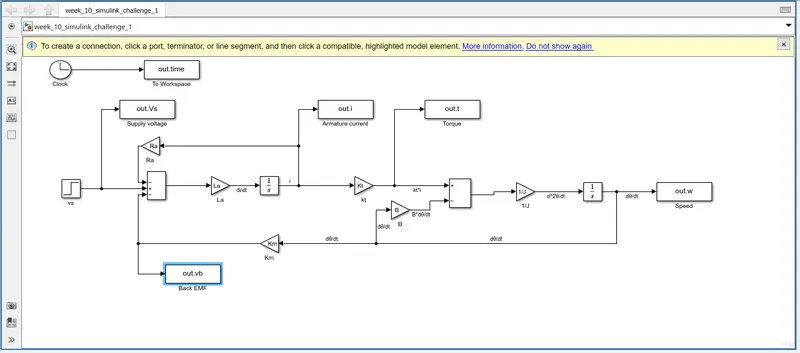
d^2θ/dt = 1/J(kt*i-B*dθ/dt) -----------1
La*di/dt = -Ra*i+vs-vb
vb = km*dθ/dt
di/dt = 1/La(-Ra*i+vs-km*dθ/dt) -----------2
From Eq 1 and 2
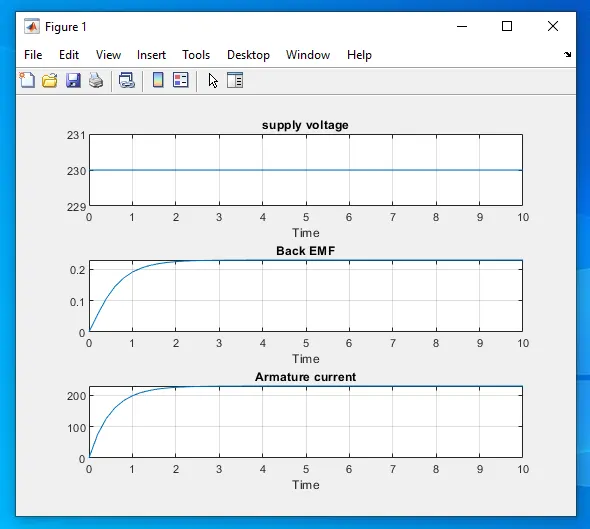
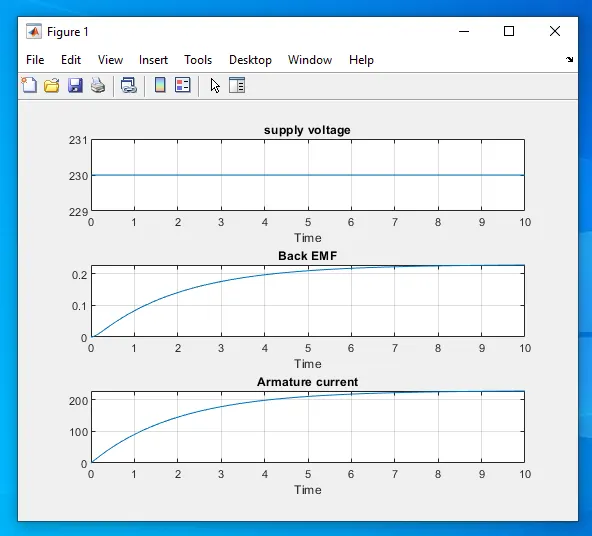
*supply voltage*Back EMF*Armature current
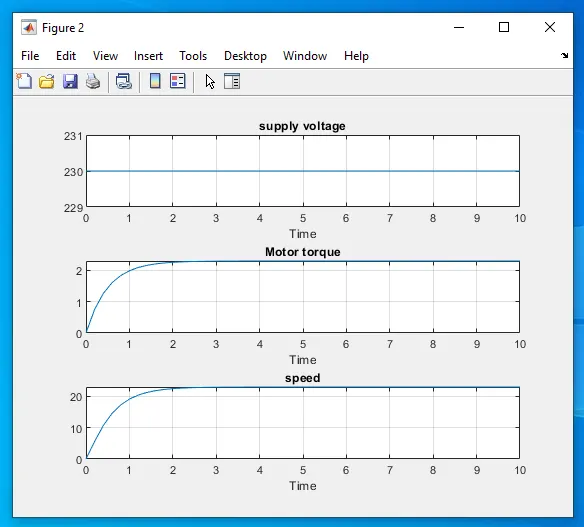
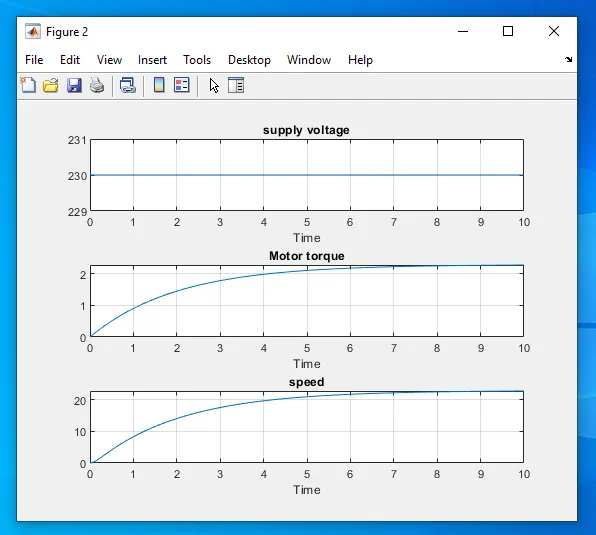
Supply voltage*Motor torque*Speed
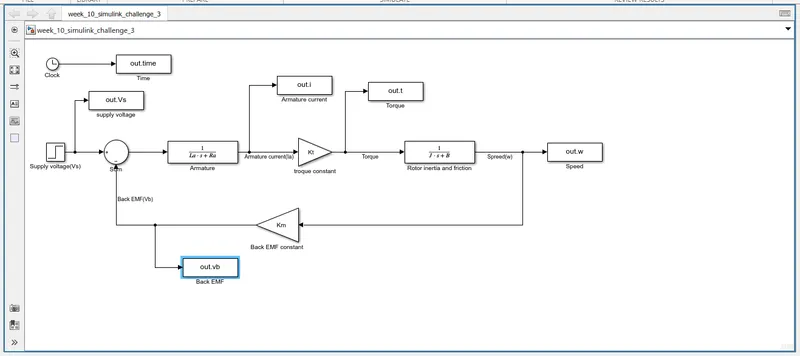
Using the Transfer function block
Laplace transfer function with the numerator and denominator polynomials in S