Week-6 Challenge: EV Drivetrain
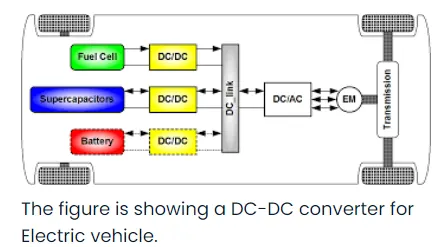
1. Which types of power converter circuits are employed in electric and hybrid electric vehicle?
ANS:-
- A motor drive consists of a power converter and the controller. The power electronic converter handels the flow of bulk power from the source to the motor input terminals The controller processes the command input and the feedback information to generate the switching signals for power converter semiconductor switches.
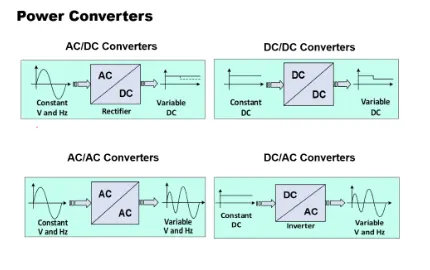
- The power convertor can be a DC Drive supplying a DC Motor or an AC drive supplying an AC motor.
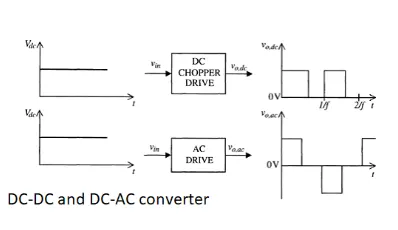
- A DC-DC convertor inits basic form converts unregulated DC input voltage at a certain level to regulated DC output voltage at a different level with very high conversion efficiency . These are operated at very high frequency. The swithches are turned ON and OFF by pulse width modulation(PWM).
- The power converter is made of high power fast -acting semiconductors devices , such as bipolar junction transistor. There are some other transistors such as MOSFET, IGBT , SCR , GTO , MCT. These devices are used as on-off electronics switch to convert the fixed supply voltage into a variable voltage and variable frequency supply.
- All these devices have a control input gate or base through which the devices are turned on and off as per the command generated by the controller.
- These two types of step converters , Hen a low voltage input is converted in to a high voltage optput then it is a step-up converter. Whereas when the high voltage input is converted into a low voltage output it is a step down converter.
2. An Electric Vehicle's powertrain with 72V battery pack in shown in the diagram below. The duty ratio for acceleration operation is 'd1' and for the braking operation the duty ratio is 'd2'.
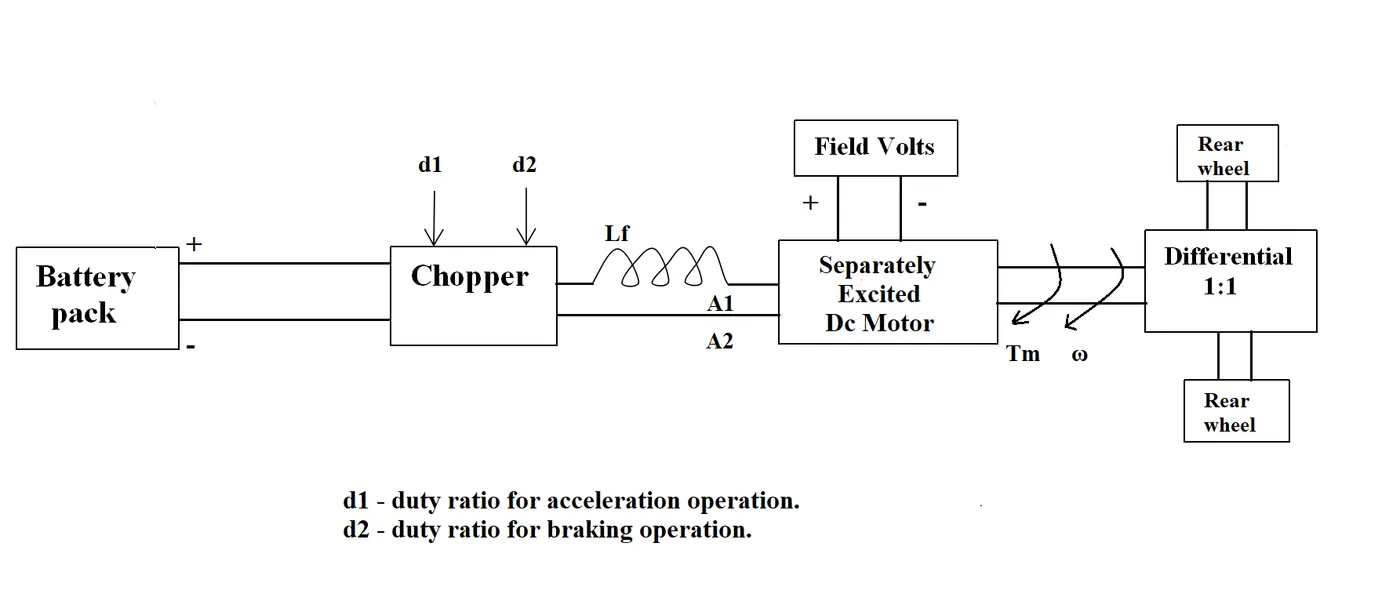
The other parameters of the electric vehicle is given below,
Motor and Controller Parameters:
Rated Armature voltage= 72 V
Rated armature current= 400 A
Ra= 0.5Ω, KΦ= 0.7 Volt second
Chopper Switching frequency= 400 Hz
The vehicle speed-torque characteristics are given by the below equation

What is EV steady state speed if duty cycle is 70%?
ANS:-
As the torque Formula is given , we need to find the speed in rad/sec. Use the other expression available which is given below.
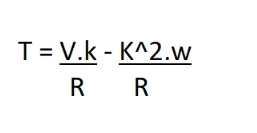
T= torque
V= Armature voltage
R= Resistance
w= Speed in rad/sec
Compare these two equations:
24.7+0.0051*w^2 = ((v*k)/R) - ((k^2)*w/R) ;
= 24.7+0.0051*w^2 = (72*0.7*0.7)/0.5 - (0.7^2/0.5)*w ; = 24.7+0.0051*w^2 = 70.56-0.98*w ;
= 24.7+0.0051*w^2 = w^2+192.15*w-8992.15 = 0
Inorder to find the roots use following formula
For a Quaratic equation of the form ax^2+bx+c = 0 , the solutions are
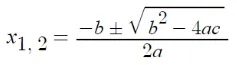
by entering all the values in the quadratic formula we get the value of x = 38.95 & x = -231.08 .
As the speed value can't be -ve
so Angular Speed (w) = 38.95 rad/sec.
3.Develop a mathematical model of a DC Motor for the below equation using Simulink.
ω= V/Kϕ -Ra/Kϕ^2 .T
ANS:-
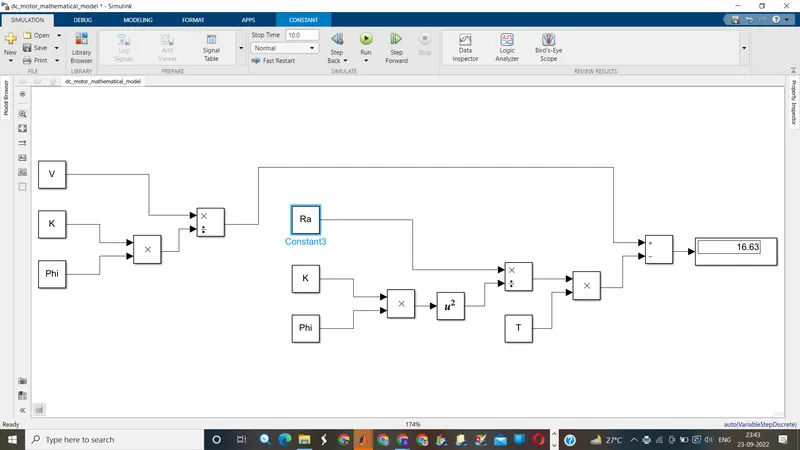
- create 3 constant blocks and give them names as V, K, phi with values 100 , 3 , 2 respectively.
- multiplied K and phi with using multiply block. than drag divided block and V divided with output value will be "V/K.Phi"
- create (Ra/Kϕ^2) drag constant blocks and create same as 1st equation.
- Then add another constant block ,name as 'T' with value 1. and mutiply with the (Ra/Kϕ^2).
- Drag the sum and subtract block and 1st equation output value connected with positive sign, and 2nd equation out put value connected with negative sign.
- Total out put connected with display bleck. Equation ω= V/Kϕ -Ra/Kϕ^2 .T of mathematical model created with using simulink.
4. Refer to the blog on below topic:
Induction Versus DC brushless motors by Wally Rippel, Tesla
Explain in brief about author’s perspective.
ANS:-
The author writes this blog to entail the differences between the two most commonly used motor drives in the automobile industry: the DC brushless motor drive and the induction motor drive. Rippel goes in to detail about the differences in construction, working, and cost between the two drive types. However, with what he has written, he has not arrived at the conclusion that one type is better than the other. In the last lines of the opening paragraph, Rippel writes that there is no one best engine type and that it is all a matter of personal preference when it comes to choosing an engine. It is in this same regard that he ends the blog stating that there is still no winner when it comes to motor drive selection either. In spite of both motor drive types having similarities, they also have their benefits and drawbacks.
For DC Brushless drives, we are told that their construction implements 2 or more permanent magnets at the rotor to generate a DC magnetic field. It also consists of a stator core (made up of thin, stacked laminations) It also uses an inverter for the current control, meaning that it cannot run on a DC power supply as the current direction has to be changed repeatedly in to maintain a constant torque.
For induction drives, there rotor has no magnets, but instead stacked steel laminations with buried peripheral conductors which form a shorted structure. It is the current in the stator windings that generates a rotating magnetic field that interacts with the rotor.
Induction motors can be used directly with power from the mains and does not require an inverter to start the drive and generate the starting torque. It has the ability to start under the mains load applied. However, DC brushless drives cannot do the same. They cannot generate a starting torque when connected to a mains power supply. They require an inverter to do this.
Induction motor drives cannot run on a DC power supply and are solely dependent on an AC power supply. Also, when they are connected to a 3 phase mains supply, the rotor rotates at a constant speed and also they have a limited starting torque as well as peak torque. In order to rectify this, an inverter can be used to operate the induction drive from a DC power supply or a battery. Also, if the inverter frequency is varied, then the constant speed is no longer an issue - it can be varied.
DC Brushless drives use permanent magnets, and cannot change the strength of their magnetic fields. It would be desirable if they could, because when the maximum torque is needed by the rotor, the magnetic field strength should also be at a maximum level. This allows for the inverter and motor currents to be at a minimum, thereby reducing the power loss by heat dissipation. Similarly, when the torque required is minimum, the magnetic field strength should also be minimum to reduce hysteresis and eddy current losses. The permanent magnets used are also quite expensive costing $50 per kilogram and their magnetic fields are difficult to control if ferromagnetic material gets close enough to the field.
On the other hand, induction drives do not have permanent magnets and so they can vary their magnetic field strength. If used with a smart inverter, they can be operated with minimum hysteresis and eddy current losses and maximum efficiency as the magnetic field strength can be changed according to the requirement by the rotor. These losses do not increase if the size of the induction drive also increases but as a DC brushless drive gets bigger, its losses increase and their efficiency decreases. So induction drives have a cost advantage compared to DC brushless drives
Although, DC Brushless drives generate less heat at the rotors. So rotors more easily and have a higher peak point efficiency than induction drives. In addition, the DC brushless motor can operate at unity power factor i.e. 1, whereas induction drives can operate up to a power factor of approximately 85%.
In conclusion, Rippel has elaborated the different aspects to compare the induction and DC brushless motor drives and has detailed the advantages and disadvantages of both types. As mentioned earlier, at the end of the day it depends on the preference of the user. If a user is seeking a high performance with comparatively lesser costs, then the induction drive would be better suited for those requirements. However, if it is high peak point efficiency, high power factor and easier control that a user seeks, then the DC brushless drive would be the smarter choice. Both types have their place in the automobile industry and will retain their relevance in their respective applications. Rippel believes that due to the increasing performance of vehicles, one day both may be used side by side under the hood of a vehicle in order to get the best of both drives. This would result in a new kind of hybrid that combines the characteristics of an ordinary vehicle e.g. sedan with that of a sports car.