Week-6 Challenge: EV Drivetrain
EV-21 WEEK-6
1. Which types of power converter circuits are employed in electric and hybrid electric vehicle
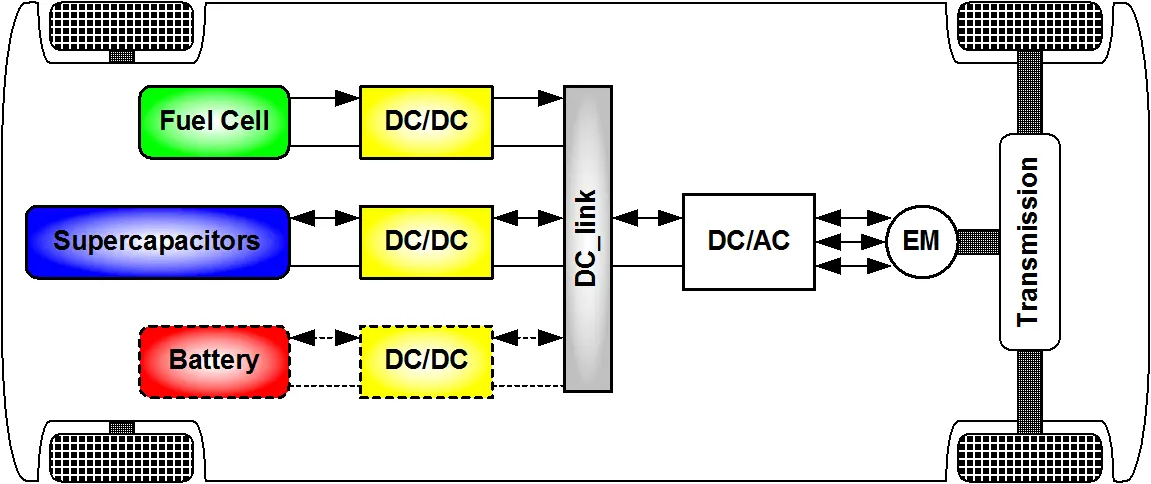
In a hybrid and other electric vehicles (EVs), two key elements work together to manage power and recharge the circuits. Here is how these critical components—the inverter and converter—work in tandem
INVERTER:-
Broadly speaking, an inverter is an electrical device that converts electricity derived from a DC (Direct Current) source to AC (Alternating Current) of the type that can be used to drive a device or appliance. In a solar power system, for example, the power stored by batteries charged by solar panels is converted to standard AC power by the inverter,1 which provides the power to plug-in outlets and other standard 120-volt devices.
An inverter serves the same kind of function in a hybrid or EV car, and the theory of operation is relatively simple.2 DC power, from a hybrid battery, for example, is fed to the primary winding in a transformer within the inverter housing. Through an electronic switch (generally a set of semiconductor transistors), the direction of the flow of current is continuously and regularly flip-flopped (the electrical charge travels into the primary winding, then abruptly reverses and flows back out). The in/outflow of electricity produces AC current in the transformer's secondary winding circuit. Ultimately, this induced alternating current electricity provides power for an AC load—for example, an electric vehicle's (EV) electric traction motor.
A rectifier is a similar device to an inverter except that it does the opposite, converting AC power to DC power.
CONVERTER :-
More properly called a voltage converter, this electrical device actually changes the voltage (either AC or DC) of an electrical power source.2 There are two types of voltage converters: step up converters (which increases voltage) and step down converters (which decreases voltage). The most common use of a converter is to take a relatively low voltage source and step-it-up to high voltage for heavy-duty work in a high power consumption load, but they can also be used in reverse to reduce voltage for a light load source
DC-DC CONVERTER :-
DC-DC converters convert or change the voltage level of applied DC input into a DC output. These converters are also known as choppers, or a transistor chopper, or switching regulator as shown in the figure.
The average output voltage of the converter circuit can be directly controlled by changing the conduction time of the controlled switch. The conduction time t of the switch is the product of the duty cycle and chopping period
t=DT
Where D is the duty cycle of the chopper and T the chopping period.
DC-AC CONVERETR :-
DC-AC converters convert the input dc power into ac power These converters are also known as inverters. There are a lot of different types of inverters; however, a typical Inverter uses four switches or thyristors. The four switches make 2 pairs, individually controlled by a switching circuit where each pair is switched on at one interval of time. This alternating switching of the thyristors provides an alternating current through the load. This rhythm of turning the switches changes the DC voltage into AC across the load. The output voltage of the circuit can be directly controlled by changing the conduction time of the switch using the switching circuit.
4. Refer to the blog on below topic:
induction versus DC brushless motors by walley Rippel ,Tesla Explain in brief about author’s perspective
His perspective about the electric vehicle future technology cannot be predicted easily the gas powered vehicle engines are not all same and there is no best engine type people choose according to their requirements such as price and performance these also comes under electric vehicle but in near by future EV drives may get stability
In the course of time lead -acid batteries are replaced by lithium - ion batteries and DC brush motors replaced by DC brushless or inducttion motors and contactor controllers are replaced by modulating inverters
the author said that both induction motor and DC brushless motor have advantages and as well as disadvantages and he explained the basic constrution of both the motors
where dc brushless machines requires permenent magnets which is cost efficient and construction of DC brushless motor is costly compared to induction motor because of magnets
And brushless motors are useless motors without the inverter and also 3-ph induction motors has great utility but with several limitations the major limitation is cannot operate from DC and AC is must further he compares the future trends which may occur in DC brushless as well as in induction motor
He finally said that DC brushless motors will dominance in HEV and PHEV and induction motors is highly preffered in PURE EV