Week-6 Challenge: EV Drivetrain
1) Which types of power converter circuits are employed in electric and hybrid electric vehicle?
Power Converter:-
Electric and Hybrid Electric Vehicle ,power converter is interface their power sources to the drivetrain of the EV's In order to design highly efficient converters for the EV's power system, advanced DC/DC and DC/AC converters are required to adopt the output voltage and current levels
Three types of converter used in Electric Vehicle
AC/DC converter,DC/DC converter,DC/AC converter
AC/DC Converter:-(Rectifier)
AC/DC converters are electrical circuits that transform alternating current (AC) input into direct current (DC) output. AC/DC Converters are also called rectifiers they convert the input AC voltage to variable DC voltage, then optimize it through a filter to obtain an unregulated DC voltage. Ac to Dc converter are commonly used in PHEV and PEV in this vehicles get their power from an external electricity source in this source AC the battery to becharged using a direct current source.for this purpose AC to DCconverter in PHEV &PEV.
DC/DC Converter:-(Chopper)
DC-to-DC converter is an electronic circuit or electromechanical device that converts a source of direct current from one voltage level to another. It is a type of electric power converter.this converter is electric power train by boosting or chopping the voltage levels.This converter one can choose the voltage variation of the devices and the power of each device can controlled.
DC/AC Converter:-(Inverter)
DC-to-AC Converters are one of the most important elements in power electronics. This is because there are a lot of real-life applications that are based on these conversions. The electrical circuits that transform Direct current (DC) input into Alternating current (AC) output are known as DC-to-AC Converters or Inverters. Converting from DC to AC is more complicated because the circuit needs some kind of oscillator that reverses the current direction at the required frequency. Most inverters rely on resistors, capacitors, transistors, and other circuit devices for converting DC Voltage to AC Voltage.
2) An Electric Vehicle's powertrain with 72V battery pack in shown in the diagram below. The duty ratio for acceleration operation is 'd1' and for the braking operation the duty ratio is 'd2'.
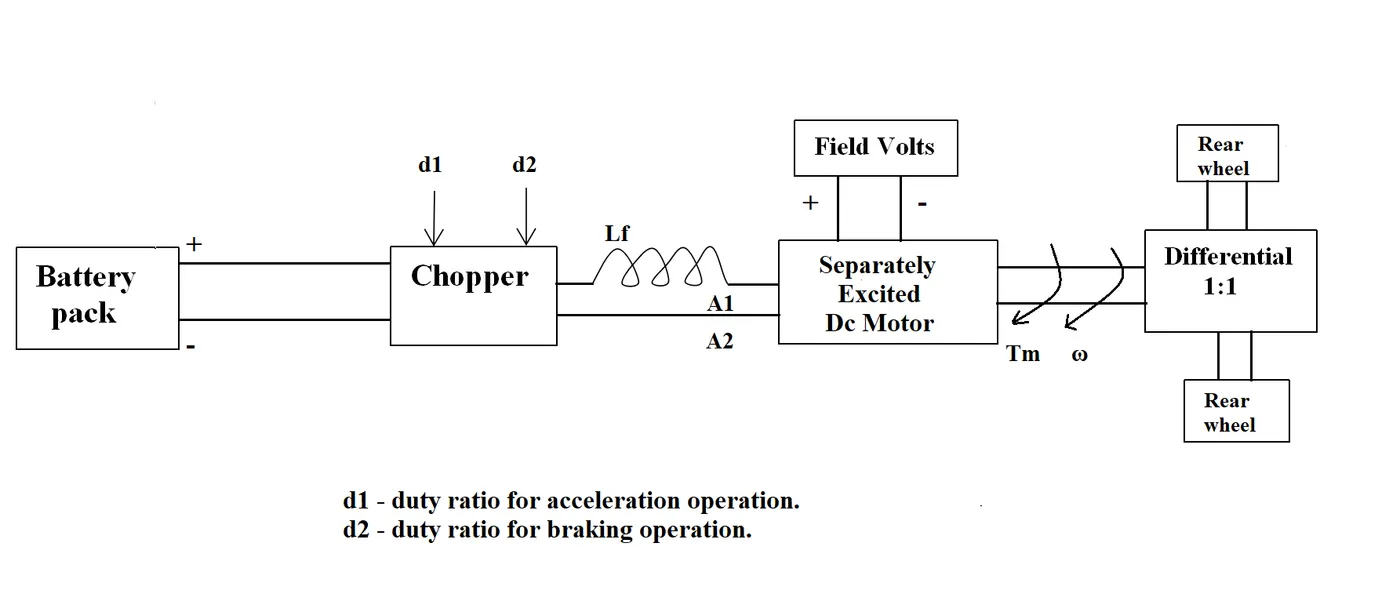
The other parameters of the electric vehicle is given below,
Motor and Controller Parameters:
Rated Armature voltage= 72 V
Rated armature current= 400 A
Ra= 0.5Ω, KΦ= 0.7 Volt second
Chopper Switching frequency= 400 Hz
The vehicle speed-torque characteristics are given by the below equation

What is EV steady state speed if duty cycle is 70%?
Solution:-
Duty cycle=70%
Actual Voltage=72*0.7=50.4V
The Speed of the motor Equation
ω=V/KΦ-[((Ra/(KΦ)^2).T]
above the equation is change the Torque
T=[VKΦ/Ra]-[ω(KΦ)^2/Ra]
=72*0.7/0.5-ω(0.7)^2/0.5
=35.28-0.49ω/0.5
T=70.56-0.98ω----2
Tv=24.7+(0.0051)ω^2-------1
From Equation 1 &2
70.56-0.98ω=24.7+(0.0051)ω^2
-0.98ω=24.7+(0.0051)ω^2-70.56
-0.98ω=0.051ω^2-45.86
0.0051ω^2+0.98ω-45.86=0----------3
Above the equation is apply to the quadratic Equation
ω1=38.912 rad/sec ω2=-231.068rad/sec
its taken from the positive value
ω=38.912 rad/sec
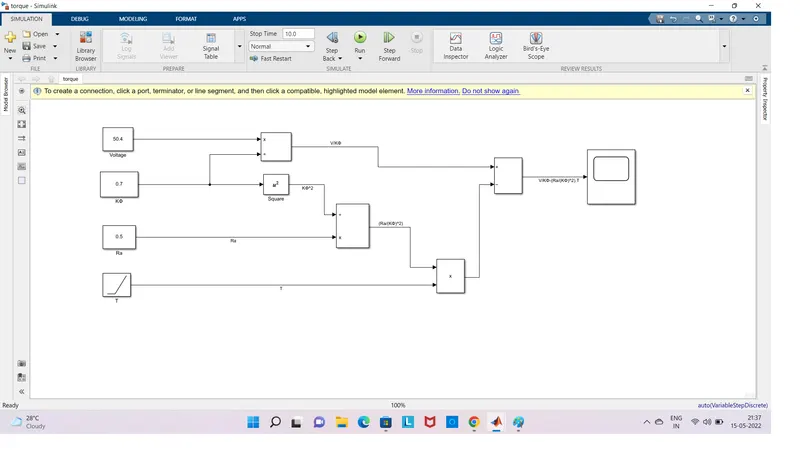
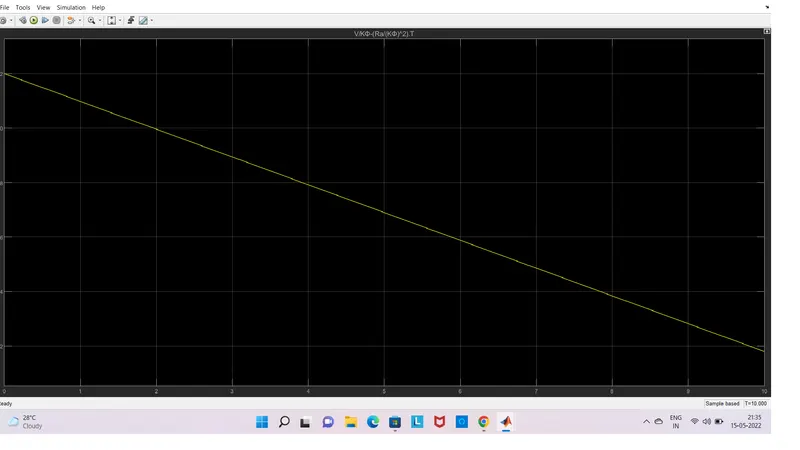
3) Develop a mathematical model of a DC Motor for the below equation using Simulink.
ω=V/KΦ-[((Ra/(KΦ)^2).T]
Voltage=50.4V
KΦ=0.7
Ra=0.5ohm
Torque is Ramp Signal
4)
Wally Rippel’s perspectives are
Due to the improvising technology, there has been alternatives found now and then such as lead-acid batteries, DC brush motors and contact controllers have been replaced by lithium batteries, brushless DC or induction motors and inverters.
Though there has been various replacements,
- Brushless DC and induction motors are playing a major role till this date.
- The construction and working of the brushless motors and induction motors are being discussed. the stators for the 3-phase induction motor and the DC brushless motor are virtually identical. Both have three sets of “distributed windings” that are inserted within the stator core. Both drives use 3-phase modulating inverters. The only differences are the rotors and the inverter controls.
- The advantages of brushless dc motors are:
Much less rotor heat is generated.
The peak point efficiency will only be a few % higher than an induction motor.
The disadvantages are:
The machine size grows
The magnetic losses increase proportionately and part load efficiency drops.
Permanent magnet (PM) rotors are also difficult to handle due to very large forces that come into play when anything ferromagnetic gets close to them.
- Induction motor has some advantages:
The motor has no magnets.
The motor can start under no-load conditions.
Disadvantages are:
They cannot operate in DC.
When operated with utility power
They have limited starting torque and limited running peak torque capabilities when compared to DC type machines.
- The author’s conclusion is that DC brushless drives will likely continue to dominate in the hybrid and coming plug-in hybrid markets, and that induction drives will likely maintain dominance for the high-performance pure electrics.
| DC Brushless | Induction Motor |
| Absolute Position Sensor | Absolute Position Sensor |
| Operate Unity Power factor | Power Factor is 85% |
| Peak Point Efficiency Higher | Peak Point Efficiency Higher |
| Average Efficiency is Low | Average Efficiency is High |
| Permanent Magneta are Expensive | No Magnet |
| Easy To Control | Control is Complicated |