Week-6 Challenge: EV Drivetrain
1..
A power converter is an electrical circuit that changes the electric energy from one form into the desired form optimized for the specific load.
There are two major power electronics units that are employed in EV and HEV as follows
- DC/DC converters
- DC/AC converter
DC/DC converters:
DC-DC converters in an electric vehicle may be classified into unidirectional and bidirectional converters.
Unidirectional DC-DC converters later to various onboard loads such as sensors, controls, entertainment, utility, and safety equipments. They are
also used in DC motor drives and electric traction.
Bidirectional DC-DC converters find applications in places where battery charging, regenerative braking, and backup power are required. The
power flow in a bidirectional converter is usually from a low voltage end such as a battery or a supercapacitor to a high voltage side and is refered to
as boost operation.
During regenerative braking, the power flows back to the low voltage bus to recharge the battery (buck mode). As a backup power system, the
bidirectional DC-DC converter facilitates the safe operation of the vehicle when ICEs or electric drives fail to drive the motor.
DC/AC converters:
It converts the DC power from the battery to AC cpower that are used in EVs and HEVS.
It can increase or decrease the power or torque of the motor by adjusting the amplitude of the signal.
It plays a significant role in capturing energy from regenerative braking and feeding it back to the battery.
2.
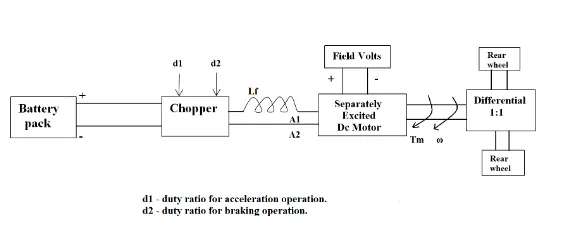
The other parameters of the electric vehicle is given below,
Motor and Controller Parameters:
Rated Armature voltage= 72 V
Rated armature current= 400 A
Ra= 0.5Ω, KΦ= 0.7 Volt second
Chopper Switching frequency= 400 Hz
The vehicle speed-torque characteristics are given by the below equation
`T_v=24.7+(0.0051)omega^2`
The standard formula to calculate the torque is
`T=V*(Kphi)/R_a-w*((kphi)^2)/R_a`
In order to get the true value of V wrt the given duty cycle value:
v=72*70/100=50.4V
then the above eqn becomes
`T=50.4*(.7/.5)-(.7)^2/.5*omega`
BY solving the above equation.
T=70.56-.98`omega`..............................1
given eqn
`T_v=24.7+(0.0051)*omega^2`.................2
now equate the eqn 1 and 2 we get
`70.56-.98omega=24.7+(0.0051)*omega^2`
by solving the above eqn we get two values for `omega`(one positive and one negative )
but we have to take the positive value
i.e `omega=38.85(rad)/s`
3.
Main points of the blog are as follows:
.There is no engine that would called the best engine rather there are different types of engines to suit personal requirements
such as price and performance.
.Lead has been replaced by lithium and DC by either DC brushless and inductions. Contactors, meanwhile, have given way to
modulating inverters
.With brushless machines, the rotor includes two or more permanent magnets that generate a DC magnetic field (as seen from the
vantage point of the rotor).
.The 3-phaase induction motor was invented by Nikola Tesla sometime before 1889
.The stators for the 3-phase induction motor and the DC brushless motor are virtually identical
.The DC brushless rotor, the induction rotor has no magnets – just stacked steel laminations with buried peripheral conductors that
form a “shorted structure
.Brushless motors are useless without the inverters.
.3-phase induction motors have great utility, they also have some severe limitations.
Conclusion:
DC brushless drives will likely continue to dominate in the hybrid and coming plug-in hybrid markets, and that induction drives will
likely maintain dominance for the high-performance pure electrics.