Week-6 Challenge: EV Drivetrain
Question 1:
Explanation:
- There are 3 converters used in electric vehicle and hybrid electric vehicle
- They are – AC to DC converter, DC to AC converter, DC to DC converter
AC to DC converter:
- AC to DC is called as rectifier
- Examples such as mobile charger, laptop charger
- It gives low voltage as output
- It is used in transformer for step down the voltage/current
- It has both positive and negative cycles for each phase shifting
- It is mainly used in charging of electric vehicle
- It is unidirectional
- Unidirectional means current can flow in one direction to charge the device
- It has a huge application in the field of power circuits
- The AC current cannot be stored
- It produces alternating waveforms thus having equal positive and negative cycles
- Types are
- Full wave rectifier
- Half wave rectifier
- Bridge rectifier
DC to AC converter:
- DC to AC is called inverter.
- The commonly used device is the UPS (Uninterrupted Power Supply) in home
- DC can be stored in the form of battery
- It is positive cycle and generates sin wave during the waveform generation
- It stores DC and gives AC as variable AC or required AC in it
- Widely used in inverters
- Can store 1 phase as well as 3 phase
DC to DC converter:
- DC to DC converter is called as chopper or buck converter
- Chopper has 3 phase works in 440V in nature
- It has an application in automobiles
- Used in car infotainment system, wiper, headlight, sensors etc
- Used in dc motor drives and dc related application
- It is either bidirectional or unidirectional
- Regeneration of braking this converter is used
Question 2:
Explanation
Motor and controlled parameters:
Rated armature voltage (V) = 72 V
Rated armature current (I) = 400 A
Ra=0.5 Ω
KΦ=0.7 Vs
Chopper switching frequency=400 Hz
Duty cycle =70%
EV speed state =?
Output voltage = voltage * duty cycle
= 72*0.7
= 50.4 V
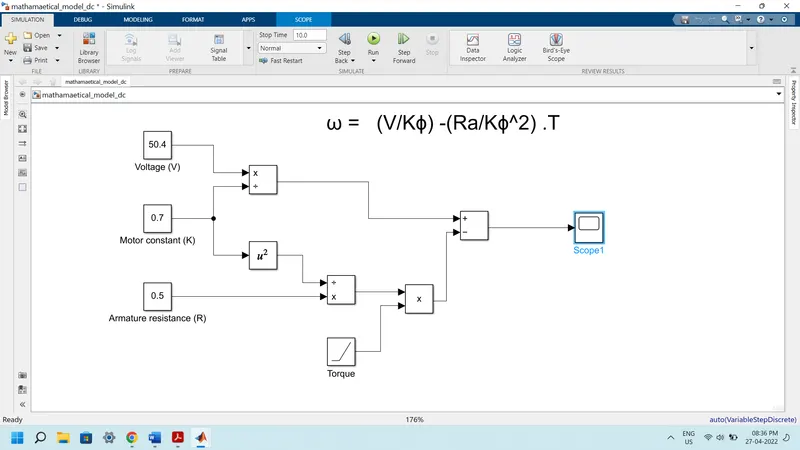
Tv = Vv* (Kϕ /Ra) – ((Kϕ)2 /Ra) * ω ---------------(1)
Tv = Vehicle Torque (Nm)
Vv = Vehicle Voltage (V)
ω = Steady State speed of Vehicle
Kϕ = Motor Constant
Ra = Armature Resistance
Sub the values in (1)
Tv = ((50.4 * 0.7) / 0.5)) – ((0.7)2 / 0.5)) * ω
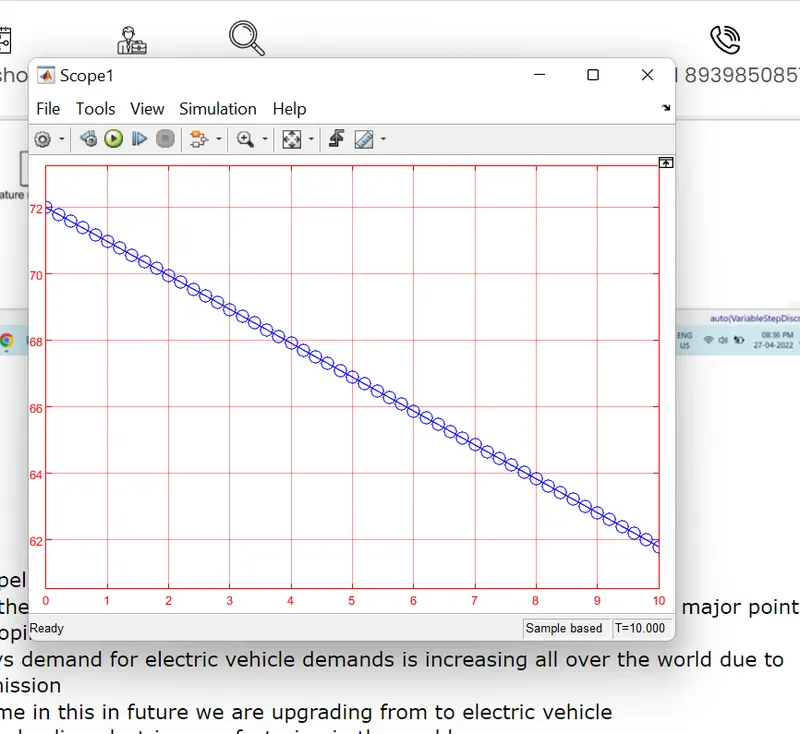
Tv = 70.56 – 0.98 ω -------------(2)
vehicle speed torque character.
Tv = 24.7 – 0.0051 ω2 ------------(3)
Steady State,
(2) = (3)
70.56 – 0.98 ω = 24.7 – 0.0051 ω2
0.0051 ω2 +0.98 ω -45.85 = 0 ----------(4)
It is solved by using quadratic equ.
= (−b ± ) / 2a
= -0.98 ± / 2* 0.0051
= 38.92 rad/sec
Question 3:
Explanation:
Question 4:
Explanation:
- Walley rippel is a man ho works in tesla
- He gaves the theory of induction vs brushless dc motor in which he says the major points about his opinion
- Now a days demand for electric vehicle demands is increasing all over the world due to carbon emission
- To overcome in this in future we are upgrading from to electric vehicle
- Tesla is the leading electric manufacturing in the world
- He talks about the induction motor which operates on AC voltage
- This is widely used motor when compared to other motor
- In the same way brushless dc motor is a widely used application
- The working of a 3 stage engine and a DC brushless motor
- Back when I had hair on my head and carried a , there were lead acid batteries, DC brush motors, and contactor controllers.
- Today, none of these remain (including my hair). Lead has been replaced by lithium and DC by either DC brushless, Contactors, meanwhile, have given way to modulating inverters
- With brushless machines, the rotor includes two or more permanent magnets that generate a DC magnetic field (as seen from the vantage point of the rotor). In turn, this magnetic field enters the stator core
- DC brushless rotor, the induction rotor has no magnets – just stacked steel laminations with buried peripheral conductors that form currents flowing in the stator windings produce a rotating magnetic field that enters the rotor.
- When a 3-phase induction motor is connected to utility type 3-phase power, torque is produced
- DC brushless drives will likely continue to dominate in the hybrid and coming plug-in hybrid markets, and that induction drives will likely maintain dominance for the high-performance
Conclusion:
All the models were created with necessary files