Project
AIM:
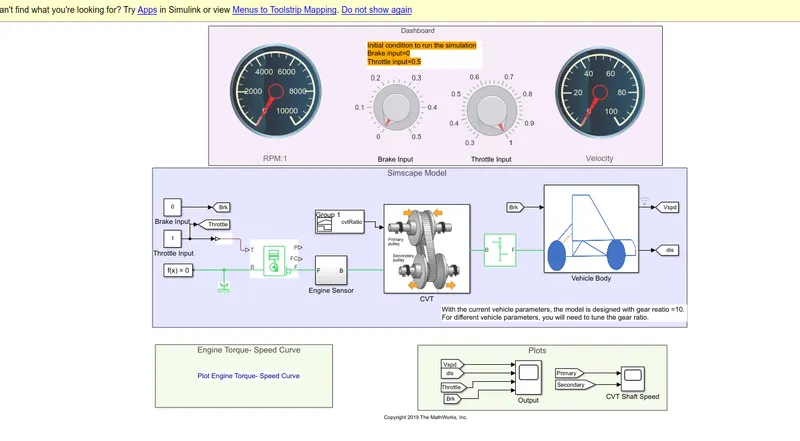
To create a simulation model of all-terrain vehicle (ATV). Here we develop Baja Atv model continuously variable transmission (CVT).
SOFTWARE:
Matlab R2022a.
BAJA ATV:
- Baja ATV is an off-road vehicle used in off roading that is it runs on all roads mainly used for racing in muds, slippery roads and wet road conditions.
- It is a single operated vehicle which is quite different to handle, is also known as quad or quadricycle vehicle.
- It is a single cylinder engine with 305 cc capacity and an output of 10 bhp (7.5 kWh).
- Baja ATV runs a competition early conducted by Society of Automotive Engineers International (SAE).
- Earlier the all-terrain model was developed by royal enfield in the early 19th
- ATV was sub divided into two major categories such as type 1 and type 2
- Type 1 is intended only for racing and it operates by single user/driver and without no passenger.
- Type 2 is intended for two-seater it can be operated by driver and a passenger seat.
BAJA ATV SAE:
- Baja ATV SAE – Society of Automotive Engineers is racing competition, team of students from SAE from all over the world designed a small off-road car.
- Before Baja SAE the racing were done using buggy in a small and rough terrain
- As of now before 2007 the Baja SAE events were called as “Mini Baja”.
- Each year 141 baja cars are entered in the baja SAE across the US and around the world.
- All the international events of Baja SAE were endorsed by SAE international and are held in Brazil, Korea, South Africa and Mexico.
- Starting from 2022 all the cars used four-wheel drive train system.
- All the events such as written reports, presentation and design evaluations are providing by participating team, the functionality and the vehicle performance is a combination of static and dynamic events.
- The report details of the engineering and design process that was used in developing each system of the team vehicle supported with engineering principles.
- Each team goal is to design and build a prototype of an all-weather, single -seat, off-road, single with enthusiasm.
COMPONENTS OF BAJA AVT:
Generic engine:
- The generic block represents an internal combustion engine produce a spark-ignition and for each and every cycle it uses diesel as fuel injector.
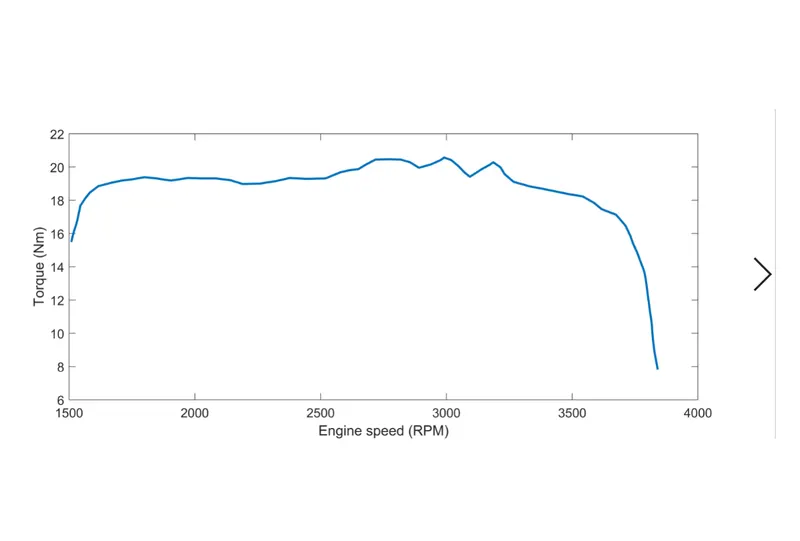
- Parameters such as speed-power and speed-torque parameters are assigned.
- The physical signal given is an input throttle signal which gives normal torque to the engine.
- Physical signal port is an output the engine fuel consumption rate based on the fuel consumption from the engine.
- Generic engine block uses a relationship between torque and speed that is modulated by throttle signal.
- The engine speed gives the maximum power available at maximum power speed. Parameters are maximum power, speed at maximum power and it gives function to physical maximum torque and speed value.
- The normalized throttle input signal specifies the actual engine power. The power is deliverable as a fraction of maximum power in a steady state at a fixed engine speed.
- By default, the Generic Engine block uses a programmed relationship between torque and speed that is modulated by the throttle signal.
- The block evaluates engine power demand as a function of engine speed, g (Ω).
- The function provides the maximum power available for a given engine speed, Ω.
- The block parameters—Maximum power, Speed at maximum power, and Maximum speed normalize this function to physical maximum torque and speed values.
- The normalized throttle input signal T specifies the actual engine power. The power is delivered as a fraction of the maximum power possible in a steady state at a fixed engine speed.
- The controlled throttle increases with a first-order lag from zero to one when engine speed falls below the reference speed.
- When the engine speed rises above the reference speed, the controlled throttle decreases from one to zero.
- When the difference between engine velocity and reference speed is smaller than the controller speed threshold, the tanh part of the equation smooths the time derivative of the controlled throttle.
- Ports used are
- T- normalized engine throttle level, physical signal. Engine torque demand as a fraction of maximum possible torque is input.
- P- instantaneous engine power, W physical signal, power produced by the engine in kg/s.
- FC- fuel consumption rate (kg/s) is a physical signal.
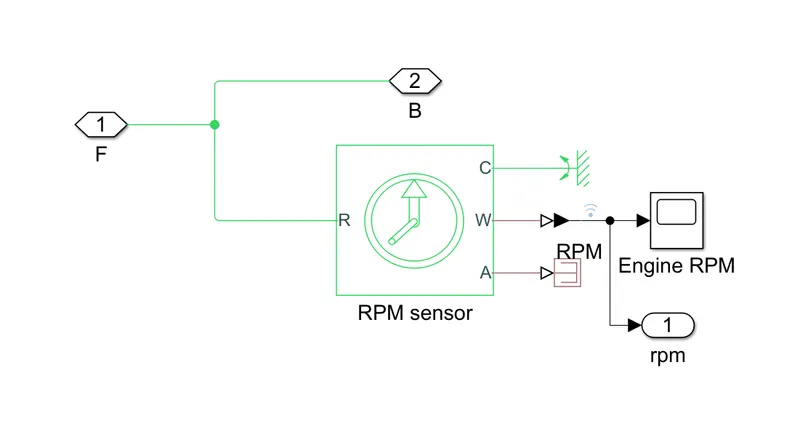
- B- mechanical rotational conserving port associated with the engine block which contains the piston cylinders.
- F- engine crankshaft, mechanical rotational force conserving port with engine crankshaft is attached to clutch and transmission.
CVT:
- CVT – Continuously Variable Transmission.
- CVT block is a continuous block which uses standard pulley and geometric equations to calculate the set point.
- Basically, CVT continuously variable transmission changes seamlessly the range of speed changes accordingly with the gear ratio of the engine.
- It is a single speed and a stepless transmissions.
- It has a fixed number of gear ratios with that of hard gear shifts while driving.
- The variable ratio transmission block gives a representation of gearbox which transfers dynamically transfers motion and torque between the torque connected driveshaft axes.
- Traditional transmission uses a variety of parts to shift between a range of present gears to pulley system.
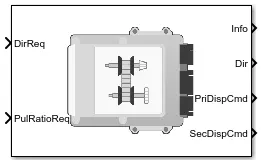
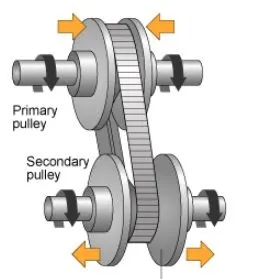
- It consists of pulley connected between shaft with the pulley that changes on the power needed or used by the user.
- CVT is specially used in scooty like models which does not have any gear in it but the acceleration and throttle is very high.
- One pulley is directly connected with the shaft with engine it gets the full power with CVT engine.
- Internal time delay is between the axis motions with transmission.
- It is like a gear a variable ratio transmission does not act as a kinematic constraint torque losses by the transmission.
IDEAL MOTION AND TORQUE TRANSFER:
- Variable ratio transmission is a mechanism for transferring motion and torque between base, the block is equivalent to a gear with a variable ratio.
NON-IDEAL TORQUE TRANSFER AND LOSSES:
- Non ideal torque transfer is equal to zero, losses in the variable ratio transmission are similarly to non-ideal gears.
- The angular velocity and dynamics are unchanged in non-ideal gearbox.
- The power and torque are reduced by coulomb friction that is between belt and wheel is derived by efficiency Ƞ.
SIMPLE GEAR:
- The simple gear block gives the representation of a gearbox that is connected to the driveline axes of base gear B and gear F.
- If both the gear axes rotate in same base axes it shows the same sign.
- If both the gear axes rotate in same base axes it shows the different sign.
- B- Base rotational mechanical port with base.
- F- Follower rotational mechanical port with follower.
VEHICLE BODY:
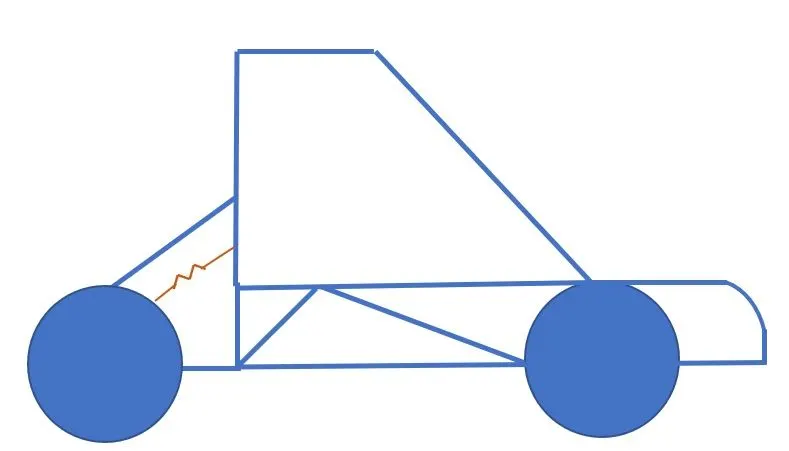
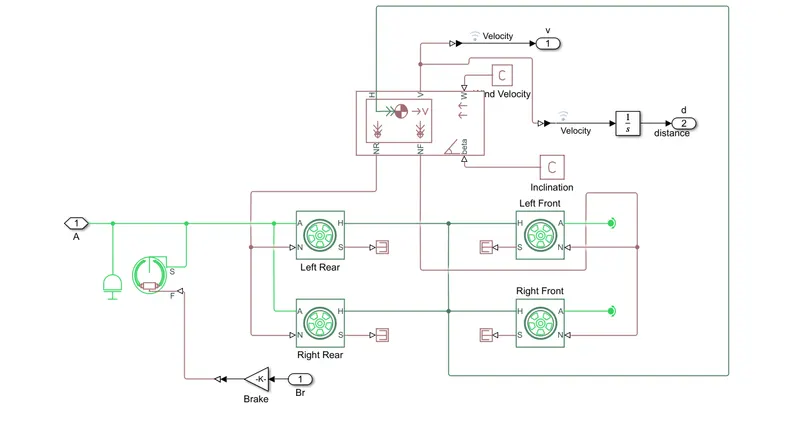
- The vehicle body represents a two-axle vehicle body in longitudinal motion, vehicle have the same or different number of wheels.
- This block has aerodynamic drag, road inclination, weight distribution and body mass have some suspension dynamics.
- It also has externally defined mass along with inertia.
- Simulation responses to the center of gravity, mass and inertia.
WHEEL:
- This block has a longitudinal magic formula with dynamics under constant conditions.
- Wheel rotates on the longitudinal direction down on the slope or inclination from a downhill.
- Fidelity of the wheel can be increased by increasing the inertia and rolling resistance.
- The power from the engine is transferred to the tyres with the axle connected with shaft which moves the wheel either forward or backward accordingly.
- N- physical signal with normal force, acting on tyre with positive force which acts downward force.
- M-magic formula coefficients
- S-slip which has physical signal associated with tyre and the road.
- A- Axle with mechanical rotational force port.
- H- Hub with mechanical translational force.
DOUBLE SHOE BRAKE:
- This block shows the frictional brake with two pivoted rigid shoes causes a force against the brake drum to produce braking action.
- This brake shoe is within the rotating drum which causes a friction between the drum and the brake shoe which causes the drum to reduce the speed of the vehicle.
- Brake is the main part of the vehicle to stop when in emergency situation, also where the shoe is important.
- If a fault trigger occurs with the input force is replaced by the faulted value of the simulation when the brake is struck.
- You can set the block issue a fault report as a error message in Simulink diagnostic viewer with fault occurs parameter.
BLOCKS USED:
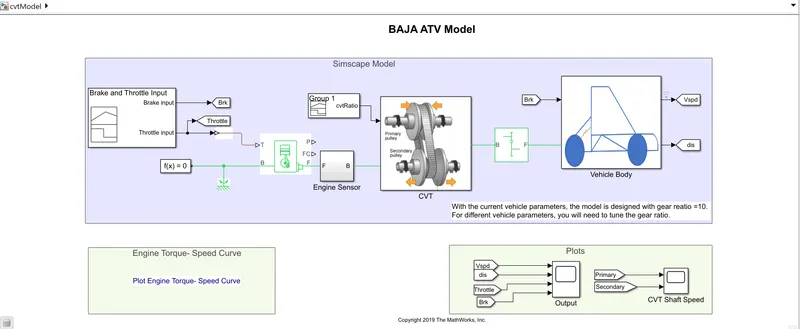
- Signal builder- for throttle input, brake and CVT ratio.
- Vehicle body- Baja ATV vehicle body representation.
- Generic engine- torque as input, speed to run the engine.
- Variable gear ratio- varies the speed to gear ratio.
- Knob- varies throttle and brake input.
- Double shoe brake- apply the brake to vehicles.
- Tyre- displacement and rotation of wheel.
- Measure gauge- measures throttle and brake input.
- Simple gear- reduce the speed by changing gear ratio.
- Inertia- to know the inertia of vehicle.
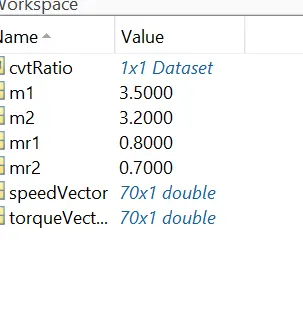
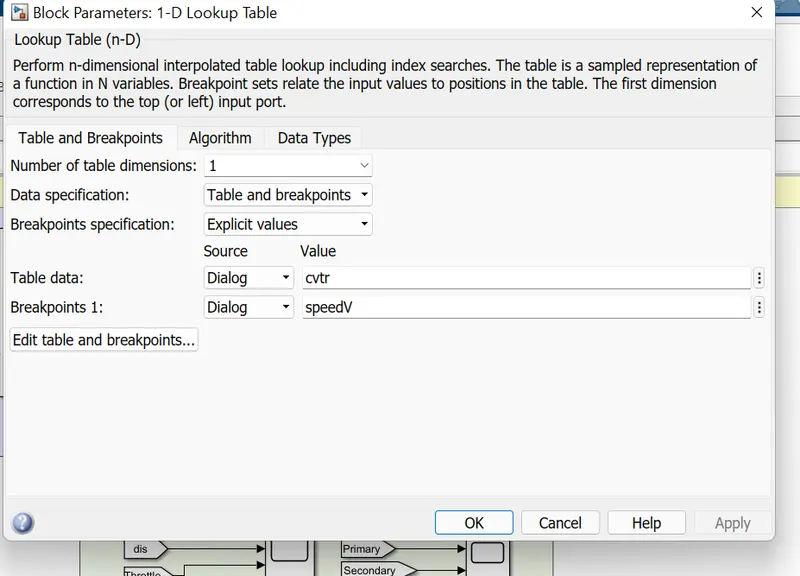
- Lookup table- gives the values from workspace.
- Solver configuration.
- Simulink PS converter.
- Rotational motion sensor.
- PS Simulink converter.
- Scope and display.
CONCLUSION:
The report for the Baja ATV was explained by the above results and from the relevant graphs and images.
REFERENCE:
- https://www.mathworks.com/matlabcentral/fileexchange/70576-baja-all-terrain-vehicle-atv-model
- https://en.wikipedia.org/wiki/Baja_SAE