Week-6 Challenge: EV Drivetrain
Aim:
1. Which type of power converter circuits are employed in electric and hybrid electric vehicle?
2. To find the steady-state of EV if duty cycle is 70%.
3.Develop a mathematical model of a DC motor.
4.Explain in brief about the authors prespective.
Answer:
1.
We know generally there are three types of electric vehicles:
- Hybrid Electric vehicle
- Plug-in Hybrid vehicle
- Battery Electric Vehicle
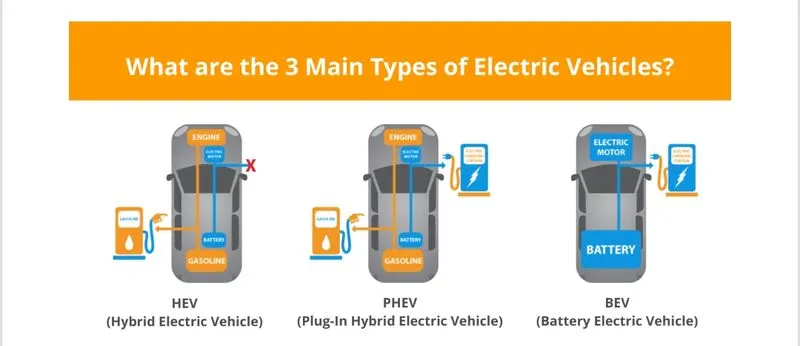
Hybrid Electric Vehicle:
- Hybrid Electric Vehicles,or HEVs,have both a gas powered engine and an electric motor to drive the car.
- All energy for the battery is gained through regenerative braking,which recoupos otherwise lost energy in braking to asset the gasoline engine during acceleration.
- In a traditional internal combustion engine vehicle,this braking energy is njormally lost as heat in the brake pads and rotors.
- regular hybrids cannot plug into the grid to rechargeand cannot charge with EVgoi.
Plug-in Hybrid Electric Vehicle:
- Plug-in Hybrid Electric Vehicles,or PHEVs, have both an engiune and electric motor to drive the car.
- Like regular hybrids they can recharge their battery through regenerative braking.
- They differ from regular hybrids by having a much larger battery,and being able to plug into the grid to recharge.
- While regular hybrids can (at low speed) travel 1 -2 miles before the gasoline engine turn on,PHEVs can go anywhere from 10 - 40 miles before their gas engine provide assistance.
- All PHEVs can charge at an EVgo L2 charger,but most PHEVs are not capable of supporting fast charging.
Battery Electric VEhicle:
- Battery Electric Vehicle,olso called BEVs and more frequently called Evs,are fully electric vehicles with rechargable battries and no gasoline engine.
- All energy to run the vehicle comes from the battery packwhich is recharged from the grid.
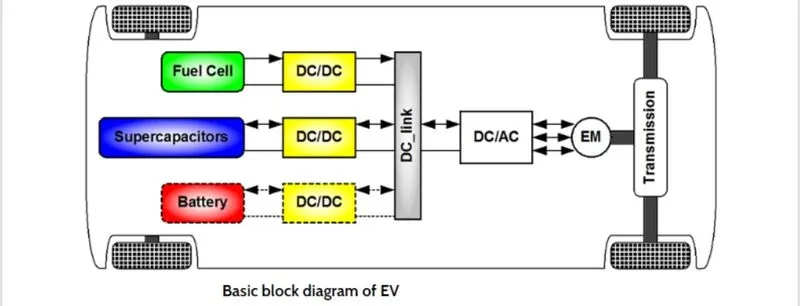
But in all these three types of Vehicls,we use basically three types of power converters.
They are: 1. AC -DC converter (Rectifier)
2. DC - DC converter (Chopper)
3. DC - AC converter (Iverter).
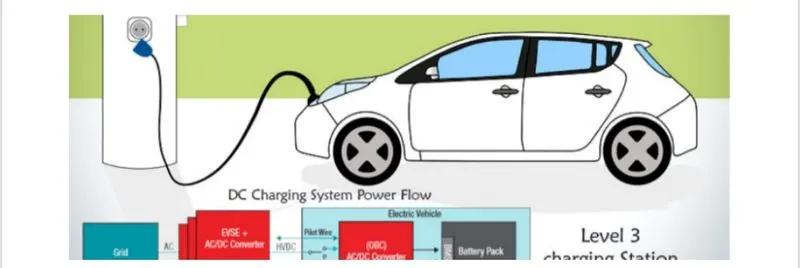
1. AC - DC Converter (Rectifier):
- AC - DC converter (Onboard charger) is used for charging the vehicle.
- As battery stores energy in ther form of DC, so AC -DC power converter is required.
- They are generally used in PHEV and BEV type vehicles.
2. DC - DC Converter (Chopper):
- We know lights,indicators and other signal generators requires only low voltage (12V or 24V).
- So the battery energy ( DC type high range ) will converted into low voltage DC by DC- DC converter (chopper).
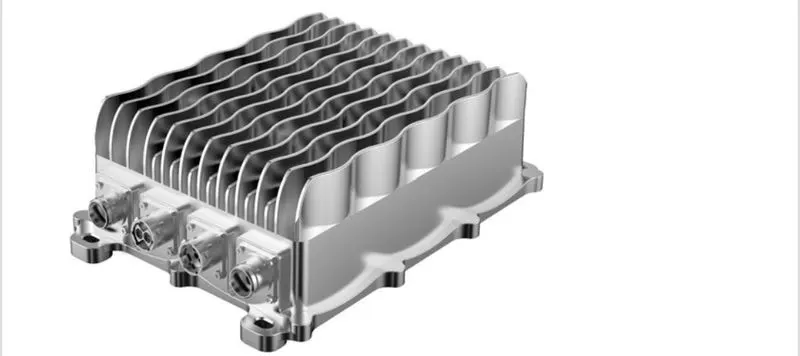
3. DC - AC Converter (Inverter):
- DC - AC converters are used to convert the battery energy (DC type) to AC supply the motor ( AC motor used).
- Therefore the converted energy (AC) is used for motor operation.
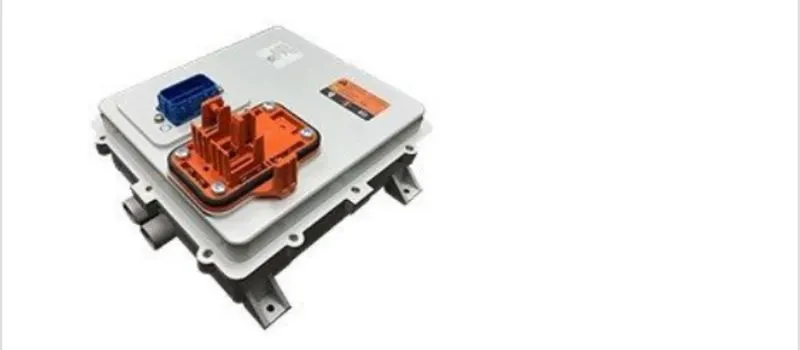
2. An Electric VEhicle powertrain with 72V battery pack is shown in the diagram below.The duty ratio for acceleration operation is 'd1' and foir the braking operation the duty ratio is 'd2'.
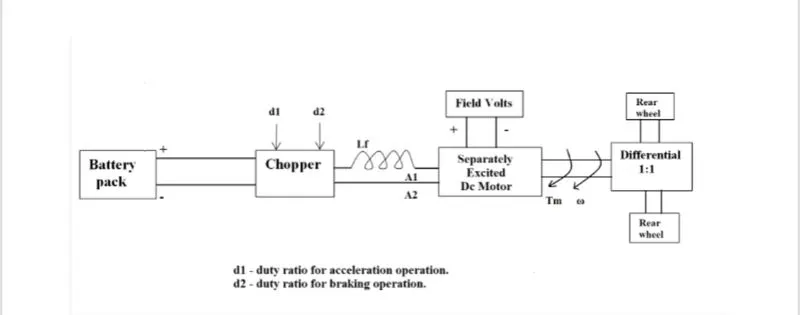
The other parameters of the electric vehicle is given below,
Motor and Controller Parameters:
Rated Armature voltage= 72 V
Rated armature current= 400 A
Ra= 0.5Ω, KΦ= 0.7 Volt second
Chopper Switching frequency= 400 Hz
The vehicle speed-torque characteristics are given by the below equation

What is EV steady state speed if duty cycle is 70%?
Answer:
As the torque formulla is given,we need to find the speed in rad/sec.Use the other expression available which is given below:
Rated Armature voltage= 72 V
Rated armature current= 400 A
Ra= 0.5Ω
KΦ= 0.7 Volt second
Chopper Switching frequency= 400 Hz
For duty ratio, δ = 70%
Voltage = Va x δ
= 72 x 0.7
= 50.4 V
We knoe,
Torque , T = KΦ/Ra*[Va - KΦ*ω]
by substituting the given values,
Torque, T = 0.7/0.5*[50.4 - 0.7ω]
= 1.4x(50.4 - 0.7 ω)
= 70.56 - 0.98ω
T = 70.56 - 0.98 ω and
Tv = 24.7 + 0.0051 ω^2 (given)
At T = Tv ;
70.56 - o.98 ω = 24.7 + 0.0051 ω^2
or, 0.0051 ω^2 + 0.98 ω +24.7 - 70.56 = 0
or, 0.0051 ω^2 + 0.98 ω -45.86 = 0
i,e., ω = 38.915 0r -231.072
Since speed cannot be negative,we will consider that the EV steadt-state speed, if the duty cycle is at 70%, is
ω = 38.915 rad.S^-1 or 371 rpm.
3. Develop a mathematical model of a DC Motor for the below equation using Simulink
Answer:
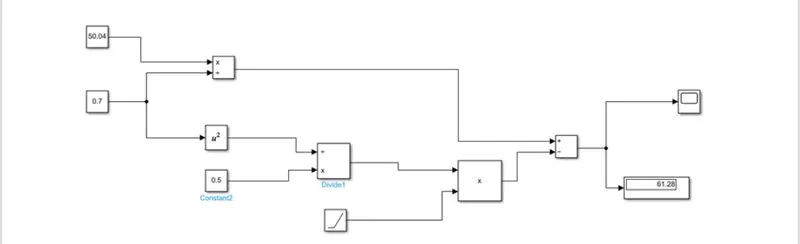
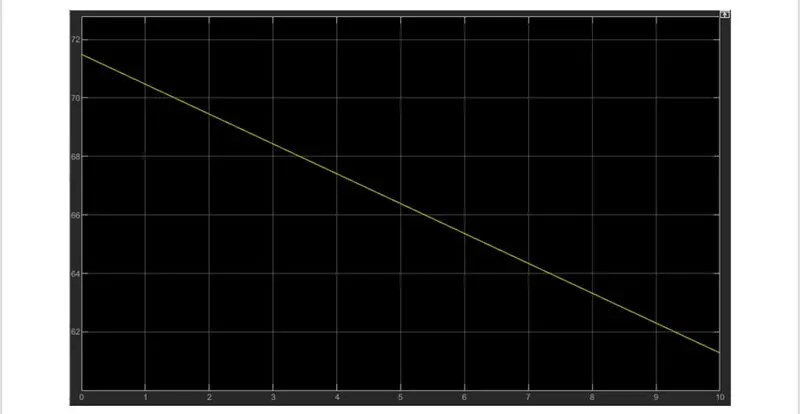
Output:-
4. Refer to the blog on below topic:
Induction versus DC Brushless motors by Wally Ripple,Tesla.
Explain in brief about authors prespective.
Answer:
Objective: To brief about the blog written by an author from Tesla.
Main Points:'
- There is no such thing called the best engine.According to the personal requirements,we need to adopt the engine type.
- In the course of time,lead-acid battries are replaced by lithium-0ion battries.
- In the course of time,DCV brush motors are replkaced by DC brushless induction motors.
- In the course of time,contactor controllers are replaced by modulating inverters.
- Tgherte is a bigger concern regardibg the stable use of these elements mentioned above over the next few decades.
- The author discusses the two technologies such as: 1. DC Brushless Drives and 2. Induction Motor with its feature of operation.
- He says Brushless motors are useless motorswithout the inverter.
- He also mentioned that the 3-phase induction motor has great utility but with several limitations.
- The major limitatyion being,the induction motor cannot operate from DC, and AC is a must.
- Further, he compares the future trends which may occour in DC Brushless as well as in induction motor.
- Since mostly all vehicles contain DC brushless motors now-a-days,only some vehicles liked GM EV1 and Tesla Roadster etc can use induction motor.
- The difference between these two kinds are too small.Since the differences are in rotors and inverter controls. DC motor requires absolute position sensor and induction requires speed sensor.
- The best power factor in induction is 85%. He also states the motor properties regarding eddy current and hystereeses.
- Induction motors are difficult to control since laws are more and also achieving stability over the entire torque speed range is difficult.
Conclusion:
He conncludes that DC Brushless Drives will likely continue to dominate in the hybrid and comming pluhg-in hybrid markets,and that induction drives will likely maintain dominance for the high performance pure electrics.