Week-6 Challenge: EV Drivetrain
Ans 1: The three type of power converter which used in electric and hybrid electric vehicle are
- DC to DC converter
- AC to DC converter
- DC to AC converter
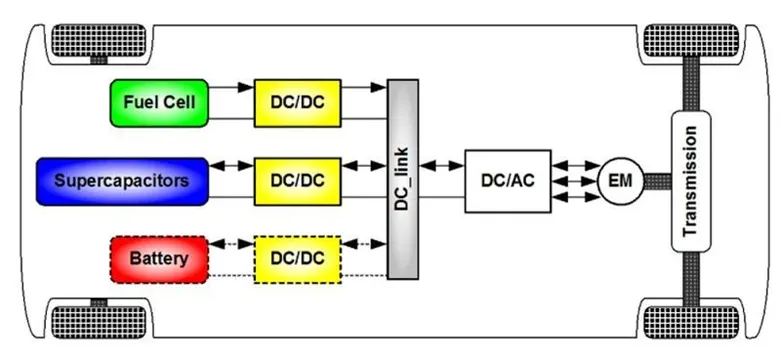
DC to DC Converter : A DC to DC converter is a category of power converters and it is an electric circuit which converts a source of direct current (DC) from one voltage level to another. The power of the DC/DC converter depends on the characteristics of the vehicle such as top speed, acceleration time from 0 to 100 Km/h, weight, maximum torque, and power profile. Generally, for passenger cars, the power of the converter is more than 20 KW and it can go up to 100 KW.
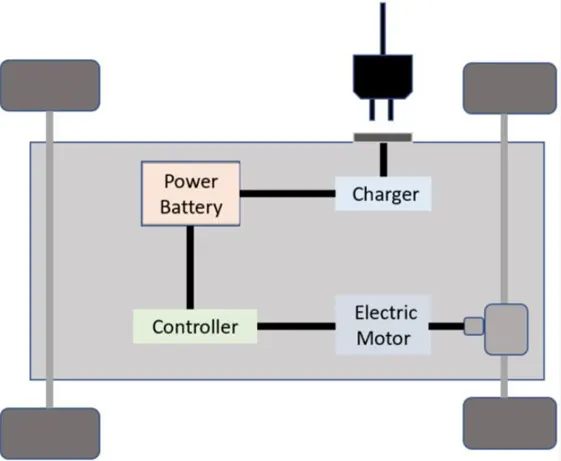
AC to DC Converter: An AC to DC converter is mainly used in Plug-in Hybrid Electric Vehicle (PHEV) and Plug-in Electric Vehicle (PEV). The AC power feed by externally power supply to charge the battery of vehicle.
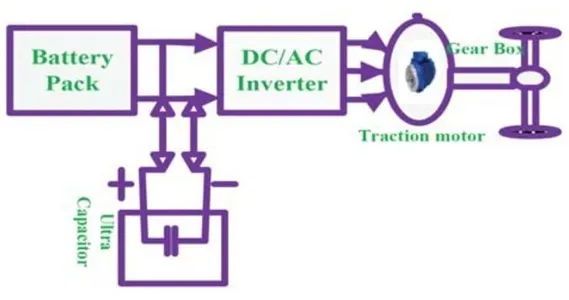
DC to AC Converter: The DC to AC converter is nothing but an inverter which convert DC power to AC power for electrical motor.
References link: https://www.intechopen.com/chapters/19583#B14
Ans 2:
Given data :
Battery Pack Voltage = 72V
Rated Armature voltage = 72 V
Rated armature curren t= 400 A
Armature Resistance = 0.5Ω
Motor Constant (KΦ) = 0.7 Volt second
Chopper Switching frequency= 400 Hz
Duty Cycle = 70%
The vehicle speed-torque characteristics are given by the below equation

Vehicle Output Voltage (Vv) = Battery Pack Voltage * Duty Cycle
= 72 * 0.70
= 50.4
Equation for vehicle speed-torque is
Tv = ((Vv - ω * KΦ) / Ra) * Ra
Where,
Tv = Vehicle Torque
Vv = Vehicle Voltage
ω = Steady state speed of Vehicle (rad/sec)
KΦ = Motor Constant
Ra = Armature Resistance
Put all this value in equation & we get
Tv = ((50.4 - ω * 0.7) / 0.5) * 0.5
Tv = (35.49 - 0.49 * ω ) / 0.5
Tv = 70.98 - 0.98ω ...........................(1)
Tv = 24.7 + 0.0051ω2 ..........................(2)
Solving Eq. (1) and (2)
70.98 - 0.98ω = 24.7 + 0.0051ω
24.7 + 0.0051ω2 + 0.98ω - 70.98 = 0
0.0051ω2 + 0.98ω - 46.28 = 0
ω1 = 39.41 rad/sec & ω2 = -231.37 rad/sec
we take only positive value,
Steady state speed of vehicle = 39.21 rad/sec
Ans 3: From que. 2 we find out torque value
Tv = 70.98 - 0.98ω
Tv = 70.98 - 0.98*39.41
Tv = 32.35 Nm
Simulink Model
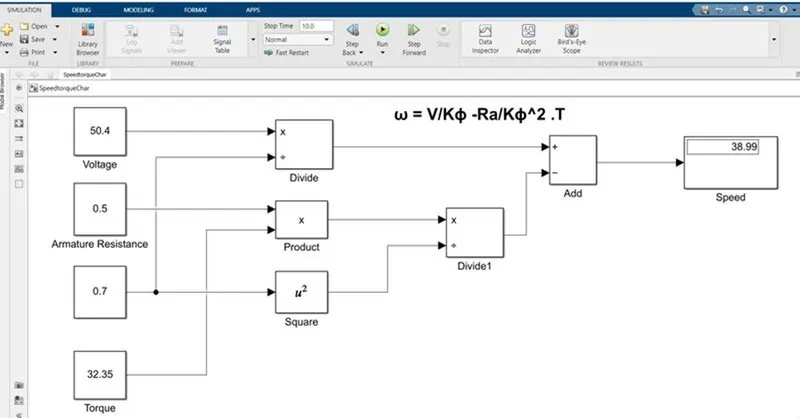
Results: Steady state speed of vehicle = 38.99 rad/sec
Ans 4: The following points are conclude
- The authors explain at the start there is no one best engine type, rather there are different types of engines to suit personal requirements, such as price and performance. This is also true for electric vehicle drives.
- He speaks about working of brushless DC motor and induction motor. Author also has done comparison between these two motors and state some advantage, disadvantage, similarity and dissimilarity
- Both DC brushless and induction drives use motors having similar stators. Both drives use 3-phase modulating inverters. The only differences are the rotors and the inverter controls. And with digital controllers, the only control differences are with control code. (DC brushless drives require an absolute position sensor, while induction drives require only a speed sensor; these differences are relatively small.)
- Induction motor has ability to start under load condition. No inverter is needed but They cannot operate from DC; AC is a must. Shaft speed is proportionate to line frequency. Hence, when used with utility power, they are constant speed machines. when operated from utility power, they have limited starting torque and somewhat limited running peak torque capabilities, when compared to DC type machines.
- One of the main differences is that much less rotor heat is generated with the DC brushless drive. Rotor cooling is easier and peak point efficiency is generally higher for this drive. The DC brushless drive can also operate at unity power factor, whereas the best power factor for the induction drive is about 85 percent. This means that the peak point energy efficiency for a DC brushless drive will typically be a few percentage points higher than for an induction drive.
- With DC brushless, as machine size grows, the magnetic losses increase proportionately and part load efficiency drops. With induction, as machine size grows, losses do not necessarily grow.
- After that author conclude that DC brushless drives will likely continue to dominate in the hybrid and coming plug-in hybrid markets, and that induction drives will likely maintain dominance for the high-performance pure electrics.