Week-6 Challenge: EV Drivetrain
1)WHICH TYPES PF POWER CONVERTER CIRCUITS ARE EMPLOYED IN ELECTRIC AND HYBRID ELECTRIC VEHICLE?
AIM:
POWER CONVERTER:
The task of a power converter is to process and control the flow of electric energy by supplying voltages and currents in a form that is optimally suited for user loads
the large number of automobiles in use around the world has caused and continues to cause serious problems of environment and human life.
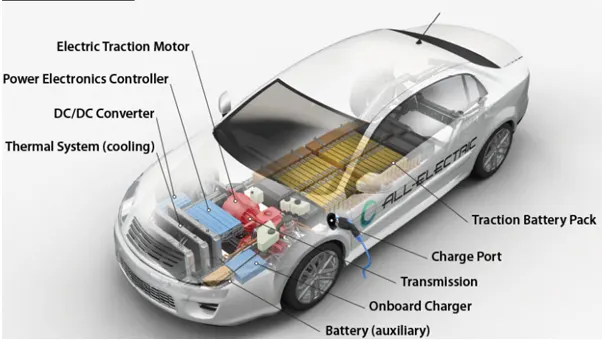
FIGURE: INTERNAL VIEW OF ELECTRIC VEHICLE(EVs)
Air pollution,global warming and the rapid depletion of the earth's petroleum resources are now serious problems.Electric vehicles(EVs).Hybrid Electric Vehicles(HEV) and Fuel cell Eletric vehicles (FCEVs)
AN Electric Vehicle is vehicle that uses a combination of different energy sources.BATTERIES AND SUPER CAPACITORS AND FUEL CELLS(FCs)
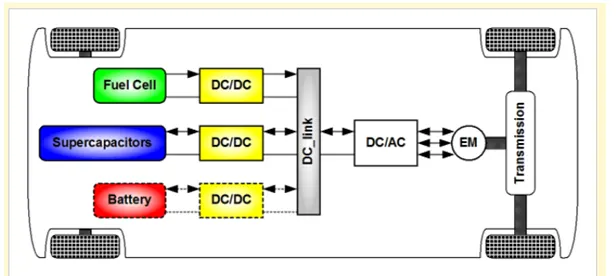
FIGURE:COMPONENTS BLOCK DIAGRAM OF ELECTRIC VEHICLE(EVs)
1.DC-AC Inverter
2.DC-DC Converter
3.Battery
4.Motor
electric vehicle comprises of 2 main power converter components they are
1.DC-DC CONVERTER
2.DC-AC INVERTER
1.DC-DC CONVERTER:
DC-DC converter can be used to interface the elements in the electric power train by boosting or chooping the voltage levels.
The different configurations of EV power supply show that at least one DC/DC converter is necessary to interface the FC.the battery or the Super capacitors module to the DC-link.
They are Used in battery charging and regenerative braking
DC/DC converter topologies can be used as bi-directional.A bi-directional converter can move power in either direction,which is useful in application requiring regenerative braking.
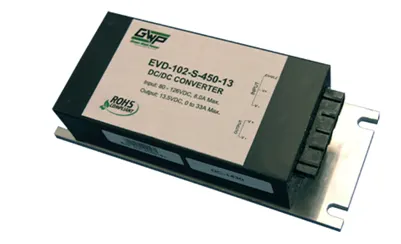
the most common DC/DC converter can be grouped as follows.
NON-ISOLATED CONVERTERS:
There are main types of converter in this non-isolated group usually called the BUCK,BOOST ,BUCK-BOOST AND CUK converters
the buck converter is used for voltages step-down
the boost converter is used for voltages step-up
the buck-boost and cuk converter can be used for either step-down or step-up
ELECTRICAL VEHICLE CONVERTER REQUIREMENTS:
small volume
low electromagnetic interference
low current ripple drawn from the fuel cell
the step up function of the converter
High efficiency
INVERTER(DC-AC)
IT converts direct current(DC) from the battery to alternating current(AC) to be used by other devices such as the traction motors
inverter can be used to control speed of the motor by adjusting the frequency of the alternating current
inverters have capability to change the torque power by adjusting the alternating current parameters
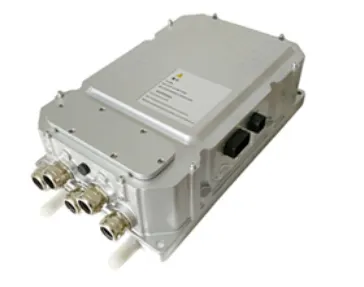
NEED OF INVERTING IN ELECTRIC CARS:
IT inverts DC charge to AC charge for driving the motor and then the opposite during regenerative braking.the motor to create a revolving magnetic field,like merry-go-round,to spin the motor's rotor4
2. An Electric Vehicle's powertrain with 72V battery pack in shown in the diagram below. The duty ratio for acceleration operation is 'd1' and for the braking operation the duty ratio is 'd2'.
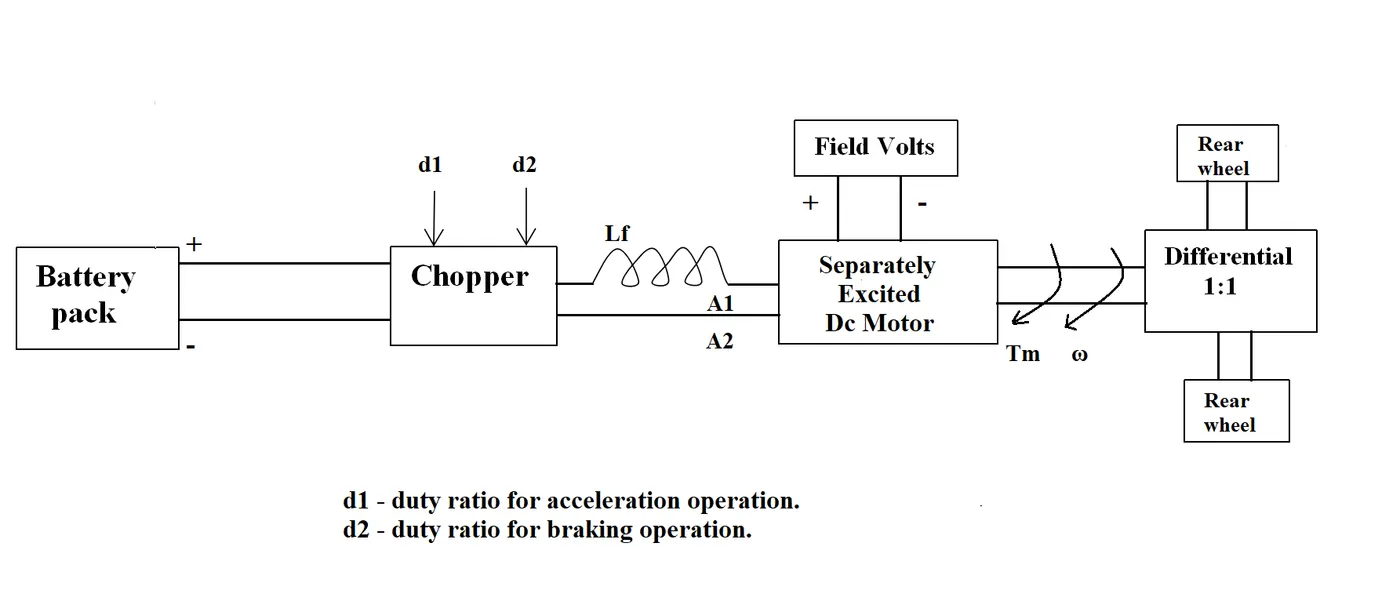
The other parameters of the electric vehicle is given below,
Motor and Controller Parameters:
Rated Armature voltage= 72 V
Rated armature current= 400 A
Ra= 0.5Ω, KΦ= 0.7 Volt second
Chopper Switching frequency= 400 Hz
The vehicle speed-torque characteristics are given by the below equation

What is EV steady state speed if duty cycle is 70%?
AIM:
Given duty cycle=70%=0.7
voltage = rated armature voltage*Duty cycle = 72*0.7=50.4Volts
T - motor torque
V - VOLTAGE
Ra - Armature resistance
Kpie - motor constant
w - Angular speed of motor
Torque - speed characteristics of DC motor
Tm=(V Kpie/Ra)-(((Kpie)^2/Ra)*w
Tm=((50.4)*0.7)/0.5-((0.7)^2/(0.5))*w
Tm=70.56-0.98-------EQ(1)
Tv=24.7+(0.0051)w^2-------------EQ(2)
Equating the above the equations (1)&(2)
24.7 +(0.0051)w^2=70.56 - 0.98
in order to find roots to solve the above equation which is in form of quadratic equation
ax^2 + bx +c=0 by using these formula:
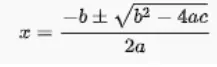
subtituting the equation values in above formula
w=0.98+-((root of (0.98)^2-4*0.0051*45.8)/2*0.0051
here we get w = 38.92 rad/sec or 231.02 rad/sec
here we get w=38.92 rad/sec or 231.02 rad/sec
steady state of the angular speed is 38.92
3. Develop a mathematical model of a DC Motor for the below equation using Simulink.
`omega`= V/K`phi` -Ra/K`phi`^2
AIM:
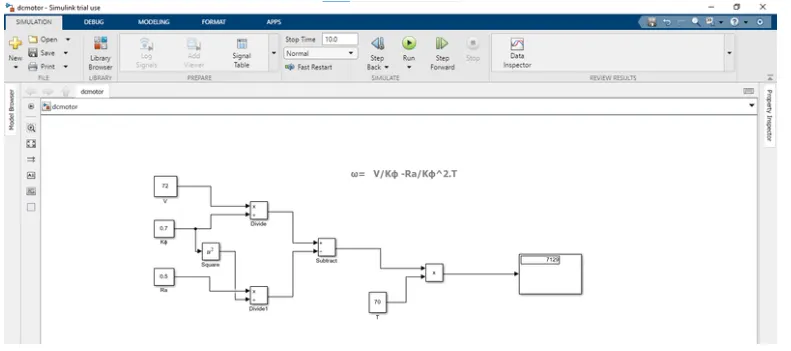
THE ABOVE FIGURE SHOWS THE EQUATION OF DC MOTOR
4. Refer to the blog on below topic:
Induction Versus DC brushless motors by Wally Rippel, Tesla
Explain in brief about author’s perspective.
AIM:
Induction Versus DC brushless motors
- His prospective about electric vehicle future technology cannot be predicted easily.the gas powered vehicles engines are not all same and there is no best engine type people choose according to their requirements such as price and performance these also comes under electric vehicles.
- induction motor does not have permanent magnets and its is connected to 3-phase utility power,torque is produced at the outset the motor has ability to start under load so the inverter is not needed so it has ability compatible with the conventional vehicles.
- limitations of induction motor is it requires source power as AC it will not operate in DC.THis motor has limited starting torque and limited running peak torque capabilites as shaft speed is proportoinate to line frquency and feed back signal and speed variation depends upon the frequency input it is hard to control .
- where dc brushless machines requires permanent magnets which is cost effient construction of Dc brushless motor is costly compared to induction motor because of magnets
- he finally said that DC brushless motors will dominanace in HEV and PHEV
- AND induction motors is highly preferred in PURE EV.
- THE AUTHOR SAID THAT BOTH INDUCTION MOTOR AND DC BRUSHLESS MOTOR HAVE ADVANTAGES AS WELL AS DIADVANTAGES AND HE EXPLAINED ABOUT BASIC CONSTRUCTION OF BOTH THE MOTORS.