Week-6 Challenge: EV Drivetrain
1. Which types of power converter circuits are employed in electric and hybrid electric vehicle?
Answer:
Three types of Power Converters are employed in Electric and Hybrid EV.
1) AC to DC Converter : Called Rectifier Circuit used in battery Charging
2) DC to AC Converter : Called Inverter used before Motor Drive
3) DC to DC Converter : Called DC-DC converter(Chopper)- used step up or step down DC Voltage as required
2. An Electric Vehicle's powertrain with 72V battery pack in shown in the diagram below. The duty ratio for acceleration operation is 'd1' and for the braking operation the duty ratio is 'd2'.
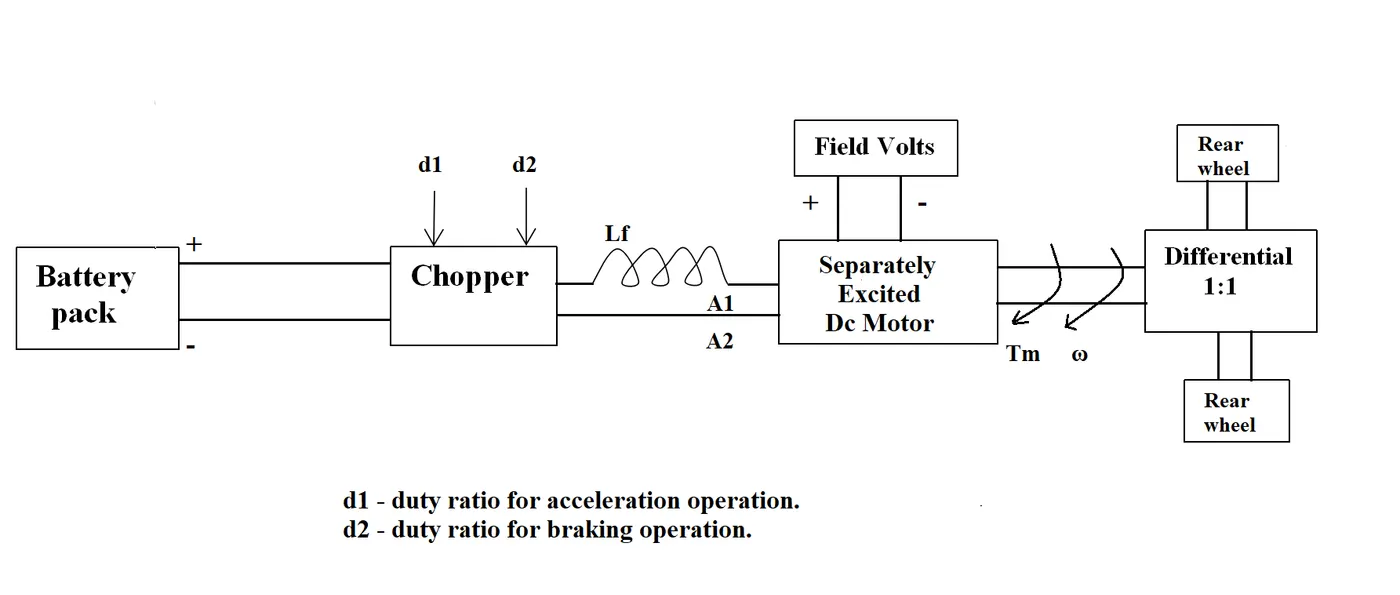
The other parameters of the electric vehicle is given below,
Motor and Controller Parameters:
Rated Armature voltage= 72 V
Rated armature current= 400 A
Ra= 0.5Ω, KΦ= 0.7 Volt second
Chopper Switching frequency= 400 Hz
The vehicle speed-torque characteristics are given by the below equation

What is EV steady state speed if duty cycle is 70%?
Solution :
Duty Cycle= 70% = 0.7
Avg. Voltage = Armature Voltage*0.7= 72*0.7 = 50.4 V;
Torque -speed Equation:
ω">ω= V/Kϕ">ϕ -Ra/Kϕ">ϕ^2 .T
Convert in terms of T
T = V. Kϕ">ϕ/Ra -(Kϕ)2/Ra = 50.4*(0.7/0.5)-((0.7*0.7)/0.5)*w = 70.56- 0.98w
ϕ">Tv= 24.7 +(0.0051)w2----(1)
ϕ">T= 70.56-0.98w----(2)
ϕ">comparing eq 1 & 2
ϕ">70.56-0.98w=24.7+(0.0051)w2
ϕ">0.0051w^2+0.98w-45.86=0
ϕ">solving this quadratic equation, we get two values(positive and negative)
ϕ">Consider Positive value
ϕ">w = 39.9 rad/sec
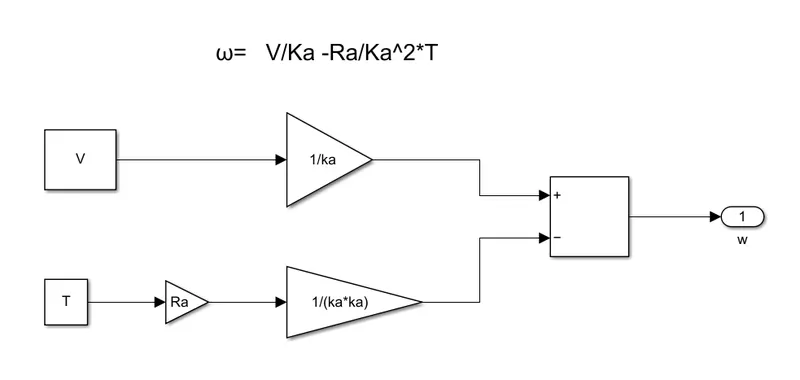
3. Develop a mathematical model of a DC Motor for the below equation using Simulink.
ω= V/Ka -Ra/Ka^2 .T
4. Refer to the blog on below topic:
Induction Versus DC brushless motors by Wally Rippel, Tesla
Explain in brief about author’s perspective.
| Brushless DC Motor | Induction Motor |
| With brushless machines, the rotor includes two or more permanent magnets that generate a DC magnetic field | The induction rotor has no magnets – just stacked steel laminations with buried peripheral conductors that form a “shorted structure.” Currents flowing in the stator windings produce a rotating magnetic field that enters the rotor.The essential difference between the two machines is with the rotor. |
| In turn, this magnetic field enters the stator core (a core made up of thin, stacked laminations) and interacts with currents flowing within the windings to produce a torque interaction between the rotor and stator. | In turn, the frequency of this magnetic field as “seen” by the rotor is equal to the difference between the applied electrical frequency and the rotational “frequency” of the rotor itself. |
| As the rotor rotates, it is necessary that the magnitude and polarity of the stator currents be continuously varied – and in just the right way - such that the torque remains constant and the conversion of electrical to mechanical energy is optimally efficient.The device that provides this current control is called an inverter. Without it, brushless motors are useless motors. | Accordingly, an induced voltage exists across the shorted structure that is proportionate to this speed difference between the rotor and electrical frequency. In response to this voltage, currents are produced within the rotor conductors that are approximately proportionate to the voltage, hence the speed difference. Finally, these currents interact with the original magnetic field to produce forces – a component of which is the desired rotor torque. |
| a brushless DC motor produces no starting torque when directly connected to fixed frequency utility power. They really need the aid of an inverter whose “phase” is maintained in step with the angular position of the rotor. | When a 3-phase induction motor is connected to utility type 3-phase power, torque is produced at the outset; the motor has the ability to start under load. No inverter is needed |
| Operated with DC Current | AC is Must, Shaft speed is proportionate to line frequency. Hence, when used with utility power, they are constant speed machines. Finally, when operated from utility power, they have limited starting torque and somewhat limited running peak torque capabilities, when compared to DC type machine |
| Both DC brushless and induction drives use motors having similar stators. Both drives use 3-phase modulating inverters. | |
| DC brushless drives require an absolute position sensor | induction drives require only a speed sensor |
| less rotor heat is generated | More rotor heat is generated |
| peak point energy efficiency higher than Induction Motor | peak point energy efficiency Less than BLDC Motor |
| In an ideal brushless drive, the strength of the magnetic field produced by the permanent magnets would be adjustable. When maximum torque is required, especially at low speeds, the magnetic field strength (B) should be maximum – so that inverter and motor currents are maintained at their lowest possible values. This minimizes the I² R (current² resistance) losses and thereby optimizes efficiency. Likewise, when torque levels are low, the B field should be reduced such that eddy and hysteresis losses due to B are also reduced. Ideally, B should be adjusted such that the sum of the eddy, hysteresis, and I² losses is minimized. Unfortunately, there is no easy way of changing B with permanent magnets. | In contrast, induction machines have no magnets and B fields are “adjustable,” since B is proportionate to V/f (voltage to frequency). This means that at light loads the inverter can reduce voltage such that magnetic losses are reduced and efficiency is maximized. Thus, the induction machine when operated with a smart inverter has an advantage over a DC brushless machine – magnetic and conduction losses can be traded such that efficiency is optimized. This advantage becomes increasingly important as performance is increased. |
| With DC brushless, as machine size grows, the magnetic losses increase proportionately and part load efficiency drops | With induction, as machine size grows, losses do not necessarily grow. |
| Permanent magnets are expensive – something like $50 per kilogram. Permanent magnet (PM) rotors are also difficult to handle due to very large forces that come into play when anything ferromagnetic gets close to them. | his means that induction motors will likely retain a cost advantage over PM machines. Also, due to the field weakening capabilities of induction machines, inverter ratings and costs appear to be lower, especially for high performance drives. Since spinning induction machines produce little or no voltage when de-excited, they are easier to protect. |
My conclusion is that DC brushless drives will likely continue to dominate in the hybrid and coming plug-in hybrid markets, and that induction drives will likely maintain dominance for the high-performance pure electrics. The question is what will happen as hybrids become more electrically intensive and as their performance levels increase? The fact that so much of the hardware is common for both drives could mean that we will see induction and DC brushless live and work side by side during the coming golden era of hybrid and electric vehicles.