Week-6 Challenge: EV Drivetrain
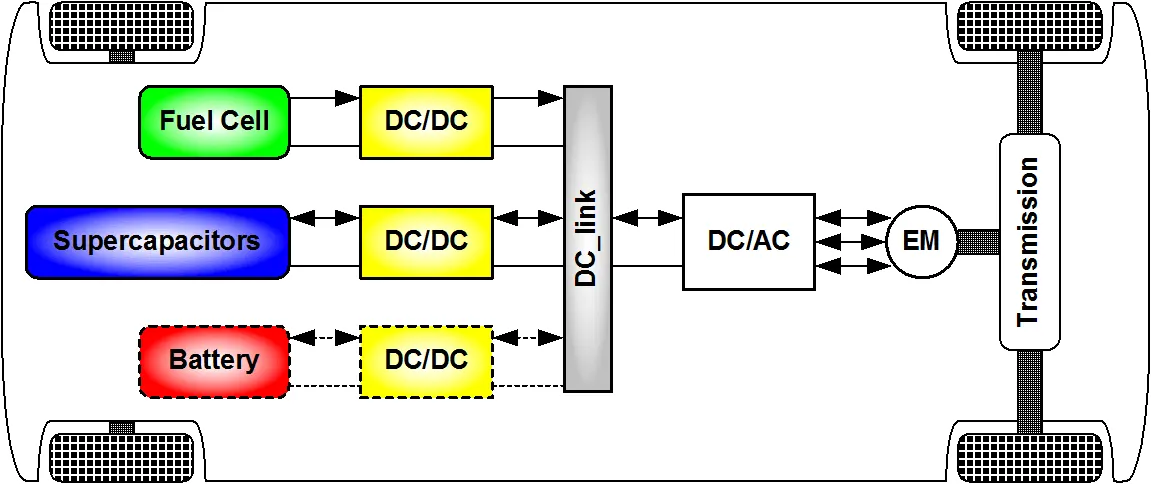
1.Which types of power converter circuits are employed in electric and hybrid electric vehicle?
Hybrid electric vehicles are powered by an internal combustion engine and an electric motor, which uses energy stored in batteries. A hybrid electric vehicle cannot be plugged in to charge the battery. Instead, the battery is charged through regenerative braking and by the internal combustion engine. The extra power provided by the electric motor can potentially allow for a smaller engine. The battery can also power auxiliary loads and reduce engine idling when stopped. Together, these features result in better fuel economy without sacrificing performance
2. An Electric Vehicle's powertrain with 72V battery pack in shown in the diagram below. The duty ratio for acceleration operation is 'd1' and for the braking operation the duty ratio is 'd2'.
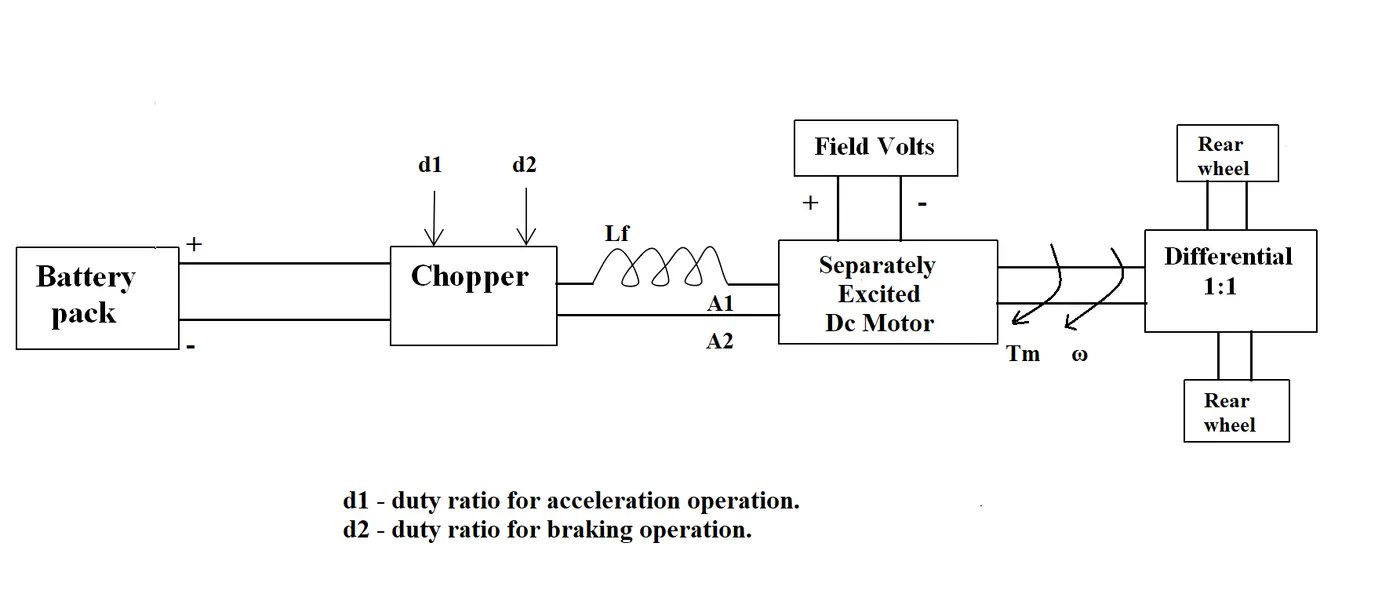
The other parameters of the electric vehicle is given below,
Motor and Controller Parameters:
Rated Armature voltage= 72 V
Rated armature current= 400 A
Ra= 0.5Ω, KΦ= 0.7 Volt second
Chopper Switching frequency= 400 Hz
The vehicle speed-torque characteristics are given by the below equation

What is EV steady state speed if duty cycle is 70%?
T =V.K-K^2.W/R^2.
T = Torque
V = Armature voltage.
R = resistance
W =Speed rad/sec
Compare the equation
24.7+0.0051*w^2 = ((v*K)/R)-((K^2)*w/r)
24.7+0.0051*w^2 = (72*0.7*0.7)/0.5-(0.7^2/0.5)*w
70.56-0.98*w=24.7+0.00051*W^2
w^2+192.15*w-892.15 = 0
w=38.95rad/sec.
3. Develop a mathematical model of a DC Motor for the below equation using Simulink.
ωω= V/Kϕϕ -Ra/Kϕϕ^2 .T
In the beginning author desribes the dominance of ingerbal combustion engine(ICE) iin the world of automobile industry and aslo discuss differ types of engine.In the blog of induction DC brushless motor has a postive and negative side of both the induction and dc motor.
The dc motor is permanent magnets are used which produced a rotating magnetic field. This magnetic field when induces a current in the conductor.This current results in force generation in the rotor and this results in rotaion of motor.
For induction drives ,there rotor has no magnets but instead stacked steel lamination with buried conductors which a shorted structure.Its is the current steel lamination.
Brushless DC motor have some adv. like: much less rotor heat is generated with the DC brushless drive.The peak point energy efficiency for Dc brushless drive is typically be a few percentage points higher than for an induction drive.
Finally the suthor not choose which drive is better than teh other but makes it clear that DC brushless drives will likely continue to dominates in the hybrid and coming plug in hybrid markets.