Week-6 Challenge: EV Drivetrain
1.
Type of Power Converters employed in Electric and Hybrid electric vehicles-:
On-board charger- AC-DC converter(Unidirectional)
Battery converter-DC-DC converter(Bidirectional)
Motor drive-DC-AC converter(Bidirectional)
Auxillary battery converter-DC-DC converter(Unidirectional)
To interface the Fuel Cell, Battery, or Supercapacitor module with DC-link, at least one DC/DC converter is required.
2.
Rated Armature Voltage = 72 Volts
Rated Armature Current = 400A
Ra (Armature Resistance) = 0.5 Ohm
KΦ= 0.7 Volt Second
Chopper Switching Frequency = 400 Hz
The Vehicle Speed –Torque characteristics are given by
Tv= 24.7 + (0.0051) ω2
Duty Cycle = 70 %
So the Vehicle Output Voltage (Vev) = Battery Voltage * Duty Cycle = 72 * 0.70 = 50.4 V
Vehicle torque can be calculated as
Tev= [(Vev-ω*KΦ).KΦ]/ Ra
Where, Tev is vehicle torque in Nm
Vev is vehicle voltage in Volts
ω is steady state speed of the vehicle in rps
KΦ is motor constant
Ra is armature resistance.
So, Tev = [(50.4 – 0.7 *ω) * 0.7]/0.5
Tev = 70.05 – 0.98 ω
And Given relation is Tv= 24.7 + (0.0051) ω2
Equating the above two equations, we will obtain
45.35 – 0.98 ω = 0.0051 . ω2
Solving the above quadratic equation result in two values of ω, 38.54 rps and -230.70 rps.
Since negative values cannot be considered, hence the ω is 38.54 rad/sec
3.
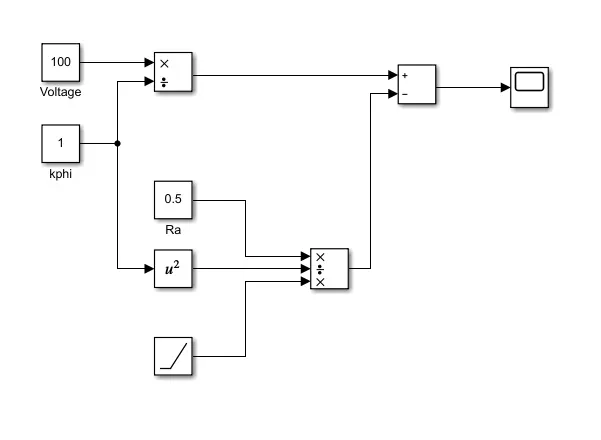
Model has been attached with this report.
4.
DC brushless drives will continue to dominate in the hybrid and plug-in hybrid markets and induction drives will likely dominate in high-performance pure electrics.