Week-6 Challenge: EV Drivetrain
CHALLENGE 6
ANSWER 1 :
The Power Electronic Converter The Power Electronic Converter can be classified into 4 types :
- AC to DC Converter (Controlled Rectifier)
- DC to DC Converter (DC Chopper)
- DC to AC Converter (Inverter)
- AC to AC Converter (AC voltage regulator)
AC to DC Converters. An AC to DC converter circuit can convert AC voltage into a DC voltage. Converts the low voltage AC supply into DC supply. The DC output voltage can be controlled by varying the firing angle of the thyristors. The AC input voltage could be a single phase or three phase.
Application. EV chargers.
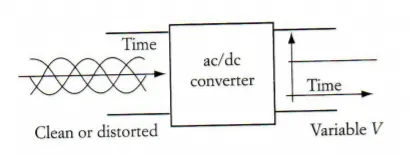
DC to DC Converters. These converters can converter a fixed DC input voltage into variable DC voltage or vice versa. The DC output voltage is controlled by varying of duty cycle.
Application. Power auxiliary loads.
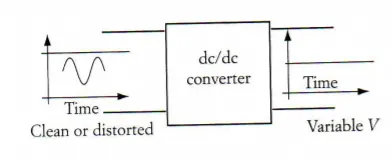
DC to AC converters. These converters are connected between DC source of fixed input, and variable AC load. Most commonly, these DC to AC converters are called as inverters. An inverter is a static device that converts fixed DC supply voltage to variable AC voltage.
Application. AC motor drive and control.
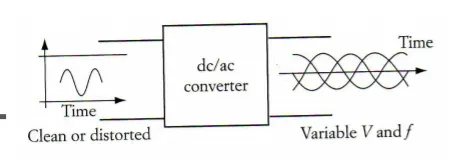
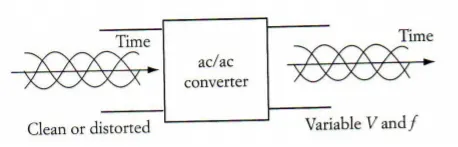
AC to AC converters. This converters can convert from a fixed ac input voltage into variable AC output voltage. This converter converts the AC voltage at one level to the other by varying its magnitude as well as frequency of the supply voltage that is, the output voltage is controlled by varying firing angle of TRIAC. These type converters are known as AC voltage regulator. An AC/AC converters connect an AC source to AC loads by controlling amount of power supplied to the load.
Application. Air conditioning regulator.
ANSWER 2 :
Given : Rated armature voltage : 72 V
Rated armature current : 400A
Ra : 0.5 ohm
K.phi : 0.7 V-s
Chopper switching frequency : 400 hz
TTR : 24.7 + 0.0051 w2
Duty cycle : 70%
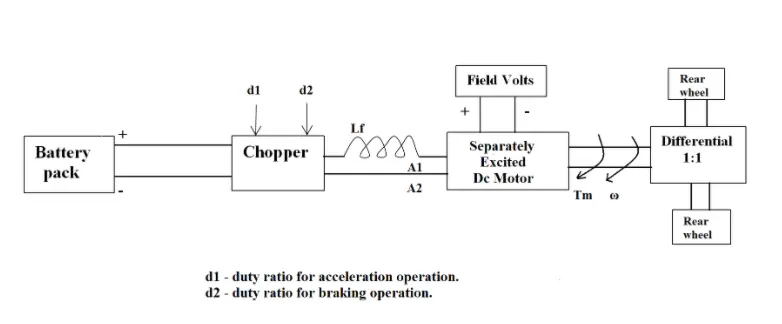
As duty cycle is 70%,
The voltage becomes.
= 72 * 70 / 100
= 50.4 volts.
Now, the equation for torque is,
So, T = (50.4 * 0.7 / 0.5) – (0.72 * N / 0.5)
T = 70.56 – (N * 0.98)
At steady state condition,
TTR = T
So,
24.72 + 0.0051 w2 = 70.56 – (w * 0.98)
0.0051 * w2 + 0.98 * w – 45.84 = 0
On solving this quadratic equation,
w = 38.91 or -231.07 in rad/sec
at steady state.
ANSWER 3 :
The author has brought the importance and differences between dc brushless motor and induction motor in the field of electrical vehicles.
|
DC brushless motor |
Induction motor |
|
Needs a DC supply. |
Needs a ac 3 phase supply. |
|
Has 2 or more permanent magnets in the rotor. |
Has stacks of steel laminations. |
|
Costs are high. |
Costs are less comparatively. |
|
Inverter is required for varying the stator currents. |
Inverter is not always necessary. |
|
Magnetic fields cannot be varied. |
Magnetic fields can be varied. |
|
Has no starting torque, which makes them to aid on inverter. |
Has the ability to start under load. |
|
Speed can be varied easily. |
Speed can not be varied without the aid of inverter. |
|
Very less amount of heat is produced. |
High amount of heat is produced. |
|
Heat management is easy. |
Heat management is difficult comparatively. |
|
Favourable only at light performance applications. |
Favourable at high performance applications. |
|
Control principles are simple. |
Complex control principles. |
|
Can operate at unity power factor. |
Can operate only at 0.85 power factor. |
Even with so many advantages and disadvantages over each other, the author states that there is still no winner as they stand tall individually for different types of applications in the market.