Week-6 Challenge: EV Drivetrain
AIM:
- Types of power converter circuits employed in electric and hybrid electric vehicle.
- An Electric Vehicle's powertrain with 72V battery pack in shown in the diagram below. The duty ratio for acceleration operation is 'd1' and for the braking operation the duty ratio is 'd2'. Rated Armature voltage= 72 V. Rated armature current= 400 A. Ra= 0.5Ω, KΦ= 0.7 Volt second. Chopper Switching frequency= 400 Hz.Vehicle speed torque characteristics Tv = 24.7+(0.0051)w . What is EV steady state speed if duty cycle is 70%?
- Develop a mathematical model of a DC Motor for the below equation using Simulink.
ω= V/Kϕ -Ra/Kϕ^2 .T
- Refer to the blog on topic: Induction Versus DC brushless motors by Wally Rippel, Tesla and Explain in brief about author’s perspective.
Solution :
1. Types of power converter circuits employed in electric and hybrid electric vehicle
There are three major power electronic units in the general configuration
- DC-DC converter
- DC-AC inverter
- AC-DC Rectifier
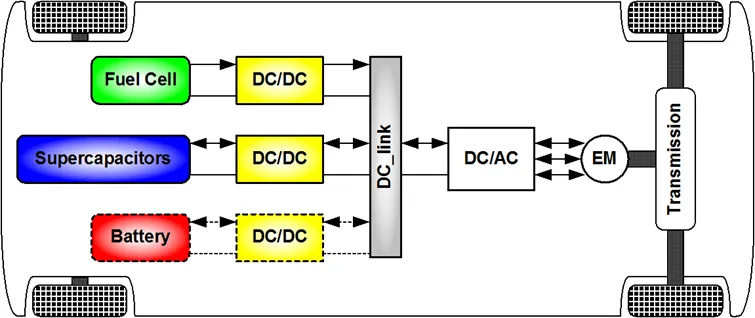
DC-DC Converter: DC-DC converters can be used to interface the elements in the electric power train by boosting or chopping the voltage levels. By introducing DC/DC converters one can chose the voltage variation of the devices and the power of each device can be controlled.
The different configurations of EV power supply show that at least one DC/DC converter is necessary to interface the Battery or the Supercapacitors module to the DC-link.
The amount of power flow between the input and the output can be controlled by adjusting the duty cycle
DC-AC inverter: Converts direct current (DC) from the battery to alternating current (AC) to be used by other devices such as the traction motor and coolant pump.
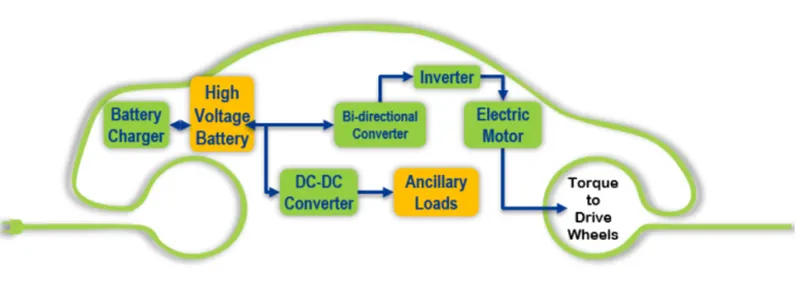
AC-DC Rectifier: Electric cars have batteries that run on direct current (DC) power.
So the AC power which we use for charging batteries is converted to DC using a rectifier which feeds DC power to the battery
2. An Electric Vehicle's powertrain with 72V battery pack in shown in the diagram below. The duty ratio for acceleration operation is 'd1' and for the braking operation the duty ratio is 'd2'. Rated Armature voltage= 72 V. Rated armature current= 400 A. Ra= 0.5Ω, KΦ= 0.7 Volt second. Chopper Switching frequency= 400 Hz.Vehicle speed torque characteristics Tv = 24.7+(0.0051)w . What is EV steady state speed if duty cycle is 70%?
Givenm:
Motor and Controller Parameters:
Rated Armature voltage= 72 V
Rated armature current= 400 A
Ra= 0.5Ω, KΦ= 0.7 Volt second
Chopper Switching frequency= 400 Hz
Duty cycle=70% , Vbat = 72V
SOLUTION:
We know that
Ω = Vt/Kϕ -Ra/Kϕ^2 .(Tt )
Vt = Vbat * Duty cycle.
=72 * 0.70
Vt =50.4
Ω= (50.4/0.7) - (0.5/(0.7) 2). Tt
Tt = (72- Ω)/1.020
Tt = 70.58-0.98 Ω
But we know that
Tv=24.7+0.0051 Ω2
Comparing Tv and Tt
24.7+0.0051 Ω2 = 70.58-0.98 Ω
0.0051 Ω2+0.98 Ω-45.88 = 0
(Ω-38.92)( Ω+231.08) = 0
Ω=38.92, -231.08
speed cannot be a negative, hence consider only the positive value
So therefore EV steady state speed = 38.92 rad/sec.
3. Develop a mathematical model of a DC Motor for the below equation using Simulink.
ω= V/Kϕϕ -Ra/Kϕϕ^2 .T
Why to model mathematically ?
Mathematical modeling is one of the bases of conversion activity of a real problem in a mathematical form and this modeling involves to formulate the real-life situations or to convert the problems in mathematical explanations to a real or believable situation.
Above equationn can be implemented using the simulinkk model as follows :
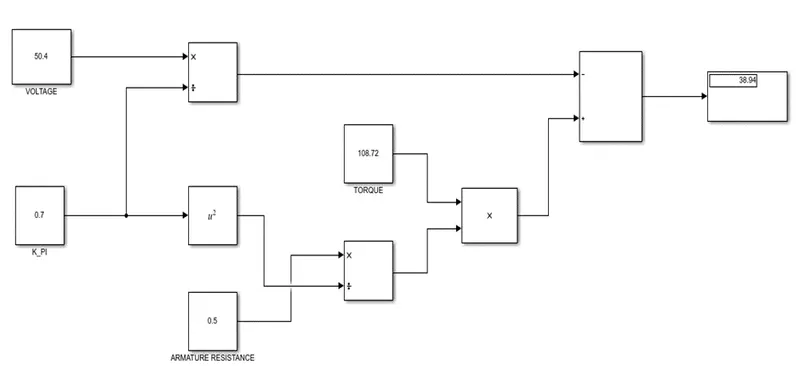
here the armature resistance value and the torque value and volatage are implementedd using the constant block and also with the help of square block it is given to the product block to get the desired value
Constant Block :
This Constant block generates a real or complex constant value signal. Use this block to provide a constant signal input. The block generates scalar, vector, or matrix output, depending on: The dimensionality of the Constant value parameter.
Product Block :
This Product block performs multiplication or division of its inputs.
This block produces outputs using either element-wise or matrix multiplication, depending on the value of the Multiplication parameter. You specify the operations with the Number of inputs parameter.
Display Block :
This Display block shows the value of the input data. You can specify the frequency of the display. For numeric input data, you can also specify the format of display. If the block input is an array, you can resize the block vertically or horizontally to show more than just the first element.
4. Refer to the blog on below topic:
Induction Versus DC brushless motors by Wally Rippel, Tesla
Explain in brief about author’s perspective.
Solution :
Wally Rippel’s perspectives are
- All engines are alike and its up to the user to select one according to his/her requirements. Due to the improvising technology, there has been alternatives found now and then such as lead-acid batteries, DC brush motors and contact controllers have been replaced by lithium batteries, brushless DC or induction motors and inverters.
- Though there has been various replacements, brushless DC and induction motors are playing a major role till this date.
- The construction and working of the brushless motors and induction motors are being discussed. the stators for the 3-phase induction motor and the DC brushless motor are virtually identical. Both have three sets of “distributed windings” that are inserted within the stator core. Both drives use 3-phase modulating inverters. The only differences are the rotors and the inverter controls.
- The pros and cons of both brushless DC motors and induction motors are being discussed. The advantages of brushless dc motors are: much less rotor heat is generated. the peak point efficiency will only be a few % higher than an induction motor. The disadvantages are: as the machine size grows, the magnetic losses increase proportionately and part load efficiency drops. permanent magnet (PM) rotors are also difficult to handle due to very large forces that come into play when anything ferromagnetic gets close to them.
- Induction motor has some advantages: the motor has no magnets. the motor can start under no-load conditions. the disadvantages are: they cannot operate in DC. When operated with utility power, they have limited starting torque and limited running peak torque capabilities when compared to DC type machines.
- The author’s conclusion is that DC brushless drives will likely continue to dominate in the hybrid and coming plug-in hybrid markets, and that induction drives will likely maintain dominance for the high-performance pure electrics.
- The fact that so much of the hardware is common for both drives could mean that we will see induction and DC brushless live and work side by side during the coming golden era of hybrid and electric vehicles.
Conclusions :
- The tyypes of power converter circuits employed in an electric and in the hybrid electric vehicle were studied
- An Electric Vehicle's powertrain with 72V battery pack in shown in the diagram below. The duty ratio for acceleration operation is 'd1' and for the braking operation the duty ratio is 'd2'. Rated Armature voltage= 72 V. Rated armature current= 400 A. Ra= 0.5Ω, KΦ= 0.7 Volt second. Chopper Switching frequency= 400 Hz.Vehicle speed torque characteristics Tv = 24.7+(0.0051)w with which the EV steady state speed if duty cycle is 70% was calculated.
- A mathematical model of a DC Motor for the below equation using Simulink was developed
ω= V/Kϕ -Ra/Kϕ^2 .T
- Refer to the blog on topic: Induction Versus DC brushless motors by Wally Rippel, Tesla and author’s perspective was explained in brief.
Gdrive Link :
https://drive.google.com/drive/folders/15KoY7GX01dFjMvc7STYQa1uVYi-0ZcJn
Links and references :
1. https://in.mathworks.com/help/
2. https://www.tesla.com/blog/induction-versus-dc-brushless-motors