Week-6 Challenge: EV Drivetrain
Q1 : Types of Power Converters Pircuits are Employed in Electric and hybrid Electric Vehicle?
A1: A Power converter is an electrical circuit that changes the electric energy from one form into the desired form optimized for the specific load. A converter may do one or more functions and give an output that differs from the input.
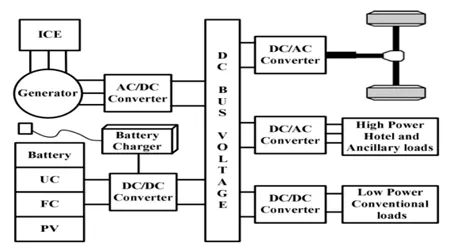
A pictorial representation of power converters in a hybrid vehicle is shown below.
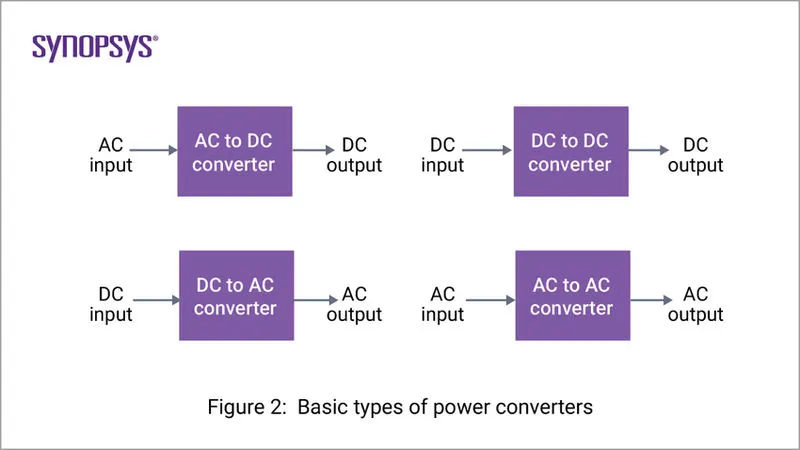
Power converters are four Types, That are
- AC to DC Converter
- DC to DC Converter
- DC to AC Converter
- AC to AC Converter
But we are used in EV and HEV are
- AC to DC Converter
- DC to DC Converter
- DC to AC Converter
1) AC to DC Converter : These are also called as Rectifier. Rectifier is the used to Convert alternating current by the generator or by the plug in supply to the form of Direct Current(DC) to store the change in the rechargeable battery.
2) DC to DC Converter : These are also called as Chopper Converter. Chopper Converter is used to convert stepdown the DC voltage to the required level of voltage of 12V. In the Electric vehicle(EV), it is used to convert Electrical Voltage for low-power conventional loads.
3) DC to AC Converter : These are also called as Inverter. Inverter converts direct current to the form of alternate current, it used to run high power Hotel and Ancillary Loads from the DC voltage Source in the electric vehicles.
Note: One more converter are there AC to AC converter. It converts AC voltage with a same AC voltage with Different Frequency or step up or step down AC voltage with same Frequency.
Q2 : An Electric vehicle's powertrain with 72V Battery pack in shown in the Diagram Below. The Duty Ratio for Acceleration operation is 'd1' and for the breaking operation the Duty Ratio 'd2'.
The other parameters of the electric vehicle is given below,
Motor and Controller Parameters:
Rated armature voltage = 72V
Rated armature current = 400A
Ra = 0.5Ω , KØ=0.7 volt second
Chopper Switching frequency = 400 Hz
The vehicle speed-torque characteristics are given below Equation
Tv= 24.7+(0.0051)ω^2
What is the EV steady state speed if Duty cycle is 70% ?
A2: Given Data
Rated armature voltage = 72V
Rated armature current = 400A
Ra = 0.5Ω
KØ=0.7 volt second
Chopper Switching frequency = 400 Hz.
Speed torque Characterstics equation is
Tv= 24.7+(0.0051)ω^2-------(1)
Duty cycle percentage = 70%
Then Vo = 72*70/100
= 50.4 V
Tv = (Vo*KΦ/Ra)-(ω*KΦ^2/Ra)
Tv = (50.4*0.7/0.5)-(ω*0.7^2/0.5)
= 70.56-0.98ω
Substuting the value of Tv in equation (1)
70.56-0.98ω=24.7+(0.0051)ω^2
0.0051ω^2+0.98ω+24.7-70.56
0.0051ω^2+0.98ω+45.86
It is in the form of ax2 + bx + c
To get the value of

Instead of x we have to find ω here
ω=-0.98±√({0.98}^2-4*0.0051*(-45.86))/2*0.0051
We get ω= 38.91, ω=-231.07
for the speed, only a positive value is considering so
ω, speed= 38.91 Rad/s
Speed = 371.56 rpm
Q3 : Develop A Mathematical Model of a DC Motor for The below equation using Simulink.
ω=V/KØ−Ra/KØ^2*T
A3: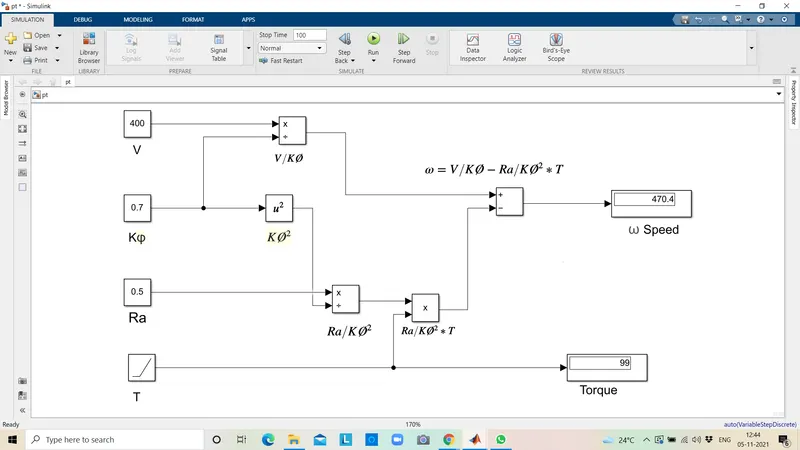
The above figure shows the block diagram of the above equation for a DC motor.
Here, we have used Simulink Blocks are
- Constant
- Ramp
- Add
- Divide
- Product
- Square
- Display
Procedure :
- Add the required blocks to the model.
- Connect the blocks as required for the model.
- For Voltage V the constant input of 400 is given.
- KØ is the constant input 0.7.
- Ra is the constant resistance value of 0.5.
- Torque is given as the constant ramp input.
- Run model for 100 seconds.
Output speed ω= 470.4 at torque t= 99.
Q4 : Induction Vs DC Brushless motor by wally Rippel, Tesla:
Objective: To study about the Induction Vs DC Brushless motor by Wally Rippel, Tesla.
Observation: In this Blog Wally Rippel,Tesla discussed about the various types of motor that he came across from 1960s.Back then the motor used in the electrical vehical is brushed DC motor with contactor which is no more in use in this field. Now a days it is replaced with Brushless DC motor and 3phase induction motor.By using the contactors and brushed DC motor the losses are high.
In both Brushless DC motor and 3 phase induction motor, the stator is same. ONly difference is the type of rotor used. In the Brushless DC motor, the rotor is made of the two or more Permanant magnet.This Permanant magnet produces the magnetic field which comes in contact with the stator windings. When the supply is given to the stator, the torque is produced in the rotor which makes the motor run. to maintain the torque constant, the current should be varried continuosly. So that inverter is used. This type of motor performs well at peak speed.The torque values can be varried by changing the value of B. But it is not possible to change the value of B in permanant magnet.
Here comes the induction motor which was invented by the Nikola Tesla. The stator is smae as we discussed before but the rotor is made of laminated steels and the conductors are arranged in the slot. When the supply is given to the Stator, it produces rotating magnetic field. This comes in contact with the rotor. The frequency of the rmf is Equal to the frequency of the supply. So that Voltage is induced in the Rotor and value is equal to difference between the value of supply frequency and speed of rotor itself. The ends of rotor are short circuited by the end rings, so the current flows through the rotor. Due to effect of rmf, the Torque is produced in the rotor.
Hence the 3 phase motor is run directly from the utility power source. But the limitation is it runs on line voltage but not on DC voltage.Hence the inverter is added to the circuit.BY using the switching operations in the Inverter the speed can be varied. And the value of B also can be reduced because there is no permanent magnet.
The brushless DC motor operation at the peak performance is efficient. The induction motor may be of less efficient at peak. But average efficiency of the induction motor is better than the brushless DC motor.
Result: The Brushless DC motor is used for Hybrid and Plug in Hybrid vehicle. While the induction motor is used for pure electric vehicle.