Week-6 Challenge: EV Drivetrain
1. Which types of power converter circuits are employed in electric and hybrid electric vehicle?
Sln. Power Converters used
1) Ac-Dc converter
2) Dc-Ac Converter
3) Dc-Dc Stepup Converter
4) Dc-Dc Stepdown Converter
Explanation:
1) Ac-Dc Converter:-
* This type of Converter used in On Board Charger and in the fast charging Station Converters
* This is a rectifier ckt which is used to convert the alternating Ac voltage supply to the DC Voltage
* This is mainly used because there is no readily available DC voltage station, usually grid are operating in High voltage Ac
* The Onboard charger consists of stepdown transformer input filter rectifier ckt and linear voltage ckt
* The stepdown transformer is used to reduce the voltage from 230Vac to required voltage of 120Vac or 240Vac
* Isolator Surge protector are used to protection of the device
2) DC-Ac Inverter:
* Generally Dc to 3-phase Ac inverter is used
* Converts Dc from the battery to alternating current Ac to be used by other devices such as traction motor and Coolant pump
3) Dc-Dc Stepup and Stepdown Chopper:
* A Converter that increases Voltage is called stepup Converter
* A Converter that decreases voltage is called stepdown converter
* In EV's/HEv's Stepup and Stepdown Converter are Combined into one unit
* An application of stepup converter is converting Ev/HEV battery Voltage (Typically 180-300 Volts) to about 650 volts to power the traction
* An Advantage of using converter to increase voltage from the battery is smaller and less expensive battery may be used while still utilizing and efficient high voltage motor.
* An Application of stepdown inverter would be decreasing high voltage DC 180-300 Volts, from the HEV/Ev battery to low voltage (12-14 Volts)
* Dc Cannot be used to charge the 12 Volt auxiliary battery and operate light load devices such as lightening radio and windows.
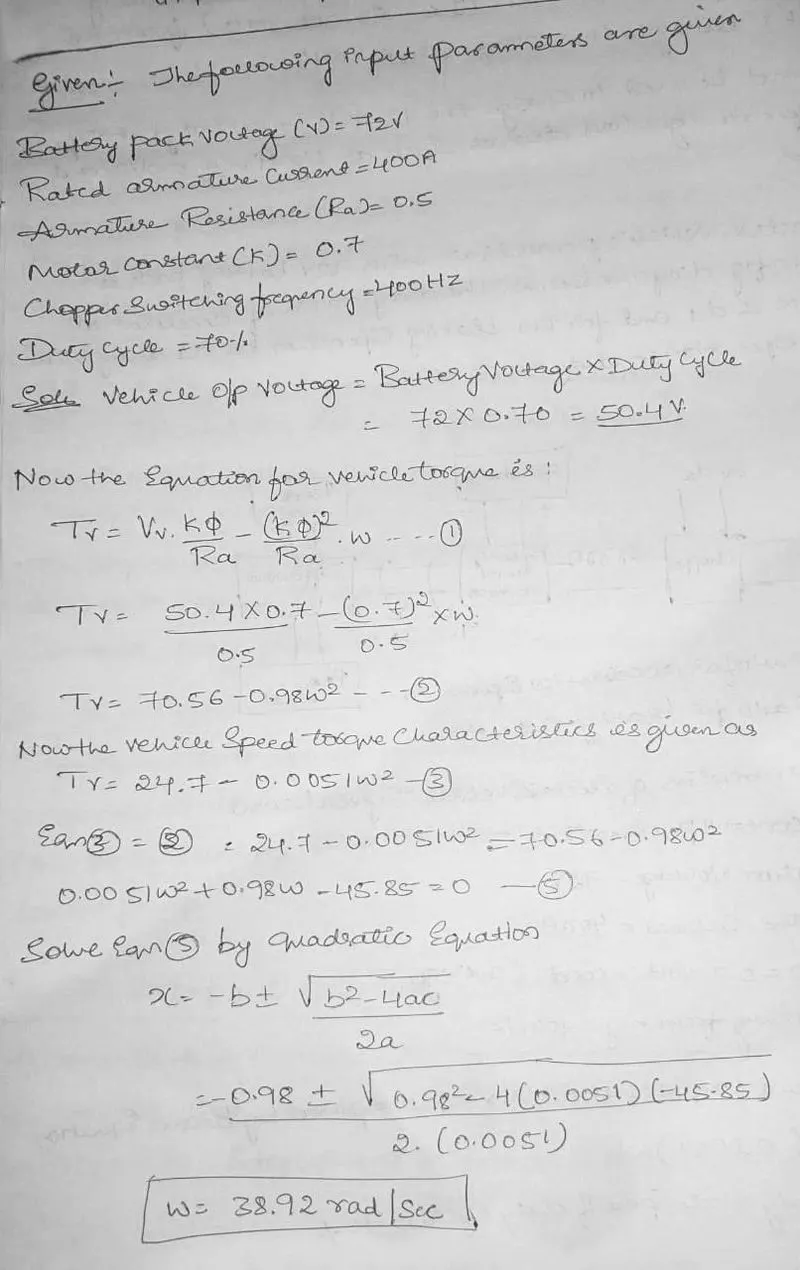
2. An Electric Vehicle's powertrain with 72V battery pack in shown in the diagram below. The duty ratio for acceleration operation is 'd1' and for the braking operation the duty ratio is 'd2'.
Solution:---------------
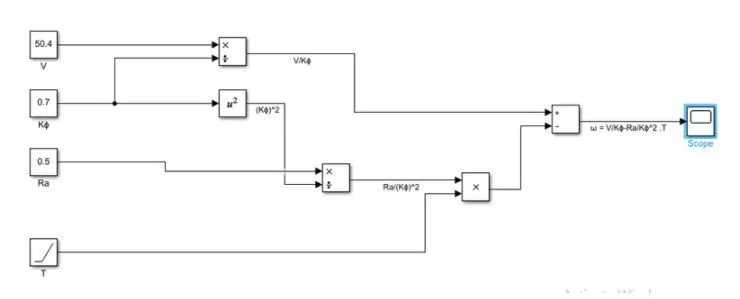
3. Develop a mathematical model of a DC Motor for the below equation using Simulink.
ω">ωω= V/Kϕ">ϕϕ -Ra/Kϕ">ϕϕ^2 .T
Sln.. V=50.4 Volts
Motor Constant K=0.7,
Ra=0.5 Ohm
and also consider torque linearly increasing Signal.
MODEL:
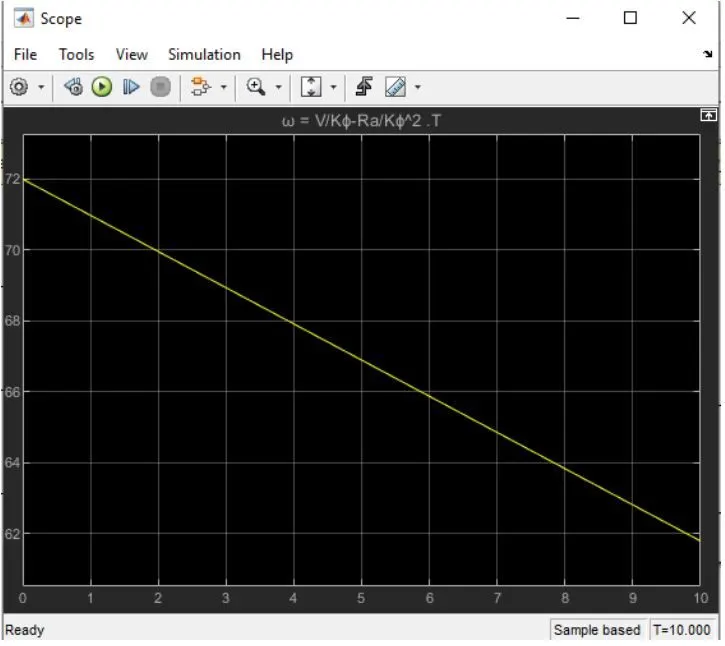
RESULT:-
4)
Refer to the blog on below topic:
Induction Versus DC brushless motors by Wally Rippel, Tesla
Explain in brief about author’s perspective
Sln..
* Wally Ripple is long time proponent of electric vehicles
* Before joining Tesla Motors he was an engineer at Aerovironment
* He Helped develop the EV1 for General Motors and was featured in the documentary Movie.
* Wally also worked for the jet propulsion Laboratory on electric vehicle battery research among the other projects.
* He built an electric car and won the Great Transontinental Electric Car Race against MIT.
* In the begining the auother describes the dominance of internal combustion engines (IEC) in the world of automobile industry.
* He explains that all the engines were similar and it was up to the user to select according to their requirement
* Next Auother highlights topics related to Ev technology especially related to DC Brushless Motor and Induction Motor.
* According to him DC Brush Motors is replaced by either DC Brushless Motor or induction Motor.
* Lead Acid Battery is replaced by lithium-ion-batteries for Ev's He also quoted that there will be the future of both the technology (DC Brushless Motor and Induction Motor) depends upon thier demands and uses.
DC BRUSHLESS MOTOR:-
With brushless machines the rotor inculdes two or more permanent magnets that generate a DC magnetic field.
* In turn this magnetic field enters the stator core and interacts with currents flowing within the windings to produce a torque interaction between the rotor and stator
* As rotor rotates it is necessary that the magnitude and polarity of the stator currents be contiuously varied and in just the right way such that the torque remains constant and the conversion of electrical to mechanical energy is optimally efficient
* The device that provides this current control is called an inverter without it, brushless motors are useless motors.
* The author also said that the brushless DC motor produces no starting torque when directly connected to fixed frequency utility power.
Advantages:
* The advantages of DC Brushless Motor is that there is low heat generation in the rotor and its cooling capacity is better as compared to induction Motor.
* The DC brushless drive can also operate at unity power factor whereas the best power factor for the induction drive is about 85%
Disadvantage:
* As machine size grows the magnetic losses increase proportionately and part load efficiency drops.
* Permanent magnets are expensive and difficult to handle due to very large forces that come into play when anything ferromagnetic gets close to them.
Induction Motor:
* The Technology behind the induction motor is that it basically uses 3-phase induction motor which was invented nikola Tesla sometime before 1889
* The induction rotor has no magnets
* Current flowing in stator windings produce a rotating magnetic field that enters the rotor.
* In an indcution motor current interacts with th magnetic field generated by the stator to produce a force which is required for rotor torque.
*When a 3-phase induction motor is connected to utility type 3-phase power torque is produced at the outset.
* The fact that induction motors are directly compatible with conventional utility power is the main for their success
Advantages:
* The induction motor does not have any magnets and in this B field is adjustable
* The motor has the ability to start under load and there is no need of an inverter
*This technology is used to reduce the magnetic losses and conduction losses, due to which efficiency will remain at max peak
Disadvantage:
* An induction motor annot operate from DC voltage
* It always require an Ac voltage supply
* In an induction motor the shaft speed is proportionate to line frequency
*When Operated from the Utility power they have limited starting torque and somewhat limited running peak torque capabilities when compared to Dc Type
*************************************************** In the end The auother couldnt choose which drive is better than othersbut makes it clear that DC Brushless motor drives will likely continue to dominate in Hybrid and Plug in Hybrid Vehicle
RESULT:
* Studied different types of power converters circuits employed in electric and hybrid vehicles
* Speed of and Ev drive train determined.
* Mathematical model of Dc motor developed
* WE have studied diffence between indcution versus Dc brushless motor by and Auother