Week-6 Challenge: EV Drivetrain
AIM : Which types of power converter circuits are employed in electric and hybrid electric vehicle?
Explanation:
- Power convertor circuits : This technology deals with processing and controlling the flow of electrical energy in order to suplly voltages and currents in a form that is optimally suir=ted for instruments.
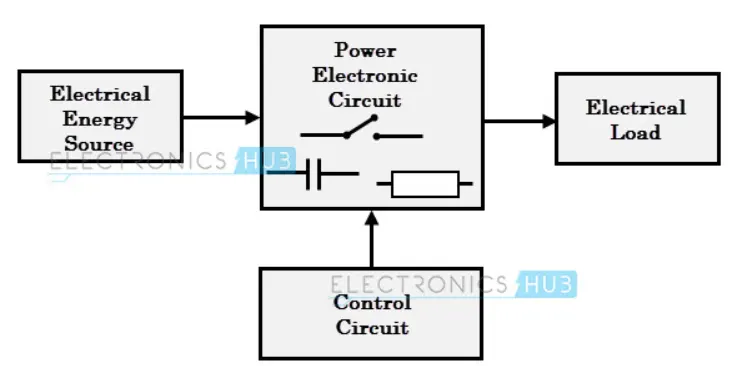
As shown in above block diagram it consists of an electical energy source a power electronic circuit a control unit and an electric load. This convertor changes one form of electrical energy to other forms of electrical energy. The power electronic circuit performs both the power part and the control part. Yhe power part transfers the energy from source to load and it consists of power electronic switches transformers electric choke capacitors fuses and sometime resistors. The control circuit regulateed the elements in the power part of the convertor. This block is built with a complex low power electronic that consists of either digital or analog circuit assembly.
Depending upon the functions performed the following are 4 diffrent classifications.
- a) AC to DC convertor which is called "rectifier"- It converts AC into Unipolar DC current.
- b) DC to AC convertor which is called "invertor" - It converts DC into AC desired voltage frequency.
- c) DC to DC convertor which is "Chopper" - It converts High voltage DC to low voltage DC (step down) or low voltage magnitude from the AC supply.
- d) AC to AC convertor which is called "cyclometer" - It converts the AC of the desired frequency and desired voltage magnitude from the AC supply.
Except for the AC to AC convertor the other 3 are predominantly used in both HEV and EV.
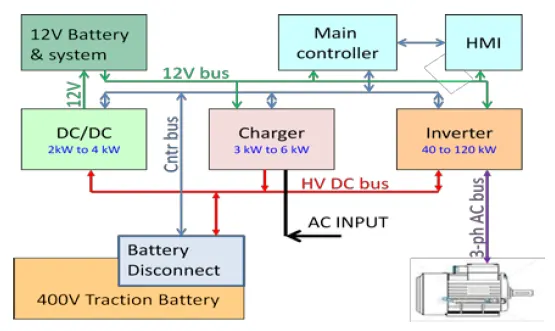
AC to DC convertor this is used for charging the traction battery. Because the source of current is AC and the voltage stored in the traction battery is DC. This DC current from the Battery is then transmitted to 2 diffrent convertors DC-AC convertor (inverter) and DC-DC converter (chopper).
The inverter is usally found between battery and Dc induction motor is directly connected to the wheels and is responsible for the traction. In case of regenerative braking this motor is directly connected to the wheels and is responsible for the traction. In case of regenrative braking this motor functions as a generator by ocnverting the mechanical energy to electrical energy which is then stored in the traction battery.
DC-DC converter takes the DC source from the traction battery. The output from this DC-DC converter is used to power all the other components of the EV/HEV like HMI, Head lamps, AC etc.
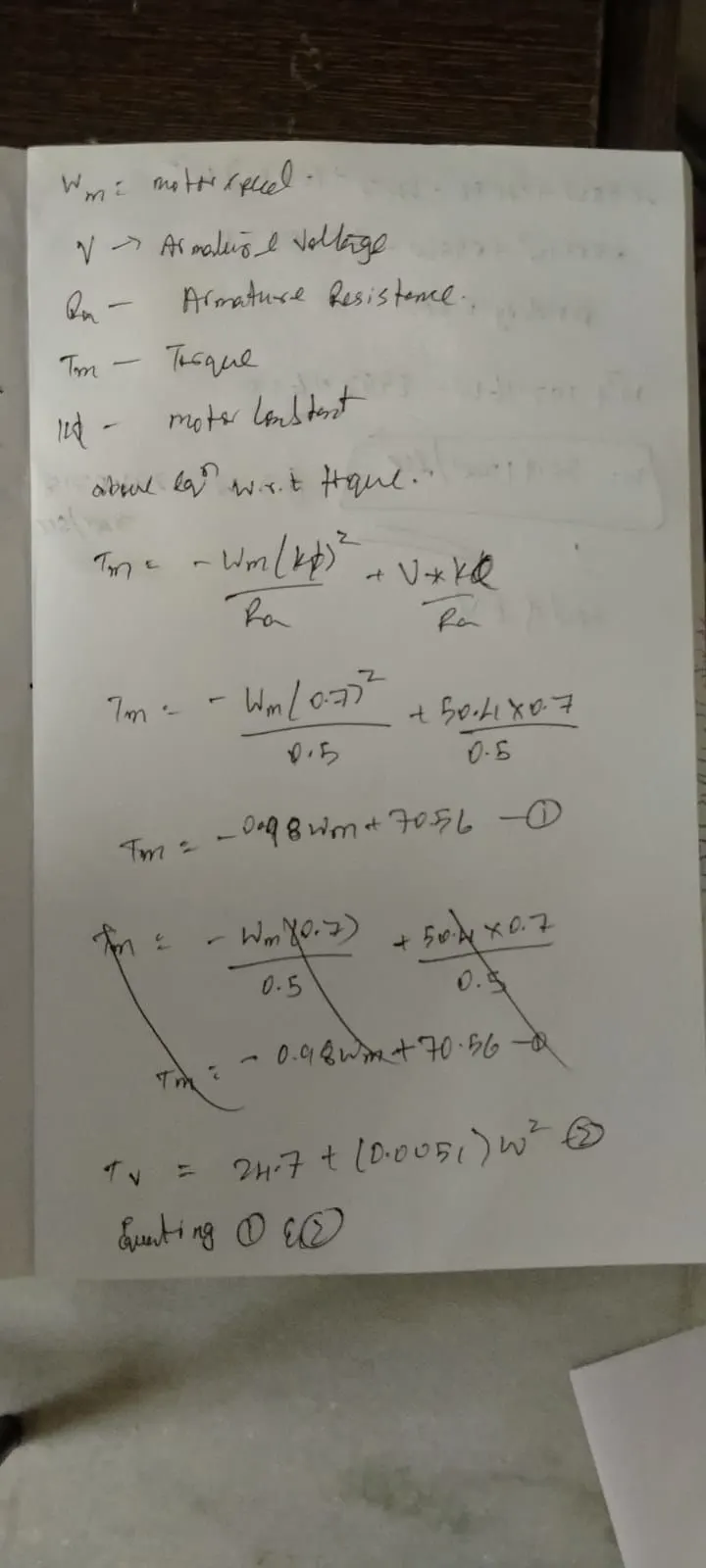
AIM 2 : An Electric Vehicle's powertrain with 72V battery pack in shown in the diagram below. The duty ratio for acceleration operation is 'd1' and for the braking operation the duty ratio is'd2'.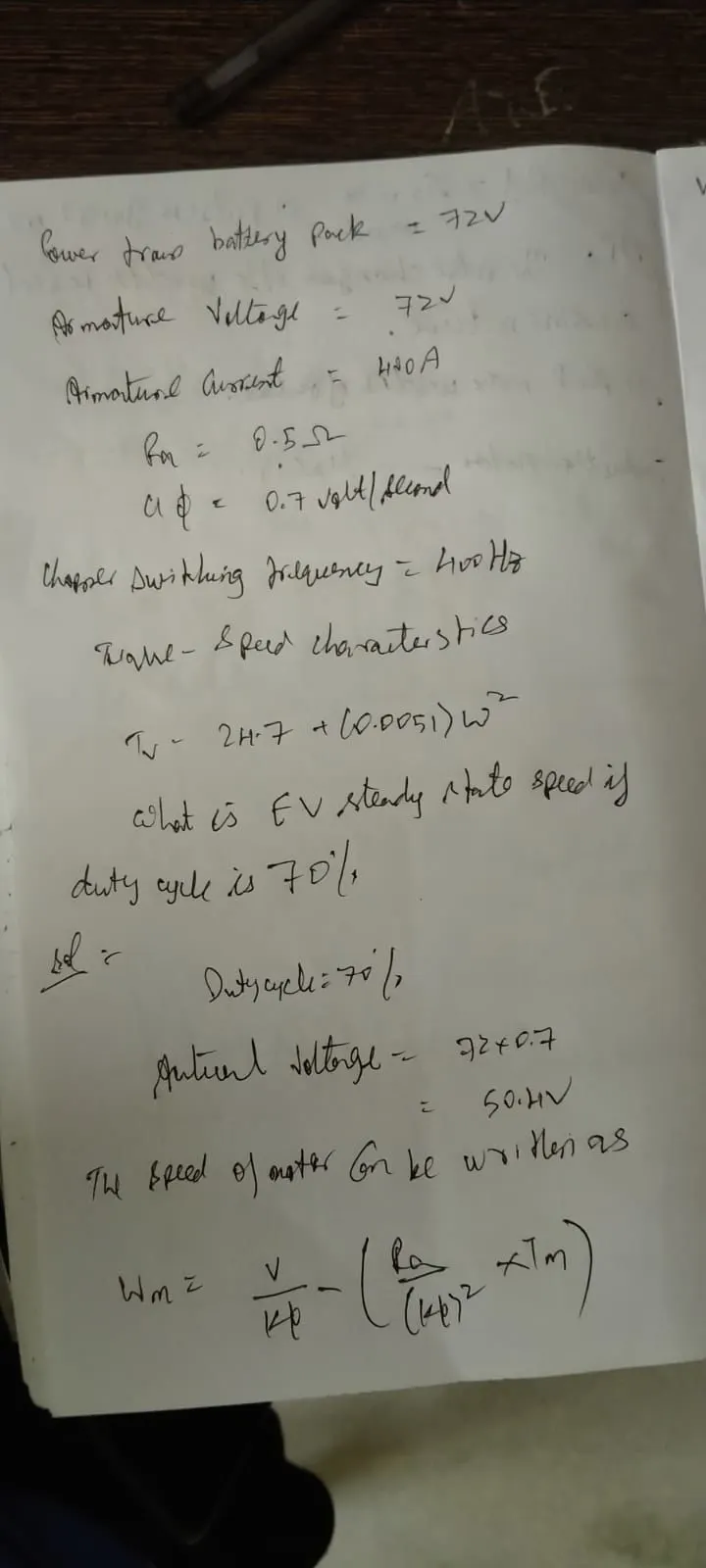
AIM 3 : Explain in brief about author’s perspective.
Actually Walley Rippel in his blog explained the working principle of both the induction and DC motor (brushless). Though Induction motors are old technology and he explained it's significant advantages over the old technology and he explained it's significant advantages over DC brushless motor in pure EV's at the same he also explained DC brushless motor significance in Hybrid and pulg in HEV and it's dominantly used in the current market. Induction motors though lastly found in General Motor EV1 the author suggested that the induction motor along with DC brushless motor will be widely used side by side as per vehicle requirement.
Working Principle Of DC Brushless Motor :
- The stator is made of thin and stacked laminations. The stator interacts with the current flowing within it's windings to produce a torque interaction between the stator and motor
- The rotor here includes 2 or more permanent magnets that generates DC magnetic filed. As the rotor rotates it is important that the magnitude and the polarity of the stator current be continuously varied so that the torque remains constant and also achieving the efficinecy
- for the functioning of DC brushless motor it is mandatory to have an inverter without which it cannot function.
Working Principle of Induction Motor :
- The stator is the same as induction motor. The only difference is that rotor is different when compared to the DC brushless. Induction motor does not have permanant magnets. The induction motor does not mandatorily require an inverter to function but with the help of a small inverter the efficiency of the induction motor will increase
- Here the rotor has stacked steel laminations with buried peripheral conductors that form a shorted structure. Current flowing in the stator windings produce rotating magnetic fields that enter the rotor.
Pros and Cons of DC Brushless :
Pros :
- i) Heat generated from the rotor is less hence rotor cooling is easy and peak point effciency is higher than the DC brushless
cons :
- i) Inverter whose phase is maintained in a step with the angular position of the rotor is mandatory without which DC Brushless motor is useless.
- ii) Magnetic field strength cannot be easily adjusted because of the permanent magnets.
iii) In DC Brushless motor as its size increases the magnetic losses also increases
- iv) permanent magnets are expensive.
Pros and Cons of Induction motor :
Pros :
- i) no need for inverter the motor has the ability to start under load.
- ii) since they do not have any magnets controlling the magnetic field here is easy. Hence Magnetic losses are minimizes and the efficiency is maximized.
iii) Induction drivrs may be the favoured approach where performance is desired; peak effciency will be a little less with DC brushless but average effciency may actually be better.
- iv) Induction motor are less expensive when compared to DC Brushless.
cons :
- i) They cannot operate from DC , AC source is must
- ii) When operated from utility power they have limited starting torque and somewhat limited running peak torque capabilities when compared to DC type machines. Even by adding the inverter the torque performance is low when compared to DC motor.
Conclusion :
Though DC brushless continues to dominate the current market with its presence in all EV and HEV induction motors will not become obsolete because as mentioned induction motors have its unique application and the significance when compared to the DC brushless. So he concluded that the both the DC Brushless and Induction Motor applications will grow side by side as per EV characterstics.