Week-6 Challenge: EV Drivetrain
1.
Types of power converter circuits used in EV's and HEV's.
Power Converters:-
A power converter is an electrical circuit that changes the electric energy from one form into the desired form optimized for the specific load.It is used to increase or decrease the magnitude of the input voltage, invert polarity, or produce several output voltages of either the same polarity with the input, different polarity, or mixed polarities such as in the computer power supply unit.
There are 3 types of power converters used in EV's and HEV's. They are:-
DC-DC Converter(Chopper):-
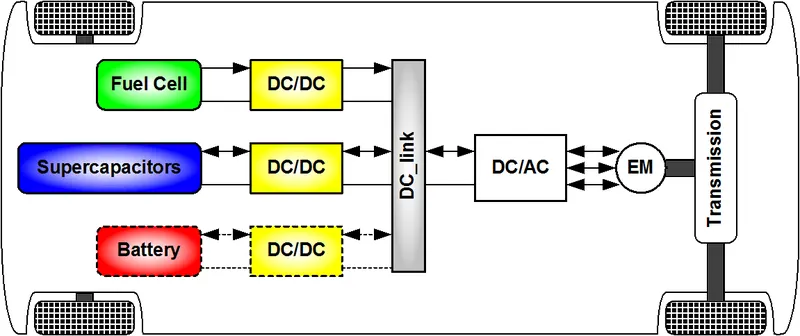
DC-DC converters can be used to interface the elements in the electric power train by boosting or chopping the voltage levels.Due to the automotive constraints, the power converter structure has to be reliable, lightweight, small volume, with high efficiency, low electromagnetic interference and low current/voltage ripple.
The main dc-dc converter changes dc power from an on-board 200-800V high voltage battery into lower dc voltages (48V or 12V) to power headlights, interior lights, wiper and window motors, fans, pumps and many other systems within electric vehicles (EV) and hybrid electric vehicles (HEV).
This high voltage to low voltage (HV-LV) dc-dc converter is often referred to as an auxiliary dc-dc, or Auxiliary Power Module (APM).
AC-DC Converter(Rectifier):-
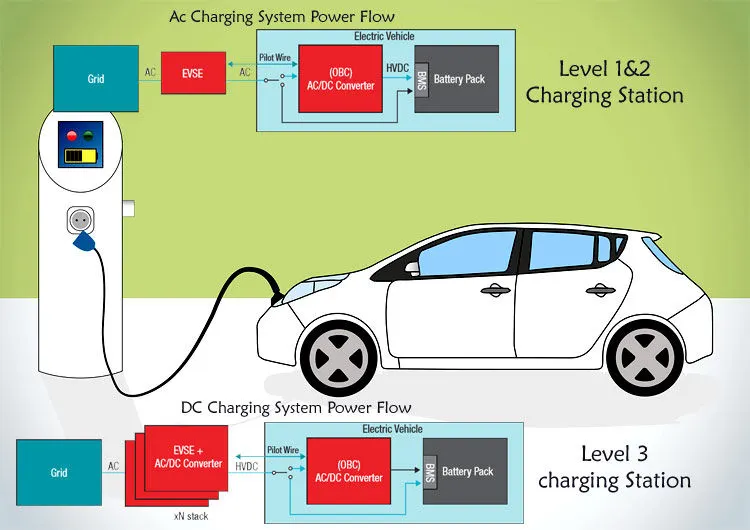
PHEVs and EVs are equipped not only with a DC/DC converter which generates electricity for the accessories but also with an AC/DC converter which supplies
electric power from a commercial power system to an onboard high-voltage battery. The AC/DC converter is required to work more efficiently to shorten the charging time and also to be downsized so as to be fitted in a restricted space.
The problems lie in large and heavy coil parts and large power loss accompanied with high frequency switching.
In EV these are referred as on-board charger.
DC-AC Converter(Inverter):-
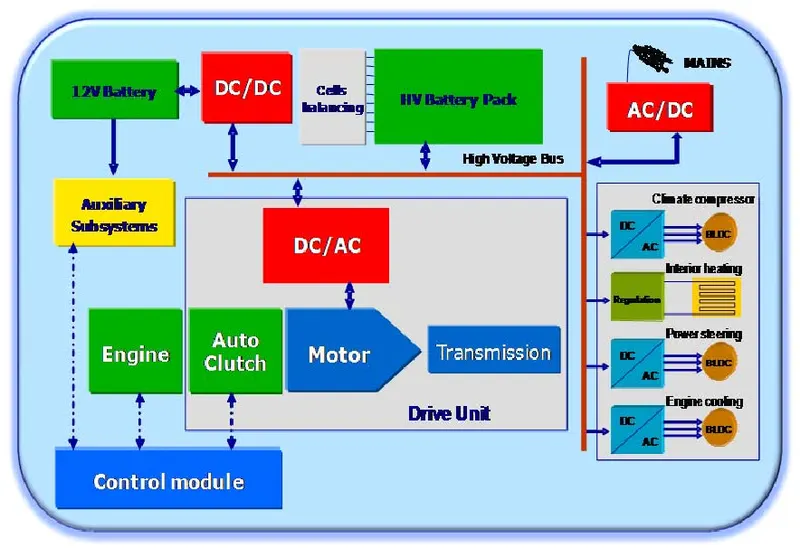
An inverter is a device that converts DC power to the AC power used in an electric vehicle motor.
The inverter can change the speed at which the motor rotates by adjusting the frequency of the alternating current.It can also increase or decrease the power or torque of the motor by adjusting the amplitude of the signal.
Along with a built-in charge controller, the inverter/converter supplies current to the battery pack for recharging during regenerative braking and it also provides electricity to the motor/generator for vehicle propulsion.
Both hybrids and EVs use relatively low-voltage DC batteries (about 210 volts) to keep the physical size down, but they also generally use highly efficient high voltage (about 650 volts) AC motor/generators.
2.
To find the given EV steady state:
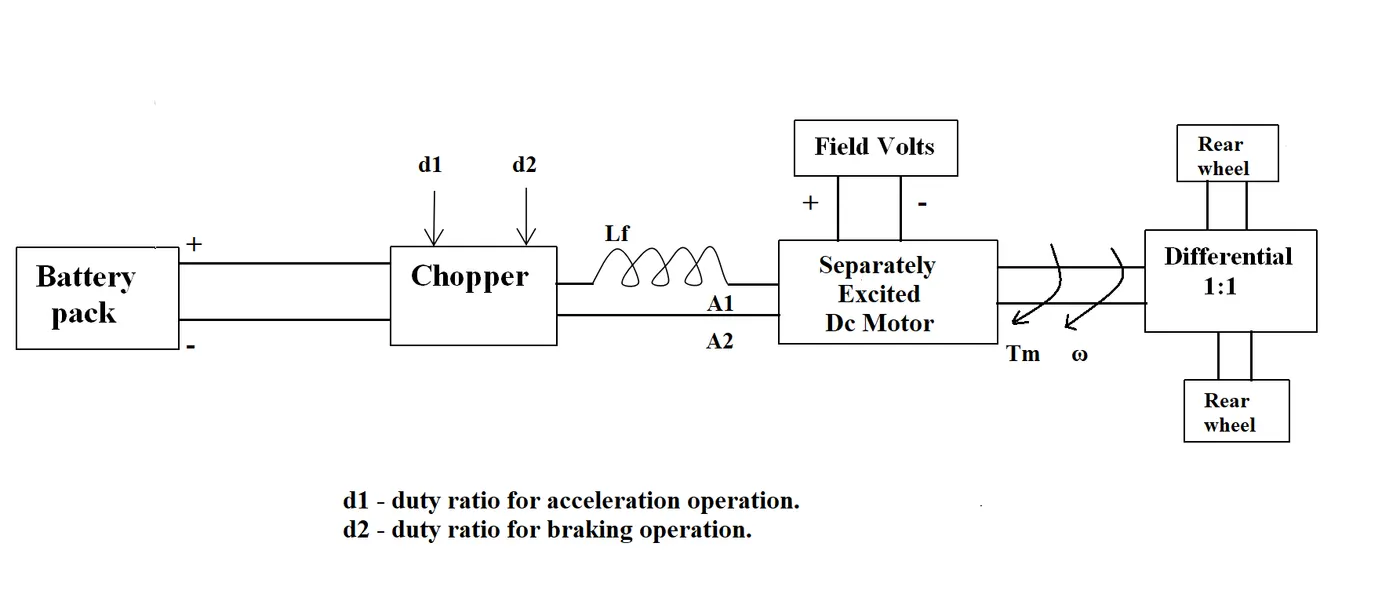
Given motor and control parameters:
Rated Armature voltage= 72 V
Rated armature current= 400 A
Ra= 0.5Ω,
KΦ= 0.7 Volt second
Chopper Switching frequency= 400 Hz
The vehicle speed-torque characteristics are given by the below equation
 ------eq 1
Duty cycle=70%=0.7
Actual Voltage=0.7*72=50.4V
Torque eq for motor is:
T=(Vkϕ/Ra)−(kϕ^2/Ra)⋅ω
T=(50.4*0.7/0.5)−(0.7^2/0.5)⋅ω
T=70.56-0.98ω ------eq 2
comparing eq 1 and eq 2
24.7+0.0051ω2=70.56-0.98ω
0.0051ω2+0.98ω-45.86=0
By solving the ab ove quadratic equation, we get 2 values
ω=38.915rad/sec and ω=-231.072rad/sec
So, If the duty cycle is 70%, then the EV steady state speed is 38.915 rad/sec =371 rpm.
3.
Mathematical model of a DC Motor for given equation using Simulink:-
ω=V/Kϕ -Ra/Kϕ^2.T
For the given equation, the variables that are taken as constant are Voltage, Kϕ and Armature Resistence.
For DC Motor as we change the torque, the speed of the vehicle changes.
So the torque is variable.
In Simulink:-
Voltage, Kϕ are taken as constant blocks.
Armature Resistance and Torue as Gain blocks.
These are added through add block and divided through divider blocks.
To dislpay the speed, display block is connected as output.
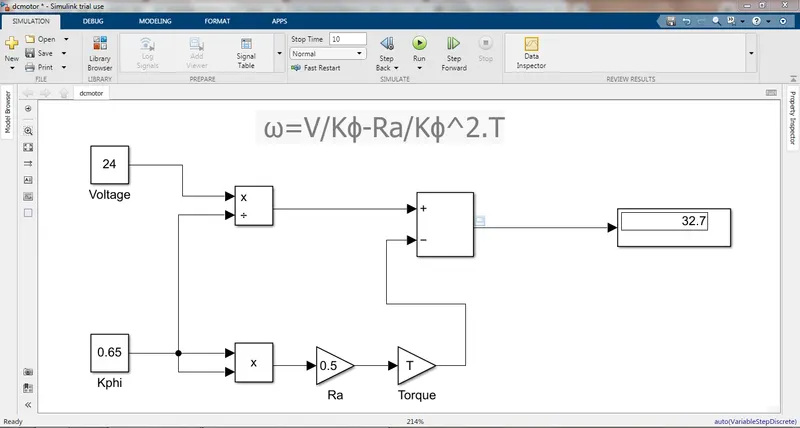
V,Kϕ,Ra values are given in blocks itself.
To change the value of Torque, we can give value in command window or we can use a slider or constant block connected to torque block.
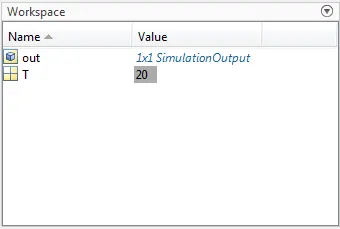
For the above model Torque value is given as 20 , V is 24, Ra is 0.5, Kphi is 0.65.
Then the value of ω or speed is 32.7.
4.
- Initially, the author told about how automoblies changed from gas powered to electrical.He explained that no vehicle is the best as it depends the requirements of the user.
- Then he dicussed about the two technologies namely DC Brushless Motor and Induction Motor.
- He explained the working of both DC Brushless Motor and Induction Motor.
- He compared the both motors and gave some advantages and differences.
- Induction motor have some advantages like:it has no magnets, the motor has the ability to start under load and no inverter is needed.
- Disadvantages of Induction motors are: They cannot operate from DC, AC is a must. Shaft speed is proportionate to line frequency hence, when used with utility power.They are constant speed machines, When operated from utility power.They have limited starting torque and somewhat limited running peak torque capabilities, when compared to DC type machines.
- Brushless DC motor have advantages like: much less rotor heat is generated with the DC brushless drive, the peak point energy efficiency for a DC brushless drive will typically be a few percentage points higher than for an induction drive.
- Disadvantages of Brushless DC motor are: as machine size grows, the magnetic losses increase proportionately and part load efficiency drops. Permanent magnets are expensive and difficult to handle due to very large forces that come into play when anything ferromagnetic gets close to them.
- Finally he conclude that he cannot tell which is the best one between them and DC brushless drives will likely continue to dominate in the hybrid and coming plug-in hybrid markets, and that induction drives will likely maintain dominance for the high-performance pure electrics