Week-6 Challenge: EV Drivetrain
OBJECTIVE-1 :- TYPES OF POWER CONVERTER USED IN ELECTRIC AND ELECTRIC HYBRID VEHICLES
SOLUTION - POWER ELECTRONIC CONVERTER
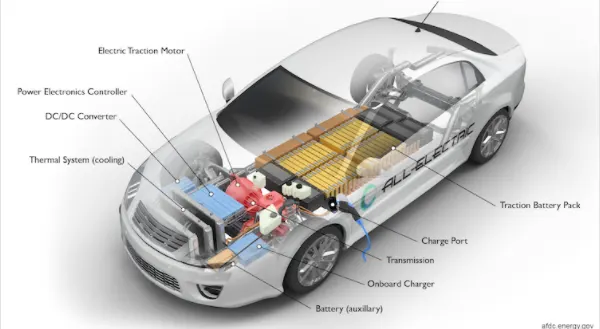
In electric vehicle and electric hybrid vehicle (EV/HEV) electronic power converters play a vital role for there power interference. For the effectiveness of the power system or the transfer of power in EV & HEV's these converters have to be used appropriately.
Types of Power Converter used in EV's & HEV's are :-
AC to DC converter :-
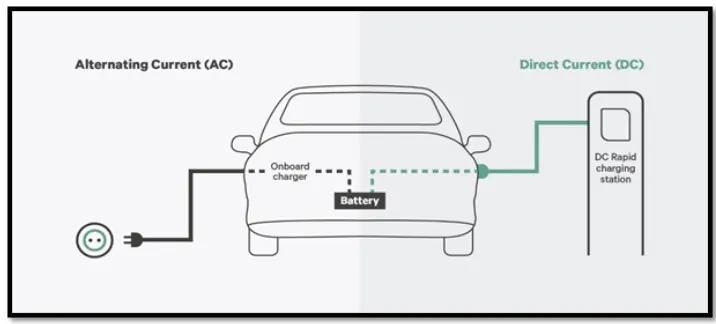
AC to DC converter are mostly used in the PHEV's(Plug in hybrid vehicles) & PEV ( Plug in electric vehicles).
In this vehicle gets the power from external source i.e electrical. The battery need DC source and in charging station incomming is AC source. For this AC to DC cob]nverter is used.
DC TO AC CONVERTER :-
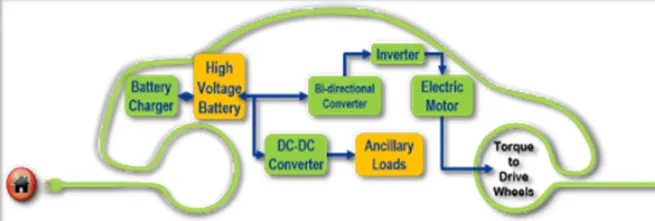
DC to AC converters are basically used in electrical machines. The power from DC battery is need to be converted to AC for that DC to AC converters are used.
DC TO DC CONVERTER :-
DC to DC converter is also called as chopper. It is used for both step up and step down of DC voltage. These are basically used for voltage variation from one level to another in a vehicle.
OBJECTIVE-2 :- FIND THE STEADY EV STATE WHEN DUTY CYCLE IS 70%
Electric vehicle power train with 72V battery pack is shown below
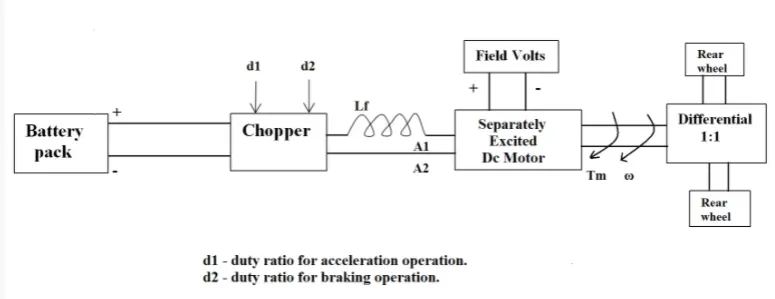
Here duty ratio for acceleration is D1 & for braking is D2

Vehicle torque and speed characterstics is given by above equation
Prameters Given to us :-
Rated Armature Voltage = 72V
Rated Armature current = 400A
Ra = 0.5ohm, K(Phi) = 0.7 V/s
Chopperswitching frequncy 400Hz
Solution :- Vehicle Voltage(Vv) = Bettery Voltage * Duty Cycle
= 72*0.7 = Vv= 50.4V
Equation of vehicle torque is given by:-
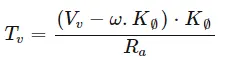
Substituting the values we get Tv equation as:-
Tv =70.56 - 0.98 w ----------(1)
aslo we have the equation
Tv = 24.7 + 0.0051.w^2 ---------(2)
Now comparing both the equations we get
w= 38.85 rad/s & w = -230.95 rad/s
Considering positive value
Steady State Speed of vehicle = 38.85 rad/s
OBJECTIVE-3 : MATHEMATICAL MODEL OF DC MOTOR USING SIMULINK
SOLUTION :- Mathematical model for DC motor for below equation using Simulink
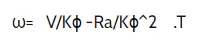
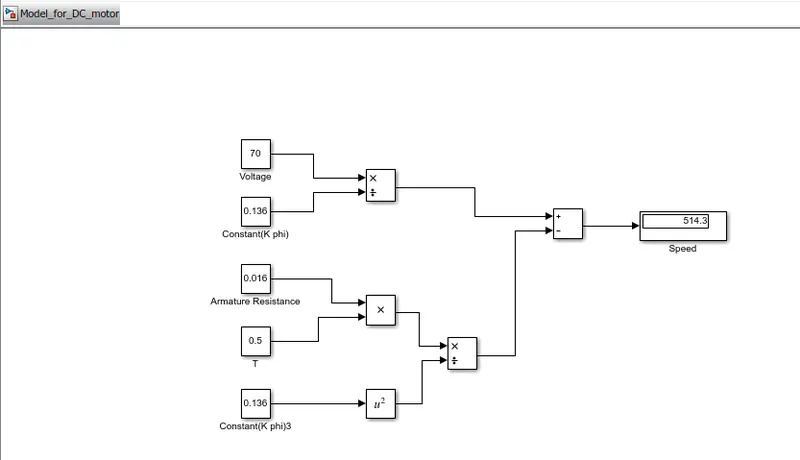
RESULT : Above shows the mathematical result for the given equation using Simulink Model.
OBJECTIVE-4 :- REFER TO THE BLOG ON TOPIC : INDUCTION VS DC BRUSHSLESS MOTORS BY WALLEY RIPEL, TESLA
SOLUTION :- Following topics can be concluded from above topic -
- Initially IEC(Internal Combustion Engine) are explained and its dominance in the world and its different types. He explains all the engines are similar and can be used as per the requirement. He then talks about the induction motor and brushless DC motor and how widely they'll be used in the future.
- Then he explains working of both Induction motor and brushless DC motor. Also they both are compared and there advantages and disadvantages are explained.
- Induction motor has advantages like - It has no magnet, it has ability to start under load, Inverter is not needed.Some disadvantages are They can only be operated from an AC source, Shaft speed is constant with line frequency hence when used with utility powers they are used with contant speed machines. When operated from utility power they have limited starting torque and limited running peak torque capabilites when compared to DC type machines.
- Brushless DC motors have some advantages like : much less heat is generated with DC brushless drive. The peak point energy efficiency is some % high then that of induction motor. Some disadvantages are as the size grows magnetic losses increases & part load efficiency drops also permanent magnets are quite expensive and increases the cost of wear and tear.
- Finally the conclusion was made that Brushless DC motor will be dominating in HEV and Plugin HEV's where as Induction motor will be dominating in Pure EV for high performance.