Week-6 Challenge: EV Drivetrain
1. Which types of power converter circuits are employed in electric and hybrid electric vehicle?
Power converters that are used in electric/hybrid vehicles to manipulate the form and magnitude of voltage and current fed from and to the vehicle.
DC/DC converter:
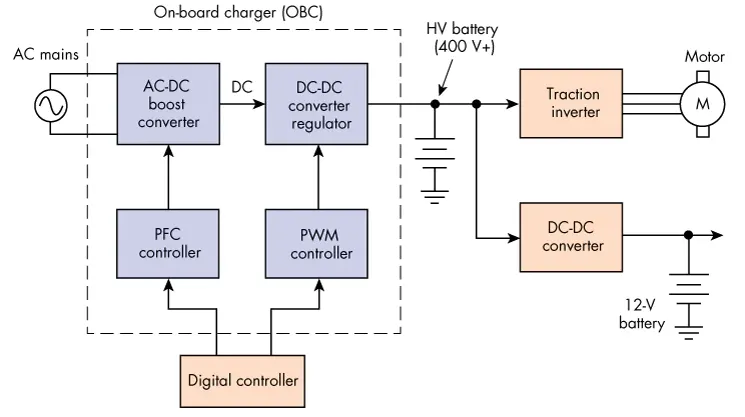
This converts high voltage DC to low voltage DC .The DC to DC converters used in EV's may be used for the following purposes;
1. Providing low voltage for low voltage loads.(12v or 14v)
2. Boosting the voltage level of the battery such that it matches the level of the DC bus voltage for driving the AC motor inverter.
3. If the traction motor is an AC motor.
4. Motor propulson (Means of converting this power into propulsive power)if the traction motor is an DC motor.
AC/AC converter:
Regulated AC output from AC input.The above converters either increase the magnitude of the output voltage(boost converters) or reduce the output voltage(buck converter).This converter can convert from a fixed ac input voltage to variable AC output voltage.The output voltage is controlled by varying firing angles of TRiac.These types of converters are known as AC Voltage regulators.
AC/DC Converter(Rectifier):
These convert AC voltage into regulated DC voltage.An Rectifier is nothing but an device whch convert the Ac into direct one by allowing it to pass through in one direction(P-N junction diode).This diode which acts as a one way valve sends the current in one direction. The reverse operation is performed by the inverter. The process is known as rectification, since it "straightens" the direction of current.
DC/AC converter(Inverter):
These converts DC voltage into regulated AC voltage.Form and magnitude are regulated.Usually employed when the AC motor is used to drive the vehicle.Incase of EV's the battery pack supplies the currect to inverter, Where the inverter consist of a transformer which contains a Primary and secondary windings.The currect from the battery is first send to the primary windings where the electronic switches repeatedly reverse the direction of the current to create an AC waveform.This current will return the way it came from.The AC in the primary windings will induce the AC in the secondary winding which then supplies the current to an AC load.e.g: AC traction motor.
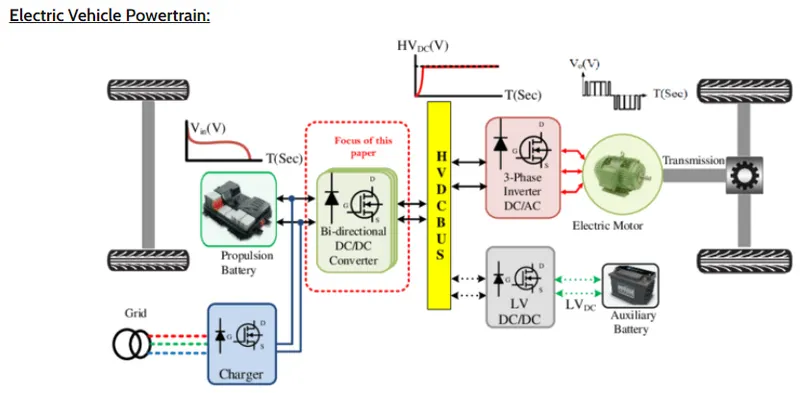
The typical EV/HEV has the following converters which are mostly used :
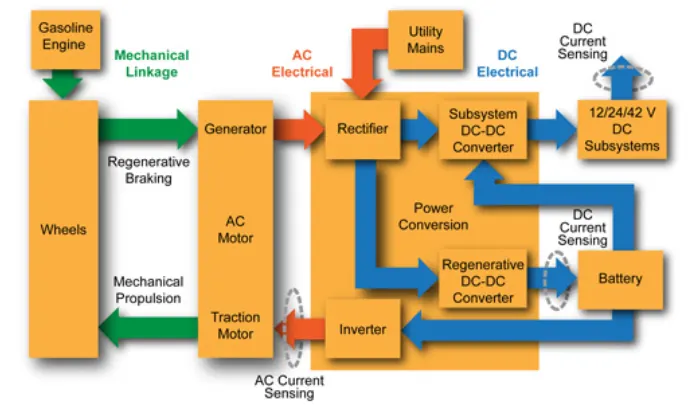
Hybrid Electric vehicle powertrain:
2. An Electric Vehicle's powertrain with 72V battery pack in shown in the diagram below. The duty ratio for acceleration operation is 'd1' and for the braking operation the duty ratio is 'd2'.
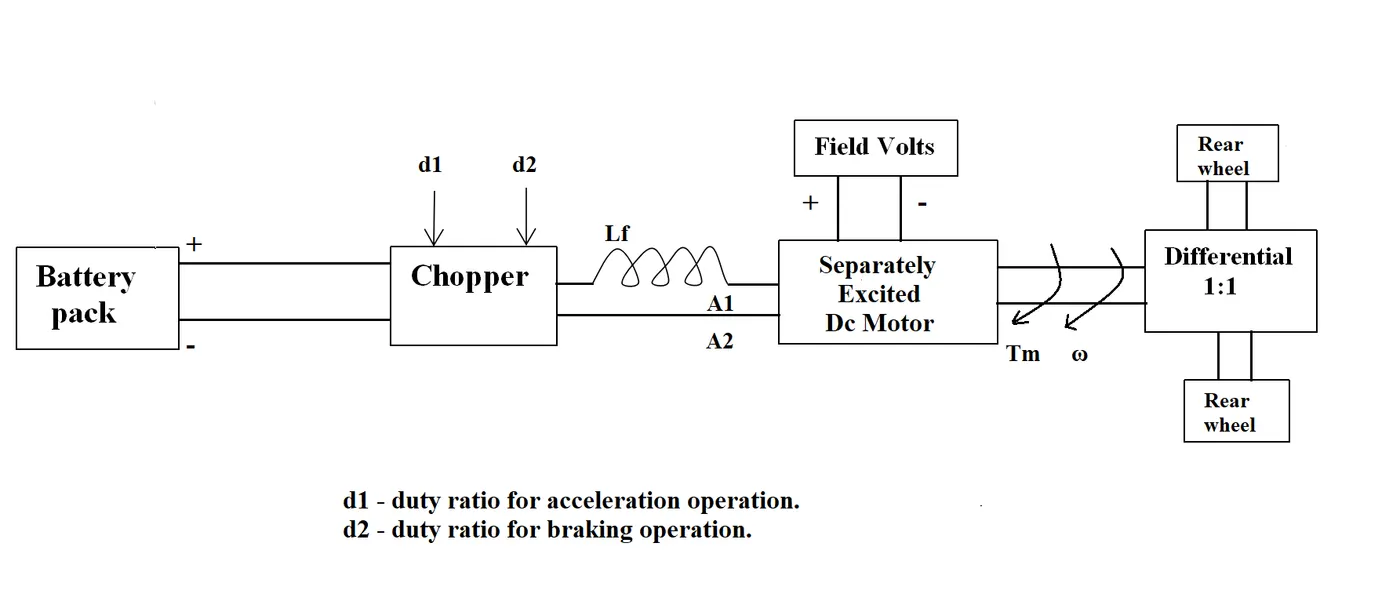
The other parameters of the electric vehicle is given below,
Motor and Controller Parameters:
Rated Armature voltage= 72 V
Rated armature current= 400 A
Ra= 0.5Ω, KΦ= 0.7 Volt second
Chopper Switching frequency= 400 Hz
The vehicle speed-torque characteristics are given by the below equation

What is EV steady state speed if duty cycle is 70%?
Given parameters are:
Rated armature voltage(Supplied voltage)=72V
Rated Armature current = 400A
Ra=0.5Ω
KΦ= 0.7 Volt second
Chopper Switching frequency= 400 Hz
The vehicle speed to torque characteristic are given by the below equation;
Tv=24.7 +(0.0051)w^2 ----------Eqn(1)
Where as the duty cycle is given as 70%
The avrg voltage Vo is given by;
Vo = Supplied voltage * Duty cycle
Vo =72*(70/100)
Vo=50.4V
The DC motor torque -speed equation is given by-
Tm = (Vo*KΦ)/Ra - ((KΦ)^2*w)/Ra ----------Eqn(2)
Substituting the given value in the eqn (2) we get,
Tm= (50.4 *0.7)/0.5 -((0.7)^2*w)/0.5
Tm=70.56 - 0.98w ---------Eqn(3)
At the steady state the speed of Electric vehicle , the torque of both vehicle and motor will be the same;
Tv = Tm
Equating Equation 1 and 3
24.7+(0.0051)w^2 = 70.56 - 0.98w
from which we get the quadratic equation,
0.0051w^2 + 0.98w^2 -45.86 = 0
Solving the quadratic equation using the formula;
w = -b ±√b^2 - 4ac /2a -------(4)
where
a = 0.0051
b= 0.98
c = 45.86
substituting the above values in eqn(4);
w = -0.98 ±√0.98^2 - 4*0.0051*(-45.86) / (2*0.0051)
by solving the above eqn with both + and - ,we get two different eqn;
w = 38.91 rad/sec and w=231.07rad/sec
The positive w value indicates the forward direction Ev steady state speed is w = 38.91 rad/sec.
4. Refer to the blog on below topic:
Induction Versus DC brushless motors by Wally Rippel, Tesla
Explain in brief about author’s perspective.
As of the mentioned blog by Mr.Wally Rippel he have made the difference between the most commonly used motor drive in the automobile industry, the DC brushless motor drive and the induction motor drive.
He also explains about the difference between the construction.cost and working performace between the two motors.Anyway he hasnt concluded that one type is better than the other, also said that there is ''nothing like the best engine type'', which depends on an matter of personal preference when it comes to choosing an engine.
It is in the same regards that there is "still no winner" when it comes to motor driving selection either.Despite both the motors having similarites with benefits and feedbacks.He concludes that DC brushless drives will likely continue to dominate in the hybrid and coming plug-in hybrid markets, and that induction drives will likely maintain dominance for the high-performance pure electrics.
DC brushless motor:
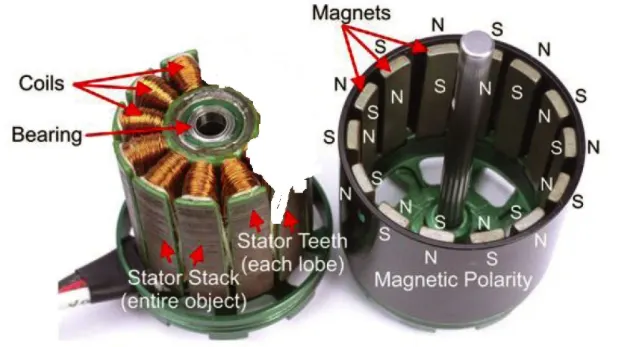
1. Using a permanant magnet as a rotor, to produce the magnetic field.
2. Using the angle position sensor for operation.
3. Does not produce much heat, cooling is easier.
4. Speed is controlled by the PWM(Pulse width modulation) method.
5. As the motor size increases the magnetic losses increases proportionally and the load effeciency drops.
6. Easier to control for lower to medium performance ranges.
7. Permanent magnets are expensive results in the increase in motor over all price and are difficult to handle because of strong magnetic force between ferromagnetic materials and magnets.
8.Has higher peak effeciency point.
9. Stator core involves current flow within the windings to produce the torque interaction between the stator and rotor. Requires inverter for operation.
10. Difficult to alter motor parameters such as field strength because of permanent magnet.
AC induction motor:
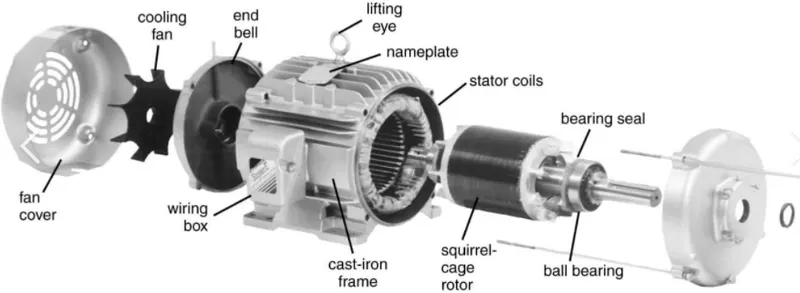
1.Using Alternating current in the stator to produce the rotating magnetic field.
2.The stator for the 3 phase induction motor and the DC brushless motor are virtually identical.They has no magnet.And doesnot requires an inverter for operation but integrating with one helps for a smoother operation for this motor in EV.
3.Requires speed sensor for operation.
4. Has an heating issue and effeciency depreciation as an effect(Cooling fan installed to avoid depreciation).
5. Has lower peak effeciency point as compared to DC brushless motor.
6. Requires just coils/Comparatively cheaper to produce and easier to handle as coils needs to be excided to produce any magnetic field.
7. Acheiving stability over the entire torque speed range and temperature is more difficult when compared to dc motor.
8. As induction machines have no magnet and B field are adjustable,Since B fiields are proportional to Voltage to Frequency.
9. Speed is controlled by altering RMS speed, by altering the frequeny of feeding in voltage.
10. Induction motors dont follow the same trends and are thus prefered for high performance applications as the average effeciency is better than the DC brushless motor.