Week-3 Challenge: ADVISOR Tool
Aim: To use the ADVISOR tool for your simulation.
Introduction:
ADVISOR tool which is developed in NOV 1994 by the National Renewable Energy Laboratory(NREL), allows users to simulate and analyze conventional,advanced,light and heavy vehicles.Inclusing Hybrid electric and Fuel cell vehicles.The Tool allows the users to acess the effort of change in vehicle components (such as motors,batteries ,catalytic converters,climate control systems and alternative fuels) and other modifications that might affect the fuel economy,performance and emissions.
It is a set of models, data and script text files in usage with Matlab and Simulink.
The Benefits of using ADVISOR:
1. Estimate the fuel economy of vehicle that have not yet been built.
2. Learn about how conventional,hybrid and electric vehicles use their energy throughout their drivetrain.
3. Compare relative tailpipe emission produced on a number of cycles.
4. Evaluate an energy management strategy for your hybrid vehicle's fuel converter.
5. Optimize the gear ratio in your transmission to minimize fuel use or maximize performance etc.
How to start Advisor tool:
* Launch MATLAB and set default folder for ADVISOR.
* Get advisor.m from Current folder space in MATLAB and Run it.
* Advisor new window will open, click on metric for unit and start using ADVISOR.
The Advisor tool have 3 windows:
1. Vehicle input window
2. Simulation parameter window
3. Result window.
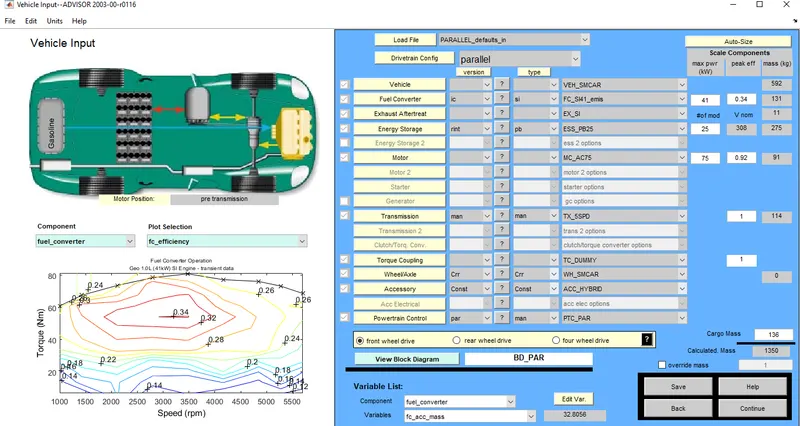
1. For EV_defaults_in file, if cargo mass is 500 kg with all other default conditions, can the vehicle travel for 45 km with FTP drive cycle? Conclude your observations.
From the Vehicle input window increase the cargo mass to 500kg and click on continue to proceed to the Result window
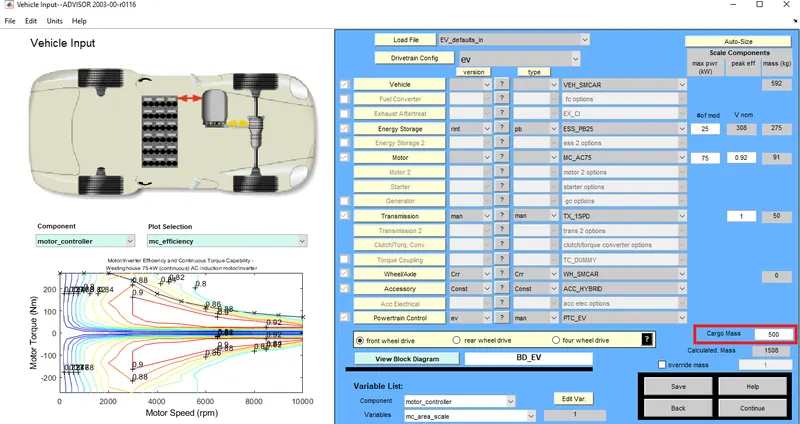
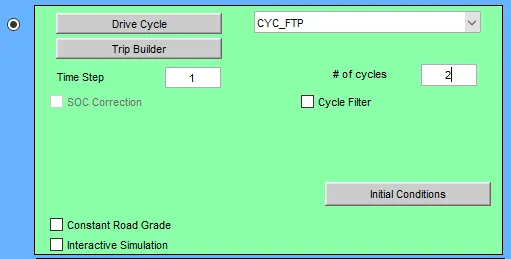
From the Simulation parameter window chose the Drive cycle : CYC_FTP and # of cycles, by increasing the drive cycles we can get the distance as required to obtain.
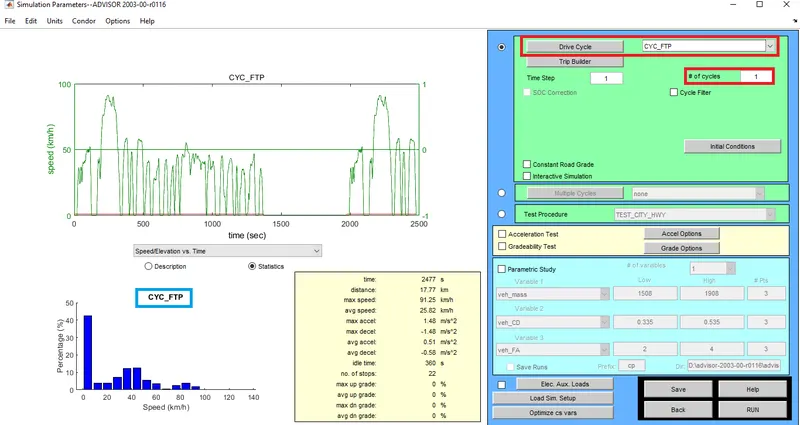
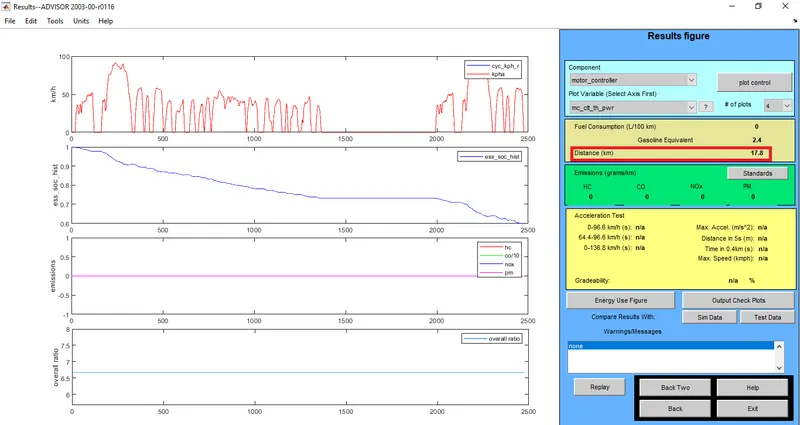
The km that the vehicle can travel in one drive cycle is 17.8km.
* Try out by increasing the Drive cycles to reach the required distance.
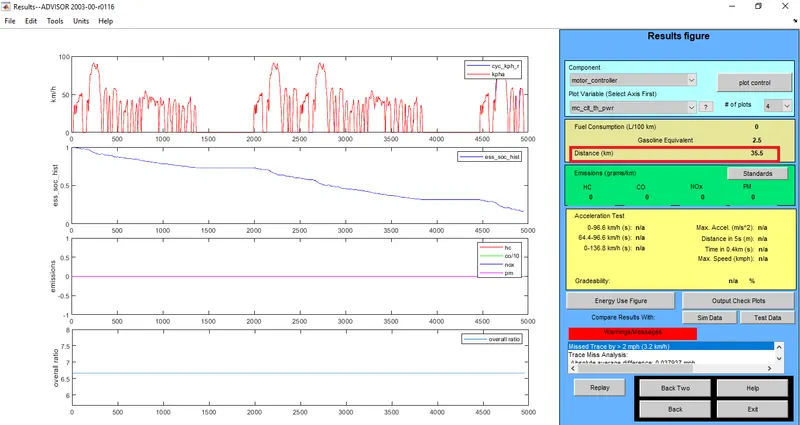
*so the vehicle can travel around 35km in 2 drive cycle.
Lets try with 3 drive cycle:
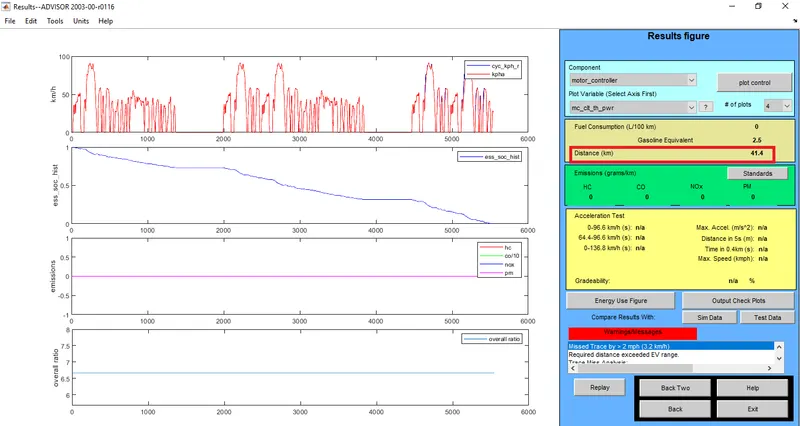
In 3 driving cycle the vehicle has reached around 41.4km.Where as the vehicles SOC is consumed to 100%.
| NO OF DRIVING CYCLES | DISTANCE COVERED |
| 1 | 17.8 |
| 2 | 35.4 |
| 3 | 41.4 |
CONCLUSION:
The minimum distance the vehicle can cover is 17.8km in 1 drive cycle...the maximum distance can travel is 41.4km which consumes 100% of SOC in 3 drive cycles.
Therefore EV_default cannot travel more than 42km because of insuffecient SOC.
2. In the above case, try changing the battery capacity and repeat the simulation.
* From the vehicle input window we will change the Battery energy storage.
* # of mod describes the battery capacity, so we will change the battery module to check the battery capacity and increase in battery weight.
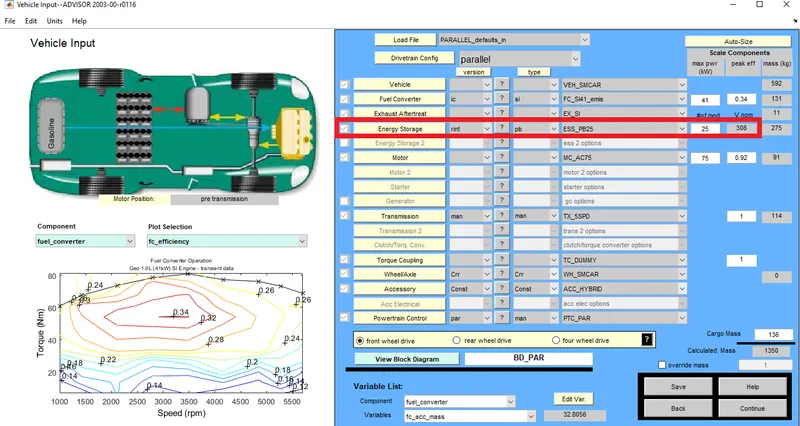
* we will try changing the modules from 26,27 and 28 modules
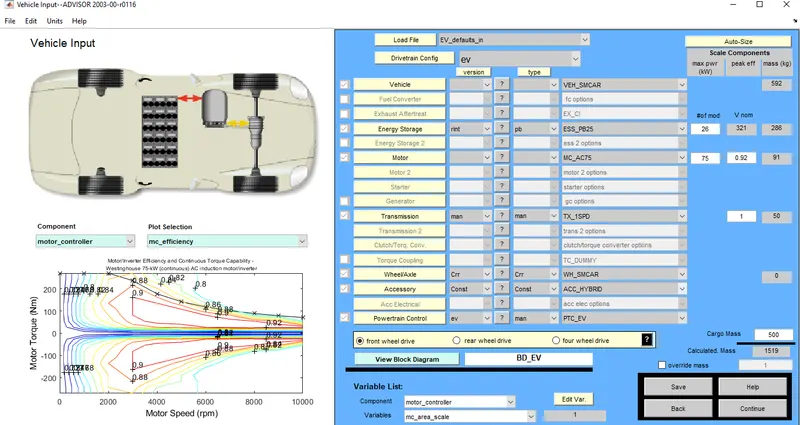
| Drive cycles | 2 | 3 |
| Module | 26 | 26 |
| Voltage | 321 | 321 |
| Weight | 286 | 286 |
| Distance(km) | 35 | 42.7 |
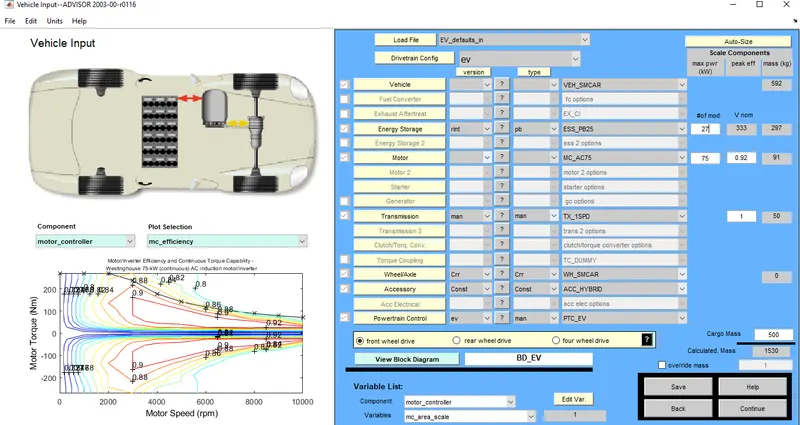
| Drive cycles | 2 | 3 |
| Module | 27 | 27 |
| Voltage | 333 | 333 |
| Weight | 297 | 297 |
| Distance(km) | 35 | 44.8 |
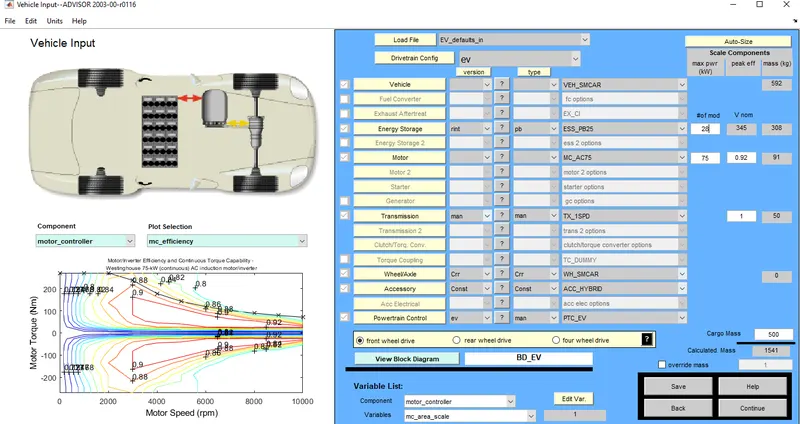
| Drive cycles | 2 | 3 |
| Module | 28 | 28 |
| Voltage | 345 | 345 |
| Weight | 308 | 308 |
| Distance(km) | 35.5 | 46 |
CONCLUSION:
By increasing the Module to 28 with a drive cycle 2 we are getting the constant distance 35km.Where as with the Module 28 by increasing the Drive cycle to 3 we can reach the distance of 46.3km.
3. Perform gradeability test with PRIUS_Jpn_defaults_in file
Compare your results in table and conclude.
* In the ADVISOR vehicle input window LOAD FILE: PRIUS_JPN_default
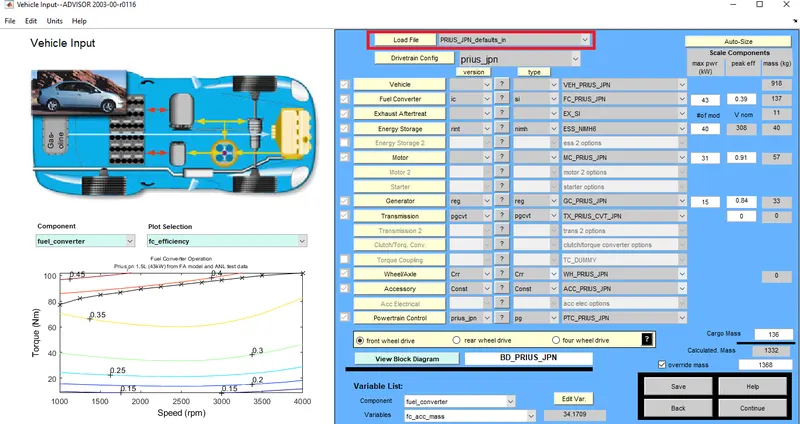
*Continue to proceed to the Simulation parameter window,where u can click on Gradiability Test -->Grade options--->Grad test Advanced Option(new window)--->Change speed /duration (Find a result comparison)
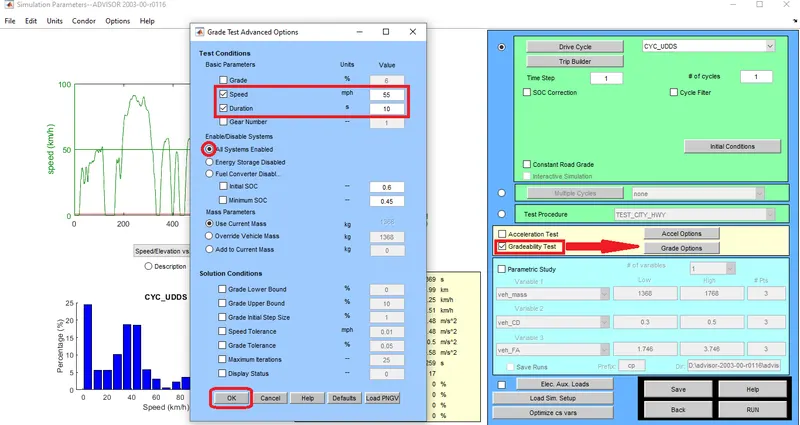
Click on OK to feed the details, and RUN it to open the Result window which shows you the gradiability value for the selected speed(mph) and Duration(sec).
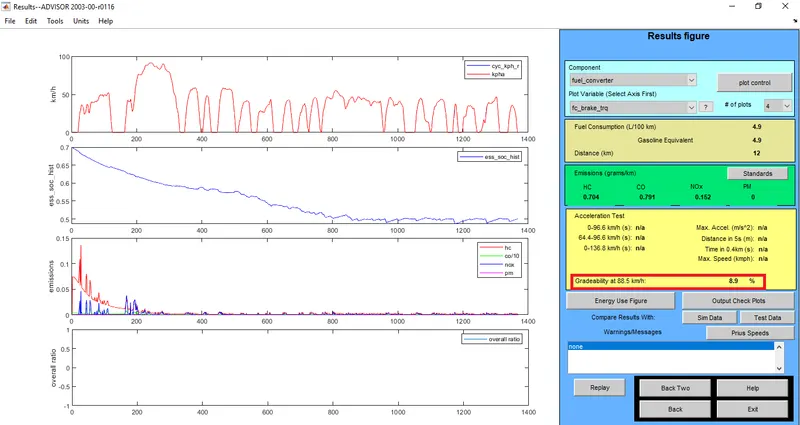
Result: We are getting 8.9% gradiability at 55mph.
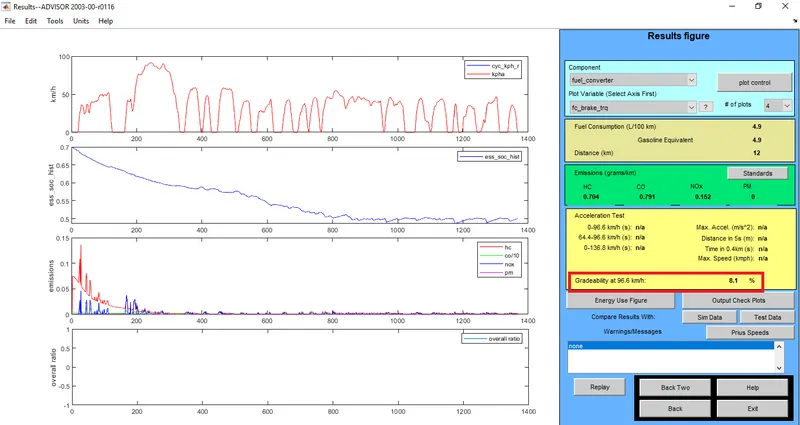
Result: We are getting 8.1% gradiability at 60mph.
Now, try by changing the value of Duration to 20sec with the speed of 55mph.
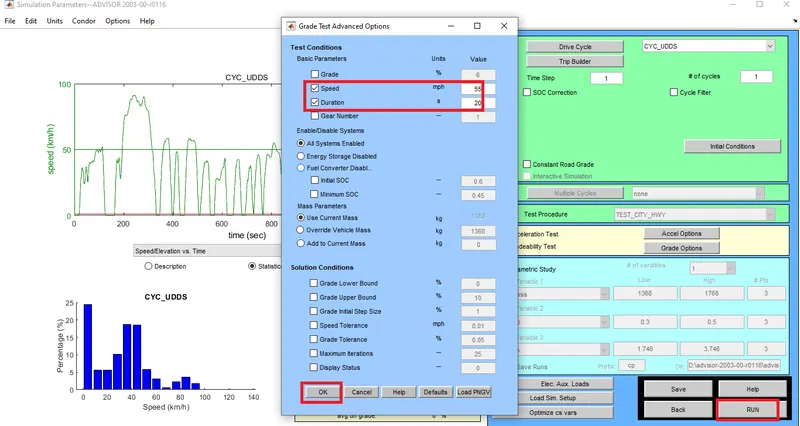
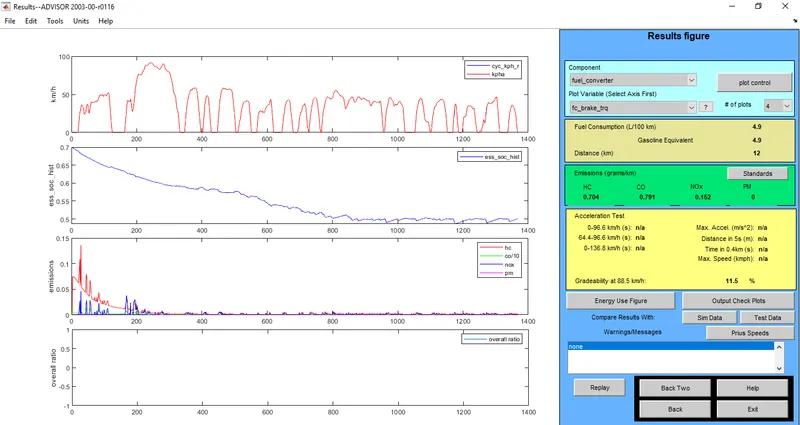
Result: By increasing the duration to 20sec at a speed of 55mph we are attaining the Gradiability of 11.5%.
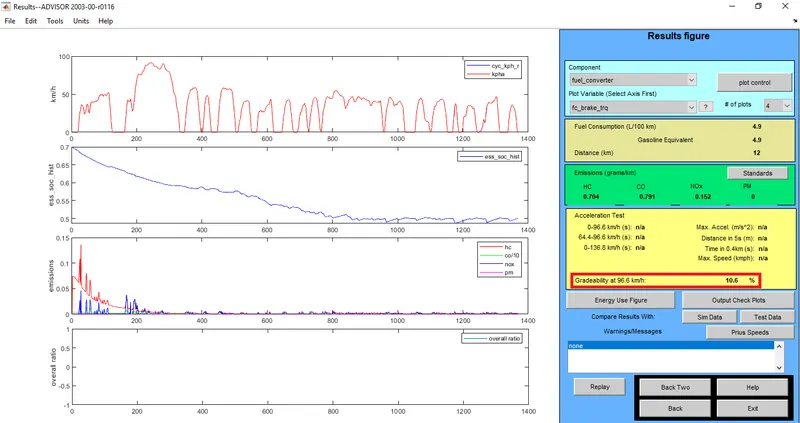
Result: By increasing the duration to 20sec at a speed of 60mph we are attaining the Gradiability of 10.6 %.
Its obvious in both the case that the Gradiability decreases with increase in speed. Gradiability inversely prop to speed.