Week-6 Challenge: EV Drivetrain
Task 1
Which types of power converter circuits are employed in an electric and hybrid electric vehicle?
A Power device consists of power converters and controllers.
The power electronic converter handles the flow of bulk power from the source to the motor input terminals and to various auxiliaries devices. The controller process the command input and the feedback information to generate the switching signals for power converter semiconductor switches.

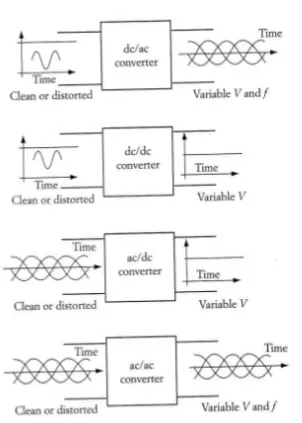
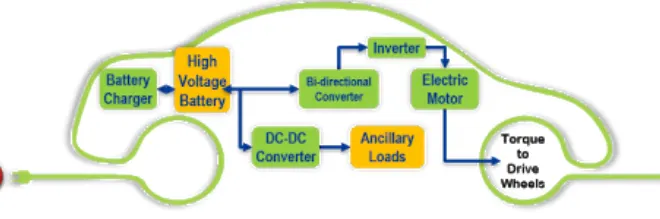
The figure is showing various converter used in an Electric vehicle.
Task 2
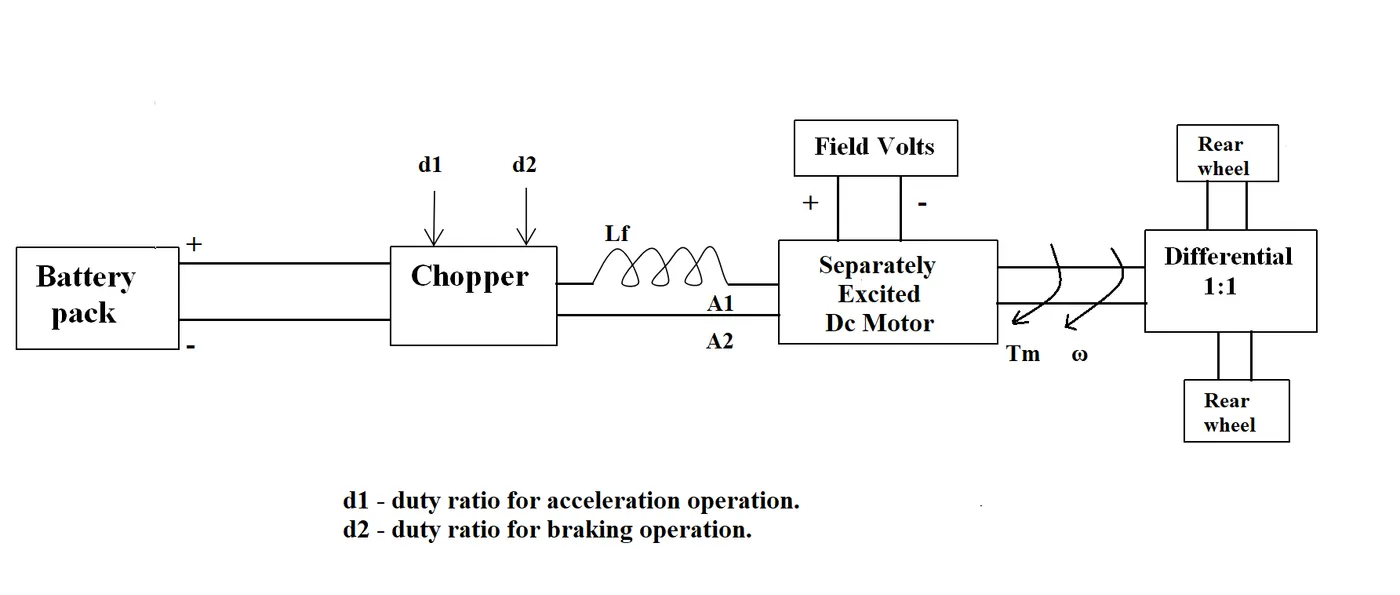
An Electric Vehicle's powertrain with a 72V battery pack shown in the diagram below.
The duty ratio for acceleration operation is 'd1' and for the braking operation the duty ratio is 'd2'.
The other parameters of the electric vehicle are given below,
Motor and Controller Parameters:
Rated Armature voltage= 72 V
Rated armature current= 400 A
Ra= 0.5Ω, KΦ= 0.7 Volt second
Chopper Switching frequency= 400 Hz
The vehicle speed-torque characteristics are given by the below equation

What is EV steady-state speed if the duty cycle is 70%?
At steady-state speed of EV the Torque of both vehicle and mother same
so
`Tunderset(M) = Tunderset(V)`
As given data, `Tunderset(V)` = 24.7 + (0.0051)`w^2`---------1
here,
V= average voltage
V= supplied voltage * duty cycle
V= 72V*.7
V= 50.4v
Therefore,
`Tunderset(M) =(V(Kphi))/R+((Kphi)^2*omega)/R`
`Tunderset(M) =(50.4(0.7))/0.5+(50.4^2*omega)/0.5`-------------2
Equate both 1 and 2
then
`0.0051ω^2+0.98ω−45.86=0`
`After solving `
So we will have 2 solutions for x i.e. the angular speed.
`ω=38.92(rad)/s` as one positive solution.
EV steady-state speed if the duty cycle is 70% is 38.92`(rad)/s`
Task 3
Refer to the blog on the below topic:
Induction Versus DC brushless motors by Wally Rippel, Tesla
author’s perspective
The author tries to Show a comparison between induction motor and DC brushless motor used in driving electric vehicles.
The author's intention is to underline the principles of operation between both motors and lists out the pro's and cons in terms of performance, control strategies, cooling system,generated torque and manufacturing costs.
This table encaptures the author's comparison between both the motors mentioned in the blog article.
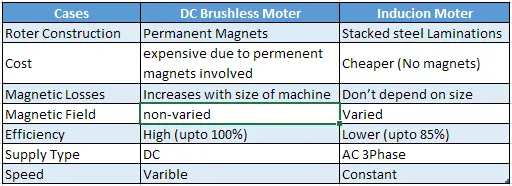
Induction motors can be used directly with power from the mains and does not require an inverter to start the drive and generate the starting torque. It has the ability to start under the mains load applied. However, DC brushless drives cannot do the same. They cannot generate a starting torque when connected to a mains power supply. They require an inverter to do this.
The author concludes that there is no cleary winner to prefer one over the other. He states that DC brushless drives are better fit for hybrid electric vehicles and AC Induction drives are better for high performance pure electric vehicles. He hopes in the future that these two motors can work side by side.