Week-6 Challenge: EV Drivetrain
AIM:
- To understand different power convertors found in EV and HEV vehicles.
- To calculate the EV steady state speed by given data.
- Explain in brief about author’s perspective in Induction Versus DC brushless motors by Wally Rippel, Tesla
STUDY - 1:
Power Converter:
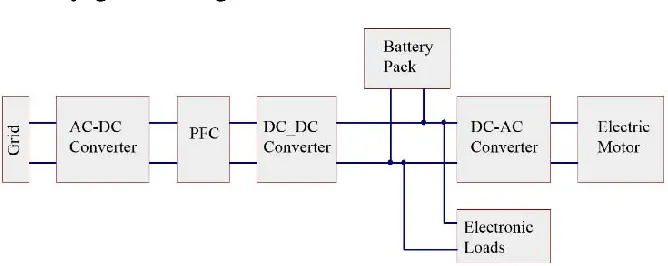
A power converter is an electrical or electro-mechanical device for converting electrical energy. Power converter can convert alternating current (AC) into direct current (DC) and vice versa; change the voltage or frequency of the current or do some combination of these. The power converter can be as simple as a transformer or it can be a far more complex system, such as resonant converter.
DC-DC converters:
DC-DC converters in an electric vehicle may be classified into unidirectional and bidirectional converters.
Unidirectional DC-DC converters cater to various onboard loads such as sensors, controls, entertainment, utility, and safety equipments. They are also used in DC motor drives and electric traction.
Bidirectional DC-DC converters find applications in places where battery charging, regenerative braking, and backup power are required. The power flow in a bidirectional converter is usually from a low voltage end such as a battery or a supercapacitor to a high voltage side and is referred to as boost operation.
During regenerative braking, the power flows back to the low voltage bus to recharge the battery (buck mode). As a backup power system, the bidirectional DC-DC converter facilitates the safe operation of the vehicle when ICEs or electric drives fail to drive the motor. Due to the aforementioned reasons, high power bidirectional DC-DC converters have gained a lot of importance in the recent past.
The converter topologies are classified as:
• Buck Converter: In Figure a ,a buck converter is shown .The buck converter is step down converter and produces a lower average output voltage than the dc input voltage.
• Boost converter: In Figure b ,a boost converter is shown. The output voltage is always greater than the input voltage.
• Buck-Boost converter: In Figure c ,a buck-boost converter is shown. The output voltage can be either higher or lower than the input voltage.
DC-AC converters (Inverters):
An inverter is a device that converts DC power from the battery to AC power used in an electric vehicle motor. The inverter can change the speed at which the motor rotates by adjusting the frequency of the alternating current.
AC - DC Converters (Rectifiers):
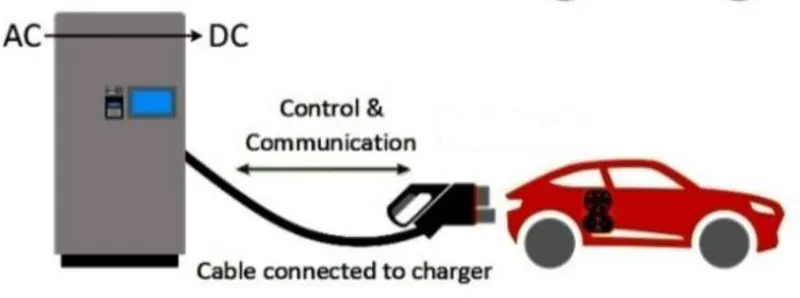
When it comes to electric vehicles,the converter is built inside the car. It's called the "Onboard Charger" though it really is a converter. It converts power from AC to DC and then feeds it into the car's battery. This is the most common charging method for electric vehicles today and most chargers use AC power.
STUDY - 2:
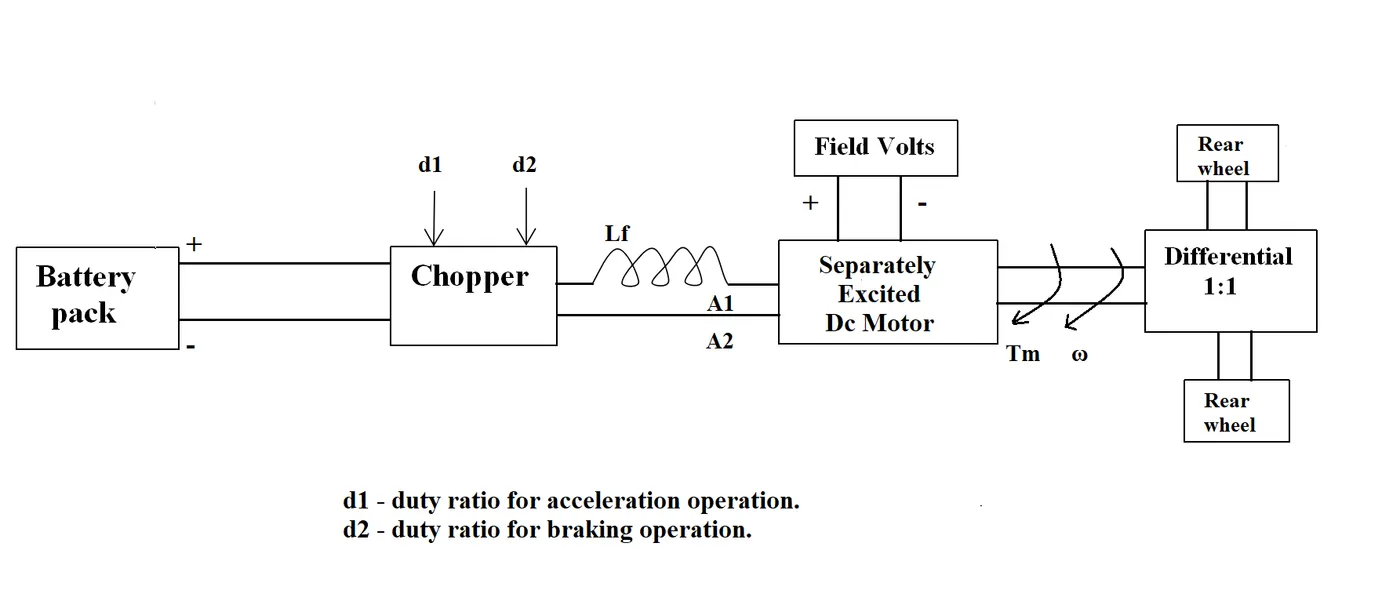
An Electric Vehicle's powertrain with 72V battery pack in shown in the diagram below. The duty ratio for acceleration operation is 'd1' and for the braking operation the duty ratio is 'd2'.
The other parameters of the electric vehicle is given below,
Given Data:
Motor and Controller Parameters:
Rated Armature voltage= 72 V
Rated armature current= 400 A
Ra= 0.5Ω, KΦ= 0.7 Volt second
Chopper Switching frequency= 400 Hz
The vehicle speed-torque characteristics are given by the below equation
 ...................eq(1)
Solution:
DC Machine Torque Speed Relation:
Where,
T - Motor Torque
V - Voltage Supply
Ra - Armature Resistance
`km(phi)` - Motor Constant
`omega` - Angular Speed of Motor
Voltage = Voltage of Armature * dutycycle
`= 72*0.7`
`= 50.4 V`
W.K.T
`T = ((V km(phi))/(Ra))-((km(phi)^2)/(Ra))omega`
`= ((50.4*0.7)/0.5)-((0.7)^2/0.5)*omega`
`T = 70.56 - 0.98 omega` .............eq(2)
Equating the Torque equation 1 & 2
`24.7+0.0051 omega^2 = 70.56 - 0.98 omega`
`0.0051 omega^2 + 0.98 omega - 45.86 = 0` ..............eq(3)
solving the quadratic equation by using
substituting the values in equation 3
`omega = - 0.98 pm sqrt ((0.98)^2+ 4*0.0051*45.8)/(2*0.0051)`
Therefore,
`omega = 38.82 (rad)/(sec)` or `-230.98 (rad)/(sec)`
wet get two values of angular speed, we take `omega = 38.8 (rad)/(sec)`
STUDY - 3:
INDUCTION VERSUS DC BRUSHLESS MOTORS
He basically said, what are these two technologies? How do they work? What differentiates them? And what do they have in common?
DC brushless drives:
The rotor includes two or more permanent magnets that generate a DC magnetic field (as seen from the vantage point of the rotor). In turn, this magnetic field enters the stator core (a core made up of thin, stacked laminations) and interacts with currents flowing within the windings to produce a torque interaction between the rotor and stator. As the rotor rotates, it is necessary that the magnitude and polarity of the stator currents be continuously varied – and in just the right way - such that the torque remains constant and the conversion of electrical to mechanical energy is optimally efficient. The device that provides this current control is called an inverter. Without it, brushless motors are useless motors.
Induction Motor Drives:
The Induction Motor Drives the stators for the 3-phase induction motor and the DC brushless motor are virtually identical. Both have three sets of “distributed windings” that are inserted within the stator core. Unlike the DC brushless rotor, the induction rotor has no magnets – just stacked steel laminations with buried peripheral conductors that form a “shorted structure.” Currents flowing in the stator windings produce a rotating magnetic field that enters the rotor. In turn, the frequency of this magnetic field as “seen” by the rotor is equal to the difference between the applied electrical frequency and the rotational “frequency” of the rotor itself.
Comparision:
- Both DC brushless and induction drives use motors having similar stators.
- Both drives use 3-phase modulating inverters.
- The only differences are the rotors and the inverter controls.
- The only control differences are with control code.
- The DC brushless drives require an absolute position sensor, while induction drives require only a speed sensor.
- One of the main differences is that much less rotor heat is generated with the DC brushless drive. Rotor cooling is easier and peak point efficiency is generally higher for this drive.
- The DC brushless drive can also operate at unity power factor.
- This means that the peak point energy efficiency for a DC brushless drive will typically be a few percentage points higher than for an induction drive.
- Thus, the induction machine when operated with a smart inverter has an advantage over a DC brushless machine.
- Thus, induction drives may be the favored approach where high-performance is desired; peak efficiency will be a little less than with DC brushless, but average efficiency may actually be better.
- Induction machines are more difficult to control. The control laws are more complex and difficult to understand.
- Achieving stability over the entire torque-speed range and over temperature is more difficult with induction than with DC brushless.
Conclusion:
When it comes to HEV markets DC brushless driver can dominate it down clearly, but going for super sport or performance electric induction drivers is the one more reliable. So when thete is a nees for a performance hybrid, we could see completely new performance drives combination with these two. So he clearly means that there is no clear cut winner in the future of EV and HEV there could be a new combined technology.