Week-6 Challenge: EV Drivetrain
QUESTION 1:
1. Which types of power converter circuits are employed in electric and hybrid electric vehicle?
Power converters are used in motor controller circuits to control voltage input and frequency. They help in controlling the speed of a motor. Now let us look at the types of power converters required in an EV.
Power converters are generally used to convert power flow from one form to another. They are mainly of four types:
AC TO DC converter:
The best example of an AC to DC converter is the rectifier. A rectifier is an electrical device that converts alternating current (AC), which periodically reverses direction, to direct current (DC), which flows in only one direction.
Rectifiers are mostly single phase or three phase. Rectifiers are further classifies into half-wave and full-wave rectifiers.
Half-wave:
In half-wave rectification of a single-phase supply, either the positive or negative half of the AC wave is passed, while the other half is blocked. It uses a single diode in case of a single phase supply, 3 in the case of a three phase supply.
Full-wave:
A full-wave rectifier converts the whole of the input waveform to one of constant polarity (positive or negative) at its output.
Rectifiers are used in EV's for battery charging.
DC TO AC converters:
This operation is done by inverters. A power inverter, or inverter, is a power electronic device or circuitry that changes direct current (DC) to alternating current (AC). Inverters do the opposite of “converters” which were originally large electromechanical devices converting AC to DC.
A typical power inverter device or circuit requires a stable DC power source capable of supplying enough current for the intended power demands of the system.
The output waveform will be a square wave, modified sine wave, pulsed sine wave, pulse width modulated wave (PWM) or sine wave depending on circuit design.
Inverters are used in EV's when AC induction motors are employed to drive the vehicle.
DC TO DC converters:
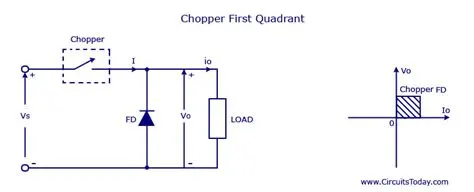
An example of DC to DC converter is the chopper. Chopper is a device that converts fixed DC input to a variable DC output voltage directly. Essentially, a chopper is an electronic switch that is used to interrupt one signal under the control of another.
Choppers are of two types step-up and step-down. They are dependent on the voltage requirement.
AC TO AC converters:
They give variable frequencies outputs and voltages at various inputs. They do not find their applications in EV's. They are used in domestic circuit applications like fan regulators.
QUESTION 2:
2. An Electric Vehicle's powertrain with 72V battery pack in shown in the diagram below. The duty ratio for acceleration operation is 'd1' and for the braking operation the duty ratio is 'd2'.
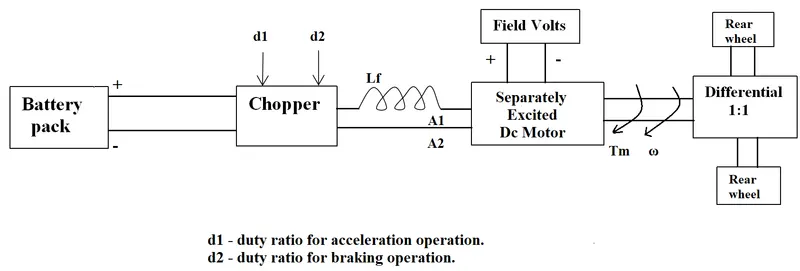
The other parameters of the electric vehicle is given below,
Motor and Controller Parameters:
Rated Armature voltage= 72 V
Rated armature current= 400 A
Ra= 0.5Ω, KΦ= 0.7 Volt second
Chopper Switching frequency= 400 Hz
The torque relation is given:
 - Let this be equation 1.
Find the steady state speed if duty cycle is 70%.
Given:
Rated voltage = 72V
For 70% duty cycle, the voltage is V = 72*0.7 = 50.4 V.
The speed-torque equation of the DC motor is given by the equation:
T = V*k(phi)/Ra - [k(phi)]^2/Ra*w
Substitute the given values in the above equation,
T = 50.4 * 0.7/0.5 - [0.7]^2/0.5 * w
T = 70.56 - 0.98 * w - Let this be equation 2
Equating 1 and 2 we get,
24.7 + 0.0051 w^2 = 70.56 - 0.98*w
0.0051 w^2 + 0.98 w - 45.86 = 0.
Apply quadratic formula to this equation to find the roots.
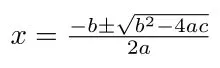
a = 0.0051 , b = 0.98 , c = -45.86
We get the values for w
w = -231.07 rad/s & 38.92 rad/s.
Since speed cannot be negative, the steady state speed is 38.92 rad/s.
QUESTION 3:
3. To explain in brief on the author's perspective.
The blog was written by Wally Rippel, who's currently serving as an engineer in Tesla motors, USA. The author explains in detail about which motors are best suited for a pure EV. He gives us two options, DC brushless motors and AC induction motors.
The author starts to explain us about the working principle of both these motors and where it was used. After explaining in detail about both these topics, he finally concludes by saying that there is no clear winner, but he predicts that DC brushless motors are the ones to dominate the HEV and EV industry in the future.
Now we will understand more about these two topics and conclude why the author thought that DC brushless are better.
BRUSHLESS DC MOTORS:
As their name implies, brushless DC motors do not use brushes. With brushed motors, the brushes deliver current through the commutator into the coils on the rotor. So how does a brushless motor pass current to the rotor coils? It doesn’t—because the coils are not located on the rotor. Instead, the rotor is a permanent magnet; the coils do not rotate, but are instead fixed in place on the stator. Because the coils do not move, there is no need for brushes and a commutator.
Since the rotor is a permanent magnet, it needs no current, eliminating the need for brushes and commutator. Current to the fixed coils is controlled from the outside.
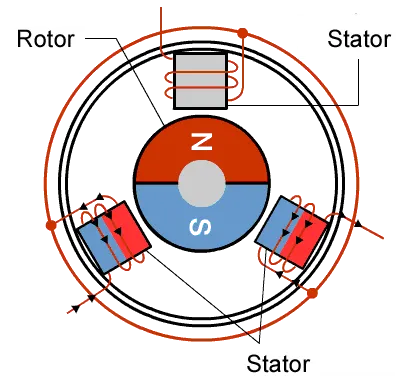
With the brushed motor, rotation is achieved by controlling the magnetic fields generated by the coils on the rotor, while the magnetic field generated by the stationary magnets remains fixed.
ADVANTAGES:
One big advantage is efficiency, as these motors can control continuously at maximum rotational force (torque). Brushed motors, in contrast, reach maximum torque at only certain points in the rotation. For a brushed motor to deliver the same torque as a brushless model, it would need to use larger magnets. This is why even small BLDC motors can deliver considerable power.
The second big advantage—related to the first—is controllability. BLDC motors can be controlled, using feedback mechanisms, to delivery precisely the desired torque and rotation speed. Precision control in turn reduces energy consumption and heat generation, and—in cases where motors are battery powered—lengthens the battery life.
AC INDUCTION MOTOR:
An induction motor or asynchronous motor is an AC electric motor in which the electric current in the rotor needed to produce torque is obtained by electromagnetic induction from the magnetic field of the stator winding. An induction motor can therefore be made without electrical connections to the rotor. An induction motor's rotor can be either wound type or squirrel cage type.
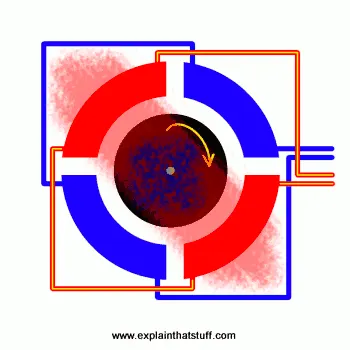
Here's a little animation to summarize things and hopefully make it all clear:
1. Two pairs of electromagnet coils, shown here in red and blue, are energized in turn by an AC supply (not shown, but coming in to the leads on the right). The two red coils are wired in series and energized together and the two blue coils are wired the same way. Since it's AC, the current in each coil doesn't switch on and off abruptly (as this animation suggests), but rises and falls smoothly in the shape of a sine wave: when the red coils are at their most active, the blue coils are completely inactive, and vice-versa. In other words, their currents are out of step (90° out of phase).
2. As the coils are energized, the magnetic field they produce between them induces an electric current in the rotor. This current produces its own magnetic field that tries to oppose the thing that caused it (the magnetic field from the outer coils). The interaction between the two fields causes the rotor to turn.
3. As the magnetic field alternates between the red and blue coils, it effectively rotates around the motor. The rotating magnetic field makes the rotor spin in the same direction and (in theory) at almost the same speed.
ADVANTAGES:
The biggest advantage of AC induction motors is their sheer simplicity. They have only one moving part, the rotor, which makes them low-cost, quiet, long-lasting, and relatively trouble free. DC motors, by contrast, have a commutator and carbon brushes that wear out and need replacing from time to time. The friction between the brushes and the commutator also makes DC motors relatively noisy (and sometimes even quite smelly).
DISADVANTAGES:
Since the speed of an induction motor depends on the frequency of the alternating current that drives it, it turns at a constant speed unless you use a variable-frequency drive; the speed of DC motors is much easier to control simply by turning the supply voltage up or down. Though relatively simple, induction motors can be fairly heavy and bulky because of their coil windings. Unlike DC motors, they can't be driven from batteries or any other source of DC power (solar panels, for example) without using an INVERTER (a device that turns DC into AC). That's because they need a changing magnetic field to turn the rotor.
This might be the reason why the author thought that DC brushless motors were better when compared to AC induction motors.